Roblox has evolved from a niche game creation tool into one of the most influential digital entertainment platforms, giving players and developers a shared space to create, publish, monetize, and socialize at global scale. In the Company Spotlights series, Roblox stands out among movers and shakers because it does not fit neatly into a single category: it is part game company, part creator economy, part social network, and part software ecosystem. That hybrid identity matters because it has changed how millions of users think about gaming, online identity, and digital entrepreneurship. When people ask what Roblox actually is, the clearest answer is this: Roblox is a platform where users build interactive experiences with Roblox Studio, distribute them through a common marketplace, and access them through a persistent account system tied to avatars, friends, chat, and virtual goods. I have worked with platform businesses and creator-led products long enough to recognize how unusual that combination is. Most companies choose either content production or toolmaking. Roblox built a business around both, then added a virtual economy that rewards successful creators. That model makes Roblox important not only for gamers looking for variety, but also for developers, educators, brands, and investors tracking the future of user-generated entertainment.
Understanding Roblox requires defining a few key terms. “Experiences” are the games and interactive worlds users play on the platform. Roblox Studio is the development environment used to build them, largely with the Lua-based Luau scripting language. Robux is the platform’s virtual currency, used for avatar items, in-experience purchases, and developer earnings. The Developer Exchange program, often called DevEx, allows eligible creators to convert earned Robux into real money. These pieces create a loop: developers build experiences, users spend time and money inside them, and Roblox earns through transactions while developers share in the upside. The reason this matters is simple. Roblox lowered the barrier to entry for game development without removing the possibility of meaningful scale. A small team, or even a solo creator, can launch an experience and reach a global audience faster than through traditional PC or console publishing channels. At the same time, players benefit from massive variety, frequent updates, and a social layer that makes discovery feel communal rather than transactional.
Why Roblox became a defining company in gaming
Roblox became a defining company because it aligned three trends earlier than many incumbents: user-generated content, cross-platform access, and always-on social play. Players can move from mobile to console to PC with a consistent identity and friend graph, which reduces friction and increases retention. That design choice sounds technical, but the effect is practical: users are not just buying a game once, they are investing in a digital presence that travels with them. In my experience, platforms that preserve identity across devices and sessions create stronger habits than standalone titles. Roblox understood that early. It also benefited from network effects. More creators meant more experiences; more experiences attracted more players; more players gave developers stronger incentives to keep building. That self-reinforcing loop is one reason Roblox has maintained relevance across age groups, even though it is still strongly associated with younger audiences.
The company’s growth also reflects its timing. During the broader shift toward live-service gaming and creator monetization, Roblox offered both in one package. Developers did not need to build account systems, payments infrastructure, or multiplayer architecture from scratch. Parents could understand it as one platform instead of dozens of separate downloads. Brands discovered that persistent virtual spaces could host events, product drops, and community activations. While some competitors focused on blockbuster production, Roblox focused on enabling thousands of smaller hits. That portfolio approach matters. A single publisher can miss trends if one title underperforms; Roblox spreads risk across a massive catalog. Popular experiences such as Adopt Me!, Brookhaven RP, and Blox Fruits show how varied successful content can be, from roleplay to collecting to action progression. The company’s influence comes less from any one game than from the system that continuously produces new ones.
How Roblox works for developers
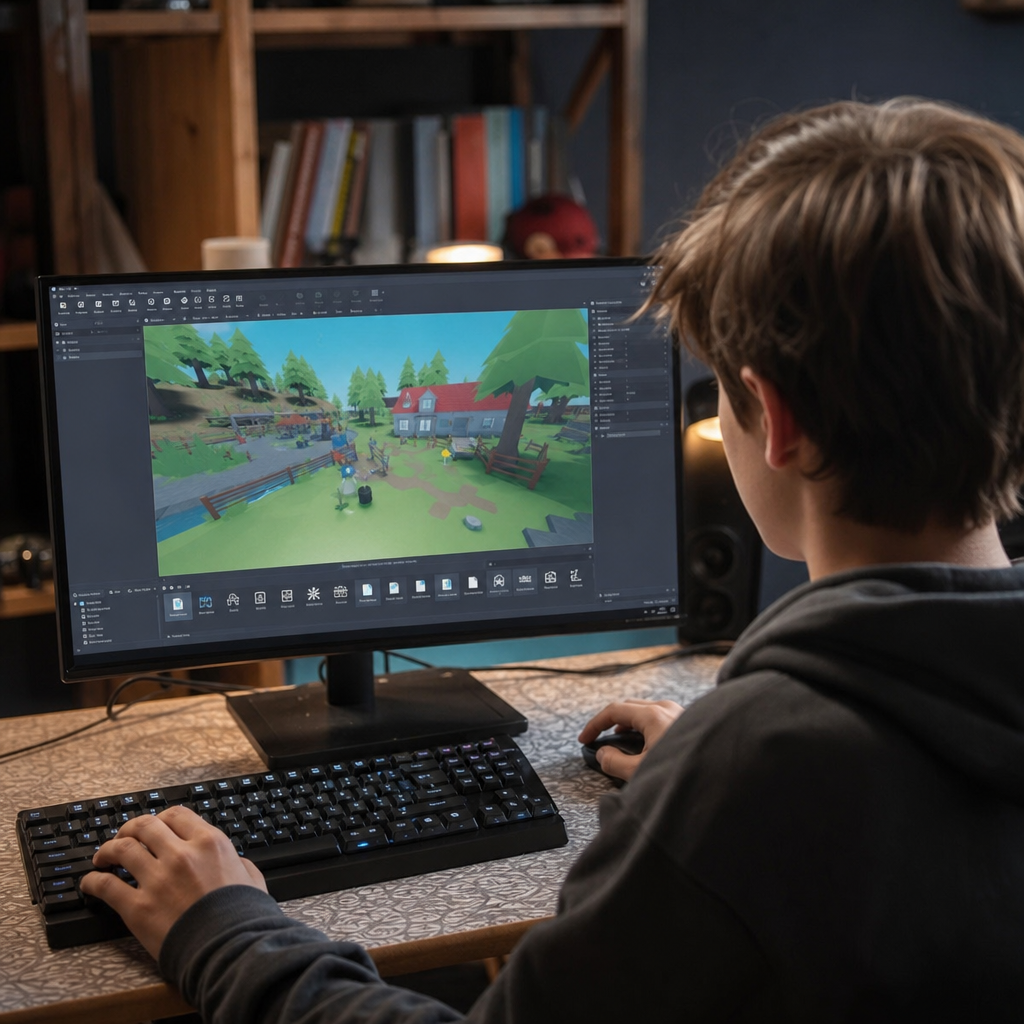
For developers, Roblox is compelling because it compresses the path from idea to launch. Roblox Studio includes terrain editing, physics systems, animation tools, asset management, testing environments, and cloud publishing, all inside a workflow accessible to beginners yet capable enough for sophisticated projects. Luau, Roblox’s scripting language, is intentionally approachable, which helps new creators learn core programming concepts quickly. I have seen teams use Roblox as both a commercial platform and a training ground: young creators start by modifying templates, then learn event-driven scripting, user interface logic, economy balancing, and multiplayer design through actual deployment rather than isolated exercises. That practical feedback loop is powerful. A game that fails to retain users teaches more than a tutorial ever could.
Roblox also gives developers analytics, monetization hooks, and distribution advantages that would otherwise require multiple third-party tools. Teams can test thumbnails, tune onboarding, track retention, and adjust in-experience purchases without rebuilding foundational systems. However, the platform is not frictionless. Revenue share debates, platform policy changes, moderation requirements, and infrastructure dependence are real constraints. Developers do not own the full stack in the way they would with a self-published PC title on independent servers. That tradeoff is central to Roblox’s value proposition: lower upfront cost and faster reach in exchange for operating inside a controlled ecosystem.
| Platform feature | What it does for developers | Real-world effect |
|---|---|---|
| Roblox Studio | Provides integrated building, scripting, testing, and publishing tools | Small teams can ship playable experiences quickly |
| Luau scripting | Simplifies coding while supporting scalable gameplay logic | New creators can learn development without a steep engine barrier |
| Robux economy | Enables in-experience purchases, passes, and cosmetic sales | Developers can monetize engagement instead of relying on upfront pricing |
| DevEx | Converts eligible virtual earnings into cash | Successful creators can build businesses, not just hobbies |
| Built-in distribution | Publishes directly to an existing user base across devices | Discovery is faster than launching a standalone game from zero |
Why gamers keep returning to Roblox
Gamers return to Roblox because it offers breadth, low commitment, and strong social continuity. A player can spend ten minutes trying a new obby, then switch to a roleplay world, then join friends in a combat game without leaving the platform. That flexibility matters in an era where many players do not want every session to require a large download, a long tutorial, or a sixty-hour commitment. Roblox experiences are often easier to sample than traditional games, and the account-level social layer makes experimentation feel safe. If friends are already inside the ecosystem, discovery becomes a social recommendation rather than a search problem.
Avatar customization reinforces that stickiness. Users express identity through clothing, accessories, emotes, and limited items, which turns participation into more than gameplay. Virtual goods have become status signals and social tools, not just cosmetic add-ons. This is one reason Roblox has been significant in the broader digital goods economy. For many younger users, buying an item for an avatar feels as natural as buying a skin in a shooter or a profile effect on a social app. Critics sometimes dismiss that behavior, but it reflects a larger shift in consumer value toward portable digital identity. Roblox did not invent that shift, but it operationalized it at massive scale.
Roblox as a business, brand, and cultural force
As a business, Roblox sits at the intersection of gaming revenue, platform economics, and digital advertising. The company earns primarily through Robux sales and related platform transactions, then shares a portion of that value with creators and ecosystem partners. That model resembles an app marketplace more than a traditional publisher. It also means Roblox’s health depends on balancing three constituencies: players who want fair value, developers who want sustainable economics, and advertisers or brands that want access to engaged communities without undermining user trust. The balancing act is difficult. Too much commercialization harms authenticity; too little limits monetization and creator opportunity.
Culturally, Roblox has become a proving ground for virtual events and branded worlds. Concerts, film tie-ins, and fashion activations have all appeared on the platform, with varying degrees of success. The strongest examples work because they feel native to Roblox interaction patterns rather than imported from offline marketing. A branded scavenger hunt, limited avatar drop, or social mini-game tends to perform better than a static virtual billboard. This is where Roblox’s movers-and-shakers status is most visible. It has influenced how major companies think about younger audiences, participatory media, and the commercial potential of shared virtual spaces. Even companies outside gaming now study Roblox to understand community-led engagement.
Risks, limitations, and what comes next
Roblox’s strengths do not erase its challenges. Safety and moderation remain central concerns because the platform serves a large youth audience and depends on social interaction. Content review, parental controls, age-appropriate design, and communication safeguards are not secondary features; they are core operational requirements. Economic criticism also persists. Some developers argue that after platform fees, advertising costs, and conversion mechanics, earning meaningful income is harder than outsiders assume. Those concerns deserve serious attention. Creator platforms are most durable when they are transparent about incentives and realistic about the distribution of success.
Looking ahead, Roblox’s future likely depends on improving technical fidelity, discovery, developer economics, and trust systems without losing the accessibility that made it successful. The company has already pushed toward better avatar technology, more advanced creation tooling, and deeper support for larger development teams. If it can preserve ease of entry while supporting increasingly sophisticated experiences, it will remain one of the most important companies in interactive media. For readers exploring movers and shakers under Company Spotlights, Roblox is the essential hub case: a platform that reshaped how games are made, how communities form, and how digital economies function. Watch its developer tools, safety policies, and monetization changes closely, then follow the connected articles in this subtopic to see how other industry leaders compare.
Frequently Asked Questions
What makes Roblox different from a traditional gaming platform?
Roblox stands apart because it is not just a place where people play games created by a single publisher. It is a platform built around user-generated experiences, which means independent developers, hobbyists, studios, and even young creators can build and publish their own interactive worlds for a global audience. That makes Roblox part gaming platform, part development ecosystem, and part social space. Instead of operating like a conventional game store filled with finished titles, Roblox provides the tools, infrastructure, discovery systems, virtual economy, and community features that allow millions of experiences to exist within one connected environment.
This hybrid model changes the relationship between players and creators. On most gaming platforms, users consume content made by professional teams behind the scenes. On Roblox, many players eventually become creators themselves, experimenting with design, coding, storytelling, monetization, and community management. That creator-to-player pipeline is one of the platform’s defining strengths. It also helps explain why Roblox has become so influential: it scales not just through content production, but through community participation. The result is a platform that feels more like a digital ecosystem than a single game, with constant reinvention driven by the people who use it.
How does Roblox empower developers and creators?
Roblox empowers developers by lowering the barriers to building and distributing interactive content. Through Roblox Studio, creators gain access to tools for world-building, scripting, game logic, interface design, animation, multiplayer systems, and live updates. Developers do not need to build their own engine, server infrastructure, payment systems, or user acquisition pipeline from scratch. Roblox provides those foundational layers, allowing creators to focus more on the experience itself and less on the costly technical overhead that typically comes with launching an online game.
Just as important, Roblox gives developers access to a built-in audience. Publishing on the platform means creators can reach players across devices and regions without independently negotiating distribution. They can also monetize their work through in-experience purchases, premium content, and other platform-supported revenue models. For many developers, especially smaller teams, this creates a realistic path from hobbyist experimentation to sustainable business. Roblox has helped normalize the idea that digital creators can be entrepreneurs, community leaders, and product builders all at once. That combination of tools, reach, and monetization is a major reason the platform has become such a powerful force in the creator economy.
Why is Roblox often described as part game company, part social network, and part creator economy platform?
Roblox earns that description because its business and user experience do not fit neatly into a single category. It is clearly connected to gaming, since players spend time exploring immersive experiences, competing, role-playing, and interacting with gameplay systems. At the same time, social connection is central to how the platform works. Friends join experiences together, attend virtual events, communicate in shared spaces, and form communities around specific creators or genres. For many users, Roblox is as much about hanging out and participating in a digital culture as it is about completing objectives in a game.
It also functions as a creator economy platform because it enables people to build digital products, attract audiences, and generate revenue. Developers can turn creativity into income, while creators and studios can iterate based on player behavior, community trends, and platform-wide demand. That makes Roblox more than entertainment software; it is an economic system where digital labor, virtual goods, audience growth, and platform tools all intersect. This blended identity is one of the main reasons Roblox has become so significant in discussions about the future of online entertainment. It shows how gaming, social interaction, and digital entrepreneurship are increasingly converging into a single platform model.
How has Roblox grown from a niche tool into a global entertainment platform?
Roblox’s rise is closely tied to its ability to scale alongside its community. In its earlier years, it was often seen as a relatively niche platform centered on simple user-created games. Over time, however, the company improved its technology, expanded device accessibility, strengthened its developer ecosystem, and refined the social and economic features that kept users engaged. As more creators joined, the variety and quality of experiences increased. As more players arrived, the incentive to build and monetize on the platform became even stronger. That feedback loop helped Roblox transform from a modest creation tool into a major global destination for digital entertainment.
The platform also benefited from broader shifts in internet culture. Audiences became more comfortable with virtual identities, online communities, digital goods, and interactive social spaces. Roblox was well positioned to capture that demand because it already offered a flexible environment where entertainment and socialization overlapped. Its growth reflects more than popularity among gamers; it reflects a larger change in how people spend time online. Users increasingly want spaces where they can play, create, communicate, and participate in shared digital experiences. Roblox succeeded by building an ecosystem around those behaviors before many competitors fully recognized their long-term significance.
Why does Roblox matter in conversations about the future of digital entertainment?
Roblox matters because it illustrates where digital entertainment is heading: toward platforms that are participatory, creator-driven, socially connected, and economically layered. Rather than separating the roles of player, developer, and community member, Roblox brings them together in one environment. A user might log on to socialize with friends, explore a new experience, buy a virtual item, attend an event, and later start building a game of their own. That fluid movement between consumption and creation is a defining characteristic of modern digital platforms, and Roblox has become one of the clearest examples of how powerful that model can be.
Its influence also extends beyond gaming. Brands, educators, developers, and media companies pay attention to Roblox because it offers insight into how younger audiences engage with digital spaces. The platform demonstrates that entertainment is no longer limited to passive viewing or standalone gameplay. Increasingly, it involves identity, participation, community, and user-generated value. In that sense, Roblox is important not only for what it is today, but for what it suggests about the future of the internet: a network of interactive, persistent, socially driven environments where users are not just audiences, but active builders of the experience itself.