Adobe has played a defining role in the digital arts revolution by turning computers into serious creative tools for design, photography, video, publishing, and interactive media. In the context of tech innovators and market leaders, Adobe stands out not simply because it sells software, but because it helped establish the workflows, file formats, and professional standards that still shape creative industries today. When people discuss digital art, they usually mean creative work produced or refined with software, including raster image editing, vector illustration, motion graphics, desktop publishing, user experience design, and digital filmmaking. Adobe has influenced every one of those categories.
I have worked with Adobe products across editorial design, marketing production, and web content teams, and the company’s impact becomes obvious the moment a project moves from concept to delivery. A logo built in Illustrator can flow into Photoshop mockups, then into InDesign brand guidelines, then into After Effects motion assets, and finally into Premiere Pro edits for campaign video. That connected ecosystem matters because modern creative work is collaborative, deadline driven, and format sensitive. Adobe’s rise also matters historically: it helped move creative control away from specialized print shops and broadcast facilities and into agencies, classrooms, small studios, and independent creators. Understanding Adobe is therefore essential to understanding how the digital arts became mainstream, scalable, and commercially viable.
From PostScript to Creative Cloud: How Adobe Built Creative Infrastructure
Adobe was founded in 1982, and its early importance came from publishing technology rather than image editing. The company’s PostScript page description language became foundational to desktop publishing because it allowed printers and screens to interpret layouts consistently. That was a major breakthrough in an era when digital typography and page composition were fragmented and unreliable. Adobe later reinforced that position through type technologies and, eventually, the PDF, a document format that solved a persistent business problem: preserving layout fidelity across devices and operating systems. Those innovations were not peripheral to digital art; they created the technical infrastructure that let artists, publishers, and businesses trust digital output.
The next phase came through category-defining applications. Photoshop, launched in 1990, became the industry benchmark for raster image editing. Illustrator established a professional standard for vector graphics. InDesign challenged QuarkXPress and became central to editorial and print design. After Effects gained dominance in motion graphics, while Premiere Pro developed into a major nonlinear editing platform. Adobe did not invent every creative discipline it entered, but it repeatedly industrialized them by combining strong tools with interoperable workflows. The later shift to Creative Cloud transformed distribution from boxed software to subscription access, creating continuous updates, cloud libraries, shared assets, and tighter collaboration. That business shift was controversial for some users, but strategically it positioned Adobe as ongoing infrastructure rather than occasional software purchase.
Why Adobe Became the Standard Across Design, Photography, Video, and Publishing
Adobe became the standard because it solved practical production problems better than most competitors for a long period of time. In professional environments, adoption is rarely about a single flashy feature. Teams choose platforms that support color management, nondestructive editing, print preflight, file compatibility, plugin ecosystems, and predictable export behavior. Photoshop supports advanced masking, compositing, retouching, smart objects, CMYK workflows, and deep third-party integration. Illustrator excels at scalable vector artwork, precision control, and packaging brand assets for print, signage, and digital interfaces. InDesign handles master pages, style sheets, long-document layout, bleed, and prepress preparation in ways that save real labor costs.
Adobe also benefited from network effects. Design schools taught Adobe products, employers listed them in job requirements, printers optimized for Adobe-generated files, and agencies built processes around Adobe formats such as PSD, AI, INDD, and PDF. Once that ecosystem matured, switching costs increased. A freelance illustrator sending layered files to an agency, a magazine art director coordinating printer-ready pages, and a social media team producing resized campaign assets could all work faster because Adobe had become a common language. Competitors existed and still do, including Affinity, Corel, Canva, Blackmagic Design, and Figma in specific segments. Yet Adobe retained leadership because it served broad, interconnected use cases from ideation through final output, especially for organizations managing high volumes of creative production.
Adobe’s Product Ecosystem and the Workflows That Changed Digital Art
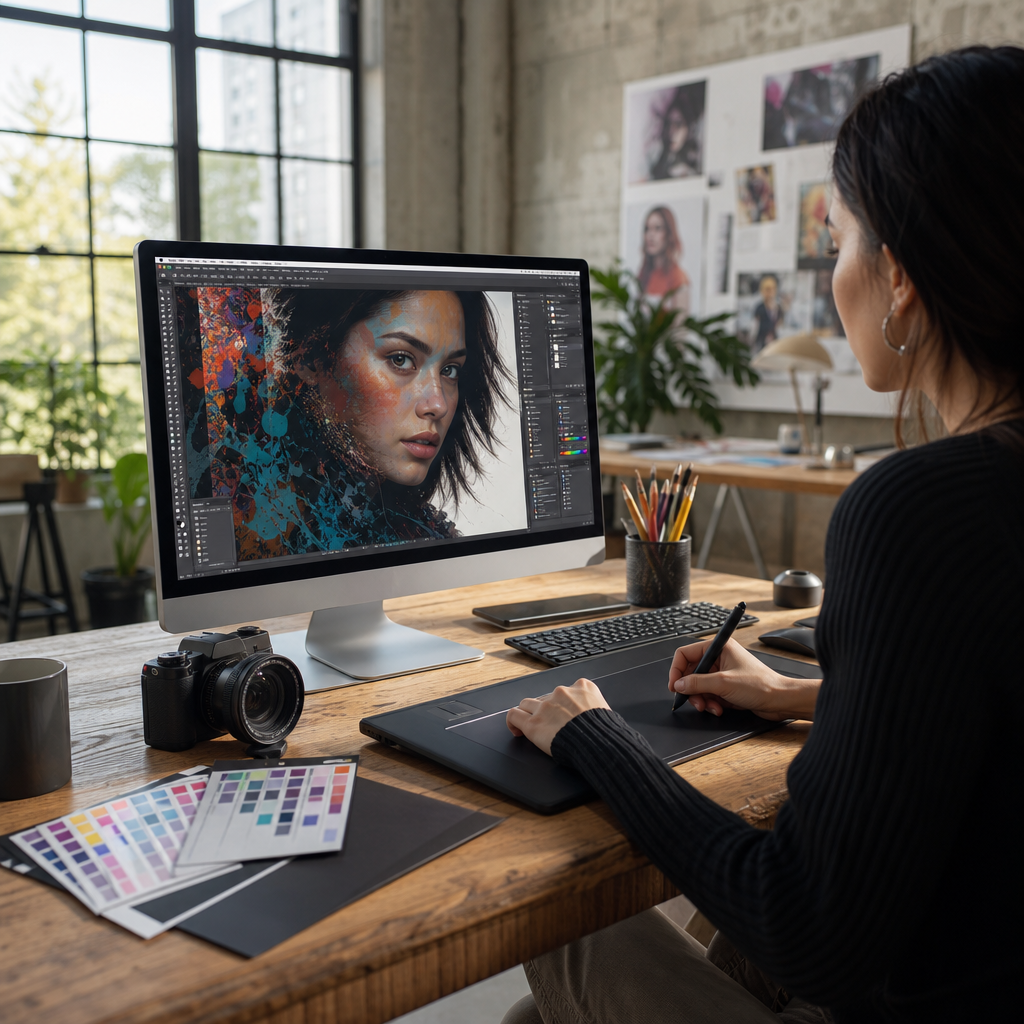
Adobe’s strongest advantage is not one flagship application but the way its products connect across disciplines. In practical workflows, that integration reduces handoff friction and preserves creative intent. A photographer can process images in Lightroom, retouch hero shots in Photoshop, place them in InDesign for a catalog, and export approved assets for web and print with consistent color profiles. A motion designer can create vector artwork in Illustrator, animate it in After Effects, and hand sequences to Premiere Pro for final assembly. Libraries, linked assets, Adobe Fonts, and cloud documents streamline repetitive tasks that used to involve version confusion and broken links.
This ecosystem changed digital art by making multidisciplinary production normal. Earlier eras separated print design, photography, video editing, and web design into different technical silos. Adobe software encouraged cross-functional creators who could sketch, edit, animate, publish, and optimize within one broad environment. That shift mattered commercially because brands increasingly needed unified visual systems across packaging, websites, ads, social video, and presentations. It mattered artistically because creators could experiment without changing platforms every few steps.
| Adobe product | Primary role | Typical industry use | Why it matters |
|---|---|---|---|
| Photoshop | Raster editing and compositing | Photo retouching, digital painting, ad creative | Set the benchmark for pixel-based image manipulation |
| Illustrator | Vector illustration | Logos, icons, packaging, signage | Delivers scalable artwork with precise path control |
| InDesign | Page layout and publishing | Magazines, brochures, reports, books | Supports sophisticated typography and print production |
| After Effects | Motion graphics and compositing | Title sequences, explainers, visual effects | Made broadcast-quality motion design broadly accessible |
| Premiere Pro | Nonlinear video editing | Commercials, social video, documentaries | Integrated editing into the same creative ecosystem |
Adobe and the Democratization of Creative Work
One of Adobe’s most important contributions is democratization, though that term needs precision. Adobe did not make creative excellence easy; craft still requires judgment, repetition, and technical discipline. What Adobe did was lower access barriers to professional-grade tools. Desktop publishing is the classic example. Before software such as PageMaker and later InDesign, complex page composition depended heavily on specialized production environments. With accessible software and improved personal computing, small publishers, nonprofits, schools, and independent designers gained capabilities that once belonged mainly to large organizations.
The same pattern appeared in photography, video, and web design. Photoshop gave independent photographers retouching power once associated with high-end imaging departments. Premiere Pro and After Effects brought advanced editing and motion graphics to agencies, YouTube producers, internal brand teams, and small studios. Adobe Express now targets faster, template-driven creation for non-specialists, extending the company’s influence beyond trained designers. In classrooms, I have seen students move from basic poster design to portfolio-ready work because Adobe tools exposed them to layers, vectors, typography, masking, color correction, and export settings that mirror real industry practice. Democratization, in Adobe’s case, means more people can participate in professional creative workflows, even if mastery remains demanding.
Influence on Industry Standards, Education, and Creative Careers
Adobe’s role extends beyond software features into standards formation. PDF became a global standard for reliable document exchange, eventually formalized through ISO standardization. In print production, Adobe applications helped normalize color-managed workflows using ICC profiles, preflight checks, and press-ready exports. In video and motion, Adobe tools became embedded in agency and post-production pipelines. Even when studios use mixed stacks, Adobe file compatibility often remains a practical requirement. That kind of influence is what separates a successful software vendor from a market leader.
Education reinforced that leadership. Art schools, journalism programs, marketing departments, and continuing education providers adopted Adobe because employers expected it. Adobe Certified Professional credentials gave learners a way to validate baseline competence. Portfolio expectations changed as well. Hiring managers increasingly assumed familiarity with layered files, nondestructive editing, style systems, asset packaging, and collaborative review workflows. In my experience, Adobe literacy often functions as employability infrastructure: it does not guarantee creative talent, but it removes friction between talent and execution. For a subtopic centered on tech innovators and market leaders, Adobe is a textbook case of a company whose products shape labor markets, curriculum design, and business operations at the same time.
Challenges, Competition, and Adobe’s Next Chapter in Creative Technology
No balanced assessment of Adobe is complete without acknowledging tradeoffs. Subscription pricing remains a frequent criticism, especially for freelancers, students, and occasional users who preferred perpetual licenses. Some creatives also argue that Adobe applications can be resource intensive, complex, and slower to simplify than newer competitors. Figma changed expectations in collaborative interface design before Adobe acquired it was blocked on antitrust grounds, while Canva expanded dramatically by serving users who prioritize speed over deep control. Affinity gained attention by offering strong design tools without subscriptions. These challenges are real because they show where market leaders can become vulnerable.
Even so, Adobe remains central to the future of digital arts because it is adapting where creative work is headed: collaboration, automation, cross-media production, and generative tools. Adobe Firefly reflects the company’s push into AI-assisted image generation and editing, with an emphasis on commercially safer training and content credentials initiatives. Substance 3D extends Adobe’s reach into texturing and 3D workflows relevant to gaming, product visualization, and immersive media. Frame.io strengthens review and approval for distributed video teams. The larger pattern is clear. Adobe is no longer just a maker of design software; it is a platform company shaping how creative assets are produced, governed, reviewed, and deployed across industries.
Adobe’s role in the digital arts revolution is best understood as a combination of invention, standardization, and scale. The company helped define desktop publishing, professional image editing, vector illustration, digital video workflows, and portable document exchange. It became a market leader not by serving a narrow niche, but by building an ecosystem that connected creative disciplines and made them operational for businesses, schools, and independent creators. That influence is visible in job descriptions, design education, agency workflows, printer standards, and the everyday language of creative production.
For readers exploring company spotlights within tech innovators and market leaders, Adobe is an essential hub topic because it shows how a software company can reshape both art and commerce. Its tools gave creators more control, broadened access to professional workflows, and established standards that still anchor modern design and media. The competitive landscape is evolving, and Adobe faces legitimate pressure on price, usability, and innovation speed, but its historic and ongoing impact remains unmistakable. If you are mapping the companies that transformed digital creativity, start with Adobe, then follow its influence across publishing, branding, photography, film, web design, and the next generation of AI-assisted content creation.
Frequently Asked Questions
How did Adobe help shape the digital arts revolution?
Adobe helped shape the digital arts revolution by making computers practical, trusted tools for serious creative work. Before digital workflows became standard, artists, designers, publishers, photographers, and filmmakers often relied on separate analog processes that were slower, harder to revise, and more expensive to scale. Adobe changed that by developing software that gave creative professionals precision, flexibility, and repeatable workflows inside a digital environment. Programs such as Photoshop, Illustrator, InDesign, Premiere Pro, and After Effects did more than offer useful features—they created a shared production language across multiple industries.
Just as importantly, Adobe influenced how creative work moved from concept to finished product. Its tools supported everything from image editing and vector illustration to page layout, video post-production, web graphics, and interactive media. That broad ecosystem allowed artists and teams to work more efficiently and collaborate more easily. Over time, Adobe became deeply tied to professional standards, education, and hiring expectations, which reinforced its role as a market leader. In that sense, Adobe did not simply participate in the digital arts revolution; it helped define the infrastructure, habits, and expectations that made digital creativity a mainstream professional practice.
Why is Adobe considered more than just a software company in the creative industries?
Adobe is often seen as more than a software company because its influence extends beyond individual applications into the underlying systems that organize creative production. It helped establish the workflows that many agencies, publishers, studios, marketing departments, and freelance professionals still use today. When a designer hands off layered image files, a publisher prepares print-ready documents, or a video editor moves footage through a post-production pipeline, Adobe tools and standards are often central to the process. That kind of influence shapes not just what people make, but how entire industries operate.
Adobe also played a major role in setting expectations around file compatibility, professional output, and cross-disciplinary collaboration. Formats such as PDF became foundational for reliable document sharing, proofing, and printing, while applications like Photoshop and Illustrator became benchmarks for image and vector editing. These tools entered classrooms, workplaces, and creative studios around the world, helping standardize skills and terminology. As a result, Adobe became woven into the culture and economics of creative work. Its role is not only about selling subscriptions or licenses; it is about enabling a common framework for modern design, photography, publishing, video, and digital media production.
What Adobe products had the biggest impact on digital art and creative workflows?
Several Adobe products had an outsized impact on digital art and creative workflows because each addressed a core creative need and then became deeply embedded in professional practice. Photoshop is perhaps the most famous example. It transformed image editing, photo retouching, compositing, and digital painting by giving artists and photographers a level of control that was previously difficult or impossible to achieve efficiently. Illustrator had a similarly powerful effect on vector-based design, enabling scalable graphics for branding, typography, packaging, and illustration. InDesign became essential in publishing and editorial design, helping replace older layout methods with faster, more flexible digital page composition.
Adobe’s influence also expanded through motion and screen-based media. Premiere Pro became a major tool for video editing, while After Effects helped popularize motion graphics, compositing, and visual effects workflows. Acrobat and the PDF format also deserve special mention because they changed how documents were shared, reviewed, and prepared for production across industries. Together, these products created an interconnected environment where creative assets could move between disciplines with greater consistency. That interoperability was critical. It meant a brand designer, photographer, editor, animator, and publisher could all contribute to the same project using tools designed to support a modern digital pipeline.
How did Adobe influence professional standards, file formats, and collaboration?
Adobe influenced professional standards by providing tools and formats that were reliable enough to become industry norms. One of the clearest examples is the PDF, which became a universal standard for preserving document formatting across devices, operating systems, and print environments. That mattered enormously for publishing, business communication, proofing, legal documentation, and prepress production. In creative fields, Adobe file types such as PSD and AI became common working formats because they preserved layers, editability, and high-quality visual information that professionals needed throughout the design process.
Beyond formats, Adobe shaped collaboration by making it easier for specialists in different roles to contribute to the same project. A photographer could edit source imagery in Photoshop, a designer could refine brand assets in Illustrator, a layout specialist could assemble final pages in InDesign, and a marketing or media team could adapt the same assets for video, web, or social use. This kind of compatibility helped define modern creative operations. Adobe’s software encouraged repeatable, professional workflows with clear handoffs, versioning, and output standards. Over time, that consistency helped employers, educators, and clients align around what “professional digital production” should look like, which further strengthened Adobe’s central role in the creative economy.
Why does Adobe still matter in today’s digital art landscape?
Adobe still matters because it remains deeply connected to both the history and the ongoing evolution of digital creativity. Even as new creative platforms and competitors emerge, Adobe continues to be a core reference point for professional-level work across design, photography, publishing, video, and interactive content. Many studios, agencies, in-house teams, and independent creators still depend on Adobe applications because they are familiar, widely taught, and integrated into established production pipelines. That installed base gives Adobe a lasting advantage, especially in collaborative environments where compatibility, speed, and predictable output are essential.
At the same time, Adobe’s relevance is not based only on legacy. It continues to adapt to changing creative demands, including cloud-based collaboration, mobile workflows, content creation for social platforms, and the growing role of artificial intelligence in editing and design assistance. Its ongoing importance comes from the combination of depth, breadth, and trust: deep tools for specialized work, broad coverage across multiple media types, and a long-standing reputation for professional reliability. In discussions about tech innovators and market leaders, Adobe stands out because it helped build the modern creative toolbox and continues to influence how digital art is produced, shared, and valued.