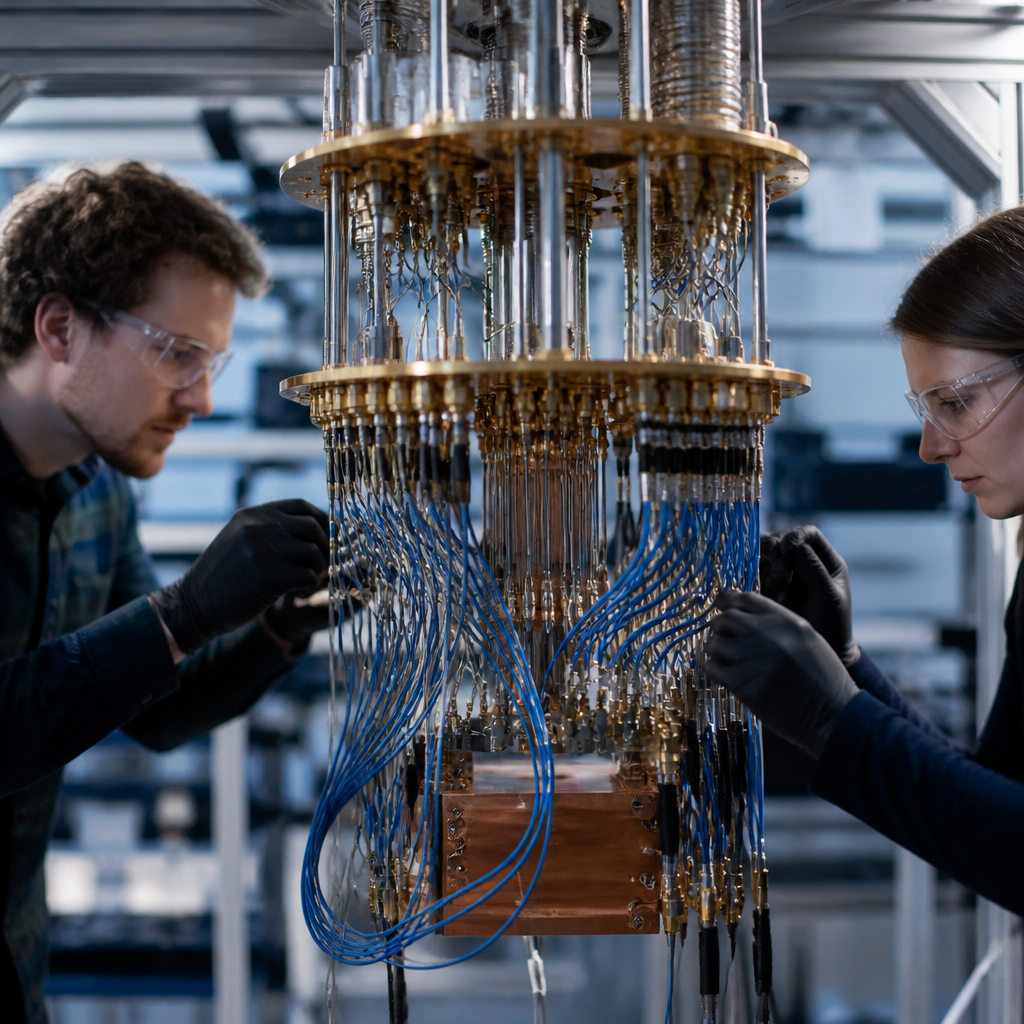
Quantum networking is moving from laboratory physics to strategic infrastructure, and the race to build a quantum internet is now shaping national research agendas, startup funding, and telecom roadmaps. At its core, quantum networking uses quantum states, usually photons, to transmit information in ways that classical networks cannot replicate. The most important concept is entanglement, a physical correlation between particles that allows measurements on one particle to be linked to another even across long distances. A second key concept is quantum key distribution, or QKD, which uses quantum mechanics to detect eavesdropping during secure key exchange. A broader quantum internet would go beyond secure messaging, enabling distributed quantum computing, networked sensors, and new scientific instruments. This matters because the organizations that master quantum links, repeaters, memories, and control systems will define the next layer of secure communications and high-performance computing. I have worked on emerging-technology content for founders and enterprise buyers long enough to see a clear pattern: every deep-tech wave looks abstract until the enabling hardware begins leaving the lab. Quantum networking is at that transition point. Governments are investing billions, standards bodies are aligning terminology, and companies from Toshiba to Quantum Xchange are commercializing pieces of the stack. For anyone tracking quantum and deep tech, this topic sits at the intersection of physics, cybersecurity, semiconductors, photonics, cloud infrastructure, and national competitiveness.
What quantum networking actually does
Quantum networking is the transmission, storage, and processing of quantum information across connected nodes. In practice, that means generating qubits, commonly encoded in single photons, moving them through optical fiber or free space, preserving coherence long enough to use them, and coordinating measurements with classical control channels. Unlike classical bits, qubits cannot be copied perfectly because of the no-cloning theorem. That single constraint changes network design completely. Instead of amplifying signals with ordinary repeaters, engineers must create entanglement between distant nodes and then extend it using quantum repeaters and entanglement swapping. The near-term application getting the most traction is QKD, because it solves a defined problem: secure key exchange with tamper evidence. Banks, defense agencies, and critical infrastructure operators care because a future fault-tolerant quantum computer could break widely deployed public-key cryptography such as RSA and elliptic curve systems. Quantum networking does not replace post-quantum cryptography, but it adds a separate security layer for high-value links. Longer term, the bigger prize is distributed quantum computing, where multiple smaller quantum processors cooperate over a network to perform tasks beyond the reach of a single machine. That is why this hub matters across quantum and deep tech: networking is the connective tissue linking quantum hardware, cybersecurity, sensing, and cloud platforms.
The technology stack behind a quantum internet
The stack starts with photon sources, detectors, and encoders. Engineers use weak coherent pulses, spontaneous parametric down-conversion, quantum dots, and trapped-ion interfaces depending on the application. Superconducting nanowire single-photon detectors are especially important because they combine high detection efficiency with low dark counts, improving link performance. Quantum memories store fragile states temporarily so that entanglement can be synchronized across different channels. Without reliable memories, scaling beyond short metropolitan links is difficult. Quantum repeaters then extend range by segmenting a link into shorter spans, generating entanglement on each segment, and connecting them through entanglement swapping. Timing and synchronization are unforgiving; picosecond-scale jitter and optical losses directly affect success rates.
Control software is just as important as hardware. A practical network needs routing logic, error management, calibration, key management integration, and orchestration between quantum and classical layers. Research groups such as QuTech and institutions linked to the U.S. Department of Energy have published architectures that treat quantum links as managed infrastructure rather than isolated experiments. In commercial settings, the stack also includes trusted nodes, key management appliances, and integration with existing telecom fiber. That is why telecom incumbents matter. They already own rights-of-way, metro fiber, and operational expertise. Startups often supply the quantum components, while carriers provide deployment pathways. This pattern resembles the early cloud market, where specialized innovators built critical layers on top of incumbent infrastructure.
Where the race stands today
The race is global and uneven. China demonstrated an early lead with the Micius satellite, which enabled quantum communication experiments over thousands of kilometers and helped validate satellite-based QKD. The European Union has backed coordinated programs through the Quantum Flagship and EuroQCI, aiming to build secure quantum communication infrastructure across member states. In the United States, the National Quantum Initiative, Department of Energy testbeds, and DARPA-style programs have accelerated research, while national labs and universities are developing metropolitan quantum networks. In the United Kingdom, Toshiba has run commercial quantum-secured networking projects, including links serving financial institutions. Singapore, the Netherlands, Japan, and South Korea are also investing heavily, often combining academic excellence in photonics with industrial policy.
Progress should be judged carefully. Headlines often celebrate distance records, but distance alone is not enough. Useful evaluation includes secret key rate, fidelity, uptime, detector performance, environmental stability, and the cost of deployment. A 600-kilometer demonstration using trusted nodes does not prove the same thing as end-to-end entanglement over that distance. Likewise, a satellite link solves one range problem while introducing others, including weather dependence, limited contact windows, and specialized ground infrastructure. In my experience, the clearest way to assess announcements is to ask three questions: Was entanglement distributed or only keys? Were trusted nodes required? Was the system tested outside laboratory conditions? Those questions separate scientific progress from infrastructure readiness.
Core approaches and tradeoffs
| Approach | Main advantage | Main limitation | Best near-term use |
|---|---|---|---|
| Fiber-based QKD | Uses existing telecom routes | Loss limits distance without trusted nodes or repeaters | Metro and intercity secure links |
| Satellite quantum links | Extends communication over continental distances | Weather, tracking, and ground-station constraints | International key exchange |
| Trusted-node networks | Deployable now with current components | Intermediate nodes must be physically trusted | Government and finance pilots |
| Repeater-based networks | Path to scalable end-to-end quantum networking | Requires mature memories and high-fidelity entanglement operations | Future distributed quantum computing |
These approaches are complementary, not mutually exclusive. Fiber dominates metropolitan deployments because operators can piggyback on existing infrastructure, especially in dark fiber environments. Satellite links matter when terrestrial fiber is unavailable or politically impractical. Trusted-node systems are controversial because critics argue they dilute the promise of quantum security, yet they remain commercially relevant because they can be installed today. Repeater-based networks are the long-term goal, but they depend on breakthroughs in memory lifetime, error correction, and integrated photonics. The winning architecture will likely be hybrid: metro fiber, intercity trusted nodes in the short term, satellite overlays for global reach, and repeaters as the technology matures.
Why startups, cloud platforms, and telecoms are all involved
This field is no longer confined to universities. Startups are building detectors, cryogenic systems, photonic chips, quantum random number generators, network control software, and security appliances. ID Quantique helped establish early commercial credibility in QKD and quantum-safe products. Aliro works on entanglement-based networking software. Qunnect has focused on room-temperature quantum memories and networking components, addressing a practical bottleneck in deployment. On the infrastructure side, carriers and equipment vendors see quantum networking as an extension of optical transport and secure services. Cloud and quantum-computing providers are watching for another reason: distributed access. If future quantum processors are geographically distributed, users will need networking layers that support remote entanglement, workload partitioning, and secure orchestration.
For startups, the opportunity is broad but technically unforgiving. Hardware cycles are long, standards are still evolving, and customer education is expensive. The strongest companies usually target a specific pain point rather than promising a full quantum internet from day one. A detector maker can sell into labs and pilots now. A networking software company can align with telecom testbeds before large-scale deployment arrives. Founders who understand procurement realities tend to do better than founders who speak only in physics milestones. Buyers want measurable outcomes: lower key-management risk, validated tamper detection, compliance support, or a roadmap to quantum-safe infrastructure.
What to watch next in quantum and deep tech
Several milestones will determine whether quantum networking becomes foundational infrastructure or remains a specialized security niche. First is the maturation of quantum repeaters. A practical repeater needs high-fidelity entanglement generation, long-lived memory, and workable rates, not just isolated proofs of concept. Second is interoperability. The sector needs stable interfaces, calibration practices, and network-layer abstractions so components from different vendors can operate together. Work from ETSI, the ITU, and national research networks will matter here. Third is integration with post-quantum cryptography. Sensible security strategies will combine software-based quantum-resistant algorithms with quantum key distribution where economics justify it. Fourth is manufacturability. Integrated photonics, packaging, and cryogenic engineering must improve dramatically to reduce cost and complexity.
The smartest way to follow this subtopic is to view it as a hub connecting several deep-tech themes: photonic chips, advanced materials, precision timing, space systems, cybersecurity, and frontier compute infrastructure. Quantum networking will not arrive as a single launch moment. It will emerge through metropolitan pilots, sector-specific secure links, hybrid terrestrial-satellite services, and eventually repeater-enabled networks. The key takeaway is simple: the race to build a quantum internet is really a race to control the standards, components, and operating models of next-generation secure communications. If you cover tech innovations and startups, keep this topic on your active watchlist, map the players by layer, and follow the infrastructure, not just the headlines.
Frequently Asked Questions
What is a quantum internet, and how is it different from today’s internet?
A quantum internet is a network designed to distribute quantum information, not just classical data such as text, video, or files. In a conventional internet, information is encoded in bits that are either 0 or 1 and then transmitted through electrical or optical signals. In a quantum network, information can be carried in quantum states, typically using photons, and can take advantage of uniquely quantum effects such as superposition and entanglement. That difference is not simply an upgrade in speed. It represents a fundamentally new way of transmitting and coordinating information across distance.
The most important distinction is that a quantum internet would enable tasks that classical networks cannot reproduce, even in principle. For example, entanglement can link particles so that their measurement outcomes remain strongly correlated across long distances. This makes possible applications such as quantum key distribution for highly secure communications, distributed quantum computing where multiple quantum processors work together, and networked quantum sensing for ultra-precise timing and measurement. Classical networks can support the coordination of these systems, but they cannot replace the underlying quantum connections required to make them work.
It is also important to understand that the quantum internet is not expected to replace the current internet entirely. Instead, it will likely emerge as a specialized layer that works alongside existing telecom infrastructure. Just as data centers, satellites, and fiber backbones support different functions in today’s communications ecosystem, future networks may combine classical channels with quantum links. In practical terms, the race to build a quantum internet is really about creating strategic infrastructure that can support next-generation cybersecurity, scientific research, and advanced computing capabilities.
Why is entanglement so important in quantum networking?
Entanglement is central to quantum networking because it creates correlations between particles that go beyond anything available in classical physics. When two photons or other quantum particles are entangled, measuring one affects the statistical relationship with the other, even when the two are separated by large distances. This does not mean information is sent faster than light, but it does mean the network can establish a type of shared quantum resource that classical systems cannot imitate. That resource is the foundation of many proposed quantum network applications.
In practical networking terms, entanglement enables protocols such as quantum teleportation, in which the quantum state of one system can be transferred to another distant system without physically sending the state itself through the channel in the usual way. This matters because directly transmitting fragile quantum states over long distances is difficult due to signal loss and environmental noise. By creating entangled links between nodes, researchers can build more sophisticated network architectures that preserve quantum information more effectively than straightforward point-to-point transmission alone.
Entanglement is also essential for scaling quantum systems beyond isolated laboratory devices. A single quantum computer may be powerful, but connecting many quantum devices could allow for distributed computation, secure synchronization, and shared sensing. In that sense, entanglement plays a role somewhat analogous to bandwidth or routing in classical networking, except it is much more foundational. It is the key ingredient that transforms quantum communication from an isolated experiment into a true networked infrastructure with strategic, scientific, and commercial value.
What are the biggest technical challenges to building a quantum internet?
The biggest challenge is that quantum information is extremely fragile. Quantum states can be disrupted by heat, vibration, electromagnetic interference, imperfect materials, and losses in optical fiber. In a classical network, a signal can be amplified and copied repeatedly with standard repeaters. In a quantum network, that approach does not work because unknown quantum states cannot simply be copied without disturbing them. This creates a major engineering problem for long-distance communication, especially over continental or global scales.
To overcome that limitation, researchers are developing quantum repeaters, devices that can extend the reach of quantum links by generating, storing, and swapping entanglement across segments of a network. But building practical quantum repeaters is extraordinarily difficult. They require high-performance photon sources, efficient detectors, reliable quantum memories, and precise synchronization between network nodes. Each of these components is challenging on its own, and integrating them into a robust system that works outside controlled laboratory environments is even harder.
Another major obstacle is interoperability. Different research groups and companies are pursuing different hardware platforms, including trapped ions, superconducting systems, nitrogen-vacancy centers in diamond, and photonic technologies. For a quantum internet to become broadly useful, standards will be needed for interfaces, protocols, error handling, and integration with classical control systems. On top of that, there are real deployment questions involving cost, fiber compatibility, satellite links, operating temperatures, and network management. The path forward is not just a physics problem. It is also a systems engineering, manufacturing, and infrastructure challenge.
How secure would a quantum internet be?
A quantum internet has the potential to be far more secure than conventional communication systems in specific use cases, but it should not be described as automatically unbreakable. Its strongest security promise comes from quantum key distribution, or QKD, where cryptographic keys are exchanged using quantum states. Because measuring a quantum state generally disturbs it, eavesdropping attempts can in principle be detected. That is a major advantage over many classical key exchange methods, which rely primarily on mathematical difficulty rather than the physical properties of the communication channel.
That said, real-world security depends on implementation, not just theory. Even if a quantum protocol is provably secure in an ideal model, practical devices may contain flaws, side channels, calibration weaknesses, or software vulnerabilities. Attackers often target endpoints, network management systems, or user devices rather than the communication physics itself. In other words, a quantum internet may significantly strengthen some layers of security, but it will not eliminate the need for careful engineering, authentication, access control, and ongoing cybersecurity practices.
It is also worth separating secure communication from broader quantum networking capabilities. Some applications of a quantum internet are about connecting quantum computers or sensors, not just protecting messages. In those cases, security includes preserving coherence, validating entanglement quality, and ensuring trusted operation across multiple nodes. So the real answer is nuanced: a mature quantum network could provide unprecedented security advantages for certain critical functions, but only if the full hardware and software stack is designed with the same rigor as the underlying quantum physics.
Who is leading the race to build a quantum internet, and why does it matter strategically?
The race involves a mix of national governments, university research centers, major telecom companies, defense agencies, and venture-backed startups. Countries including the United States, China, members of the European Union, the Netherlands, Singapore, and others have invested heavily in quantum communication testbeds, satellite experiments, metropolitan quantum networks, and enabling hardware. Leadership is not defined by a single breakthrough. It depends on sustained progress across basic science, engineering, manufacturing, standards, and deployment.
This matters strategically because quantum networking is increasingly viewed as foundational infrastructure, much like semiconductors, AI systems, or secure telecom backbones. A country or company that develops reliable quantum networking capabilities could gain advantages in secure government communications, financial systems, critical infrastructure protection, and advanced computing ecosystems. It could also shape technical standards and intellectual property in ways that influence global markets for decades. That is why quantum networking has moved well beyond academic curiosity and into the realm of industrial policy and national competitiveness.
At the same time, the field is still early enough that leadership remains fluid. Some players are strong in satellite-based quantum communication, others in fiber-based metropolitan networks, and others in quantum memory or repeater technologies. The most likely outcome is not a sudden winner-take-all moment, but a gradual buildout in which regional networks, research collaborations, and commercial pilots lay the groundwork for broader adoption. The strategic significance comes from the long-term potential: whoever helps define the architecture of the quantum internet may also help define the next era of secure communications and distributed computing.