Quantum computing headlines often focus on qubit count, but the more meaningful measure of progress is quantum error correction. A qubit is the basic unit of quantum information, able to exist in superposition and become entangled with other qubits. Those properties create extraordinary computational potential, yet they also make qubits fragile. Tiny disturbances from heat, vibration, stray electromagnetic fields, control imperfections, and imperfect measurement introduce errors far faster than useful algorithms can finish. Quantum error correction is the collection of methods that detect and suppress those errors without destroying the information stored in a quantum state.
This matters because raw qubits alone do not deliver practical quantum advantage. In every hardware platform I have worked around and evaluated, from superconducting systems to trapped ions, the central challenge is not just creating more qubits but preserving logical information long enough to execute deep circuits. A machine with a thousand noisy qubits can be less useful than one with far fewer qubits that supports stable logical operations. Investors, founders, engineers, and technical buyers need this distinction because it changes how roadmaps, valuations, and product claims should be interpreted.
Within Quantum & Deep Tech, error correction is the organizing concept that connects hardware, software, cryogenics, control electronics, algorithms, and commercialization timelines. It determines whether a device remains a research instrument or becomes a dependable computing platform. It also clarifies adjacent topics this hub should anchor: qubit modalities, fault tolerance, quantum networking, post-quantum security planning, and the startup ecosystem building compilers, calibration tools, and error mitigation layers. If you want to understand where the field is actually heading, start with error correction rather than headline qubit totals.
What quantum error correction actually does
Classical error correction stores redundancy by copying bits. Quantum information cannot be copied directly because of the no-cloning theorem, so quantum error correction uses entanglement and carefully designed measurements to spread one logical qubit across many physical qubits. The system repeatedly measures auxiliary qubits, often called ancillas, to extract an error syndrome. That syndrome reveals whether a bit-flip, phase-flip, or combined error likely occurred, while preserving the encoded quantum information. Control software then applies a correction or updates a classical record known as a Pauli frame.
The key idea is that useful quantum computers must operate on logical qubits, not bare physical qubits. A logical qubit is an encoded object protected by a code such as the surface code, Bacon-Shor code, or color code. In practice, the surface code dominates many roadmaps because it tolerates local interactions on two-dimensional lattices and has a relatively high threshold error rate. The threshold is the point below which adding more physical qubits to the code reduces the logical error rate faster than new error pathways are introduced. Crossing that threshold is a turning point; below it, scaling starts to help instead of hurt.
Error correction is different from error mitigation, a distinction that many startup pitches blur. Error mitigation tries to estimate and reduce the effect of noise on current devices without full encoding, using techniques such as zero-noise extrapolation, probabilistic error cancellation, and measurement correction. Those methods are valuable for near-term experiments, but they do not provide the exponential suppression of logical errors required for long, complex algorithms like Shor’s algorithm or large-scale quantum chemistry. For commercially significant applications, fault-tolerant computing remains the destination.
Why qubit count is a misleading headline metric
Qubit count is easy to market because it is simple, comparable at a glance, and reminiscent of transistor counts. Unfortunately, it hides the engineering realities that determine whether a system can run useful workloads. A quantum processor’s value depends on gate fidelity, coherence times, connectivity, crosstalk, reset speed, measurement fidelity, calibration stability, and compiler efficiency. If any of those are weak, adding more qubits can increase noise, scheduling overhead, and failure probability. This is why benchmark conversations increasingly include logical error rates, two-qubit gate errors, and quantum volume style metrics rather than headline counts alone.
Consider two hypothetical systems. Processor A has 1,000 physical qubits with two-qubit gate fidelity of 98.5 percent and drifting calibrations that require frequent downtime. Processor B has 150 physical qubits with 99.9 percent two-qubit fidelity, fast mid-circuit measurement, and a demonstrated logical qubit whose lifetime exceeds the best physical qubit lifetime by a meaningful factor. Processor B is closer to fault tolerance even though its raw qubit count is much lower. The reason is straightforward: reliable logical operations compound, while unreliable physical operations compound failure.
Industry announcements increasingly reflect this shift. Google’s work on surface-code experiments, IBM’s roadmap emphasis on quality and modular scaling, and Quantinuum’s focus on high-fidelity trapped-ion gates all signal the same lesson. The field has moved beyond “how many qubits exist on the chip” to “how many useful logical operations can the machine sustain.” For startup analysis, that means technical diligence should ask about threshold crossing, decoder latency, fabrication yield, and syndrome extraction performance before celebrating another qubit-count milestone.
The engineering stack behind fault-tolerant quantum computing
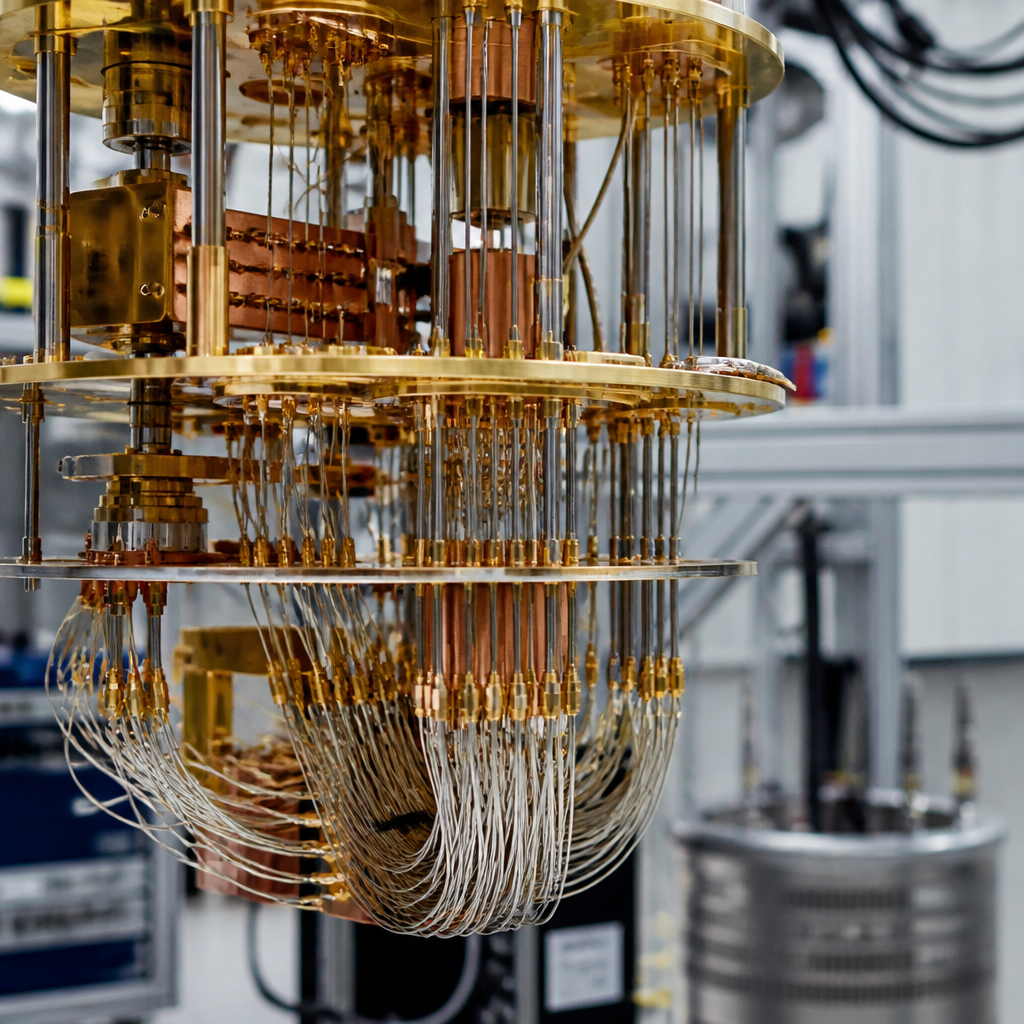
Quantum error correction is not a single algorithm layered on top of hardware. It is a full stack problem spanning materials science to runtime orchestration. Better substrates, cleaner fabrication, and improved packaging reduce loss channels. Microwave engineering or laser control determines gate precision. Cryogenic infrastructure stabilizes superconducting devices, while vacuum and optical systems shape trapped-ion and neutral-atom performance. Above that, calibration pipelines tune pulses, compensate drift, and characterize correlated errors. Decoders then process syndrome data in real time, often under strict latency requirements, because delayed corrections can erase the advantage of the code.
In practical system design, tradeoffs are unavoidable. Superconducting qubits offer fast gates and strong ecosystem maturity, but they demand complex cryogenics and dense control wiring. Trapped ions deliver excellent fidelities and all-to-all connectivity within a chain, but gate speeds are slower and scaling requires photonic interconnects or modular architectures. Neutral atoms bring flexible geometry and promising scale, while photonic approaches target room-temperature networking and modularity. Error correction is the common yardstick across all of them: the winning platform will be the one that converts physical performance into low-cost logical qubits most efficiently.
| Hardware approach | Typical strengths | Error-correction challenge | Commercial implication |
|---|---|---|---|
| Superconducting | Fast gates, mature fabrication, broad tooling | Cryogenic complexity, crosstalk, wiring density | Strong near-term ecosystem, intense scaling pressure |
| Trapped ions | High fidelity, long coherence, flexible connectivity | Slower gates, modular networking overhead | Premium performance for early logical demonstrations |
| Neutral atoms | Large arrays, reconfigurable layouts | Uniform control and readout at scale | Promising for scalable architectures if fidelities improve |
| Photonic | Networking compatibility, room-temperature components | Loss management and probabilistic operations | Attractive for distributed quantum systems |
Software is equally central. Compilers must map circuits onto hardware while minimizing depth and error exposure. Decoders such as minimum-weight perfect matching implementations or neural-network-assisted decoders infer likely error patterns from syndrome streams. Verification teams rely on randomized benchmarking, gate set tomography, and cycle benchmarking to separate control errors from stochastic noise. When these layers work together, a company can honestly claim progress toward fault tolerance. When one layer lags, impressive hardware specifications may still fail to translate into reliable computation.
Why this topic anchors the wider Quantum & Deep Tech landscape
As a hub topic, quantum error correction links nearly every meaningful conversation in Quantum & Deep Tech. Start with quantum hardware: every modality must prove it can support repeated syndrome extraction and scalable control. Move to quantum software: compilers, transpilers, and resource estimators exist largely to reduce the overhead of logical operations. Consider quantum networking: distributed architectures may combine smaller modules into larger fault-tolerant machines, making entanglement purification and error-managed links essential. Even quantum sensing and communication borrow related ideas about protecting fragile states against environmental noise.
For startups, this creates several investable layers beyond the headline processor companies. There are businesses building cryogenic electronics, low-noise amplifiers, photonic interconnects, control stacks, calibration automation, verification software, and quantum cloud orchestration. There are also algorithm and middleware companies that help enterprises estimate when an application will require thousands versus millions of physical qubits once error correction overhead is included. In diligence, I look for founders who can articulate not just a physics breakthrough but a path to lower logical qubit cost, because that is the metric that ultimately shapes adoption.
This perspective also keeps commercialization claims grounded. Drug discovery, materials simulation, optimization, and cryptanalysis are often discussed as end markets, but each has distinct resource requirements. Simulating a modest molecule with chemistry-grade accuracy may demand far more logical operations than a marketing deck implies. Breaking public-key cryptography is even more resource intensive once realistic overhead is counted. Error correction forces precision into these discussions. It separates exploratory demonstrations from applications that can withstand the scrutiny of enterprise buyers, regulators, and technical procurement teams.
How to evaluate progress over the next five years
If you are tracking the field, the most important question is not “Who has the most qubits?” but “Who is improving the ratio between physical resources and reliable logical computation?” Watch for repeated logical cycles with lower error than constituent physical qubits, published threshold data, and evidence that performance survives outside carefully selected benchmark cases. Pay attention to whether a company reports two-qubit gate fidelity, measurement fidelity, leakage rates, and calibration stability over time. Durable progress appears as consistent system behavior, not isolated record numbers.
Also examine architecture and business fit. A company serving national labs may prioritize ultimate performance over ease of deployment, while a cloud provider may emphasize uptime, tooling, and hybrid workflow integration. Partnerships matter: collaboration with foundries, cryogenic suppliers, hyperscalers, and research universities often accelerates the path from lab result to platform. Finally, be realistic about timelines. Useful fault-tolerant quantum computing is advancing, but it will arrive through disciplined engineering, not marketing velocity. The organizations worth following are the ones that treat error correction as the product roadmap, because in this industry, it is.
Quantum error correction matters more than qubit count because it turns fragile experiments into dependable computation. It defines whether additional hardware creates value or merely adds noise. It also provides the clearest framework for understanding the broader Quantum & Deep Tech landscape, from hardware choices and software stacks to startup opportunities and commercialization claims. When you evaluate the space through the lens of logical qubits, thresholds, and fault tolerance, the signal becomes much clearer.
The practical takeaway is simple: ask how well a system protects information, not just how much information it nominally holds. That question leads to better technical decisions, sharper investment judgment, and more realistic expectations about timelines and applications. If you are building, buying, or backing in quantum, make quantum error correction your first filter, then explore each linked subtopic in this hub with that standard in mind.
Frequently Asked Questions
Why does quantum error correction matter more than raw qubit count?
Qubit count makes for an easy headline, but by itself it does not tell you whether a quantum computer can perform useful, reliable work. The central challenge in quantum computing is that qubits are extraordinarily sensitive to noise. Heat, vibration, stray electromagnetic interference, imperfect control pulses, and measurement errors can all disturb a qubit’s state. As a result, errors accumulate quickly, often much faster than a long or complex computation can finish. A machine with more qubits but high error rates may still struggle to complete meaningful algorithms.
Quantum error correction matters more because it addresses the core engineering problem: how to preserve fragile quantum information long enough to compute with it. Instead of treating each physical qubit as independently useful, error correction combines many imperfect physical qubits into a smaller number of much more reliable logical qubits. That tradeoff is crucial. A system with fewer, high-quality logical qubits can be more powerful in practice than a larger system full of noisy physical qubits that cannot sustain deep computations.
In other words, qubit count measures size, while quantum error correction measures stability and scalability. The field is ultimately trying to build machines that can run long algorithms accurately enough to solve problems beyond the reach of classical computers. That requires fault tolerance, not just bigger hardware. So when experts evaluate progress, they increasingly look at whether a platform is improving coherence, reducing gate errors, detecting and correcting faults in real time, and demonstrating logical qubits that outperform their underlying physical components. Those are stronger signals of practical progress than a simple qubit total.
What exactly is quantum error correction, and how is it different from classical error correction?
Quantum error correction is a set of methods for protecting quantum information against the errors that naturally arise in quantum hardware. In classical computing, error correction is relatively straightforward because information is stored as definite 0s and 1s that can be copied and checked. If one bit flips, the system can compare repeated copies and recover the intended value. Quantum information is different. A qubit can exist in superposition, can be entangled with other qubits, and cannot be copied arbitrarily because of a fundamental rule known as the no-cloning theorem. That means quantum error correction has to preserve information without directly duplicating an unknown quantum state.
The solution is to encode one logical qubit across many physical qubits in a carefully structured way. Rather than measuring the quantum information itself, a quantum error-correcting code measures indirect properties called syndromes. These syndrome measurements reveal whether certain kinds of errors, such as bit-flip-like or phase-flip-like faults, have occurred, but they do so without collapsing the logical state that the computation is trying to preserve. This is one of the most elegant aspects of quantum engineering: detecting damage without destroying the information you want to keep.
Another major difference is the variety and subtlety of quantum errors. Classical bits mostly suffer from simple flips between 0 and 1. Qubits can experience bit flips, phase flips, combinations of both, leakage into unwanted states, crosstalk from neighboring qubits, and correlated noise across parts of the processor. Quantum error correction must therefore manage a much richer error landscape. That is why it requires sophisticated codes, repeated rounds of measurement, and precise control systems that can respond quickly and accurately. It is not just a quantum version of parity checks; it is a fundamentally different strategy designed for the unique physics of quantum information.
How do logical qubits and physical qubits relate to each other?
A physical qubit is the actual hardware element built in the lab, such as a superconducting circuit, trapped ion, neutral atom, photonic mode, or spin in a material system. A logical qubit is the protected, higher-level unit of quantum information created by encoding information across many physical qubits. This distinction is essential because physical qubits are noisy and fragile, while logical qubits are intended to be robust enough for real computation.
You can think of physical qubits as the raw components and logical qubits as the dependable computational resources produced from them. To create one logical qubit, a quantum computer may need many physical qubits devoted not only to storing the encoded state but also to detecting errors continuously. The exact overhead depends on the hardware quality, the type of error-correcting code being used, and the reliability target for the computation. In early systems, that overhead can be very large, which is one reason why a high physical qubit count does not automatically translate into practical capability.
The key goal is to reach a point where the logical qubit performs better than any single physical qubit could on its own. Once that happens consistently, the system begins to show the real value of error correction. As physical qubits improve and codes become more efficient, the number of physical qubits required per logical qubit can effectively decrease for a given performance target. That is why researchers care so much about logical error rates, code distance, fault-tolerant operations, and scaling behavior. The future of quantum computing depends less on how many physical qubits can be placed on a chip and more on how effectively those physical qubits can be organized into useful logical ones.
Why are qubits so fragile, and what kinds of errors are most important to correct?
Qubits are fragile because quantum states must remain exquisitely isolated from unwanted interactions while still being controllable enough to perform gates, measurements, and communication. That balancing act is extremely difficult. The same sensitivity that gives quantum systems their power also makes them vulnerable. Even tiny environmental disturbances can disrupt superposition or entanglement, causing decoherence and reducing computational accuracy. In practical devices, noise can come from thermal effects, material defects, fluctuating electromagnetic fields, mechanical vibrations, imperfect microwave or laser control, and even errors introduced during readout itself.
The most commonly discussed error types are bit flips and phase flips. A bit flip changes a qubit in a way roughly analogous to swapping 0 and 1. A phase flip changes the relative phase of the quantum state, which may not sound dramatic but can completely alter the result of an interference-based quantum algorithm. Because quantum computing relies heavily on interference patterns, phase errors are especially important. Many real hardware errors involve combinations of both, and some systems also face leakage errors, where the qubit escapes the intended computational states entirely.
Another major concern is correlated error. If many qubits are affected together by the same disturbance, the problem becomes harder than if errors are isolated and random. Crosstalk between neighboring qubits, shared control electronics, and common environmental fluctuations can all create patterns of failure that stress error-correcting codes. Measurement errors are also critical because quantum error correction depends on repeatedly reading out syndrome information correctly. If the system cannot trust those measurements, correction becomes far less effective. That is why improving qubit hardware, control fidelity, materials, cryogenics, and readout quality all matter alongside better coding schemes. Fragility is not caused by one issue; it is the cumulative effect of many small imperfections acting on a very delicate information carrier.
What should readers watch for when judging real progress in quantum computing?
If you want to judge meaningful progress, look beyond the largest qubit number in a press release. More informative signs include lower physical error rates, longer coherence times, higher gate fidelities, better measurement accuracy, and successful demonstrations of repeated error-correction cycles. Especially important is evidence that a logical qubit can outperform the physical qubits from which it is built. That is a far stronger milestone than simply showing that many qubits can exist on one chip or in one system.
Another strong indicator is whether a platform is moving toward fault tolerance. Fault tolerance means the computer can continue operating accurately even while components experience errors, as long as those errors remain below certain thresholds. Researchers often discuss threshold behavior because, below that level, adding more error correction actually improves reliability instead of making things worse. Demonstrations of logical operations, logical memory lifetimes that improve with code size, and scalable architectures for routing control and readout are all major signs that a system is advancing in the right direction.
It is also worth watching how companies and labs talk about logical qubits, not just physical qubits. A roadmap that explains how many physical qubits are needed to build stable logical qubits, how error rates are trending, and how the architecture supports scaling is generally more credible than one centered only on raw totals. In the long run, useful quantum advantage in chemistry, materials science, optimization, or cryptanalysis will depend on running deep circuits accurately, not merely assembling large but noisy devices. The most important question is not “How many qubits are there?” but “How well can the machine protect and use quantum information over time?” That is why quantum error correction has become the more meaningful benchmark of progress.