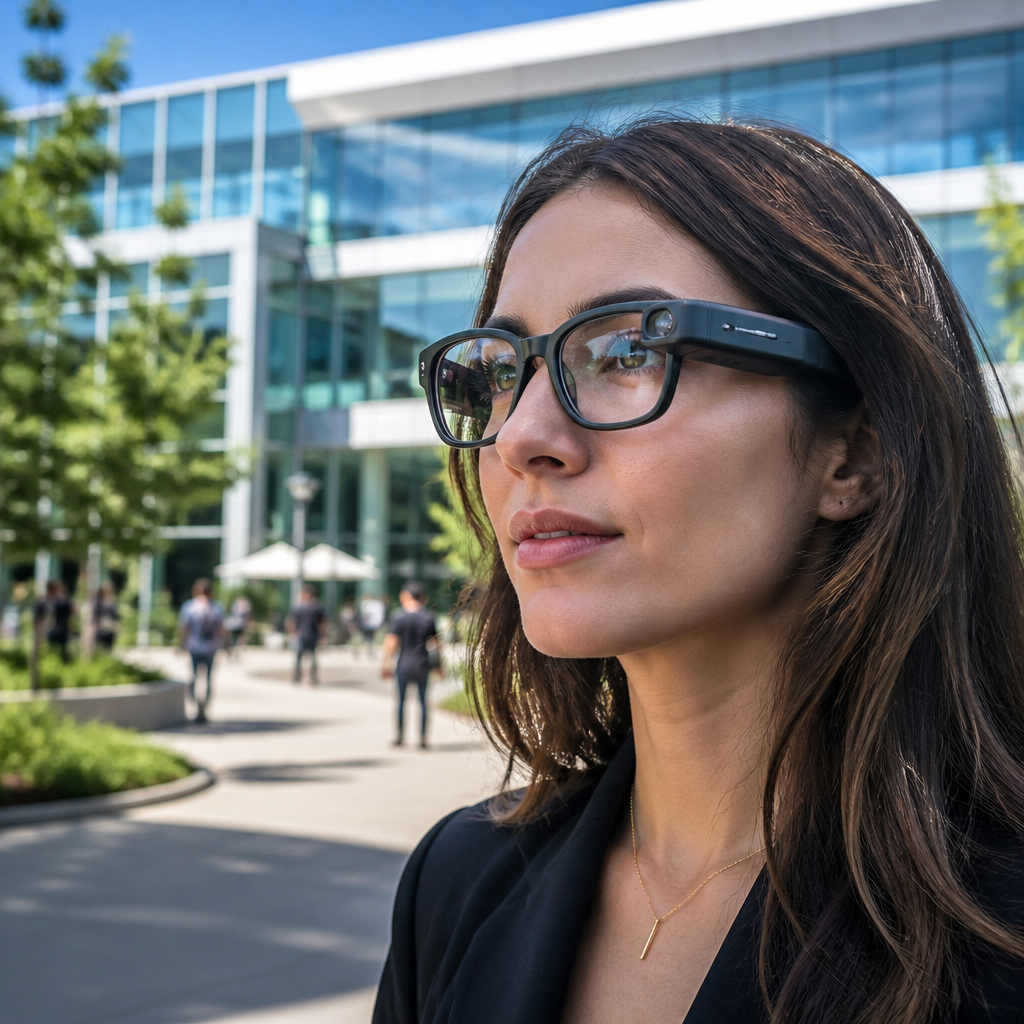
Smart glasses startups in Silicon Valley are turning a category once defined by false starts into one of the most closely watched segments in wearables and spatial computing. Smart glasses combine sensors, cameras, microphones, displays, wireless connectivity, and software that place digital information into the user’s field of view or earshot. Spatial computing is the broader model behind them: computing that understands physical space, user context, and real-time intent. This matters now because artificial intelligence has solved a problem earlier wearable devices could not solve well enough: making limited hardware feel genuinely useful in everyday moments.
I have worked around wearable product strategy long enough to see the cycle repeat. Early devices promised hands-free productivity, ambient navigation, and seamless capture, but battery limits, weak voice interfaces, awkward industrial design, and privacy concerns kept them niche. What changed is not just better displays or lighter frames. The real shift is multimodal AI that can interpret speech, images, location, and user history fast enough to deliver relevant assistance without forcing people to pull out a phone. In Silicon Valley, that capability is reviving investor interest, startup formation, and platform competition across consumer and enterprise markets.
For readers following Tech Innovations & Startups, this hub explains why wearables and spatial computing deserve close attention. It covers the startup landscape, enabling technologies, business models, design constraints, and the practical questions founders, investors, and buyers should ask. It also sets context for deeper articles on AR glasses, enterprise wearables, AI assistants, optical systems, and privacy regulation. If you want a grounded view of where smart glasses fit in the next computing cycle, begin here.
Why AI changed the smart glasses equation
AI is reviving wearable computing because it increases utility per second of use. On a phone, users tolerate opening apps, typing prompts, and switching contexts. On glasses, that friction kills adoption. The interface must be immediate. Modern speech recognition, on-device wake word detection, large language models, computer vision, and retrieval systems now support an interaction loop that feels natural: look, ask, hear, glance, act. Meta’s Ray-Ban smart glasses helped prove the consumer appetite for lightweight AI-enabled eyewear by emphasizing photos, audio, calls, and assistant features instead of overpromising full augmented reality. Startups noticed that users will accept modest visuals if the device solves real tasks elegantly.
In enterprise settings, the value is even clearer. Field technicians can receive step-by-step guidance while keeping both hands free. Warehouse workers can scan inventory, confirm picks, and get route prompts without checking handheld terminals. Surgeons and clinicians can access reference material or remote support while maintaining sterile workflows. These are not hypothetical use cases. Companies such as Vuzix and RealWear built practical adoption around exactly these workflows, and younger Silicon Valley startups are refining the model with better AI summarization, object recognition, and natural language interfaces. The lesson is direct: when AI reduces cognitive load, the hardware earns its place.
The Silicon Valley startup landscape in wearables and spatial computing
Silicon Valley remains the densest ecosystem for smart glasses startups because it combines optics talent, semiconductor supply relationships, software infrastructure, venture capital, and access to platform acquirers. Startups generally cluster into four groups: consumer AI eyewear, enterprise assisted-reality tools, core component makers, and spatial software platforms. Consumer companies chase large-scale adoption through design, audio, messaging, capture, and assistant experiences. Enterprise players focus on workflow integration, safety compliance, and measurable productivity gains. Component startups build waveguides, microLED display modules, power systems, or low-power computer vision chips. Software firms provide mapping, object anchoring, collaboration, or AI orchestration layers that sit across hardware vendors.
The funding logic is also different from the last wave. Investors are less willing to back pure concept demos. They want evidence that founders understand gross margin structure, reference designs, and software retention. A startup selling glasses at hardware-like margins with no recurring revenue faces a hard path. A company that bundles device management, workflow analytics, remote assistance, and subscription AI has a stronger case. This is why many founders position their products as wearable computing systems rather than gadgets. The hub across wearables and spatial computing is not one product type; it is the stack linking optics, compute, AI models, cloud services, and vertical applications.
The technology stack making modern smart glasses viable
Several technical advances converged to make current products more credible. Display systems improved through microOLED and microLED research, though many shipping devices still avoid full visual overlays to preserve battery life and reduce cost. Audio has become a major interface, with beamforming microphones and open-ear speakers supporting private enough interactions for calls and assistant responses. Computer vision stacks can now run lightweight models at the edge for scene recognition, translation, and object identification. Connectivity through Bluetooth Low Energy, Wi-Fi, and phone tethering lets startups offload heavier computation when needed while keeping the glasses thin.
Battery and thermal design still define what is possible. In my experience, startup teams learn quickly that a great demo can collapse under real-world heat, weight distribution, and idle drain. A glasses product succeeds only when optical engine size, processor choice, sensor count, and enclosure materials are balanced ruthlessly. Qualcomm’s Snapdragon AR platforms, custom neural processing units, and efficient image signal processors matter because every milliwatt affects comfort. Even the best AI model is irrelevant if users feel temple-arm heat after ten minutes. The winning startups treat wearables and spatial computing as industrial design problems as much as software problems.
| Layer | What it does | Why startups care |
|---|---|---|
| Optics and display | Projects text or visuals through waveguides, prisms, or microdisplays | Determines brightness, field of view, weight, and cost |
| Sensors and audio | Captures voice, images, head movement, and environment data | Enables multimodal AI, calls, capture, and contextual awareness |
| Compute and power | Processes data on-device or via tethered phone/cloud resources | Controls battery life, latency, heat, and form factor |
| AI and software | Runs assistants, recognition, translation, summarization, and workflows | Creates recurring value beyond hardware sales |
Business models, adoption patterns, and the path to scale
Consumer and enterprise smart glasses scale differently. Consumer adoption depends on style, comfort, social acceptability, and one or two high-frequency behaviors. That is why startups increasingly lead with messaging, music, photos, translation, and AI help instead of immersive 3D overlays. People wear glasses on their face for long periods only if they look normal and perform reliably. Enterprise adoption is less style-driven and more ROI-driven. Buyers ask whether training time drops, error rates improve, travel costs fall, or first-time fix rates increase. If the savings are measurable, procurement can move surprisingly quickly despite smaller volumes.
Recurring revenue is the strategic hinge. Hardware launches generate attention, but software subscriptions build durable companies. In warehouse deployments, for example, startups can charge for device management, workflow templates, analytics dashboards, API integrations, and support. In consumer markets, the monetization path is less settled. Subscription AI assistants, cloud storage, premium translation, or commerce referrals may help, but they must feel additive rather than compulsory. Apple, Meta, Google, and Amazon loom over this market because platform owners can subsidize hardware to gain ecosystem control. Startups therefore win by specializing faster, integrating better, or reaching overlooked use cases before larger companies standardize the category.
The hardest problems: privacy, ergonomics, and regulation
Every serious discussion of smart glasses startups in Silicon Valley must address the reasons earlier products stalled. Privacy is the first issue. A visible camera on a face-worn device changes social dynamics immediately. Startups need obvious recording indicators, clear consent policies, strong data retention rules, and transparent model behavior. If a device performs cloud-based image analysis, users and bystanders should understand what is captured, where it is processed, and how long it is stored. Regulations vary by jurisdiction, and companies selling across healthcare, industrial, or education settings face additional compliance burdens, including HIPAA-adjacent workflow considerations and workplace surveillance concerns.
Ergonomics is the second issue, and it is often underestimated by software-first founders. Glasses must balance bridge pressure, temple fit, lens compatibility, and total mass while surviving drops, sweat, and all-day wear. Prescription support matters more than many startup decks admit. So does accessibility for users with hearing differences, motion sensitivity, or low vision. Regulation is the third issue. Radio certifications, battery transport rules, eye safety standards, and import controls can delay launches. Enterprise buyers also ask about SOC 2 practices, mobile device management compatibility, and incident response plans. The startups that endure are the ones that treat trust, comfort, and compliance as product features, not legal cleanup.
What founders, investors, and readers should watch next
The next phase of wearables and spatial computing will be decided by whether smart glasses become an everyday interface instead of an occasional accessory. Watch for three signals. First, look for products that solve a narrow, repeated task exceptionally well, because habitual use predicts retention better than futuristic demos. Second, track component breakthroughs in microLED efficiency, waveguide manufacturing yields, and low-power AI silicon, since those advances unlock lighter designs. Third, pay attention to software ecosystems: device management, developer tools, and app distribution often determine platform durability more than launch-day hardware reviews.
The central takeaway is simple. AI is reviving wearable computing because it finally gives smart glasses a compelling reason to exist between the smartphone and the headset. Silicon Valley startups are pushing that transition by combining practical design, multimodal intelligence, and focused use cases across consumers and enterprise teams. Not every company will survive, and the category still faces real limits in battery life, privacy, and cost. But the direction is unmistakable. If you follow Tech Innovations & Startups, use this hub as your starting point, then explore the deeper wearables and spatial computing topics that connect hardware, software, and the next wave of hands-free computing.
Frequently Asked Questions
1. Why are smart glasses startups in Silicon Valley gaining momentum again after earlier wearable failures?
Smart glasses startups are gaining traction again because the technology stack is finally catching up to the vision. Earlier generations of wearable computing struggled with limited battery life, bulky hardware, weak use cases, privacy backlash, and software that did not feel essential. Today, Silicon Valley startups are revisiting the category with a very different foundation: better chips, lighter materials, improved sensors, more efficient displays, faster wireless connectivity, and most importantly, AI systems that can make glasses genuinely useful in real time.
The biggest difference is that modern AI can turn smart glasses from passive display devices into context-aware assistants. Instead of simply showing notifications on your face, newer systems can listen, see, interpret surroundings, summarize information, translate speech, identify objects, and respond to user intent with minimal friction. That changes the value proposition. For many startups, the goal is no longer to build a novelty gadget, but to create an always-available interface for navigation, communication, productivity, accessibility, and ambient computing.
Silicon Valley is also the ideal environment for this revival because it combines venture capital, talent in hardware and machine learning, software ecosystems, and close ties to suppliers and platform companies. Startups benefit from a broader shift toward spatial computing, where devices are designed to understand the user’s environment rather than just display content on a screen. In that context, smart glasses are increasingly seen as a practical bridge between smartphones and more immersive AR headsets. They are less isolating, more socially acceptable, and potentially more scalable for everyday use. That combination of AI maturity, hardware improvements, and renewed market interest is why the category is being watched so closely again.
2. What role does AI play in reviving wearable computing through smart glasses?
AI is the key reason wearable computing feels relevant again. Without AI, smart glasses risk becoming little more than miniature second screens. With AI, they can function as intelligent companions that understand what the user is doing, where they are, and what information is useful in that moment. This is especially important in wearables because the interface is small, attention is limited, and interactions need to feel natural and low-friction.
In practical terms, AI enables features that make smart glasses meaningfully different from earlier devices. Computer vision can help the glasses recognize objects, read signs, identify landmarks, and interpret visual context. Speech recognition and language models can support hands-free commands, real-time transcription, multilingual translation, and concise answers delivered through audio or lightweight visual overlays. Sensor fusion allows data from cameras, microphones, inertial sensors, GPS, and other inputs to be combined into a more accurate understanding of user context. That is what allows the device to move from reactive behavior to proactive assistance.
AI also improves the experience behind the scenes. It can optimize battery usage, prioritize notifications, reduce information overload, and personalize responses over time. For enterprise scenarios, AI can guide workers through tasks, surface instructions while they work, and document processes automatically. For consumers, it can support navigation, reminders, accessibility, travel assistance, and messaging in a way that feels less interruptive than pulling out a phone. In short, AI revives wearable computing by giving smart glasses a clear purpose: not just displaying information, but delivering the right information at the right moment in the real world.
3. How do smart glasses fit into the broader trend of spatial computing?
Smart glasses are one of the most accessible forms of spatial computing because they bring digital intelligence into the user’s real-world environment without fully replacing that environment. Spatial computing refers to systems that understand space, movement, objects, and user intent in real time. Instead of treating computing as something confined to a flat screen, spatial computing allows software to interact with the physical world as the user experiences it. Smart glasses fit naturally into that model because they sit directly on the user, continuously observing context through sensors and responding in place.
That makes smart glasses especially important as a bridge category. On one end of the market, people are still anchored to smartphones, which require constant manual attention. On the other end, high-end AR and mixed reality headsets promise deeply immersive experiences but are often expensive, bulky, and not yet ideal for all-day use. Smart glasses sit in the middle. They can offer glanceable information, voice interaction, audio prompts, environmental awareness, and lightweight overlays while preserving mobility and social presence.
For startups in Silicon Valley, this positioning matters. It means smart glasses do not need to solve every challenge of full augmented reality on day one. Instead, they can succeed by handling high-value spatial tasks such as turn-by-turn navigation, workplace guidance, remote support, contextual search, note capture, live translation, or accessibility support for users with visual or hearing impairments. Over time, as displays, optics, power efficiency, and on-device AI improve, smart glasses can become a more capable spatial interface. That is why many investors and founders see them not as a niche accessory, but as a major step toward a future where computing is embedded into everyday surroundings.
4. What are the biggest challenges smart glasses startups still need to overcome?
Even with renewed excitement, smart glasses startups face serious challenges. Hardware design remains one of the toughest. Glasses have to be lightweight, comfortable, stylish, durable, and power-efficient, all while incorporating cameras, microphones, sensors, processors, batteries, wireless radios, and in some cases displays. That is an extremely difficult engineering problem because users compare them not just to other gadgets, but to normal eyewear. If a device looks awkward, feels heavy, or has poor battery life, adoption can stall quickly.
Privacy is another major challenge. Because smart glasses can capture audio, video, and environmental data, they raise concerns for both users and bystanders. Startups need clear policies around recording, data storage, consent, and security. Visual indicators, on-device processing, and limited default collection can help, but trust has to be earned. This is especially true in public settings, where social acceptance can determine whether a product becomes mainstream or remains niche.
There is also the challenge of defining compelling everyday use cases. The technology may be impressive, but consumers usually adopt devices because they solve frequent, obvious problems. Startups need to show that smart glasses save time, reduce friction, improve communication, enhance accessibility, or unlock hands-free workflows better than a phone, smartwatch, or earbuds can. In enterprise markets, this case may be easier to prove through productivity gains and workflow efficiency. In consumer markets, the bar is often higher because convenience, fashion, and price sensitivity all matter at once.
Finally, ecosystem and platform issues remain important. Smart glasses often depend on strong integration with mobile operating systems, cloud services, AI models, mapping systems, and developer tools. Startups must decide whether to build closed products, partner with larger tech platforms, or create open ecosystems that attract third-party developers. The winners in this space will likely be the companies that combine strong hardware execution with trustworthy AI, practical use cases, and a product experience that feels natural enough for daily wear.
5. Which use cases are most likely to drive mainstream adoption of AI-powered smart glasses?
Mainstream adoption will likely come from use cases that are frequent, hands-free, and clearly better than looking down at a phone. Navigation is one of the strongest examples. Smart glasses can provide turn-by-turn guidance, landmark cues, transit updates, and location-based prompts without forcing the user to break stride. Translation is another highly promising category, especially for travel, business, and multilingual communication. Real-time speech translation, subtitles, and contextual language assistance are easy for users to understand and immediately valuable.
Communication and productivity also have strong potential. Smart glasses can surface messages, reminders, calendar prompts, and summarized notifications in a less disruptive way than a smartphone. In meetings or field settings, they can support note capture, live transcription, and quick access to relevant information. For professionals in logistics, manufacturing, healthcare, and maintenance, glasses can deliver task instructions, remote expert support, inventory data, and workflow guidance directly in view. These enterprise use cases may continue to lead adoption because they provide measurable return on investment.
Accessibility may become one of the most meaningful long-term drivers. AI-powered smart glasses can help users identify objects, read text aloud, provide scene descriptions, amplify or transcribe speech, and improve environmental awareness. That makes wearable computing more than a convenience product; it turns it into an assistive tool with real social impact. Meanwhile, consumer interest may also grow around content capture, fitness, ambient search, and personal AI assistance, as long as those features are delivered in a way that feels useful rather than distracting.
Ultimately, the use cases most likely to win are the ones that fit naturally into daily life and take advantage of what smart glasses do uniquely well: seeing what the user sees, hearing what they hear, understanding physical context, and responding instantly with minimal effort. When that experience becomes reliable, lightweight, and socially acceptable, AI-powered smart glasses have a much stronger path to mainstream adoption than earlier wearable devices ever did.