
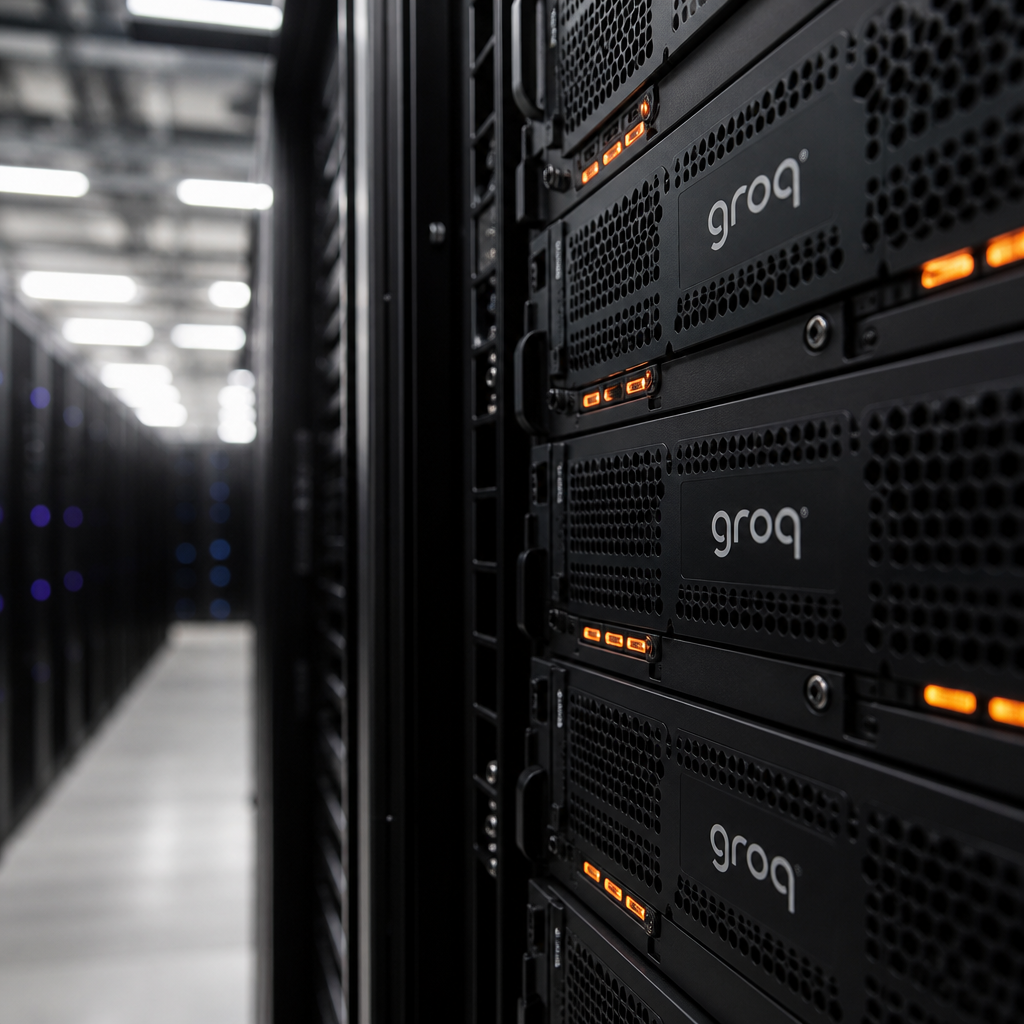
Groq has become one of the most closely watched companies in AI compute because its Language Processing Unit, or LPU, is designed for one job above all others: faster AI inference. In practical terms, inference is the moment a trained model turns a prompt into an answer, a token stream, a classification, or a recommendation. That step now matters as much as training, because businesses deploying large language models, speech systems, vision pipelines, and agents pay for response speed, consistency, and operating cost every time a user makes a request. I have worked with GPU clusters, edge accelerators, and low-latency serving stacks, and the same bottleneck appears repeatedly: even powerful hardware can waste cycles when model execution depends on irregular memory access, contention, and scheduling overhead.
That is where Groq’s architectural claim stands out. Rather than treat AI inference as a graphics-adjacent problem, Groq built a processor and software stack around deterministic execution. The company argues that predictable dataflow, compiler-led scheduling, and single-core scale-up design can reduce latency and smooth throughput for transformer workloads. For readers tracking AI compute and semiconductors, Groq matters for a broader reason as well. This sector is no longer just a contest between general-purpose CPUs and dominant GPUs. It now includes tensor accelerators, inference ASICs, wafer-scale engines, NPUs in PCs and phones, networking silicon, advanced packaging, and memory technologies such as HBM. Understanding Groq helps frame the bigger market question: what kind of chip architecture actually delivers better real-world inference for modern AI applications?
This company spotlight serves as a hub for AI compute and semiconductors by using Groq as a focal point. It explains what the LPU is, how it differs from GPU-based inference, where it may fit in production, what tradeoffs buyers should examine, and which adjacent topics deserve deeper study. If you are evaluating model serving infrastructure, semiconductor trends, or the economics of generative AI, Groq is a useful case because it forces a precise discussion about architecture instead of headline benchmark theater alone.
What Groq means in AI compute and semiconductors
Groq is a semiconductor and systems company focused on accelerating AI inference. Its signature product is the LPU, an application-specific processor built to execute machine learning models with very low latency and highly predictable performance. The key idea is simple to state and difficult to engineer: remove as much runtime uncertainty as possible. In many conventional accelerated systems, work is distributed across many cores, memory hierarchies, and schedulers. That flexibility supports a wide range of workloads, but it can also introduce stalls, synchronization costs, and jitter. Groq’s design attempts to avoid those penalties by using a deterministic architecture in which the compiler orchestrates execution paths ahead of time.
Within the wider AI compute market, Groq belongs to a wave of specialized silicon providers challenging the assumption that GPUs are always the best answer. Other companies in the same broad conversation include NVIDIA, AMD, Intel, Cerebras, SambaNova, Graphcore, Qualcomm, and hyperscaler in-house chip teams such as Google TPU, AWS Trainium and Inferentia, and Microsoft Maia. Each approaches the balance among programmability, performance, power, and deployment differently. Groq’s emphasis is particularly sharp: optimize inference speed for language models and related sequential generation tasks where every token delay affects user experience.
That focus aligns with current demand. Enterprises increasingly care about time to first token, tokens per second, and tail latency, not just raw peak TOPS. A chatbot that starts answering instantly often feels smarter than one that pauses, even if both use the same model. In customer support, coding assistants, voice applications, and retrieval-augmented generation systems, predictable response behavior can matter as much as throughput. Groq’s market relevance comes from targeting that exact operational pain point.
How LPU architecture targets faster AI inference
The central difference between the LPU and a typical GPU is architectural philosophy. GPUs were originally built for massively parallel graphics workloads and later adapted brilliantly for AI through CUDA, tensor cores, and mature software ecosystems. They excel at throughput and flexibility across training and inference. Groq instead designed the LPU around deterministic, compiler-scheduled execution. In plain terms, Groq tries to decide in advance where operations run, when data moves, and how resources are allocated, reducing the need for dynamic scheduling at runtime.
This matters because transformer inference is not just matrix multiplication. It also involves token-by-token generation, key-value cache management, memory bandwidth pressure, and control dependencies that can expose inefficiencies. When runtime overhead accumulates, latency rises. Groq’s approach aims to keep the datapath fed continuously, minimizing the bubbles that occur when general-purpose systems juggle many threads and memory requests at once.
The company also emphasizes a single-core, software-defined architecture at large scale. That phrasing can sound abstract, but the practical implication is that developers interact with a system intended to behave predictably across execution rather than relying on many loosely coordinated cores. In environments where jitter breaks service-level objectives, deterministic execution is valuable. I have seen this distinction matter in real deployments: average latency can look acceptable on paper while p95 and p99 latency degrade badly under concurrent load. A design that narrows that spread can improve user experience and infrastructure planning.
| Metric | Why it matters for inference | How Groq positions the LPU |
|---|---|---|
| Time to first token | Controls how quickly a user sees the model begin responding | Deterministic execution is intended to reduce startup delay and jitter |
| Tokens per second | Determines streaming speed for generative applications | Compiler-managed scheduling aims to keep token generation flowing steadily |
| Tail latency | Affects service reliability under bursty or concurrent demand | Predictable dataflow is designed to narrow p95 and p99 slowdowns |
| Utilization efficiency | Impacts cost per query and capacity planning | Reduced runtime overhead can improve useful work per watt and per chip |
None of this means architecture alone guarantees superiority on every model. Performance depends on model size, precision support, batching strategy, context length, memory behavior, and software maturity. Still, the LPU’s value proposition is technically coherent: if inference is increasingly a latency-sensitive serving problem, a processor built specifically for deterministic token generation may outperform more general accelerators in selected scenarios.
Where Groq fits versus GPUs, TPUs, and other accelerators
Groq should not be evaluated as a universal replacement for GPUs. It is better understood as a targeted option within a layered AI infrastructure stack. GPUs remain dominant because they combine strong training performance, broad framework support, enormous developer familiarity, and a mature ecosystem spanning NVIDIA TensorRT, Triton Inference Server, CUDA libraries, and every major model framework. TPUs and cloud inference chips offer compelling alternatives where organizations are willing to align closely with a given cloud provider’s software path.
Groq enters where low-latency inference is the primary goal and model serving economics justify specialization. That can include public model endpoints, enterprise copilots, call center automation, transcription pipelines, and real-time agent systems. If a business serves millions of short interactions, shaving delay from every token can create measurable gains in engagement and infrastructure efficiency. Conversely, if a team needs one platform for training, fine-tuning, experimentation, and broad model support, GPUs may remain the default because operational simplicity outweighs latency gains.
This is the key semiconductor lesson. AI hardware purchasing is moving from generic benchmark comparisons toward workload-architecture matching. Buyers increasingly ask: Is the model dense or mixture-of-experts? Is the traffic interactive or batched? Is the bottleneck compute, memory bandwidth, networking, or orchestration overhead? Groq is relevant because it embodies the idea that a well-chosen architecture can beat a more general one on the metrics that actually affect application quality.
Real-world use cases, limitations, and what to study next
The strongest use cases for Groq are applications where response speed is visible to end users. A coding assistant benefits when completions begin immediately. A voice agent benefits when transcription, reasoning, and reply generation happen inside conversational timing thresholds. A retrieval-augmented support bot benefits when the model streams grounded answers without awkward pauses. In these settings, low time to first token and stable token output can improve satisfaction more than a modest increase in model size.
There are, however, important limitations to examine. First is ecosystem depth. Specialized chips often face a software adoption challenge, because developers value compatibility with PyTorch, ONNX, Hugging Face, Kubernetes-native serving, observability stacks, and existing MLOps workflows. Second is model coverage. The practical question is not whether a chip is fast in theory, but which popular open and proprietary models it supports efficiently today. Third is scaling economics. Hardware buyers must compare not just chip performance, but system availability, cloud access, networking needs, support quality, and total cost of ownership.
For anyone using this page as a hub for AI compute and semiconductors, the next topics to explore are clear: GPU versus ASIC inference economics, HBM and memory bandwidth constraints, chiplet and packaging strategies such as CoWoS, compiler-led optimization, quantization methods like INT8 and FP8, and serving frameworks that shape end-to-end latency. Groq is worth following because it sharpens every one of those discussions. Its LPU architecture makes a definitive argument that faster AI inference comes from reducing uncertainty in execution, not simply adding more parallel hardware. If you are building an AI infrastructure roadmap, use Groq as a reference point for evaluating how chip design choices translate into application performance, deployment tradeoffs, and business value.
Frequently Asked Questions
What is Groq, and how is its LPU different from a GPU or CPU for AI inference?
Groq is an AI compute company focused on accelerating inference, which is the stage where a trained model takes a live input and produces an output such as generated text, a speech transcription, an image understanding result, or a recommendation. Its core hardware is the Language Processing Unit, or LPU, a processor architecture built specifically to deliver fast, predictable execution for model serving. That focus matters because many real-world AI products succeed or fail based on response time, throughput, and consistency once the model is already trained and deployed.
Compared with CPUs and GPUs, the LPU is notable for its specialized design priorities. CPUs are general-purpose processors that handle a broad range of software tasks well, but they are not optimized for the massive parallel math workloads common in large neural networks. GPUs improved AI performance dramatically by offering highly parallel computation, which made them excellent for both training and many inference workloads. However, GPU architectures were originally shaped by graphics and then adapted for AI at massive scale. Groq’s pitch is that the LPU starts from a different premise: optimize around the execution characteristics of inference itself, especially the sequential and latency-sensitive nature of generating tokens in language models.
In practice, that means Groq emphasizes deterministic performance, low latency, and high token generation speed. Deterministic execution is especially important because enterprise users care not just about raw benchmark peaks but about predictable service behavior under load. If an AI assistant, customer support bot, coding copilot, or voice application feels inconsistent, user experience and infrastructure planning both suffer. Groq’s architecture is designed to reduce those bottlenecks and make inference more streamlined, which is why it has attracted attention from developers and businesses looking for faster model responses rather than simply more training horsepower.
Why is faster AI inference becoming so important for businesses deploying large language models?
Faster inference has become a top priority because the value of many AI systems now depends on how quickly they can respond in production. Training still matters, but once a model is built, the day-to-day business reality is dominated by inference. Every prompt sent to a chatbot, every spoken sentence transcribed in real time, every image classified in an application, and every recommendation generated for a customer depends on inference performance. If that step is too slow, expensive, or inconsistent, the user experience degrades and operational costs rise.
For large language models in particular, speed has a direct impact on usability. A model that takes too long to produce its first token feels sluggish, and a model that generates follow-up tokens too slowly can make conversations feel broken or frustrating. In customer service, that can increase abandonment. In software development tools, it can interrupt workflow. In voice interfaces, it can make a system feel unnatural because humans expect near-instant interaction. Faster inference improves perceived intelligence because users often judge a system by responsiveness as much as by answer quality.
There is also a cost and scalability dimension. Businesses serving many users at once need infrastructure that can handle demand efficiently. If inference is slow, companies may need more hardware to maintain acceptable response times, which increases capital and operating expenses. Predictable, high-throughput inference can improve utilization and make it easier to meet service-level objectives. This is one reason specialized inference hardware has become so attractive: it can turn AI from an impressive demo into a viable production system with better economics, lower latency, and a more reliable customer experience.
How does Groq’s LPU architecture aim to improve latency and token generation speed?
Groq’s LPU architecture is designed to target one of the most visible pain points in generative AI: the delay between a user request and the model’s output. In language models, speed is not just about total runtime but also about how quickly the system can begin responding and how steadily it can continue generating tokens. Groq’s approach centers on making inference execution more streamlined and predictable, reducing the overheads and inefficiencies that can slow down model serving on more general-purpose hardware.
A key concept often associated with Groq is deterministic execution. In simple terms, that means the hardware and software stack are engineered to execute workloads in a more predictable way, which can help avoid variability in latency. That predictability is valuable because AI applications are frequently interactive. Users notice jitter, pauses, and inconsistent throughput immediately. By focusing on a tightly controlled execution model, Groq seeks to produce fast first-token times and sustained token generation rates that make large language model outputs appear more fluid and responsive.
Another important aspect is architectural specialization. Inference workloads, especially for autoregressive language models, have different performance characteristics than model training. Training benefits heavily from enormous parallelism over large batches, while inference often involves serving live requests, handling smaller batches, and generating outputs token by token. Groq’s LPU is built to perform well in that context, where the bottleneck is often the speed and efficiency of sequential generation rather than pure training-scale throughput. The result, at least in Groq’s positioning, is a system better aligned with real-time AI deployment needs such as chat, agents, summarization, and speech-enabled applications.
What kinds of AI applications benefit most from Groq’s faster inference approach?
The strongest use cases for Groq’s approach are applications where latency directly affects usefulness, user satisfaction, or system design. Large language model chat interfaces are an obvious example. When a user asks a question, requests a summary, or collaborates with an AI writing assistant, every second matters. Faster inference makes the interaction feel smoother and more natural, and it can significantly improve the perceived quality of the product even when the underlying model is the same.
Speech and voice systems are another especially strong fit. Real-time transcription, voice assistants, live translation, and conversational AI all depend on low-latency processing. In these environments, delays are much more noticeable than they are in batch jobs. If a voice assistant pauses too long before responding, users lose trust quickly. Fast inference can help these systems support more natural back-and-forth interaction, making them practical for contact centers, accessibility tools, enterprise meeting assistants, and consumer devices.
Other high-value categories include vision pipelines, recommendation systems, and AI agents. In vision, inference speed matters for video analysis, industrial inspection, robotics, and security workflows where decisions may need to happen immediately. In recommendation engines, low-latency predictions can improve personalization in commerce and media platforms. For AI agents, which may chain multiple model calls together, each inference delay compounds across the workflow. Reducing latency at each step can dramatically improve the overall speed of task completion. In short, Groq’s value proposition is strongest wherever AI is not just being run, but being experienced live by users or embedded into time-sensitive business processes.
Does Groq’s focus on inference mean it is competing on a different part of the AI stack than training-focused hardware?
Yes, and that distinction is important. The AI hardware market is often discussed as if every company is solving the same problem, but training and inference are different workloads with different business priorities. Training is about building or fine-tuning models, which typically requires vast compute clusters, huge memory capacity, and long-running optimization jobs. Inference is about serving those trained models to end users or downstream systems efficiently, repeatedly, and at scale. Groq’s strategy is much more centered on the second problem.
That means Groq is not necessarily trying to replace every training accelerator or general-purpose AI chip in the market. Instead, it is targeting the production phase where organizations need low latency, high throughput, and predictable behavior. For many enterprises, this is where the commercial pressure is greatest because inference is what customers actually touch and what companies pay for continuously. A business may train a model occasionally, but it can run inference millions of times per day. That makes inference optimization a major lever for performance, cost control, and product quality.
From a market perspective, this also reflects how the AI stack is maturing. As models become more capable and widely available, competitive advantage increasingly shifts from simply having a model to delivering that model efficiently in real products. Companies that can reduce wait times, improve consistency, and lower serving costs gain a meaningful edge. Groq’s LPU architecture fits into that trend by concentrating on inference as a distinct and increasingly critical layer of AI infrastructure. In other words, its relevance comes from the reality that for many organizations, the future of AI success will be measured not only by how models are trained, but by how fast and reliably they answer.