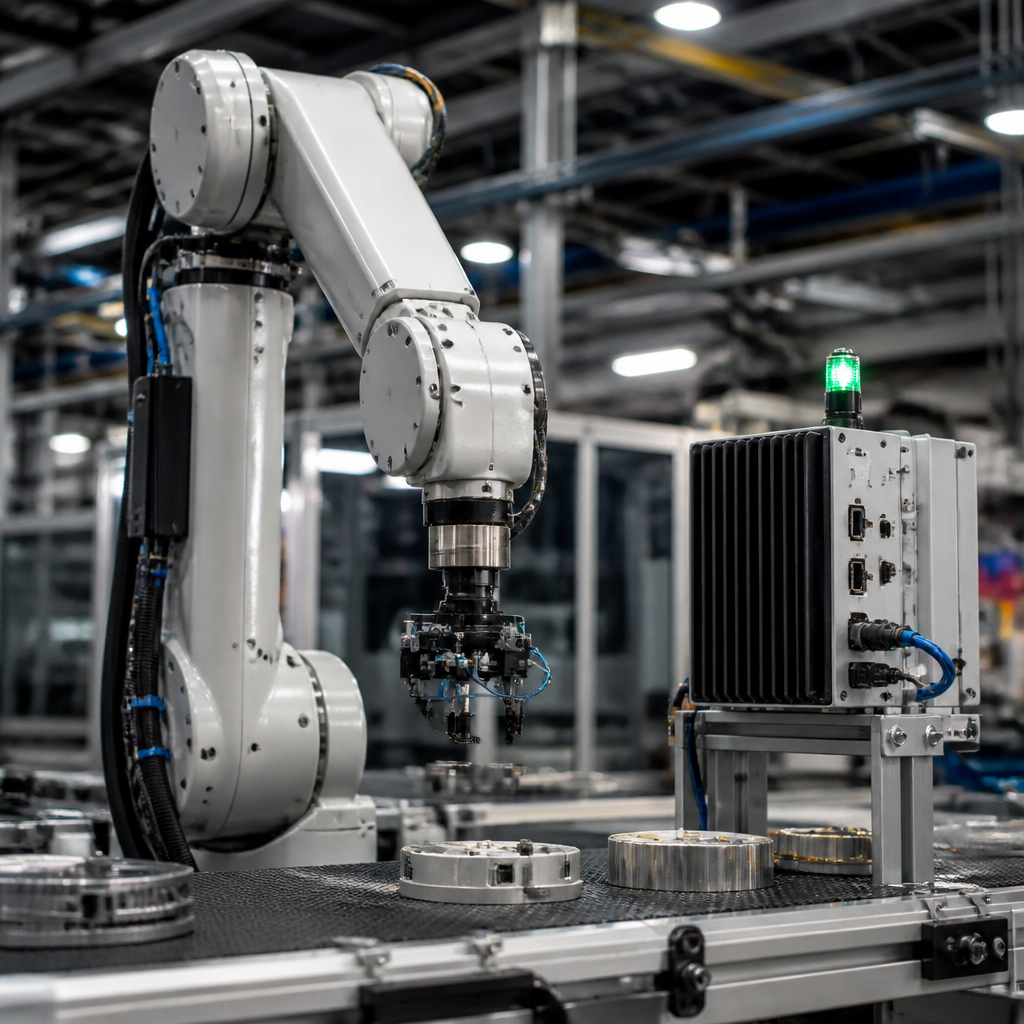
SiMa.ai is emerging as one of the most closely watched companies in AI compute and semiconductors because it targets a problem many industrial teams still struggle to solve: how to run advanced machine learning at the edge without the power draw, latency, and integration burden of data center hardware. In practical terms, edge AI means deploying models directly on devices such as factory cameras, robotics controllers, medical imaging systems, smart transportation units, and defense platforms rather than sending every frame or signal to the cloud for inference. AI compute refers to the processors, accelerators, memory architecture, and software stack that make those inferences possible. Semiconductors are the physical chips at the center of that stack, but in industrial deployments, the chip alone never determines success. What matters is whether a platform can deliver deterministic performance, low power consumption, thermal efficiency, long lifecycle support, and software tools that engineers can actually use in production. That is where SiMa.ai has positioned itself.
I have worked with edge inference programs where a technically impressive accelerator failed because it needed too much cooling, required custom model rewrites, or could not coexist with existing PLC, sensor, and vision pipelines. Industrial buyers do not evaluate silicon the same way hyperscalers do. They care about watts per frame, bill of materials, functional safety pathways, and whether a system integrator can maintain the platform five years from now. SiMa.ai matters in this context because it presents a full-stack approach built around machine learning system-on-chip design for embedded and industrial environments. As a hub within AI compute and semiconductors, this article explains what SiMa.ai does, why its architecture matters, how it fits into the broader chip landscape, and what readers should examine next across this subtopic.
At its core, SiMa.ai develops purpose-built hardware and software for machine learning at the edge. Its flagship positioning centers on enabling computer vision and multimodal inference in power-constrained devices. The company is often discussed alongside other edge AI silicon vendors, but its real differentiator is the attempt to bridge high efficiency with practical deployment tooling. For manufacturers, OEMs, and product teams researching AI compute and semiconductors, SiMa.ai is useful as a case study in how the market is moving beyond raw TOPS marketing toward measurable system-level performance.
What SiMa.ai Builds and Why Industrial Edge AI Needs It
SiMa.ai is best known for its machine learning system-on-chip platform designed for embedded edge workloads, especially vision-heavy use cases such as defect detection, object tracking, safety monitoring, and automated inspection. In these environments, sending data to a cloud endpoint is often too slow, too expensive, or operationally impossible. A production line camera cannot wait hundreds of milliseconds for a remote model to decide whether a component passes quality standards. A mobile robot navigating a warehouse cannot rely on unstable connectivity to avoid collisions. Industrial edge AI therefore demands local inference with predictable latency.
The company’s value proposition centers on achieving that local inference efficiently. Industrial devices typically run inside tight thermal envelopes, sometimes fanless, often in sealed enclosures, and frequently in harsh conditions with vibration, dust, or temperature variation. Traditional GPU-based approaches can work, but they are often overprovisioned for these edge scenarios and may increase power and cooling requirements. SiMa.ai instead focuses on an architecture intended to deliver strong inference throughput at lower power. That matters because reducing energy consumption also reduces enclosure complexity, reliability risks, and total system cost.
Another important point is software accessibility. In industrial AI, many projects stall not because the model is poor but because deployment is too brittle. SiMa.ai has emphasized an integrated software environment so teams can take models from common frameworks and map them to its hardware more directly. That is essential in markets where engineering teams are small and productization timelines are unforgiving.
How SiMa.ai Fits Into the AI Compute and Semiconductors Landscape
AI compute and semiconductors now span several categories: general-purpose CPUs, GPUs, FPGAs, neural processing units, application-specific accelerators, and increasingly heterogeneous SoCs that combine multiple processing blocks. SiMa.ai sits in the edge accelerator segment, where efficiency and workload specialization often matter more than maximum raw throughput. Its direct competitive context includes companies such as NVIDIA in edge modules, Qualcomm in embedded AI, Intel through Movidius and FPGA-related offerings, Hailo in low-power inference, and a wide set of startup accelerators targeting vision and sensor workloads.
The industrial market differs from the enterprise AI training market in one decisive way: inference dominates. Factories, transportation systems, agricultural machines, and medical devices generally do not train large models on-device. They run optimized models repeatedly, under strict latency and power constraints. This shifts the semiconductor design goal from peak parallel compute toward memory movement efficiency, scheduler design, model compiler quality, and sustained performance per watt. SiMa.ai’s relevance comes from addressing that exact optimization problem rather than chasing data center scale narratives.
As the hub page for this subtopic, it is helpful to frame SiMa.ai within broader themes readers should connect across related company spotlights: edge versus cloud inference, custom silicon versus programmable logic, software stack maturity, and vertical integration. When evaluating any AI chip vendor, including SiMa.ai, those are the four questions that determine whether a promising benchmark becomes a deployable product.
Architecture Priorities: Performance Per Watt, Latency, and System Integration
In real deployments, performance per watt is usually the first metric that matters. Vendors often promote tera operations per second, but industrial engineering teams should ask a narrower question: how much useful inference can the platform sustain for the target model within the available power budget? SiMa.ai has built its market identity around efficient machine learning acceleration, and that aligns with what edge buyers actually purchase. A camera appliance drawing modest power but classifying defects accurately at line speed is more valuable than a faster chip that forces a redesign of the thermal system.
Latency is equally important. In packaging lines, machine vision systems may need response times low enough to trigger reject mechanisms in real time. In autonomous mobile robots, perception delay directly affects stopping distance. SiMa.ai’s edge-oriented design aims to keep inference close to the sensor and avoid cloud round trips. That lowers latency and also improves privacy and uptime because critical decisions can continue even when connectivity drops.
System integration is the third priority and the one many semiconductor discussions neglect. Industrial devices require interfaces for cameras, sensors, networking, and control systems. They may need Linux-based application layers, containerized deployment, secure boot, device management, and compatibility with OpenCV, GStreamer, PyTorch, or ONNX workflows. SiMa.ai’s strategy makes sense because it does not treat the accelerator as an isolated component; it treats it as part of an operational edge platform.
| Evaluation factor | Why it matters for industrial edge AI | How SiMa.ai is typically positioned |
|---|---|---|
| Performance per watt | Determines cooling needs, enclosure design, and operating cost | Designed for efficient sustained inference in constrained devices |
| Latency | Supports real-time decisions for vision, robotics, and safety systems | Local inference reduces network dependence and delay |
| Software toolchain | Affects time to deployment and model portability | Emphasis on integrated developer workflow |
| System integration | Impacts compatibility with sensors, cameras, and control stacks | Positioned as a full edge platform, not only a chip |
| Lifecycle suitability | Industrial buyers need long support windows and reliability | Marketed toward embedded and OEM use cases |
Use Cases Where SiMa.ai Can Deliver Clear Value
The strongest use cases for SiMa.ai are applications where vision inference is continuous, local, and power-sensitive. Automated optical inspection is a clear example. A manufacturer inspecting solder joints, labels, or machined surfaces needs high frame-rate analysis close to the production line. If every image had to travel to a server, the system would introduce bottlenecks and possible failure points. Running inference on-device enables faster pass-fail decisions and lower network load.
Robotics is another natural fit. Warehouse robots, collaborative arms, and autonomous guided vehicles increasingly combine cameras with neural models for navigation, pick verification, and worker safety. These systems benefit from compact AI compute that can run reliably from limited onboard power. In my experience, robotics teams care less about headline benchmark wins than about whether a module can sustain perception workloads all shift long without thermal throttling. SiMa.ai’s positioning directly addresses that concern.
Smart transportation and defense-adjacent edge sensing also align with the platform. Roadside units, perimeter monitoring devices, and mobile surveillance systems often operate in environments where bandwidth is expensive or intermittent. Local inference lowers the volume of data that must be transmitted and allows systems to send alerts or metadata instead of raw video. Healthcare imaging at the edge is another possibility, particularly in portable or embedded devices where immediate analysis is useful but data handling must remain controlled.
What Buyers Should Verify Before Choosing Any Edge AI Semiconductor Platform
SiMa.ai is promising, but no edge AI semiconductor should be selected from marketing claims alone. Buyers should validate model compatibility first. Many vendors support standard frameworks, yet specific operators, quantization approaches, and preprocessing pipelines can still create friction. Run representative models, not demo networks. Measure accuracy retention after compilation and optimization.
Second, test sustained behavior under realistic thermal and workload conditions. A chip may look strong in short benchmarks but degrade inside a sealed industrial enclosure at ambient temperatures common on factory floors. Third, inspect software maturity. Good edge AI platforms provide compilers, profiling tools, runtime monitoring, documentation, and clear support for secure deployment. Fourth, evaluate supply chain resilience and product longevity. Industrial OEMs cannot redesign every year, so roadmap stability matters almost as much as technical elegance.
For readers exploring the wider AI compute and semiconductors category, SiMa.ai represents a useful anchor company because it highlights the market’s central lesson: the future of edge AI belongs to platforms that combine efficient silicon, deployable software, and real industrial fit. Follow this company spotlight as a starting point, then compare adjacent vendors, architectures, and toolchains to build a sharper view of where edge inference is heading next.
Frequently Asked Questions
What does SiMa.ai actually do, and why is it getting so much attention in edge AI?
SiMa.ai develops machine learning compute platforms designed specifically for edge deployments, where AI models need to run directly on devices rather than being sent back to a cloud or centralized data center. That matters because many industrial environments cannot tolerate the delay, bandwidth dependency, or power consumption that comes with traditional server-based AI infrastructure. In settings such as factory automation, machine vision, robotics, transportation systems, medical devices, and defense hardware, decisions often need to happen in real time and on-site.
The reason SiMa.ai is drawing attention is that it focuses on a practical gap in the market. A great deal of AI innovation has historically been optimized for hyperscale cloud environments, but industrial teams have very different requirements. They need hardware that can operate within tight thermal and power envelopes, fit inside ruggedized systems, handle multiple sensor inputs, and still deliver strong inference performance for computer vision and other machine learning workloads. SiMa.ai’s value proposition is centered on making that tradeoff more achievable by combining efficient silicon, edge-oriented architecture, and software intended to simplify deployment. For companies trying to bring AI into real-world equipment instead of server racks, that is a highly relevant proposition.
Why is edge AI so important for industrial devices compared with running AI in the cloud?
Edge AI is important because industrial systems often operate under constraints that make cloud dependence impractical or risky. In a factory, for example, a vision system inspecting parts on a production line may need to identify defects in milliseconds. In autonomous or semi-autonomous robots, delayed inference can reduce safety and performance. In medical imaging or transportation systems, connectivity may be limited, intermittent, or simply too slow for time-sensitive decisions. By running AI models directly on the device, organizations can reduce latency, improve system responsiveness, and avoid disruptions caused by unreliable network connections.
There are also cost, privacy, and operational benefits. Sending large volumes of sensor or video data to the cloud can become expensive and difficult to scale, especially when multiple high-resolution cameras or other data-heavy instruments are involved. Keeping inference local reduces bandwidth usage and can make deployments more predictable financially. It can also help with privacy and data governance, since sensitive operational or imaging data does not always need to leave the device or facility. For industrial organizations, edge AI is not just a technical preference; in many cases, it is the only realistic way to make advanced machine learning usable within the physical, economic, and regulatory conditions of the field.
What kinds of industrial applications are a good fit for SiMa.ai’s edge AI approach?
SiMa.ai’s approach is especially well suited to applications that combine real-time decision-making, constrained power budgets, and demanding deployment environments. One of the clearest examples is machine vision in manufacturing, where cameras are used for inspection, classification, defect detection, worker safety monitoring, and process optimization. These systems often need to analyze video streams locally with minimal delay, and they may be deployed across many production lines where efficiency and ease of integration matter.
Robotics is another strong fit. Industrial and collaborative robots increasingly rely on AI for navigation, object recognition, motion planning support, and adaptive behavior. In these use cases, processing needs to happen close to the machine to maintain responsiveness and avoid the risks of round-trip cloud latency. Similar logic applies in transportation, where roadside infrastructure, fleet systems, and onboard intelligence may need to interpret sensor data in real time. Medical imaging systems can also benefit when AI-assisted analysis must happen at the point of care without introducing major power or cooling demands. Defense and aerospace platforms are another natural match because they frequently operate in disconnected or contested environments where cloud connectivity cannot be assumed. Across all of these segments, the common thread is the need for efficient, embedded AI compute that works reliably in the field.
How does SiMa.ai help address power, latency, and integration challenges in edge deployments?
At the edge, performance alone is not enough. A device may need to fit inside a compact enclosure, operate without active cooling, run continuously for long periods, and coexist with other industrial electronics. That is why power efficiency is such a central issue. SiMa.ai’s strategy is built around delivering machine learning acceleration in a way that is better aligned with the realities of embedded and industrial systems than general-purpose data center hardware would be. Lower power draw can translate into easier thermal design, smaller system footprints, and lower total operating costs, all of which are major advantages for OEMs and equipment manufacturers.
Latency is addressed by keeping inference local. Instead of transmitting raw sensor data to a remote server, the device can process inputs on-site and act immediately. This is critical for use cases like visual inspection, anomaly detection, robotics control, and safety systems. Integration is the third major challenge, and it is often underestimated. Many industrial teams do not simply need a powerful chip; they need a hardware and software stack they can realistically incorporate into products and workflows. A platform like SiMa.ai is attractive when it offers tooling, model support, and deployment pathways that reduce engineering friction. In other words, the appeal is not just in raw compute capability, but in helping bridge the gap between AI prototypes and production-ready embedded systems.
What should companies evaluate before adopting SiMa.ai or any edge AI platform for industrial use?
Organizations should start by defining the actual operational problem they want AI to solve. That includes understanding the model types involved, the sensor inputs required, the response time the application demands, and the environmental constraints of the target device. A factory camera performing defect detection has different needs than a mobile robot, a smart traffic unit, or a medical imaging appliance. Evaluating an edge AI platform should therefore include not only performance benchmarks, but also power consumption, thermal behavior, physical integration, supported frameworks, software maturity, security, and lifecycle support.
It is also important to assess deployment complexity. Companies should ask how easy it is to move from trained models to production inference, whether the platform supports the models and toolchains their teams already use, and how well it fits into existing embedded architectures. Long-term maintainability matters just as much as initial performance. Industrial products often stay in service for years, so buyers need confidence in roadmap stability, vendor support, update processes, and ecosystem compatibility. For many teams, the best choice will be the platform that delivers not just impressive technical specs, but a practical path to scalable deployment across fleets of devices. That is precisely why companies like SiMa.ai are being watched so closely: they are competing on the ability to make edge AI genuinely deployable in the real world, not just theoretically powerful in a lab.