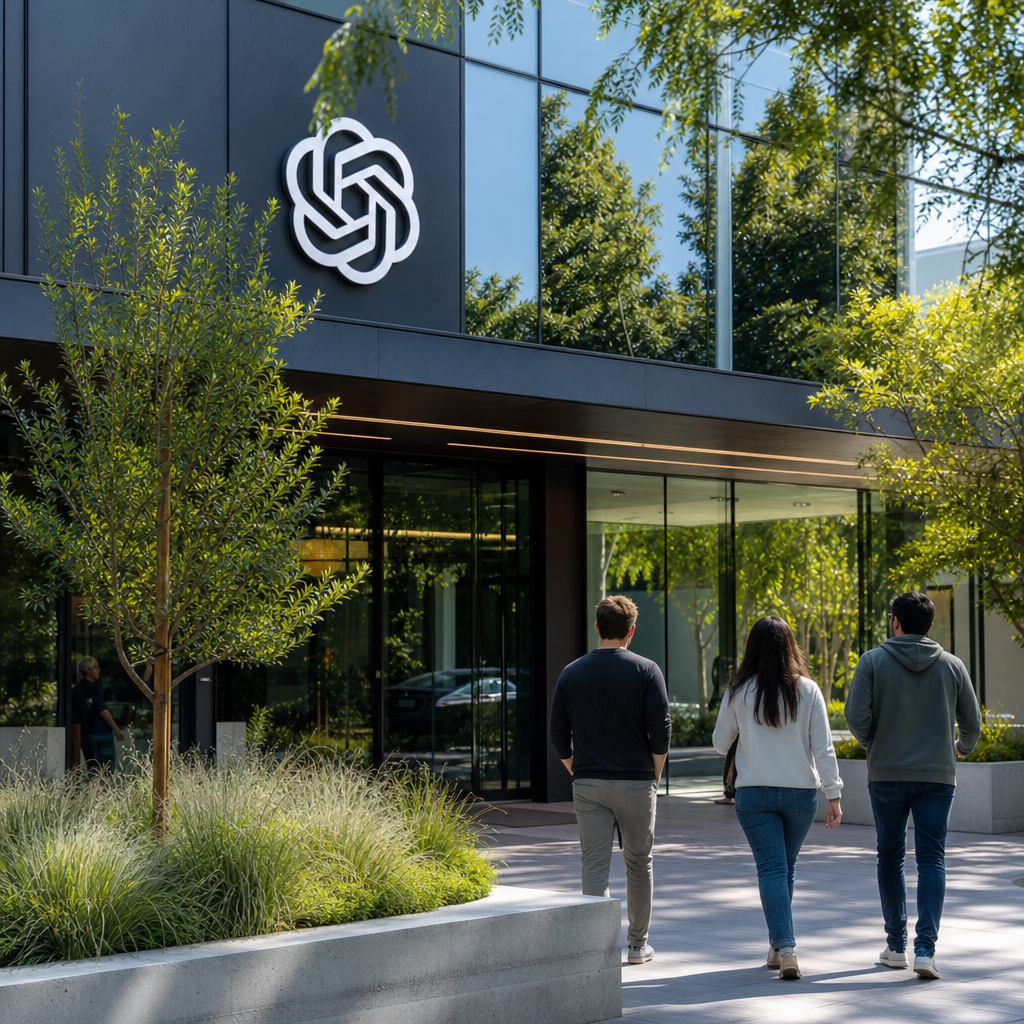
OpenAI represents a defining example of how Silicon Valley turns ambitious research into products that reshape daily work, education, and software development. In the broad landscape of tech innovators and market leaders, the company stands out because it combines frontier artificial intelligence research with consumer-scale deployment, enterprise partnerships, and a public conversation about safety. For readers exploring company spotlights, OpenAI is an essential hub topic because it connects several major themes at once: innovation strategy, product-market fit, platform economics, research commercialization, and governance under public scrutiny.
When people describe OpenAI as innovative, they usually mean more than inventing impressive models. Innovation in this context includes building large language models, translating them into accessible tools such as ChatGPT, creating APIs that developers can integrate into products, and iterating fast enough to respond to user behavior in real time. In Silicon Valley terms, that is the full stack of innovation: research, infrastructure, distribution, monetization, and ecosystem development. I have worked on AI content and product positioning projects close to this cycle, and the pattern is clear: companies lead markets not simply by launching breakthrough technology, but by making that technology reliable, understandable, and useful at scale.
OpenAI matters because it has helped move generative AI from a specialist field into mainstream business decision-making. Boards now ask how AI can improve service operations, software teams rely on AI-assisted coding, and educators debate how language models should be used responsibly. The company also matters because it illustrates the tension at the center of modern Silicon Valley: speed versus safety, openness versus control, and mission versus commercial pressure. Understanding OpenAI therefore helps readers understand the broader category of tech innovators and market leaders, including how category leaders establish trust, create standards, and influence adjacent industries.
From Research Lab to Market-Shaping Company
OpenAI began as a research organization focused on advancing artificial intelligence, but its market significance grew when it paired research milestones with practical product delivery. That evolution matters. Many AI labs publish important papers; far fewer build a direct channel to hundreds of millions of users. The release of GPT-based systems, followed by ChatGPT, changed expectations for how quickly a company could take a model from technical demonstration to global adoption. In plain terms, OpenAI did not just prove that generative AI worked. It proved that people would use it daily for writing, coding, brainstorming, summarizing, and search-like tasks.
Its rise also reflects a familiar Silicon Valley pattern: start with a breakthrough capability, then expand through platform effects. Once a flagship product earns user attention, the next move is usually to support developers, enterprise teams, and strategic partners. OpenAI followed that path with API access, business offerings, and integrations into widely used software. This matters for market leadership because platforms become more durable than standalone applications. A single chatbot can attract headlines; a developer platform creates recurring demand and embeds the company inside other products.
Another reason OpenAI became a market shaper is timing. Cloud infrastructure, transformer architectures, and a mature startup ecosystem were already in place when generative AI reached inflection. Silicon Valley rewarded the company not only for invention but for execution in that moment. That combination explains why OpenAI belongs at the center of any discussion about company spotlights in technology.
How OpenAI Innovates in Practice
OpenAI’s innovative spirit is best understood through its operating model. The company invests heavily in model training, evaluation, and reinforcement learning, but the real advantage comes from turning user interaction into product insight. Every high-growth technology company in Silicon Valley learns from usage data; OpenAI does this in a domain where quality, factuality, latency, and safety all affect adoption. In practice, that means shipping model improvements, expanding multimodal capabilities, refining system behavior, and improving reliability for developers who depend on predictable outputs.
The company also innovates by reducing friction. ChatGPT gave nontechnical users a conversational interface instead of a command line or research paper. APIs gave technical teams structured access without requiring them to train their own frontier models. Enterprise offerings addressed compliance, administrative controls, and procurement concerns that often block adoption inside large organizations. That is a textbook example of market leadership: remove barriers at each layer of the customer journey.
| Innovation Layer | What OpenAI Built | Why It Matters in the Market |
|---|---|---|
| Research | Large language and multimodal models | Creates technical differentiation and performance gains |
| Product | ChatGPT and related user tools | Turns AI capability into mainstream daily usage |
| Platform | APIs for text, image, audio, and automation tasks | Lets other companies build on OpenAI infrastructure |
| Enterprise | Business controls, integrations, and security features | Supports procurement, governance, and scaled deployment |
Real-world examples make this clearer. A customer support team can use OpenAI-powered workflows to draft responses, classify tickets, and summarize case histories for agents. A software company can use coding assistance to speed up documentation and routine development tasks. A marketing team can generate first drafts, adapt copy for different audiences, and analyze large feedback sets. These use cases are not abstract. They are exactly how market leaders gain influence: by becoming useful across departments rather than solving only one niche problem.
Silicon Valley Context: Why OpenAI Became a Leader
Silicon Valley rewards companies that combine technical depth with narrative clarity, and OpenAI has done both. It operates in an environment shaped by venture capital expectations, hyperscale cloud partnerships, elite engineering talent, and aggressive competition. In that environment, a company becomes a leader by making itself the default reference point for a category. OpenAI achieved that status when “generative AI” became synonymous, for many users, with trying ChatGPT first.
Partnership strategy played a major role. Access to large-scale compute is essential for frontier model development, and deep alliances with cloud providers can compress years of infrastructure work into months. This is one of the less glamorous but most decisive facts about AI leadership: training and serving advanced models require capital, chips, networking, storage, and optimization expertise at extraordinary scale. Companies that solve the infrastructure equation gain a compounding advantage in experimentation and deployment.
OpenAI also benefited from strong distribution loops. Users shared outputs on social platforms, media outlets amplified both breakthroughs and controversies, and businesses rushed to test internal use cases. That combination created a feedback engine few firms could match. However, leadership in Silicon Valley is never permanent. Competitors from startup labs to major technology platforms continue to push open-weight models, enterprise AI suites, and specialized copilots. OpenAI’s position therefore depends on sustained execution, not early momentum alone.
Strengths, Tradeoffs, and the Governance Question
No serious company spotlight on OpenAI is complete without addressing tradeoffs. The company’s strengths are obvious: advanced models, product reach, developer mindshare, and a powerful brand. Yet the same scale that creates influence also increases scrutiny. Questions about model hallucinations, bias, copyright, security, energy use, and labor associated with data operations are not side issues. They are central to whether AI companies can keep public trust while expanding into sensitive workflows.
From direct experience advising teams on AI adoption, I have seen the same pattern repeatedly: decision-makers are enthusiastic until they confront reliability thresholds. A model that is helpful 80 percent of the time may still be unusable in regulated environments unless there is human review, prompt discipline, audit logging, and clear escalation paths. OpenAI has responded with stronger controls, documentation, and enterprise features, but limitations remain inherent to probabilistic systems. That is why responsible implementation matters more than marketing claims.
Governance has also shaped public perception of OpenAI in unusual ways. Leadership changes and board-level disputes drew intense attention because they raised a larger Silicon Valley question: how should an AI company balance mission commitments with commercial realities? There is no easy answer. What is clear is that governance is now part of product strategy. Customers want continuity, regulators want accountability, and partners want assurance that roadmaps will remain stable.
What Businesses and Readers Should Watch Next
For businesses evaluating tech innovators and market leaders, OpenAI is important not just for what it has launched, but for what it signals about the future of software. First, expect AI to become a native layer inside productivity, customer service, analytics, and development tools. Second, expect competition to shift from model novelty to workflow reliability, proprietary data integration, and measurable return on investment. Third, expect buyers to demand stronger security, governance, and evaluation standards before they expand AI into mission-critical operations.
Readers using this hub as a starting point should also watch adjacent themes that connect to OpenAI’s story: semiconductor supply constraints, cloud platform competition, AI regulation, model benchmarking, and enterprise change management. These topics explain why some innovators become enduring market leaders while others remain impressive but narrow players. OpenAI’s trajectory shows that breakthrough research is only the first chapter. Lasting influence comes from adoption, integration, trust, and the ability to keep improving under pressure.
The innovative spirit of OpenAI in Silicon Valley is ultimately the story of converting advanced AI research into broad economic and cultural impact. The company has set the pace for generative AI by pairing technical ambition with accessible products, developer tools, and enterprise pathways. It also reveals the real conditions of market leadership: infrastructure scale, fast iteration, ecosystem reach, and credible governance. For anyone following company spotlights, OpenAI is a core case study because it links invention to adoption more clearly than almost any other modern technology firm.
The key takeaway is practical. Study OpenAI not as an isolated phenomenon, but as a model for how tech innovators and market leaders emerge, scale, and face accountability. Its success shows the value of shipping useful products from deep research; its challenges show why trust and controls matter just as much as model performance. Use this hub as your foundation, then explore related company profiles and AI market analyses to understand where the next wave of leadership will come from.
Frequently Asked Questions
What makes OpenAI a standout example of Silicon Valley innovation?
OpenAI stands out because it reflects a core Silicon Valley pattern: taking advanced research and turning it into tools that reach millions of people. Many organizations do excellent research, and many companies build successful consumer products, but OpenAI has become especially notable for operating at both levels at once. It develops frontier artificial intelligence systems while also deploying them in ways that affect everyday work, education, coding, customer service, and content creation. That combination of scientific ambition and product execution is a major reason it is often discussed as a defining company in the modern technology landscape.
Another reason OpenAI is so influential is its ability to connect multiple parts of the innovation ecosystem. It is not just a lab, and it is not just a software vendor. It sits at the intersection of research, infrastructure, enterprise adoption, developer platforms, and public policy debate. In Silicon Valley terms, that makes it a hub company: one that shapes not only what products people use, but also how founders, investors, engineers, and business leaders think about the next wave of technology. Its work helps set expectations for what AI can do, how quickly it can improve, and what kinds of business models can emerge around it.
OpenAI also represents the region’s long-standing belief that major technical breakthroughs can move from niche expertise to mainstream utility very quickly. Tools powered by large language models and multimodal AI have gone from research demos to business-critical systems in a relatively short period of time. That speed is a hallmark of Silicon Valley’s culture of iteration, experimentation, and scale. OpenAI’s visibility in both consumer and enterprise markets makes it one of the clearest examples of how that culture operates today.
How has OpenAI translated advanced AI research into products people use every day?
OpenAI has translated complex artificial intelligence research into practical products by focusing on interfaces, usability, and broad accessibility rather than limiting its work to academic publication alone. In simple terms, it has taken highly sophisticated model architectures and made them available through chat interfaces, APIs, and enterprise tools that non-specialists can actually use. That matters because a technology only becomes widely transformative when people can incorporate it into their existing workflows without needing a deep machine learning background.
For everyday users, this means AI systems that can help draft emails, summarize documents, explain difficult concepts, brainstorm ideas, generate code, and assist with research. For students and educators, it means tools that can support tutoring, writing feedback, language practice, and knowledge exploration. For developers, it means faster prototyping, code generation, debugging support, and easier access to machine intelligence through application programming interfaces. For companies, it means the ability to build customer support agents, internal knowledge assistants, workflow automation tools, and productivity features into existing software products.
The important point is that OpenAI has helped normalize AI as a utility layer rather than a specialized lab capability. By packaging advanced models into accessible products and platforms, it has accelerated AI adoption across a wide range of industries. This is one of the reasons the company is so central to discussions about the future of work and software development. Its products do not just demonstrate technical possibility; they change behavior by becoming part of daily routines.
Why is OpenAI important in conversations about the future of work, education, and software development?
OpenAI is important in these conversations because its technology touches all three areas in practical, visible ways. In the workplace, AI systems can automate repetitive tasks, speed up communication, assist with analysis, and support decision-making. That does not mean human expertise disappears. More often, it means workers can shift time away from routine drafting and information retrieval toward judgment, collaboration, and strategy. As a result, OpenAI is frequently discussed not just as a technology company, but as a force influencing productivity, job design, and the structure of knowledge work.
In education, OpenAI’s relevance comes from its ability to personalize explanation and feedback at scale. AI tools can adapt to different learning levels, answer follow-up questions, clarify difficult material, and provide instant assistance in ways that traditional static resources cannot. At the same time, these capabilities raise important questions about academic integrity, critical thinking, and the role of teachers in an AI-supported environment. That tension is precisely why OpenAI remains central to education debates: its systems offer real benefits while also forcing institutions to rethink how learning is assessed and supported.
In software development, OpenAI has had an especially direct impact because developers can use AI both as an end-user tool and as a platform component. Engineers can rely on AI for coding assistance, documentation, testing support, and faster iteration, while product teams can also embed AI into the applications they build for customers. This dual role makes OpenAI unusually significant. It influences how software gets created and what modern software is expected to do. In Silicon Valley, companies that reshape both production and product design tend to have an outsized impact, and OpenAI fits that pattern closely.
How do enterprise partnerships and large-scale deployment strengthen OpenAI’s position in the tech industry?
Enterprise partnerships and large-scale deployment are critical because they move OpenAI beyond the category of an exciting research brand and into the category of a durable platform company. In the technology industry, long-term influence often depends on whether a company can integrate its innovations into real business operations at scale. OpenAI’s partnerships with major enterprises, software providers, and developers help demonstrate that its models are not just impressive in theory, but useful in production environments where reliability, security, compliance, and measurable business value matter.
These partnerships also expand OpenAI’s reach across sectors such as finance, healthcare, education, customer support, media, and software infrastructure. When enterprises adopt AI capabilities through APIs, embedded tools, or strategic integrations, OpenAI becomes part of larger digital ecosystems. That is an important milestone in Silicon Valley growth cycles. It shows a company is shaping industry standards, influencing how other products are designed, and becoming foundational to broader technology stacks rather than operating as a standalone application.
Large-scale deployment further strengthens OpenAI by creating continuous feedback loops. Consumer usage reveals how people naturally interact with AI, while enterprise usage reveals what organizations need in terms of trust, governance, and operational control. Those lessons can inform model improvements, product design, and safety policies. In effect, scale becomes a strategic advantage. It allows OpenAI to learn quickly, refine capabilities, and remain highly visible in a market where leadership depends on both technical progress and real-world adoption.
Why is safety and public discussion such an important part of OpenAI’s identity?
Safety and public discussion are central to OpenAI’s identity because artificial intelligence is not just another software category. It raises broad questions about accuracy, bias, misuse, transparency, labor disruption, security, and the social effects of automation. A company developing powerful AI systems cannot operate only as a conventional product builder without engaging those concerns. OpenAI has become especially visible because it sits at the point where advanced capabilities meet mass adoption, which means its choices are closely watched by policymakers, researchers, businesses, educators, and the public.
This public-facing safety emphasis also reflects a larger Silicon Valley shift. Earlier eras of consumer technology often prioritized growth first and dealt with social consequences later. With AI, that approach is much harder to defend because the systems can influence communication, decision-making, and access to information at enormous scale. OpenAI’s role in the public conversation signals that leading AI companies are expected to address not only performance, but also deployment risks, safeguards, and responsible use. Whether one sees those efforts as fully sufficient or still evolving, the fact that they are central to the company’s public identity is itself significant.
For readers exploring OpenAI as a company spotlight, this safety dimension is one of the key reasons it matters beyond pure market success. The company represents a model of innovation where research, commercialization, and governance questions are deeply intertwined. That makes OpenAI an essential case study in how Silicon Valley is adapting to technologies that are powerful, widely accessible, and socially consequential all at once.