
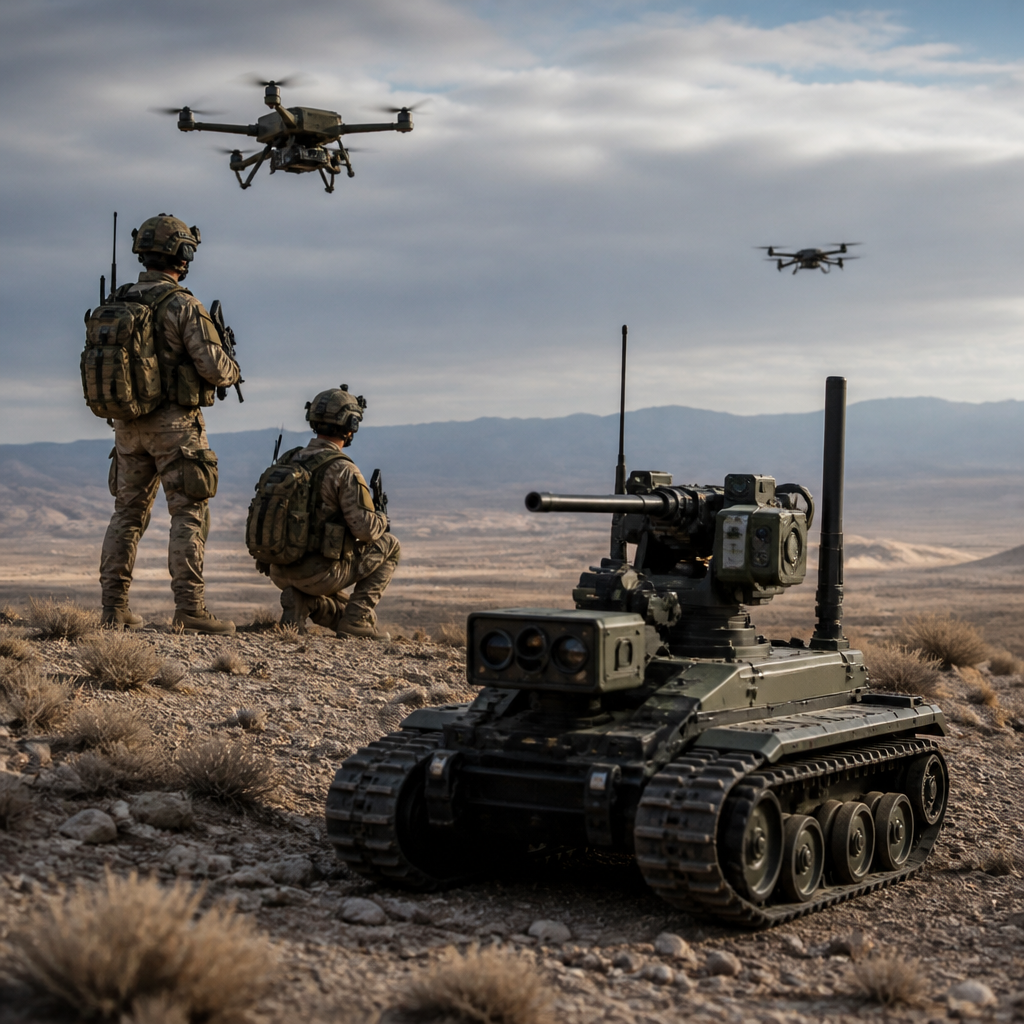
Autonomous systems for defense combine artificial intelligence, uncrewed aerial vehicles, ground and maritime robots, secure communications, and human command into operational tools that can sense, decide, and act with varying levels of independence. In defense practice, autonomy does not mean a machine is simply turned loose; it means software handles defined tasks such as navigation, target recognition, route planning, electronic surveillance, or logistics while human operators set objectives, constraints, and rules of engagement. I have worked with defense innovation teams evaluating these systems, and the most important distinction is between automation, which follows fixed rules, and autonomy, which adapts to changing conditions using perception models, probabilistic reasoning, and onboard computing.
This convergence matters because modern militaries face simultaneous pressures: contested airspace, tighter personnel pipelines, rising sensor volumes, and the need to operate faster than traditional command cycles allow. A single surveillance mission may involve satellite imagery, drone video, radar tracks, acoustic data, and cyber indicators arriving in seconds. Human analysts alone cannot triage everything in time. Autonomous systems compress that burden by fusing data, flagging anomalies, and handling repetitive or dangerous tasks. They also extend reach. A relatively small unit can deploy loitering munitions, counter-drone sensors, robotic resupply vehicles, and maritime surface drones to cover more terrain and react more quickly than legacy force structures.
For readers following space and defense tech, this subject sits at the center of current investment, procurement, and startup activity. Governments are funding autonomy stacks, edge processors, resilient positioning systems, and dual-use platforms that can move from commercial inspection to military reconnaissance with modifications. Prime contractors are integrating software-defined mission systems into aircraft, ships, and vehicles. Startups are filling gaps in navigation without GPS, swarm coordination, synthetic training data, and low-cost attritable drones. Understanding how AI, drones, and robotics converge is essential to understanding where defense technology is heading, what problems it can realistically solve, and where its limits still demand human judgment.
The Core Stack Behind Autonomous Defense Systems
Every autonomous defense system rests on a stack of interdependent technologies. The first layer is sensing: electro-optical cameras, infrared imagers, lidar, synthetic aperture radar, passive radio frequency detectors, sonar, and inertial measurement units. The second layer is perception, where machine learning models classify objects, estimate motion, map terrain, and identify patterns such as unusual vessel behavior or a vehicle concealed under camouflage netting. The third layer is planning and control, which translates mission goals into routes, avoidance maneuvers, search patterns, or task allocations across multiple platforms. The fourth layer is communications, including data links, mesh networking, and satellite connections that keep humans and machines synchronized even when bandwidth degrades.
Edge computing is the practical enabler. In fielded conditions, systems cannot rely on constant cloud access. They need graphics processing units, field-programmable gate arrays, or specialized AI accelerators onboard to process sensor data in real time. NVIDIA Jetson modules appear in many prototypes, while military programs often harden compute packages for heat, vibration, and electromagnetic stress. The software layer usually combines classical robotics tools such as simultaneous localization and mapping, Kalman filtering, and model predictive control with machine learning for detection and prioritization. This hybrid approach is more reliable than using a neural network for every problem because deterministic methods still outperform learned models in some navigation and safety functions.
Cybersecurity and resilience are not add-ons. Any autonomous platform is only as trustworthy as its ability to resist spoofing, jamming, model drift, and supply chain compromise. That is why defense programs increasingly require zero-trust architectures, signed software updates, hardware roots of trust, and fallback modes when sensors fail or communications are denied. The most credible systems degrade gracefully. If GPS is jammed, they switch to visual odometry, inertial navigation, terrain matching, celestial cues, or signals of opportunity. If video links are cut, they continue a bounded mission, return to base, or hold position based on commander-defined logic.
How AI Changes the Role of Drones and Robots
AI turns drones and robots from remote-controlled tools into adaptive teammates. In a basic remotely piloted aircraft, the operator handles steering, sensor pointing, and observation. In an autonomous drone, the software can maintain altitude, avoid obstacles, geofence itself, classify objects, and suggest or execute route changes based on weather, threats, or mission priorities. That shift reduces cognitive load and lets one operator supervise multiple assets. It also shortens the sensor-to-decision timeline. Instead of streaming hours of video to analysts, the platform can transmit alerts, cropped detections, and confidence scores.
Real-world examples show the progression. Ukraine has demonstrated how low-cost drones integrated with AI-assisted targeting, mapping, and battle damage assessment can alter battlefield economics. The U.S. Department of Defense’s Replicator initiative reflects a similar logic: field larger numbers of autonomous systems quickly to create mass and complicate adversary defenses. At sea, uncrewed surface vessels developed by companies such as Saildrone and programs under the U.S. Navy use autonomy for long-duration surveillance, collecting radar and maritime domain awareness data at lower operating cost than crewed patrol assets. On land, robotic mules and autonomous resupply vehicles are being tested to move ammunition and medical supplies across dangerous routes where convoys would be exposed.
The convergence is especially powerful when platforms collaborate. A satellite may cue a high-altitude drone to inspect a sector. That drone may hand off coordinates to a quadcopter for close confirmation. A ground robot may then investigate a tunnel entrance or deliver a sensor package. The common value is not any single machine; it is the mission network linking sensors, analytics, and effectors. Defense organizations that understand this design principle procure differently. They prioritize open architectures, modular payloads, and interoperable command software over exquisite standalone platforms that cannot share data efficiently.
Key Use Cases Across Air, Land, Sea, and Space
The strongest use cases are those where autonomy improves persistence, safety, speed, or affordability. Intelligence, surveillance, and reconnaissance remains the leading category because machines are well suited to repetitive observation. Border monitoring, base security, anti-submarine tracking, explosive ordnance disposal, contested logistics, and infrastructure inspection are close behind. In space and defense tech, autonomy also matters above the atmosphere. Satellites increasingly use onboard AI for anomaly detection, image triage, collision avoidance support, and dynamic tasking, reducing downlink burden and accelerating response.
| Domain | Typical autonomous system | Primary mission value | Example |
|---|---|---|---|
| Air | ISR drone or loitering munition | Fast sensing and precision reach | Autonomous route replanning around jamming |
| Land | UGV for resupply or EOD | Reduces soldier exposure | Robot clearing a suspected explosive route |
| Sea | Uncrewed surface or undersea vessel | Persistent maritime surveillance | Months-long ocean patrol with remote oversight |
| Space | AI-enabled satellite operations | Faster imagery triage and tasking | Onboard filtering of disaster or threat imagery |
Counter-drone defense is another major growth area. Autonomous detection systems fuse radar, RF sensing, electro-optical tracking, and acoustic signatures to identify small drones that are difficult to spot with any one sensor alone. The response may involve jamming, protocol takeover, interceptor drones, or directed energy in advanced programs. Here, speed is everything. A human-in-the-loop still authorizes actions, but AI handles classification and track management at machine tempo. That is a pattern across defense autonomy: the best systems elevate human decision quality by removing delay and information overload.
Constraints, Ethics, and What Comes Next
Autonomous defense systems are not magic, and the hardest problems are not only technical. Reliability varies with weather, clutter, camouflage, and adversary adaptation. A model trained on clear desert imagery may degrade in urban canyons or dense forest. Communications remain fragile in electronic warfare environments. Formal verification is limited for complex learning systems, which is why militaries rely on extensive test and evaluation, red teaming, simulation, and constrained operating envelopes. Standards from NATO, the U.S. Department of Defense, and national safety authorities increasingly emphasize traceability, human oversight, and fail-safe behavior rather than unchecked autonomy.
The ethical and legal debate is equally important. Questions about accountability, distinction, proportionality, and meaningful human control are not abstract policy issues; they shape acquisition requirements and export controls today. In practice, responsible programs separate functions carefully. Navigation, sensing, and defensive maneuvering may be highly automated, while target engagement decisions remain subject to explicit authorization and auditable logs. Startups entering this market need to understand these guardrails early, along with procurement realities such as Authority to Operate, classified integration, and long validation cycles.
For the broader space and defense tech ecosystem, the clear takeaway is that convergence is now the operating model. Winning systems combine AI, robotics, resilient communications, and mission software into scalable networks rather than isolated hardware products. The commercial spillover is significant: autonomy developed for defense often improves industrial inspection, disaster response, offshore monitoring, and emergency logistics. If you are building, investing in, or tracking this market, focus on platforms that can operate with degraded connectivity, integrate with existing command systems, and prove performance in realistic field conditions. That is where durable value will be created, and it is the right starting point for exploring the rest of this hub on space and defense tech.
Frequently Asked Questions
What are autonomous systems in defense, and how do AI, drones, and robotics work together?
Autonomous systems in defense are integrated military technologies that can perceive their environment, process information, and carry out defined actions with limited or structured human input. In practice, this convergence happens when artificial intelligence provides the software “brain,” drones and other uncrewed vehicles provide mobility and sensing, and robotics supplies the physical ability to move, manipulate, monitor, or deliver payloads across air, land, and sea. Rather than being a single machine, an autonomous defense system is often a networked combination of platforms, sensors, communications links, and command tools working together toward a mission objective.
AI plays a central role by handling tasks such as image recognition, object detection, route optimization, anomaly detection, electronic surveillance analysis, and decision support. Drones extend reach into contested or dangerous spaces, giving forces a way to scout, relay communications, track movement, or deliver supplies without putting personnel directly at risk. Ground robots can inspect hazardous areas, support perimeter security, or carry equipment, while maritime autonomous systems can patrol coastlines, monitor shipping lanes, or assist in mine countermeasures. Secure communications and battle management systems tie these assets together so data gathered by one platform can inform the actions of another, all while staying aligned with commander intent.
The most important point is that autonomy in defense is usually task-specific. A platform may navigate on its own, avoid obstacles, maintain formation, or flag potential threats, but those functions exist inside a broader operational framework established by human leadership. That is what makes modern autonomous defense systems so significant: they combine machine speed, persistence, and precision with human judgment, operational oversight, and mission-level control.
Does autonomy in defense mean humans are removed from decision-making?
No. In responsible defense applications, autonomy does not mean humans disappear from the process. It means certain functions are delegated to software and machines so forces can operate faster, more safely, and at greater scale. Human operators and commanders still define objectives, set rules of engagement, establish mission constraints, approve authorities, interpret context, and decide how autonomous tools should be used. The machine may execute a route, classify terrain, monitor a sensor feed, or recommend a course of action, but it does so within boundaries established by people.
This distinction matters because military environments are complex, ambiguous, and highly sensitive. AI can process large volumes of data far faster than a human analyst, but it does not replace command responsibility or legal accountability. In most realistic defense concepts, people remain “on the loop” or “in the loop” depending on the mission and the level of automation involved. For example, a drone might autonomously patrol a designated area and identify unusual movement, but a human operator may still review the alert, validate the information, and determine the appropriate response. Similarly, a logistics robot may independently deliver supplies across a base, yet the mission parameters, access permissions, and contingency actions are all set by human supervisors.
The broader goal is not to eliminate human decision-making but to improve it. Autonomy reduces workload, speeds up reaction time, and allows personnel to focus on high-value judgments instead of repetitive tasks. In defense, the strongest systems are usually those that combine machine efficiency with clear human command, transparent oversight, and well-defined operational limits.
What are the main defense applications for autonomous drones and robotic systems?
Autonomous drones and robotic platforms are used across a wide range of defense missions because they can extend awareness, improve survivability, and sustain operations in environments that are difficult, dangerous, or too resource-intensive for continuous human presence. One of the most common applications is intelligence, surveillance, and reconnaissance. Uncrewed aerial systems can monitor terrain, track movement, detect changes, and provide persistent overhead coverage, while AI helps process video, radar, thermal, and signals data in near real time. This gives commanders faster, more actionable situational awareness.
Another major application is force protection. Ground robots can patrol perimeters, inspect suspicious objects, map hazardous spaces, and support explosive ordnance disposal operations. Maritime autonomous systems can conduct coastal surveillance, anti-mine operations, or infrastructure monitoring around ports and sea lanes. In logistics, autonomous systems can transport ammunition, fuel, medical supplies, or equipment across complex terrain, reducing the exposure of personnel to ambushes, artillery, or other battlefield threats. Swarm-enabled systems are also being explored for distributed sensing, decoy operations, communications relay, and massed reconnaissance, where multiple low-cost platforms work together as a coordinated team.
Electronic warfare and communications support are growing use cases as well. Autonomous platforms can carry sensors that detect emissions, monitor spectrum activity, and help maintain communications in contested environments. Some systems serve as mobile nodes in a resilient network, passing information between units when traditional infrastructure is degraded. Across all of these applications, the value of autonomy lies in persistence, speed, and adaptability. Defense organizations are not just looking for machines that move without a driver; they are fielding systems that can sense, analyze, and perform mission-relevant functions while remaining under structured human direction.
What are the biggest benefits and challenges of autonomous systems for defense?
The benefits are substantial. Autonomous systems can increase operational tempo, reduce risk to personnel, extend surveillance coverage, and improve mission endurance. Machines do not fatigue in the same way people do, which makes them useful for long-duration monitoring, repetitive patrols, and data-heavy environments where continuous attention is difficult to sustain. AI-enabled systems can also process sensor inputs at a scale and speed no human team could match, helping military units detect threats earlier, respond more efficiently, and make better-informed decisions. In contested or remote areas, autonomous platforms can preserve combat power by taking on tasks that would otherwise expose service members to direct danger.
At the same time, the challenges are serious and cannot be treated as secondary. Reliability is one of the biggest concerns because defense systems must operate under electronic attack, GPS disruption, communications loss, harsh weather, and physical damage. AI models can produce false positives, miss important cues, or degrade when conditions differ from their training data. Cybersecurity is another major issue; if an adversary can jam, spoof, hack, or manipulate an autonomous system, the tactical consequences can be severe. Integration is also difficult, since defense organizations must connect new autonomous tools to existing command systems, doctrine, communications architectures, and maintenance pipelines.
There are also legal, ethical, and policy challenges. Militaries need clear rules governing accountability, human oversight, escalation control, and the acceptable use of machine decision-making in sensitive operations. Trust is equally important. Operators must understand what a system can do, where it performs well, and where it may fail. That is why successful adoption depends not only on the hardware or the AI model itself, but also on testing, verification, training, doctrine development, secure networking, and disciplined operational design. The promise of autonomy in defense is real, but it delivers lasting value only when capability is matched with control, resilience, and responsible use.
How is the future of autonomous defense systems likely to evolve?
The future of autonomous defense systems will likely be shaped by greater interoperability, more capable AI, stronger human-machine teaming, and wider deployment across every operational domain. Instead of isolated drones or standalone robots, defense forces are moving toward connected ecosystems in which aerial, ground, maritime, and space-enabled assets share data continuously and support each other’s actions. A reconnaissance drone might detect a change in activity, pass the information to a command platform, cue a ground robot to investigate, and update a human operator with ranked response options in seconds. That kind of cross-domain coordination is where convergence becomes strategically important.
AI is also expected to become more useful as a decision-support layer rather than just a navigation or detection tool. Future systems will likely improve in sensor fusion, predictive analytics, adaptive mission planning, and collaborative autonomy, where multiple platforms coordinate their behavior dynamically. Swarm technologies may allow large numbers of lower-cost systems to perform distributed surveillance, deception, or communications relay missions with greater resilience than a single high-value asset. At the same time, advances in secure edge computing should allow more processing to happen on the platform itself, which is especially valuable when communications are delayed, denied, or degraded.
Even so, the long-term direction is not simply “more autonomy at any cost.” Defense adoption will likely continue to emphasize trusted autonomy: systems that are explainable enough to be used confidently, resilient enough to survive hostile conditions, and controllable enough to stay aligned with commander intent. Procurement, doctrine, and training will increasingly focus on how people and machines operate as integrated teams. In that sense, the future of autonomous systems for defense is less about replacing human warfighters and more about giving them faster insight, broader reach, and more flexible options in complex operational environments.