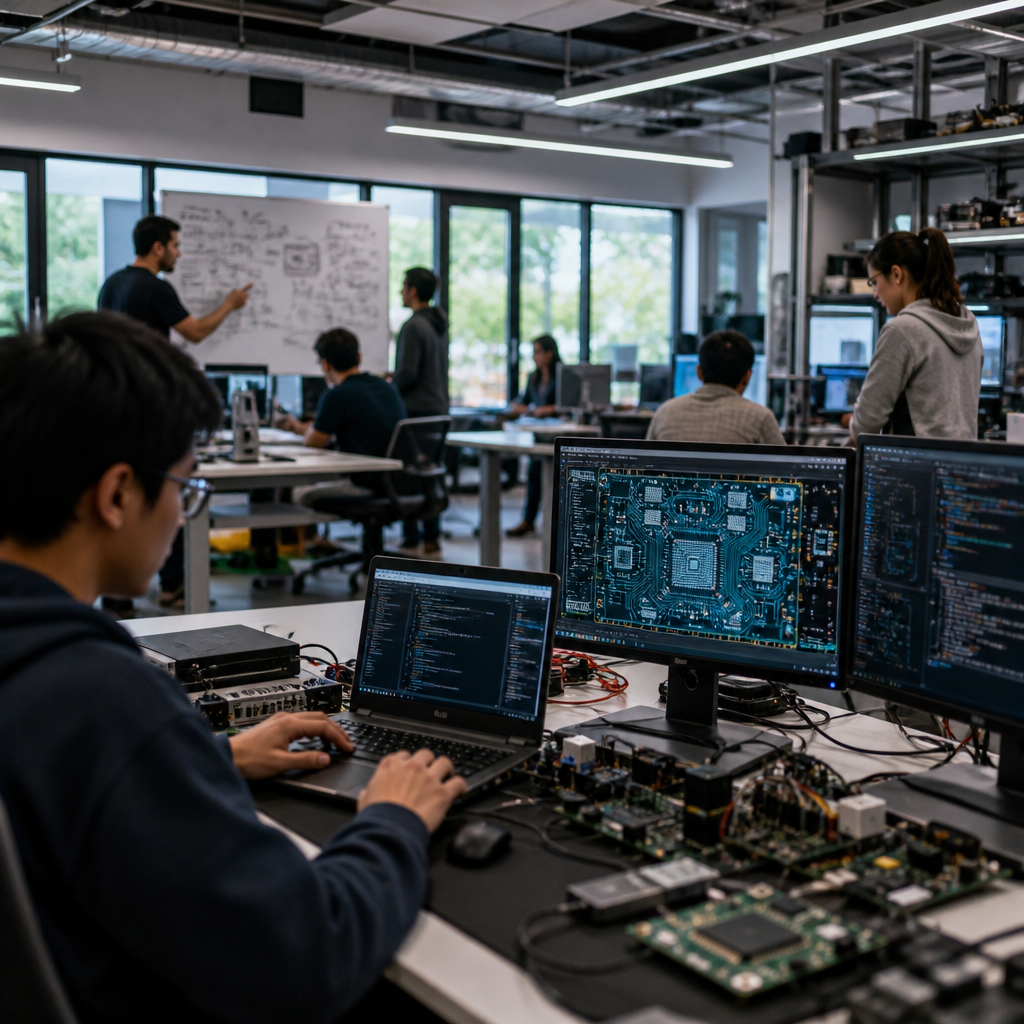
Silicon Valley’s AI chip startups are mounting the most serious challenge to Nvidia in more than a decade, reshaping how investors, cloud providers, and enterprise buyers think about semiconductors and compute. In this market, “AI chips” refers broadly to processors designed for machine learning workloads, including training, inference, networking, memory acceleration, and power management, while “compute” covers the full stack of hardware resources required to run modern models efficiently. I have worked with teams evaluating accelerator roadmaps, and the pattern is clear: demand for generative AI has exposed bottlenecks that general-purpose graphics processors alone cannot solve. That matters because compute is now a strategic resource, not just an IT expense. Startups in Silicon Valley are attacking specific weaknesses in cost, latency, energy use, memory bandwidth, and software flexibility, aiming to build alternatives for hyperscalers, enterprises, and edge deployments. This hub article maps the semiconductor and compute landscape, explains where these challengers fit, and shows why the next phase of AI infrastructure will be defined by specialized architectures rather than one dominant vendor. For founders, operators, and technical buyers, understanding this shift is essential to making better bets on platforms, partnerships, and product strategy.
Why Nvidia leads, and where challengers see openings
Nvidia leads because it combined three strengths early: high-performance parallel processors, a mature software ecosystem led by CUDA, and a roadmap tightly aligned with AI research needs. The company’s data center products, from A100 to H100 and now Blackwell-class systems, became the default for training large language models because they deliver massive throughput, high-bandwidth memory, and established support across frameworks such as PyTorch, TensorFlow, and JAX. In practice, buyers are not purchasing a chip alone. They are buying compilers, communication libraries, interconnects, developer tooling, reference designs, and supply chain reliability.
Yet leadership creates openings. Nvidia hardware is expensive, often supply constrained, and optimized for broad workloads rather than every niche. Training frontier models needs dense matrix performance and fast scaling across thousands of accelerators, but many commercial deployments depend more on inference economics: serving prompts at lower cost, lower power, and predictable latency. That difference is where startups enter. Some build chips for transformer inference. Others rethink memory movement, wafer-scale integration, photonic interconnects, or reduced-precision arithmetic. The core thesis is simple: if a startup can solve one painful constraint better than the incumbent, it can win a foothold even without matching Nvidia everywhere.
The startup playbook in AI semiconductors
Silicon Valley AI chip startups generally do not try to beat Nvidia head-on across the entire market. They target a narrow wedge where architecture matters more than brand dominance. In my experience reviewing vendor pitches, the strongest companies define a workload precisely, such as recommendation ranking, retrieval-augmented inference, on-device vision, or low-latency serving for smaller language models. They then align silicon, packaging, memory hierarchy, and compiler design around that workload instead of treating every neural network the same.
Groq is a useful example because it emphasizes deterministic low-latency inference with a tensor streaming architecture. Cerebras took a different path with wafer-scale engineering, placing an enormous compute fabric on one chip to reduce communication overhead. SambaNova focused on reconfigurable dataflow and integrated systems. d-Matrix has targeted generative inference with in-memory compute concepts to reduce data movement, one of the biggest energy costs in AI. EnCharge AI, Mythic, and other analog or mixed-signal players have explored whether nontraditional architectures can improve efficiency for edge and enterprise use cases. Not all will scale commercially, but each represents a serious attempt to solve a real bottleneck that standard GPU clusters do not eliminate.
Key battlegrounds in semiconductors and compute
The competition is not one-dimensional. Performance matters, but so do economics, deployment speed, and software maturity. Buyers evaluating AI semiconductors usually compare options across several criteria at once.
| Battlefield | What buyers need | Why startups focus here |
|---|---|---|
| Training throughput | Fast scaling across many processors | Large models are limited by communication and memory efficiency |
| Inference cost | Lower dollars per token or query | Most enterprise AI revenue comes after deployment, not training |
| Latency | Consistent response times | Real-time apps cannot tolerate unpredictable queueing |
| Energy efficiency | More output per watt | Power availability is now a hard cap in data centers |
| Software stack | Easy model porting and optimization | Hardware without usable tools rarely gets adopted |
| Supply chain | Reliable access to packaged systems | Customers want alternatives to constrained GPU availability |
Among these factors, memory bandwidth and interconnect design are especially decisive. AI workloads move enormous amounts of data between compute units and memory. If that movement is inefficient, theoretical peak performance never translates into real output. That is why high-bandwidth memory, chiplet design, advanced packaging from TSMC, and networking technologies such as NVLink-class fabrics or Ethernet-based scaling solutions are central to the semiconductor and compute story, not secondary details.
Silicon Valley startups to watch
Several companies stand out in the current wave. Groq has gained attention for inference speed and predictable latency, especially for interactive AI applications. Cerebras has built one of the most distinctive hardware platforms in the market, using its Wafer-Scale Engine and MemoryX systems to support very large models with reduced communication overhead. Sambanova Systems has positioned itself as a full-stack provider, combining hardware with software and managed services to simplify adoption for enterprises that lack hyperscale engineering talent.
d-Matrix is notable because it squarely targets generative AI inference economics, an area many buyers now care about more than peak training benchmarks. Etched, though younger, has drawn interest with an application-specific approach centered on transformer workloads. Speedata has pursued analytics acceleration, showing that “AI compute” often overlaps with data processing and vectorized query workloads. Ayar Labs, while not an accelerator vendor in the usual sense, matters because optical interconnects could relieve bandwidth and power bottlenecks across future AI systems. Astera Labs also deserves attention for connectivity and memory solutions that support scale-up and scale-out architectures. The lesson is broader than any one startup: the next challenger to Nvidia may come from compute cores, networking, memory, packaging, or system software, not a single monolithic chip.
What makes an AI chip startup credible
In this sector, credibility comes from measurable execution. A startup needs more than benchmark slides. It needs silicon that works, a compiler stack that developers can use, and design wins that prove customers will deploy it in production. Serious buyers ask direct questions: What models are supported today? How much code must be rewritten? What happens when frameworks update? Which foundry node and packaging path are being used? How does the company handle thermals, redundancy, and rack-level integration?
Standards and ecosystem alignment matter. ONNX compatibility, support for PyTorch, Kubernetes integration, and observability hooks through familiar tools reduce adoption friction. So do partnerships with TSMC, HBM suppliers, cloud platforms, and server OEMs. Startups that provide complete systems often have an advantage because enterprises prefer validated hardware-software bundles over assembling experimental infrastructure themselves. However, that systems approach requires more capital and a more complex go-to-market motion.
Risks, limits, and the realities of competition
Most AI chip startups will not displace Nvidia across the full market. The incumbent’s moat is real, especially in developer mindshare and software compatibility. CUDA remains deeply embedded in research code, enterprise pipelines, and commercial AI services. Porting costs can erase hardware savings if tooling is immature. There is also manufacturing risk. Advanced nodes, CoWoS-style packaging capacity, and high-bandwidth memory supply are constrained, favoring companies with scale and purchasing leverage.
Capital intensity is another barrier. Building leading-edge semiconductors can cost hundreds of millions of dollars before broad revenue arrives. Startups also face timing risk: model architectures change quickly, and a chip optimized for one dominant approach may lose relevance if inference techniques, sparsity methods, or multimodal workloads evolve. That said, the market is large enough for specialized winners. History in semiconductors shows that incumbents rarely own every category forever. CPUs did not eliminate GPUs; GPUs did not eliminate custom networking; and AI accelerators will not eliminate the need for workload-specific hardware. Competition will expand the stack.
What this means for startups, investors, and enterprise buyers
For startup founders in the broader tech ecosystem, the semiconductor and compute shift changes product strategy. Building AI applications now requires decisions about model size, hosting architecture, latency budgets, and hardware dependencies much earlier than before. For investors, the key question is not whether Nvidia remains strong. It almost certainly will. The better question is which startup can own a meaningful layer of the AI infrastructure value chain by solving a painful bottleneck with durable differentiation.
Enterprise buyers should evaluate AI chip startups according to workload fit, software portability, total cost of ownership, and vendor resilience. A lower benchmark cost means little if the deployment model is brittle. The strongest approach is pragmatic: map each workload to the right compute profile, run pilot tests, and compare end-to-end economics rather than headline specs. As the “Tech Innovations & Startups” hub for semiconductors and compute, this article sets the foundation for deeper coverage of AI accelerators, advanced packaging, foundries, interconnects, memory systems, and cloud infrastructure. Follow the subtopic, compare architectures carefully, and use this market transition to build a more resilient AI strategy.
Frequently Asked Questions
Why are AI chip startups in Silicon Valley suddenly seen as real challengers to Nvidia?
AI chip startups are gaining serious attention because the market has changed in ways that favor specialization. Nvidia still holds a dominant position, especially in GPU-based AI training, but the explosive growth of generative AI, large language models, edge deployment, and enterprise inference has created demand for more than one kind of solution. Startups are stepping in with architectures designed for specific bottlenecks such as latency, energy efficiency, memory bandwidth, interconnect performance, model serving costs, and deployment flexibility.
Another reason these companies are being taken seriously is that the AI infrastructure stack is no longer judged on raw chip performance alone. Cloud providers, enterprise IT buyers, and model developers now care about total cost of ownership, software integration, rack density, power draw, cooling requirements, and how easily hardware can be matched to a particular workload. A startup that can reduce inference costs dramatically or improve throughput for targeted use cases can become highly competitive even without matching Nvidia everywhere.
Silicon Valley also gives these challengers unusual advantages. The region combines access to top chip architects, hyperscaler relationships, venture capital, advanced software talent, and early enterprise customers willing to test new infrastructure. That ecosystem helps startups move faster from concept to deployment. In short, they are not replacing Nvidia overnight, but they are forcing the market to rethink whether one company should define the future of AI compute across every layer and workload.
What kinds of AI chips are these startups actually building?
When people hear “AI chips,” they often think only of training accelerators, but the category is much broader. Silicon Valley startups are building processors and supporting hardware for many parts of the AI pipeline, including model training, inference, high-speed networking, memory expansion, data movement, and power optimization. Some focus on general-purpose AI accelerators meant to compete with GPUs in data centers, while others target narrower but commercially important tasks such as low-latency inference for chatbots, recommendation systems, search, vision models, or on-device AI.
A number of startups are pursuing custom architectures rather than conventional GPU designs. These may include tensor-focused compute fabrics, wafer-scale systems, domain-specific accelerators, reconfigurable hardware, or tightly integrated chip-and-software platforms. Others are innovating around the surrounding infrastructure, which matters just as much as the processor itself. Networking chips, memory technologies, photonics, packaging approaches, and power delivery solutions can all influence how efficiently large models are trained and served.
This broader definition matters because modern AI performance depends on the full compute stack. A chip may be powerful in theory, but if memory becomes a bottleneck, networking slows distributed training, or energy consumption becomes too high, the real-world value drops quickly. That is why investors and customers are increasingly evaluating startup offerings not just as “chips,” but as end-to-end systems designed to solve practical AI deployment problems.
Can any of these startups realistically take market share from Nvidia?
Yes, but the answer depends on where in the market you are looking. Taking broad, direct share from Nvidia across all AI workloads is extremely difficult because Nvidia benefits from scale, mature hardware, a deep software ecosystem, extensive developer adoption, and strong relationships with cloud providers and enterprises. However, startups do not need to beat Nvidia everywhere to win meaningful business. They can capture share in segments where customers are more price-sensitive, more power-constrained, or more interested in optimized performance for a narrow set of models and applications.
Inference is one of the most promising entry points. As AI moves from experimentation to production, many companies discover that serving models at scale can be more expensive than training them. If a startup can offer lower inference costs, better performance per watt, or more predictable deployment economics, it can become attractive to enterprises and hyperscalers alike. Startups may also gain traction in edge AI, private cloud deployments, sovereign AI infrastructure, or custom hardware partnerships where flexibility matters more than standardization.
That said, market share gains in semiconductors usually happen gradually. Buyers are cautious, qualification cycles are long, and software support can determine success as much as silicon design. The most realistic scenario is not a sudden overthrow of Nvidia, but a more fragmented market in which startups carve out profitable positions and force incumbents to compete harder on pricing, innovation, and system-level efficiency.
Why do investors and cloud providers care so much about these new AI chip companies?
Investors care because AI infrastructure has become one of the most important and capital-intensive areas in technology. Demand for compute is growing so fast that even a small slice of this market can support very large businesses. If a startup develops a differentiated architecture and secures adoption from major cloud providers or enterprise customers, the upside can be substantial. Investors also see strategic value in backing alternatives to a highly concentrated market leader, especially when customers are actively looking for supply diversity and better economics.
Cloud providers care for slightly different reasons. They need enormous volumes of compute, and relying too heavily on a single vendor creates both cost and supply risks. By working with startups, hyperscalers can negotiate more effectively, diversify infrastructure, and sometimes co-design solutions tuned to their own workloads. In some cases, cloud providers want chips that better match the economics of AI inference, internal services, or customer-specific offerings. A startup that delivers measurable gains in utilization, energy efficiency, or workload-specific acceleration can become strategically valuable even if it never reaches mass-market dominance.
There is also a broader platform issue. The future of AI profits may depend not only on who builds the best models, but on who controls the underlying compute stack. That makes chips, interconnects, memory, and system software central to long-term competitiveness. For both investors and cloud providers, these startups are not just semiconductor bets; they are potential leverage points in the next phase of the AI economy.
What should enterprise buyers watch for when evaluating AI chip startups versus established vendors?
Enterprise buyers should begin with workload fit rather than brand recognition. The most important question is whether a startup’s hardware meaningfully improves the specific AI tasks a company needs to run. That includes model size, latency requirements, throughput expectations, data privacy constraints, software compatibility, and deployment environment. A startup may be a strong choice for inference-heavy applications or private infrastructure, but less suitable for broad internal research or mixed workloads that depend on a mature GPU ecosystem.
Software support is equally critical. Even excellent hardware can struggle in production if the tooling is immature, frameworks are poorly supported, or model migration is difficult. Enterprises should assess compiler quality, integrations with common machine learning frameworks, orchestration support, observability, debugging tools, and the availability of engineers who know how to work with the platform. The strength of the software stack often determines whether promised performance gains are achievable outside of benchmark conditions.
Buyers should also examine vendor stability and operational readiness. Important factors include manufacturing partnerships, product roadmaps, customer support, security posture, service-level commitments, and the company’s financial durability. In AI infrastructure, the purchase decision is rarely just about peak performance; it is about whether the vendor can support production workloads reliably over several years. The smartest enterprise buyers compare startups and incumbents through the lens of total value: cost savings, performance, power efficiency, integration complexity, and long-term platform risk.