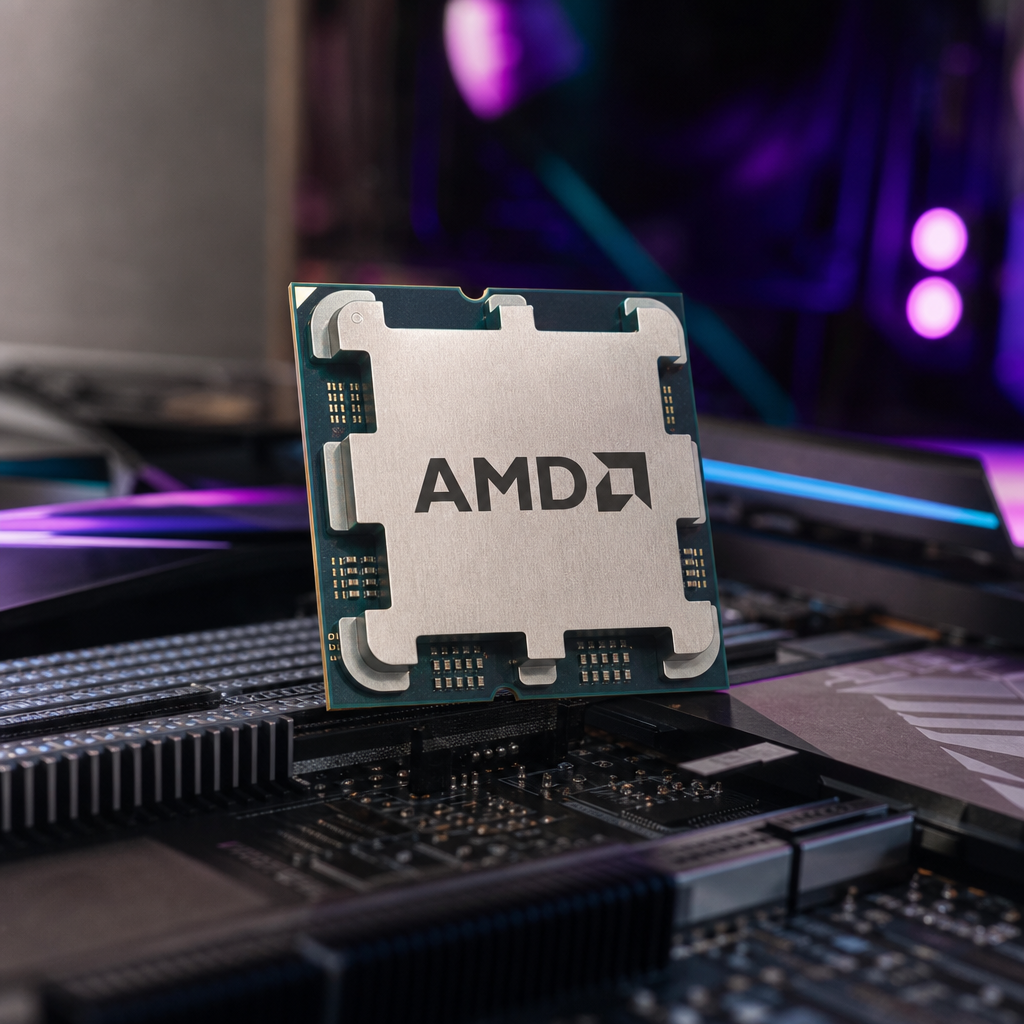
AMD has become one of the defining companies in modern semiconductor history, shaping how people game, create, train AI models, and run enterprise workloads. Short for Advanced Micro Devices, AMD designs central processing units, graphics processing units, adaptive computing products, and data center accelerators that compete at the highest end of the market. In a technology landscape where compute density, power efficiency, and software compatibility decide winners, AMD matters because it sits at the crossroads of consumer electronics, cloud infrastructure, supercomputing, and embedded systems. I have followed AMD’s product cycles through desktop builds, workstation deployments, and server evaluations, and its trajectory is remarkable: a company once viewed mainly as the price challenger now influences the direction of the broader industry. For readers exploring tech innovators and market leaders, AMD is essential because its story explains how strategic architecture bets, manufacturing partnerships, and disciplined execution can overturn entrenched assumptions in a brutally competitive sector.
Understanding AMD starts with a few key terms. A CPU handles general-purpose computing tasks, a GPU accelerates graphics and massively parallel workloads, and a system-on-chip combines multiple functions into a single package for efficiency. AMD’s recent growth has been driven by the Zen CPU architecture, the RDNA graphics architecture, and data center platforms such as EPYC and Instinct. Equally important is its fabless model: AMD designs chips but relies on manufacturing partners, especially TSMC, to fabricate advanced nodes. That structure lets AMD focus capital on architecture, packaging, software, and platform integration rather than owning fabrication plants. The result is a company that now competes not just on price, but on performance per watt, core density, memory bandwidth, and total cost of ownership. Those factors influence everyone from PC gamers and creative professionals to CIOs choosing server fleets and national labs building exascale systems.
As a hub within Company Spotlights, this article maps AMD’s role across the broader technology ecosystem and highlights why it belongs in any serious discussion of market leadership. It covers the company’s business model, product families, competitive strengths, strategic risks, and wider impact on innovation. It also points naturally toward related articles on chip design, AI hardware, gaming platforms, cloud infrastructure, and semiconductor supply chains. If you want one company that shows how engineering discipline, ecosystem development, and timing can reset an entire market, AMD is a strong place to start.
From Challenger Brand to Strategic Force
AMD’s current position makes more sense when viewed against its long competitive history. Founded in 1969, the company spent decades alternating between breakthrough periods and difficult stretches, often competing directly with Intel in CPUs and with Nvidia in graphics. What changed the narrative was the leadership shift under CEO Lisa Su and the architectural reset represented by Zen. Rather than pushing incremental updates to underperforming designs, AMD rebuilt its CPU roadmap around scalable chiplet-based engineering, stronger instructions-per-clock performance, and disciplined platform execution. In practical terms, that meant desktop Ryzen processors that offered more cores at compelling prices, Threadripper chips that redefined workstation value, and EPYC server CPUs that gave hyperscalers and enterprises a credible alternative to Intel’s Xeon lineup.
I have seen this shift play out in real buying decisions. A few years ago, recommending AMD in enterprise environments often required a long caveat about software certification, vendor support, or roadmap uncertainty. Today, EPYC appears in serious procurement discussions because it delivers measurable advantages in virtualization density, memory channels, PCIe lane availability, and power efficiency. The same pattern emerged in consumer markets. Ryzen did not succeed because it was merely cheaper; it won because it solved tangible user needs like multitasking, streaming while gaming, compiling code, and rendering media faster at a given budget. That distinction matters. Market leaders sustain momentum when products address real workloads, not just benchmark snapshots.
Core Product Lines and Why They Matter
AMD’s portfolio now spans several interconnected categories. Ryzen serves mainstream desktops and laptops. Radeon addresses gaming and graphics workloads. EPYC powers data center servers. Instinct accelerators target AI and high-performance computing. Following the Xilinx acquisition, AMD also added adaptive SoCs, FPGAs, and embedded platforms used in aerospace, telecommunications, automotive, industrial automation, and edge inference. This breadth gives AMD a more resilient business than a company tied to one device class. When consumer PC demand slows, data center or embedded segments can offset weakness. When AI investment surges, accelerators and high-bandwidth memory become central to revenue growth.
The product strategy works because the pieces reinforce one another. CPU leadership strengthens OEM relationships. GPU and accelerator development improves packaging, interconnect, and software capabilities that also benefit data center products. Embedded offerings deepen exposure to long-lifecycle, high-margin markets where customers prioritize reliability and customization. AMD’s Infinity Fabric, advanced chiplet packaging, and support for standards such as PCIe 5.0 and DDR5 are not isolated features; they are part of a platform-level approach. For buyers, that translates into broader deployment choices. A company can use AMD for developer laptops, workstation towers, cloud servers, and specialized edge hardware while maintaining a more unified supplier relationship.
| AMD Segment | Flagship Products | Primary Use Cases | Why Buyers Care |
|---|---|---|---|
| Client Computing | Ryzen 7, Ryzen 9, Ryzen AI | Laptops, desktops, creator PCs | Strong multi-core performance, efficiency, integrated AI features |
| Gaming Graphics | Radeon RX series | PC gaming, content creation | Competitive raster performance, display support, open features like FSR |
| Data Center CPU | EPYC Genoa, Bergamo, Turin | Cloud, virtualization, analytics | High core counts, memory capacity, lower total cost of ownership |
| AI and HPC | Instinct MI300 series | Model training, inference, supercomputing | Massive memory bandwidth, CPU-GPU integration, scale-out capability |
| Adaptive and Embedded | Xilinx Versal, Zynq | Telecom, industrial, aerospace, automotive | Flexible hardware acceleration, long support cycles |
AMD in PCs, Gaming, and Creative Workflows
For mainstream consumers, AMD is often encountered first through Ryzen and Radeon. Ryzen changed buyer expectations by making high core counts normal in desktop systems and by pushing laptop efficiency to a level that could challenge premium incumbents. In real use, that means smoother multitasking, stronger battery-conscious performance, and compelling options for students, creators, engineers, and streamers. AMD also became deeply visible through gaming platforms. Its custom silicon powers both the PlayStation 5 and Xbox Series X|S families, giving the company a major role in the console ecosystem. That console presence matters beyond unit sales because it shapes developer familiarity with AMD graphics architectures and optimization paths.
On the graphics side, Radeon competes in a market where software maturity and ecosystem tooling are as important as raw frame rates. AMD has pushed technologies such as FidelityFX Super Resolution, HYPR-RX, and modern display standards support to improve value for gamers. While Nvidia has often held the strongest mindshare in ray tracing and AI-enhanced graphics features, AMD remains highly relevant because many buyers still prioritize price-to-performance in traditional rasterized gaming. In creative workflows, the calculus is more nuanced. Video editors, 3D artists, and CAD users care about application-specific optimization, driver stability, and codec support. AMD performs best when hardware strengths align with software that is well tuned for its architecture, so informed buyers should always match the GPU to the applications they use most often.
Data Centers, AI, and the Battle for Future Workloads
The most consequential chapter in AMD’s rise is in the data center. EPYC processors broke through because they offered capabilities that directly influence infrastructure economics: more cores per socket, more memory channels, abundant PCIe lanes, and strong performance per watt. In cloud and enterprise environments, these details are not academic. They affect how many virtual machines fit on a server, how quickly databases process transactions, and how much power and cooling a rack consumes over years of operation. Analysts and hyperscalers increasingly evaluate servers by total cost of ownership, not sticker price, and AMD has repeatedly benefited from that shift.
AI has raised the stakes further. With the Instinct MI300 family, AMD moved beyond being a secondary accelerator supplier and into serious contention for high-end AI and HPC deployments. The MI300A and MI300X designs are important because they combine advanced packaging, high-bandwidth memory, and platform-level integration suited to large-scale model training and inference. AMD has also benefited from visible wins such as the El Capitan supercomputer, built at Lawrence Livermore National Laboratory, which uses AMD CPUs and GPUs in an exascale system. That kind of deployment signals credibility. Enterprises deciding whether to diversify away from a single AI hardware supplier want evidence that a vendor can support complex, mission-critical environments with mature software and sustained roadmap investment.
Competitive Strengths, Constraints, and What Comes Next
AMD’s strengths are clear: disciplined leadership, effective use of chiplets, strong partnership with TSMC, broad product coverage, and a sharper ability to convert architectural progress into commercial share gains. Its acquisitions, especially Xilinx, expanded the company into adaptive computing and reduced dependence on cyclical consumer segments. The company also benefits from industry demand for supplier diversification. Large customers rarely want to rely on one chip vendor if a credible alternative exists.
Still, AMD faces real constraints. It competes against giant rivals with deep software ecosystems, marketing reach, and balance-sheet strength. In AI, software frameworks, developer familiarity, and deployment tooling can matter as much as silicon. Nvidia’s CUDA ecosystem remains a formidable barrier, while Intel retains major OEM and enterprise relationships. AMD is also exposed to supply chain concentration because advanced semiconductor manufacturing depends heavily on a small number of foundry and packaging partners. Geopolitical tension, capacity bottlenecks, or slower-than-expected software adoption can limit upside even when the hardware is strong.
AMD stands out because it proves leadership in semiconductors is not permanent; it must be earned generation after generation. Across PCs, gaming, embedded systems, servers, and AI infrastructure, the company has shown that sound architecture, patient execution, and ecosystem investment can reshape market rankings. For anyone tracking tech innovators and market leaders, AMD is more than a chip brand. It is a case study in how product strategy and operational focus create durable competitive advantage. Explore the related Company Spotlights in this hub to compare AMD with other firms shaping the future of computing and graphics, and use those comparisons to sharpen your own view of where the industry is headed.
Frequently Asked Questions
What does AMD do, and why is it so important in modern computing?
AMD, short for Advanced Micro Devices, is a semiconductor company that designs many of the chips that power today’s digital world. Its product portfolio includes CPUs for desktops, laptops, and servers; GPUs for gaming, content creation, and AI workloads; adaptive computing solutions such as FPGAs and SoCs; and data center accelerators used in cloud and enterprise environments. That range matters because computing is no longer limited to one device type or one use case. The same company now needs to serve gamers, engineers, AI researchers, hyperscale cloud providers, and businesses running mission-critical applications, and AMD has positioned itself across all of those categories.
AMD is especially important because it competes at the highest end of the market in areas where performance per watt, parallel processing capability, platform scalability, and software ecosystem support are critical. Its Ryzen processors helped reshape the consumer PC market by pushing more cores and stronger multithreaded performance into mainstream systems. Its EPYC server processors gave enterprises and cloud providers a serious alternative in the data center, where efficiency, virtualization density, and total cost of ownership are key decision factors. On the graphics side, Radeon products support gaming and creative workflows, while AMD’s accelerator technologies are increasingly relevant to AI and high-performance computing.
In practical terms, AMD matters because it influences how fast systems run, how much energy they consume, how much they cost to deploy at scale, and how competitive the broader computing industry remains. When AMD executes well, it increases pressure across the market, which often leads to faster innovation, better pricing, and more choice for consumers and businesses alike.
How has AMD changed the CPU market for consumers and data centers?
AMD has had a major impact on both consumer and enterprise CPUs by aggressively improving core counts, architectural efficiency, and platform value. In the consumer space, the launch and evolution of Ryzen processors reestablished AMD as a top-tier CPU competitor. Rather than focusing only on entry-level price positioning, AMD delivered processors that could compete on raw performance, multitasking capability, gaming results, and creator workloads. This helped normalize higher core counts in mainstream desktop systems, which benefited users doing everything from streaming and video editing to software development and heavy productivity work.
In laptops, AMD’s mobile processors improved the balance between battery life and performance, giving OEMs more credible alternatives for thin-and-light systems, gaming notebooks, and workstation-class devices. For buyers, that translated into more options across pricing tiers and form factors. In many cases, AMD-based systems became attractive because they offered strong integrated graphics, efficient multicore performance, and competitive value for the overall platform.
The data center impact has arguably been even more significant. AMD EPYC processors disrupted the server market by offering high core density, substantial memory bandwidth, large I/O capacity, and strong performance-per-dollar and performance-per-watt metrics. These advantages matter enormously in cloud infrastructure, virtualization clusters, analytics environments, and enterprise application deployments. A data center operator evaluating thousands of servers is not only looking at peak benchmark numbers; they are assessing rack density, power draw, cooling requirements, licensing implications, and long-term operating costs. AMD’s server strategy aligned well with those priorities, which is why EPYC gained traction with hyperscalers, research institutions, and enterprise customers.
By changing expectations in both desktops and servers, AMD helped accelerate the broader market’s focus on efficient multicore computing. That influence continues to shape product roadmaps and purchasing decisions across the industry.
What role does AMD play in graphics, gaming, and content creation?
AMD is one of the central players in graphics computing through its Radeon lineup and related technologies. In gaming, AMD GPUs power dedicated graphics cards for PCs and also contribute to the silicon behind major gaming platforms. This gives the company a meaningful role not just in enthusiast desktop gaming, but in the broader gaming ecosystem where developers optimize engines, APIs, and rendering techniques across hardware classes. AMD’s graphics technologies support high-resolution gaming, advanced visual effects, and performance features aimed at smoother frame rates and better image quality.
For PC gamers, AMD’s value comes from a mix of rasterization performance, platform synergy with AMD CPUs, display technologies, and software features designed to improve responsiveness and visual fidelity. Depending on the product generation, AMD often competes by delivering strong price-to-performance ratios in key segments of the graphics card market. That is particularly important for gamers who want capable hardware for modern titles without moving to the very highest pricing tiers.
Beyond gaming, AMD also matters to creators and professionals working in video production, 3D rendering, animation, photography, design, and simulation. Modern creative applications increasingly rely on GPU acceleration for effects processing, encoding, rendering, and AI-assisted tools. AMD’s GPUs can help reduce rendering times, improve viewport performance, and support demanding visual workloads. As workflows become more hybrid, with both CPU and GPU resources contributing to final output, AMD’s broader compute portfolio becomes an advantage because users can build systems that combine strong multicore processors with powerful graphics in the same ecosystem.
Graphics is no longer just about drawing pixels to a screen. It now intersects with AI upscaling, real-time collaboration, simulation, media pipelines, and immersive experiences. AMD’s role in that shift makes it a meaningful company not only for gamers, but also for anyone whose work depends on visual computing performance.
How is AMD involved in AI, high-performance computing, and enterprise workloads?
AMD’s role in AI and high-performance computing has grown substantially as these markets have expanded from niche technical domains into strategic priorities across industries. AI training and inference require enormous computational throughput, fast memory access, scalable interconnects, and software environments that can support increasingly complex models. High-performance computing environments, such as scientific research centers and engineering simulation clusters, have similarly demanding needs. AMD addresses these opportunities through a combination of server CPUs, GPUs, data center accelerators, and adaptive computing technologies.
Its EPYC processors are relevant because AI and enterprise deployments still depend heavily on strong CPU infrastructure for orchestration, preprocessing, virtualization, storage, networking, and mixed workloads. At the same time, AMD accelerators and GPU technologies are important for massively parallel tasks such as model training, large-scale inference, simulation, and analytics. The company’s acquisition-driven expansion into adaptive computing also broadened its reach into embedded AI, networking, telecom, aerospace, industrial systems, and specialized acceleration use cases where programmable hardware can deliver low latency and strong efficiency.
For enterprises, AMD’s appeal often comes down to infrastructure flexibility. A business may need a platform that supports cloud-native applications, databases, VDI, analytics, edge deployments, and AI workloads all within one broader architectural strategy. AMD’s portfolio helps address that reality. In addition, power efficiency has become a top priority in modern infrastructure planning. Whether a company is building a private data center or leasing cloud capacity, energy use directly affects cost, cooling, sustainability goals, and deployment density. AMD’s competitive positioning in performance per watt has made it increasingly relevant in these conversations.
Just as important is the software side. Hardware alone does not determine success in AI or enterprise computing. Framework compatibility, developer tools, libraries, and deployment support matter enormously. AMD’s long-term importance in AI and HPC depends on both silicon innovation and continued maturation of the software ecosystem that enables organizations to build, train, optimize, and run workloads efficiently at scale.
Why do power efficiency, compute density, and software compatibility matter so much for a company like AMD?
These three factors are at the heart of modern semiconductor competition because performance today is measured by more than raw speed. Power efficiency determines how much useful work a chip can do for a given energy budget. That matters in everything from ultraportable laptops to hyperscale data centers. A more efficient processor can help a notebook run cooler and longer on battery, while in a server environment it can lower electricity costs, reduce thermal stress, and allow operators to fit more compute into existing power and cooling envelopes. As hardware deployments scale, those benefits become financially and operationally significant.
Compute density refers to how much processing capability can be delivered within a limited physical and power-constrained footprint. In the data center, this is crucial. Cloud providers and enterprises want to maximize performance per rack, per server, and per watt. More dense compute resources can improve utilization, reduce infrastructure sprawl, and support higher-value workloads without proportionally increasing space and energy demands. AMD has earned attention in part because its products have often aligned well with these economic and architectural realities.
Software compatibility is equally important because even the best chip has limited value if developers and organizations cannot easily use it. Consumers care about whether games run well, whether applications are optimized, and whether the platform is stable. Enterprises care about virtualization stacks, operating systems, orchestration tools, security features, and application certifications. AI developers care about frameworks, libraries, model portability, and deployment toolchains. This is why semiconductor leadership is never just a hardware story. Companies like AMD must deliver not only silicon performance, but also a reliable and expanding software ecosystem that makes adoption practical.
Together, power efficiency, compute density, and software compatibility define whether a platform succeeds in the real world. They shape purchasing decisions, deployment costs, user experience, and long-term strategic relevance. AMD’s ability to compete on all three is a major reason it has become such an influential force in the