
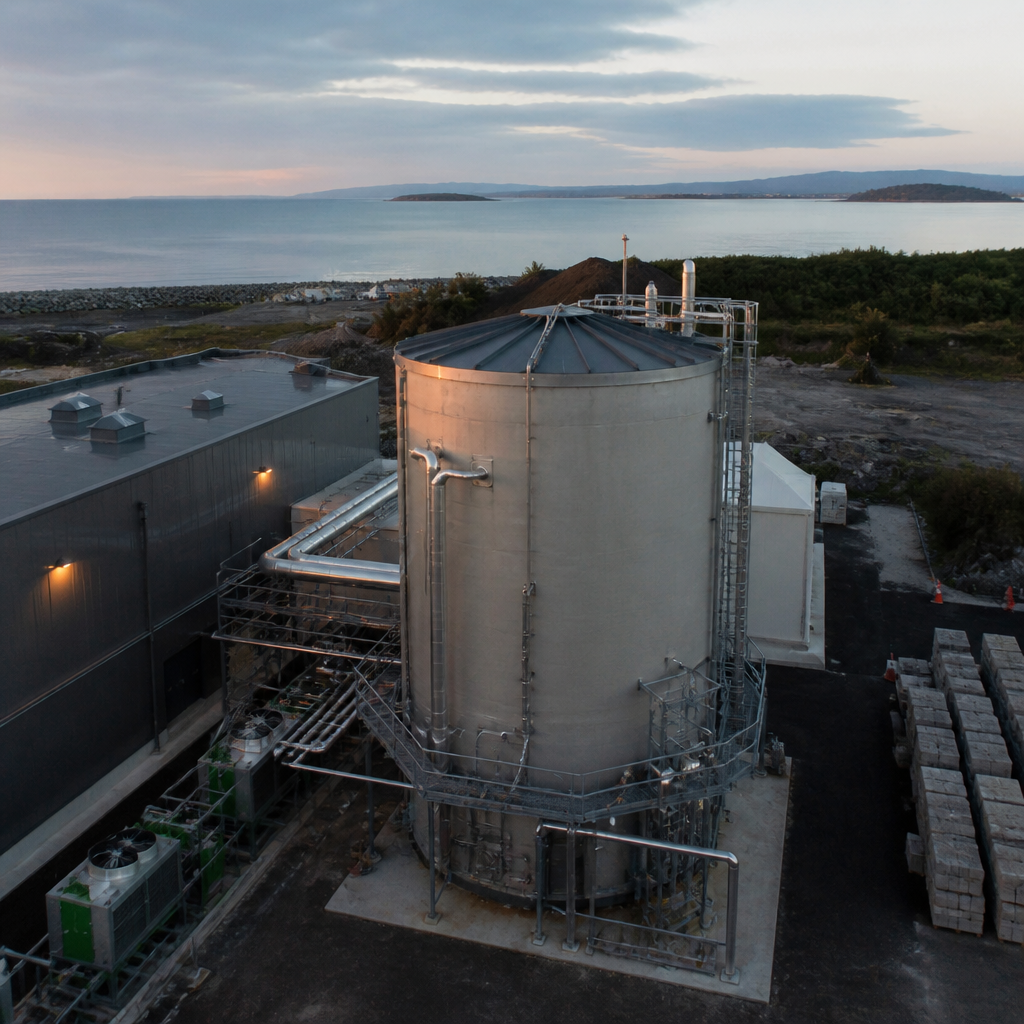
Antora Energy is building a practical answer to one of the hardest climate and energy problems: how to cut industrial emissions when factories need heat, not just electrons. The company’s core idea is straightforward—use cheap or surplus electricity to heat solid carbon blocks to extremely high temperatures, store that energy as thermal energy, and then discharge it as industrial heat or electricity when needed. For sectors such as steel, cement, chemicals, food processing, and mining, that matters because heat drives production, and heat below roughly 1,500 degrees Celsius remains heavily dependent on fossil fuels.
Industrial decarbonization refers to reducing greenhouse gas emissions from manufacturing and materials production, especially process heat, on-site combustion, and purchased power. Long-duration energy storage means storing energy for many hours or days so it can be shifted in time, balancing variable wind and solar output. Thermal energy storage is one of the oldest concepts in energy systems, but Antora’s approach updates it for modern grids and heavy industry by combining very high temperatures, modular hardware, and the economics of low-cost renewable power. I have worked around industrial energy procurement and storage evaluations long enough to see the same constraint repeatedly: plants will not adopt decarbonization tools unless reliability, temperature, and cost align with production realities.
That is why Antora Energy deserves close attention within climate, energy, and industrial technology. It sits at the intersection of clean electricity, grid flexibility, manufacturing competitiveness, and emissions reduction. It also serves as a useful hub topic because understanding Antora requires understanding broader themes: why industrial heat is difficult to electrify, how thermal batteries compare with lithium-ion systems, what policies and market structures support deployment, and which adjacent companies are attacking the same challenge from different angles. For readers exploring company spotlights across climate and industrial tech, Antora offers a strong lens on where decarbonization is moving next.
What Antora Energy Does and Why Its Technology Stands Out
Antora Energy develops thermal batteries that convert electricity into heat and store that heat in blocks of carbon. Carbon is attractive here because it is abundant, durable at high temperatures, and capable of glowing at temperatures suitable for industrial use. During charging, renewable or off-peak grid electricity passes through resistive heating elements, raising the temperature of the storage medium. During discharge, the system can deliver heat directly as hot air or other thermal output to industrial processes. Antora has also discussed thermophotovoltaic conversion, which turns radiant heat back into electricity using specialized cells, giving the platform flexibility in facilities that need both power and heat.
The distinction between direct heat delivery and reconversion to electricity is important. Every energy conversion step introduces losses, so when a factory primarily needs heat, direct thermal discharge is usually the highest-value use case. In practical project screening, that improves round-trip economics even if the system is not optimized to compete with four-hour lithium-ion batteries on pure electric arbitrage. Antora’s value proposition is not “battery replacement” in the consumer sense. It is industrial fuel switching plus flexible load management plus resilience against volatile gas prices.
High-temperature thermal storage also matches how many plants already think about energy. Industrial operators budget for boilers, burners, kilns, dryers, furnaces, and steam systems. They care about delivered temperature, ramp rates, duty cycles, maintenance intervals, and uptime. A technology that can slot into those conversations has an easier path than one that requires total process redesign. Antora’s hardware is modular, which helps with phased deployment at industrial sites where downtime windows are limited and capital must be staged across multiple budget years.
Why Industrial Heat Is the Decarbonization Bottleneck
Industry accounts for roughly a quarter of global carbon dioxide emissions when direct and indirect emissions are considered together, according to International Energy Agency analysis. A large share comes from heat used in processes such as drying paper, pasteurizing food, making glass, refining metals, and producing chemicals. The challenge is not simply generating enough clean electricity. It is delivering consistent, controllable, affordable heat at the right temperature profile. Low-temperature heat can often be electrified with heat pumps or electric boilers, but medium- and high-temperature applications are more difficult.
Natural gas remains dominant because it offers dispatchability, established equipment, and familiar fuel logistics. Plant managers know how to run combustion systems twenty-four hours a day, and lenders understand the risk profile. Decarbonization alternatives must therefore compete against a mature incumbent, not against a blank slate. Hydrogen may eventually serve some high-heat applications, but green hydrogen is still constrained by cost, infrastructure, and conversion losses. Carbon capture can reduce emissions at some facilities, yet it adds complexity and often works better on concentrated streams than on distributed heat demand.
Thermal storage addresses a specific gap: it lets factories buy or absorb electricity when it is cheapest and cleanest, then use that energy later without forcing operations to match renewable generation hour by hour. In regions with strong solar production, midday power prices can collapse and occasionally turn negative. Instead of curtailing that electricity, systems like Antora can store it. For a ceramics plant, food processor, or chemical facility, that means cleaner heat without sacrificing production schedules.
How Antora Compares With Other Industrial Decarbonization Paths
No single technology will decarbonize all industrial heat, so decision-makers need a comparison framework grounded in temperature, duty cycle, fuel availability, and retrofit complexity. Antora competes most directly where sites need repeated thermal loads, have decent access to low-cost electricity, and want to reduce exposure to gas volatility. It is less obviously suited to every ultra-high-temperature process or facilities with limited electrical interconnection capacity. That nuance matters because good climate technology analysis depends on fit, not slogans.
| Option | Best Fit | Main Advantage | Main Limitation |
|---|---|---|---|
| Antora thermal battery | Repeated industrial heat demand | Uses low-cost electricity and shifts it in time | Requires site integration and power access |
| Electric boiler | Low- to medium-temperature steam | Simple electrification pathway | Limited storage value without added flexibility |
| Green hydrogen | Some high-heat or feedstock uses | Combustible clean fuel | High production and delivery cost today |
| Carbon capture | Existing combustion-heavy assets | Can preserve installed process equipment | Energy penalty and added system complexity |
Compared with lithium-ion batteries, Antora is targeting a different value stack. Lithium-ion excels at fast electrical response, frequency services, and shorter-duration storage. Thermal batteries gain an edge when the end use is heat and the storage duration needs to extend across long production cycles. Compared with molten salt systems, often associated with concentrating solar power, solid carbon storage can be simpler in modular industrial deployments. Compared with geothermal heat, Antora is not geography-constrained in the same way.
Other companies in this broader climate, energy, and industrial tech landscape include Rondo Energy in thermal storage, Form Energy in long-duration storage for the grid, Heliogen in industrial heat, and Boston Metal in green steelmaking pathways. Readers building a company map for this sub-pillar should also connect Antora to adjacent enablers such as electric furnace suppliers, thermophotovoltaic developers, industrial controls firms, and utilities offering flexible interconnection or demand response programs.
Business Model, Deployment Realities, and Grid Value
For Antora, the commercial question is not whether heat can be stored. It is whether stored heat lowers total cost of ownership while meeting plant reliability standards. Projects typically depend on several variables: local power prices, hourly price volatility, capacity factors, emissions targets, avoided fuel purchases, and the cost of integrating with existing process equipment. In my experience reviewing industrial energy projects, the fastest deals happen when a technology solves two problems at once. Antora can do that by cutting emissions and reducing energy procurement risk.
The grid value is equally significant. Flexible charging allows industrial customers to absorb renewable overgeneration, flatten demand peaks, and potentially participate in utility or wholesale market programs where rules allow. That makes thermal storage more than a behind-the-meter decarbonization tool. It becomes a grid-balancing asset. In regions such as California, Texas, and parts of Australia, where solar output can be abundant but unevenly timed, the ability to move electrons from low-value hours to high-value industrial use hours is increasingly attractive.
Deployment still requires discipline. Interconnection queues are long in many markets. Industrial retrofits can uncover hidden constraints in controls, piping, refractory materials, and site layout. Safety and performance validation must satisfy conservative engineering teams. Those are not signs of weakness; they are normal realities in industrial technology adoption. The companies that win in this sector are the ones that survive detailed engineering review, not just investor presentations.
What Antora Signals for the Future of Climate, Energy, and Industrial Tech
Antora Energy represents a larger shift in decarbonization strategy: moving from one-size-fits-all electrification toward application-specific energy systems. Heavy industry does not need elegant theory. It needs bankable equipment that integrates with production, survives harsh operating conditions, and competes with fossil fuels on operational logic. Thermal batteries answer that need more directly than many consumer-facing clean energy narratives do.
The company also highlights a broader investment thesis across this subtopic. The most consequential climate technologies are often not visible to consumers. They live in factories, substations, heat loops, and balance-of-plant equipment. Yet these quieter technologies can unlock outsized emissions reductions because they tackle the physical core of industrial activity. As grids add more variable renewable power, assets that convert cheap electricity into useful industrial output will become increasingly strategic.
For readers using this page as a hub for company spotlights, Antora is a strong starting point because it connects multiple themes: long-duration storage, electrified heat, industrial resilience, and grid flexibility. The key takeaway is clear. Storing electricity as heat is not a niche idea; it is an economically grounded pathway for industrial decarbonization where direct heat demand dominates. Watch how Antora executes on project deployment, manufacturing scale, and customer integration. Then explore the neighboring technologies and companies shaping this market, because the future of climate and industrial innovation will be built as much in thermal systems as in power electronics.
Frequently Asked Questions
What is Antora Energy’s core technology, and how does storing electricity as heat actually work?
Antora Energy’s core technology is based on a simple but powerful idea: convert low-cost electricity into very high-temperature heat, store that energy inside solid carbon blocks, and deliver it later when an industrial facility needs heat or power. Instead of treating electricity and heat as separate energy systems, Antora connects them by using electricity as the input and thermal energy as the storage medium. This matters because many industrial processes do not primarily need electrons—they need reliable, intense heat for furnaces, kilns, dryers, reactors, and other equipment.
In practice, the system uses electricity, ideally when renewable power is abundant or grid prices are low, to heat carbon blocks to extremely high temperatures. Those blocks act as thermal batteries. Because carbon can tolerate very high heat and store large amounts of energy, it becomes a practical medium for long-duration thermal storage. When a customer needs energy, the stored heat can be discharged directly as industrial process heat, which is often the most efficient pathway for factories. In some configurations, the system can also convert that stored thermal energy back into electricity, giving facilities added flexibility.
The reason this approach is attracting attention is that it aligns with how industry actually operates. Heavy industry often runs continuously, needs large quantities of energy, and cannot always depend on variable renewable generation in real time. By storing energy as heat, Antora aims to help factories decouple when electricity is purchased from when thermal energy is used. That can lower energy costs, improve resilience, and support decarbonization without forcing industrial operators to completely redesign the physical reality of heat-intensive production.
Why is storing energy as heat especially important for industrial decarbonization?
Industrial decarbonization is difficult because a large share of factory emissions comes from producing heat, not simply from consuming electricity. Sectors such as steel, cement, chemicals, food processing, and mining rely on thermal energy for essential operations, often at high temperatures and on demanding schedules. While many climate discussions focus on electrifying vehicles or powering buildings with renewables, industry presents a different challenge: a factory may need around-the-clock heat at temperatures that are hard to supply economically with conventional clean-energy solutions.
That is why thermal storage can be so important. If a company can buy or absorb inexpensive renewable electricity when it is available and turn it into stored heat, it can use that energy later in a form that matches industrial demand. This reduces dependence on fossil fuels such as coal, oil, or natural gas, which have historically been the default fuels for industrial heat. It also helps solve one of the key integration challenges of wind and solar power: their output changes over time, while factories often need consistent, uninterrupted thermal energy.
Another major advantage is system-level efficiency. For many industrial applications, delivering heat directly is more sensible than converting electricity into another form and then back again. If the end use is heat, storing energy thermally can be more practical than relying only on electrochemical batteries, especially at large scales and high temperatures. Antora’s approach addresses a part of the decarbonization puzzle that is frequently underserved: providing dispatchable, high-temperature clean heat for hard-to-abate industries. That makes thermal storage not just a niche technology, but a potentially central tool for lowering emissions across major industrial sectors.
Which industries could benefit most from Antora Energy’s thermal battery systems?
Antora Energy’s systems are especially relevant for industries that use large amounts of process heat and face growing pressure to cut emissions without sacrificing reliability or economics. Steel is a leading example because steelmaking involves extremely energy-intensive thermal processes. Cement is another major opportunity, given the sector’s enormous heat demand and significant carbon footprint. Chemical manufacturing also stands out because many processes depend on controlled, high-temperature heat supplied continuously and at scale.
Food processing can benefit as well, even though it is sometimes overlooked in heavy-industry conversations. Many food and beverage facilities require substantial thermal energy for drying, sterilizing, cooking, pasteurization, and steam generation. Mining operations are another potential fit, particularly where remote sites face high fuel costs or where electrification paired with energy storage can improve both economics and logistics. In all of these sectors, the appeal is not only lower emissions, but also better use of available electricity and reduced exposure to fossil fuel price volatility.
What makes these industries good candidates is the combination of three factors: significant heat demand, sensitivity to energy cost, and the need for dependable operations. A technology like Antora’s is most compelling where the factory can take advantage of low-cost power, store it efficiently, and then deploy heat on the plant’s schedule rather than the grid’s schedule. The exact economics and technical fit will vary by facility, process temperature, and operating profile, but the broad industrial landscape is full of applications where thermal batteries could provide meaningful decarbonization value.
How does Antora Energy compare with conventional batteries or direct electrification for factories?
Antora Energy is not trying to solve the same problem in exactly the same way as conventional lithium-ion batteries. Electrochemical batteries are excellent for many grid applications, short-duration storage needs, and mobile uses, but they are not always the most natural fit for supplying high-temperature industrial heat. Factories that need thermal energy often benefit more from a system designed to store and discharge heat directly, rather than storing electricity and then converting it through multiple steps before it becomes usable process heat.
Compared with direct electrification alone, Antora’s model adds flexibility. A factory could, in theory, electrify some heating processes directly, but if electricity prices are high at certain hours or renewable generation is not available when heat is needed, the economics can become more challenging. Thermal storage helps shift energy use over time. It allows a facility to take advantage of off-peak, surplus, or renewable electricity when conditions are favorable, then use the stored heat later during production. That time-shifting capability can improve cost control and reduce strain on the grid.
There is also a practical integration advantage. Many industrial operators are looking for decarbonization solutions that fit into real-world plant environments with minimal disruption. Antora’s approach can potentially complement electrification rather than replace it. It gives facilities a way to use electricity as the energy source while still meeting the operational reality that the process itself requires heat. In that sense, thermal batteries can sit between the clean power system and the industrial heat load, translating one into the other in a way that is often more aligned with factory needs than conventional battery storage by itself.
What makes Antora Energy’s approach promising from both a climate and economic perspective?
From a climate perspective, Antora Energy is targeting a very large and very difficult emissions source: industrial heat. Heavy industry accounts for a substantial share of global greenhouse gas emissions, and much of that comes from burning fossil fuels to generate thermal energy. A solution that can replace or reduce combustion in industrial settings has outsized potential because it addresses emissions in sectors that have historically been difficult to clean up. By enabling factories to run on stored renewable or low-carbon electricity in the form of heat, Antora’s technology could help decarbonize processes that otherwise have limited practical alternatives.
From an economic perspective, the model is appealing because it is built around using cheap or surplus electricity. As renewable energy deployment expands, periods of low-cost power are becoming more common in many markets. The ability to capture that electricity, store it as heat, and use it later can create real operational savings, particularly for energy-intensive manufacturers. It can also reduce exposure to natural gas or coal price swings, which is increasingly valuable for industrial planning and competitiveness.
The broader promise lies in combining decarbonization with industrial practicality. Climate solutions gain traction fastest when they do not ask companies to choose between sustainability and reliable performance. Antora’s concept is compelling because it is grounded in what factories actually need: affordable, dispatchable, high-temperature energy. If the technology scales successfully, it could offer a rare combination of emissions reduction, energy flexibility, and cost competitiveness. That is exactly the kind of solution industrial decarbonization requires—not just cleaner in theory, but workable in everyday operations.