
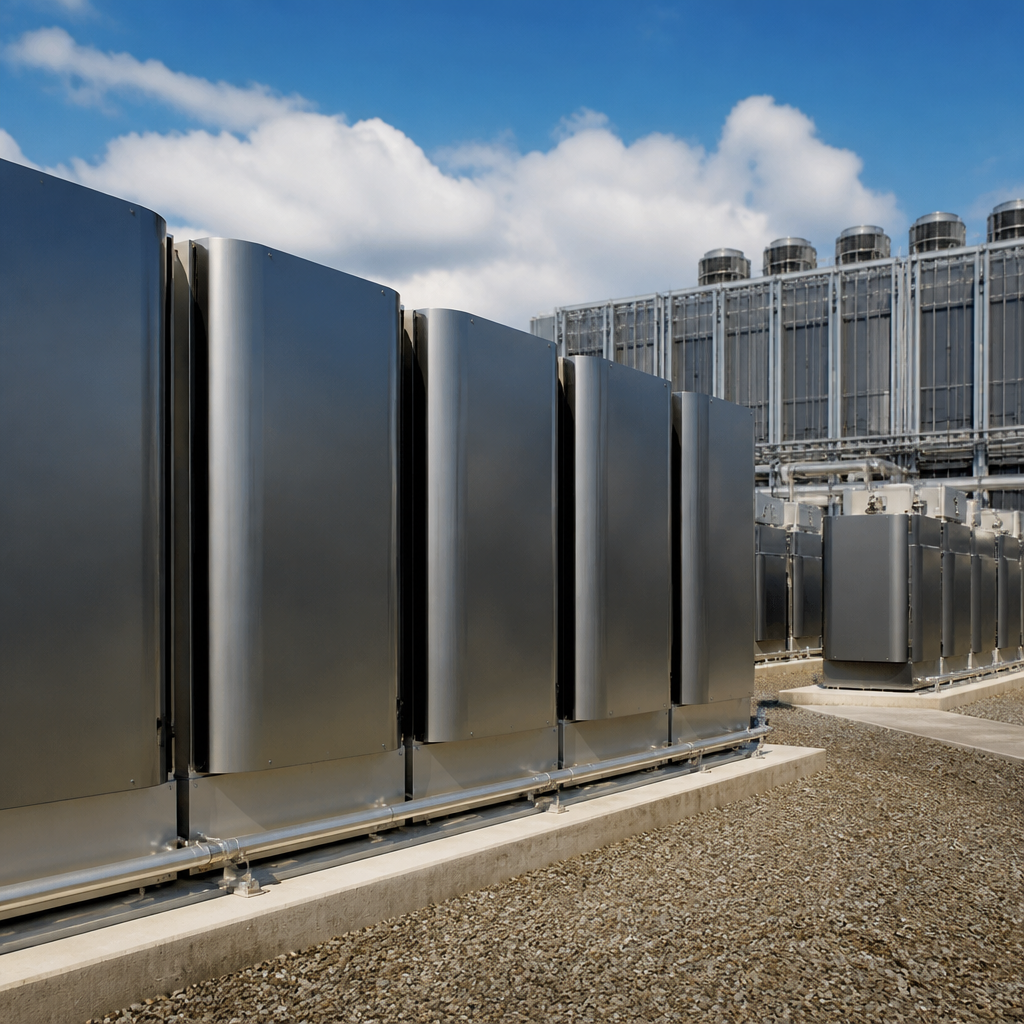
Bloom Energy and the AI data center power boom are now tightly linked because the newest wave of artificial intelligence infrastructure needs electricity that is fast to deploy, highly reliable, and scalable beyond what many grids can deliver today. Bloom Energy, best known for solid oxide fuel cell systems, has moved back into the center of investor and operator attention as hyperscale data centers search for practical ways to energize new campuses. In this climate, energy, and industrial tech landscape, fuel cells are no longer a niche backup technology. They are increasingly evaluated as primary or supplementary power for compute-heavy facilities.
To understand why, it helps to define the core pieces. Bloom Energy builds stationary power systems based on solid oxide fuel cells, or SOFCs, which generate electricity electrochemically rather than through combustion. AI data centers are facilities optimized for training and inference workloads, often packed with high-density GPU clusters that can demand hundreds of megawatts at a single site. The power boom refers to the sudden acceleration in demand caused by generative AI, cloud expansion, and enterprise model deployment. Utilities, developers, and equipment vendors are all feeling the strain.
I have worked on energy technology coverage long enough to see several distributed generation cycles rise and fade. What is different now is the combination of three hard constraints arriving at once: interconnection delays, local grid congestion, and the extreme uptime expectations of AI operators. Data center developers do not merely want cleaner power or a lower utility bill. They need capacity on a timeline that matches construction schedules, and in many markets that means looking beyond conventional utility service. That is the gap Bloom Energy is trying to fill.
Why AI data centers are reshaping power demand
AI data centers consume far more power per rack than traditional enterprise facilities because advanced accelerators draw significant electricity and create substantial heat. A conventional data hall might have planned around 5 to 10 kilowatts per rack. Many modern AI deployments now target 30, 50, or even more than 100 kilowatts per rack depending on architecture and cooling design. Multiply that by tens of thousands of accelerators, and a campus can quickly reach utility-scale loads.
The challenge is not only total consumption. It is also the speed and certainty of delivery. In major North American markets, grid interconnection queues can stretch for years. Transmission upgrades, substation work, and local permitting create bottlenecks that are hard to compress. For hyperscalers and colocation providers, a delayed power timeline can be more damaging than a higher power price because stranded capital in land, shells, and servers erodes returns. That is why behind-the-meter generation, microgrids, and modular energy assets have moved from contingency planning into core site strategy.
Reliability adds another layer. AI workloads tied to customer products, training runs, and internal development pipelines cannot tolerate unstable supply. Traditional backup diesel remains standard for emergency support, but it does not solve a constrained base-load problem. Operators increasingly want on-site resources that can run continuously, support resilience, and integrate with utility power rather than simply waiting for outages.
What Bloom Energy sells and why the technology fits this moment
Bloom Energy’s flagship offering is the Bloom Energy Server, a modular solid oxide fuel cell platform that converts fuels such as natural gas, biogas, or hydrogen blends into electricity with high electrical efficiency and low criteria pollutant emissions compared with combustion-based generators. SOFC systems operate at high temperatures and use ceramic electrolytes, allowing internal fuel reforming and steady base-load output. That operating profile matters because data centers need predictable, around-the-clock generation more than intermittent bursts.
In practical terms, Bloom’s value proposition rests on four points. First, modular deployment can help sites add capacity in increments rather than waiting for a massive central plant. Second, installation timelines can be shorter than major grid upgrades in constrained regions. Third, fuel cells can reduce local air pollution relative to diesel peakers and reciprocating engines. Fourth, they can be integrated into microgrid designs that support reliability and islanding strategies.
Bloom is not the only company chasing this opportunity, but it is one of the best known because it has spent years building commercial references with hospitals, manufacturers, retailers, and data center operators. That installed-base history matters in industrial tech markets. Buyers trust equipment that has lived through maintenance cycles, fuel quality issues, and utility coordination in the field.
Why fuel cells are back in focus now
Fuel cells were often discussed in earlier clean energy cycles as efficient distributed power, yet adoption remained uneven because economics depended heavily on local utility rates, incentives, and gas prices. Today, the discussion has changed. The first driver is speed to power. If a utility cannot provide full service for four years, an on-site fuel cell project that can be energized much sooner becomes strategically attractive even if the levelized cost is not the absolute lowest option.
The second driver is power quality and resilience. Data center operators measure value not only in cents per kilowatt-hour but in avoided downtime, reduced project delay, and infrastructure flexibility. The third driver is emissions pressure. Corporate buyers are under scrutiny from investors, regulators, and customers, so replacing some diesel runtime and enabling cleaner transition pathways has become a meaningful benefit. Bloom also promotes future hydrogen capability, which appeals to firms planning for decarbonization even if most projects currently run on natural gas.
| Power option | Main advantage | Main limitation | Best fit for AI data centers |
|---|---|---|---|
| Utility grid only | Often lowest operating complexity | Interconnection delays and congestion | Mature markets with available capacity |
| Diesel backup | Proven emergency reliability | Not suitable for continuous primary power | Short-duration outage protection |
| Gas turbines or engines | Large-scale dispatchable output | Permitting, emissions, maintenance tradeoffs | Campuses needing substantial on-site generation |
| Solid oxide fuel cells | Modular, efficient, lower local pollution | Fuel supply dependence and capital cost | Sites needing fast, reliable distributed base load |
How Bloom Energy fits into the wider climate, energy, and industrial tech hub
As a company spotlight within climate, energy, and industrial tech, Bloom sits at the intersection of three long-term trends. The first is electrification. More of the economy depends on stable electricity, from transport to industrial automation to digital services. The second is decentralization. Businesses increasingly want generation closer to load because grid expansion is slow and resilience has become a board-level issue. The third is industrial decarbonization. Even when near-term projects still use natural gas, customers want equipment that can improve efficiency today and adapt to lower-carbon fuels over time.
This makes Bloom a useful hub topic because its story connects to adjacent areas readers often explore next: microgrids, hydrogen infrastructure, data center cooling, utility interconnection reform, battery storage, and backup power regulation. It also links to broader questions about how AI growth affects emissions, natural gas demand, and regional power markets. A company profile here is not just about one stock or one product line. It is a lens on how infrastructure markets are repricing speed, reliability, and carbon performance.
The economics, tradeoffs, and risks investors and operators should watch
The bullish case for Bloom Energy in AI data centers is straightforward: demand for power is surging, many grids are constrained, and Bloom offers a technology that can be deployed on-site with a strong reliability narrative. Yet serious buyers and investors should keep the tradeoffs in view. Fuel cells are capital-intensive systems. Their economics depend on fuel price, service agreements, financing structure, capacity factor, and any value assigned to resilience or avoided delay. A project that looks excellent in Silicon Valley or Northern Virginia may pencil differently in a region with cheaper, faster grid access.
There are also operational considerations. SOFC systems require skilled maintenance, thermal management, and long-term service planning. Natural gas infrastructure must be robust, because fuel security matters as much as equipment availability. Emissions are lower than diesel, but gas-fed fuel cells are not zero carbon, so they may face scrutiny in markets with strict climate targets. Hydrogen-ready claims are relevant, but the commercial availability and delivered cost of clean hydrogen remain constraints today.
For investors, the key metrics are backlog quality, repeat data center customers, gross margin progression, service economics, and the pace at which announced projects convert into recognized revenue. Watch partnerships with utilities, engineering firms, and major developers because those relationships often determine whether Bloom becomes a standard part of data center design or remains a selective solution for constrained sites.
What to monitor next in Bloom Energy and the AI power buildout
Over the next several years, the most important signal will be whether AI infrastructure developers standardize multi-source power architectures. If new campuses routinely combine utility service, on-site generation, batteries, and advanced controls, Bloom’s addressable market expands significantly. Another signal is regulatory treatment. States and local air districts will shape how easily fuel cells can be permitted compared with engines and turbines. The third signal is customer concentration. Large wins from hyperscalers can validate the platform, but overreliance on a few buyers can increase volatility.
The bottom line is clear. Bloom Energy is back in focus because AI data centers need power solutions that are available now, not only promised later. Fuel cells will not replace the grid, and they will not solve every decarbonization challenge. What they can do is bridge a critical infrastructure gap with modular, dispatchable on-site electricity that aligns with the realities of the current build cycle. For readers following climate, energy, and industrial tech, Bloom is one of the most revealing companies to watch because it exposes where digital growth collides with physical energy limits. Track its deployments, partnerships, and margins closely, and use this hub as your starting point for deeper coverage across the sector.
Frequently Asked Questions
Why is Bloom Energy getting so much attention in the AI data center power buildout?
Bloom Energy is drawing renewed attention because AI data centers have a very different power profile from traditional enterprise facilities. Training and inference workloads can require enormous amounts of electricity, and operators often need that capacity much faster than local utilities can provide new grid interconnections or transmission upgrades. Bloom’s solid oxide fuel cell systems offer a practical answer to that timing problem: they can be deployed on-site, scaled in modular increments, and designed to provide highly reliable baseload power for energy-intensive campuses.
What makes this especially relevant today is the widening gap between power demand and grid readiness. Hyperscalers and colocation providers are racing to secure land and build new AI campuses, but in many markets the electric infrastructure is constrained, permitting for transmission takes years, and utility timelines can stretch well beyond what developers or tenants will accept. Bloom steps into that gap with distributed generation that can shorten the path to energizing a facility. That speed-to-power advantage is one of the main reasons the company has moved back into focus.
There is also a strategic angle. Data center operators are not just looking for any power source; they want power that is predictable, resilient, and suitable for mission-critical operations. Bloom’s systems are designed for continuous operation and can reduce dependence on a single point of grid failure. In a world where downtime is costly and AI infrastructure is becoming a major competitive asset, that combination of deployment speed and operational reliability is highly attractive.
How do Bloom Energy’s fuel cells work, and why are they considered useful for data centers?
Bloom Energy’s core technology is the solid oxide fuel cell, which generates electricity through an electrochemical process rather than combustion. In simple terms, the system converts fuel into electricity at high efficiency by separating and moving ions through a solid ceramic electrolyte. Because it is not burning fuel in the same way a conventional generator does, it can deliver steady, on-site power with different emissions characteristics and potentially better efficiency than some traditional distributed power alternatives.
For data centers, the value is less about the chemistry itself and more about the operational outcome. These systems are modular, which means operators can add capacity over time instead of waiting for a massive single power project to come online. They also provide a form of localized generation that can support critical loads when the surrounding grid is stressed or delayed. That matters enormously for AI campuses, where even a small delay in available megawatts can postpone revenue generation, customer onboarding, or model training schedules.
Another reason fuel cells are useful in this context is their ability to support a broader energy architecture. They can be deployed as primary power in some cases, as supplemental power in others, or as part of a resilience strategy alongside utility service, storage, and backup systems. For operators facing uncertainty around interconnection dates or future load growth, that flexibility is valuable. Bloom’s appeal is not that fuel cells replace every other power source, but that they offer a credible, near-term building block in a power strategy for high-density computing infrastructure.
Why are fuel cells back in focus now after years of limited mainstream attention?
Fuel cells are back in focus because the market conditions have changed more than the core technology has. For years, one of the biggest barriers to broader adoption was that many customers still assumed the grid would be available, affordable, and expandable on a reasonable timeline. The AI data center boom has challenged that assumption. In several major markets, utilities are warning of multi-year waits for large load interconnections, while developers are under intense pressure to deliver capacity quickly. That has revived interest in technologies that can generate power at the site itself.
The other factor is the changing economics of delay. In the AI era, time is exceptionally valuable. A postponed campus is not just a construction issue; it can represent lost cloud revenue, delayed compute capacity, and strategic disadvantage. Technologies once viewed as niche can become much more compelling when they solve an urgent bottleneck. Fuel cells fit that profile. They may not be the universal solution for every facility, but they are increasingly seen as a realistic way to bridge the gap between immediate power needs and slower-moving grid expansion.
There is also a resilience and diversification theme. Data center operators have become more aware of concentration risk in energy supply, whether from grid congestion, weather events, or infrastructure bottlenecks. Fuel cells offer a way to diversify the power stack. Combined with growing awareness of energy security, corporate sustainability targets, and the need for 24/7 reliable electricity, that has helped move Bloom and similar technologies back into serious conversations among investors, developers, and enterprise buyers.
Can Bloom Energy replace the grid for AI data centers, or is it mainly a supplemental solution?
In most cases, Bloom Energy is better understood as part of a broader power strategy rather than a simple one-for-one replacement for the grid. Some sites may use Bloom systems to provide a substantial share of their primary electricity, particularly where grid access is delayed or constrained. Others may use them to supplement utility service, support phased campus growth, or improve resilience for critical loads. The exact role depends on local regulations, site design, fuel availability, economics, and the operator’s risk tolerance.
For many AI data center projects, the practical question is not whether the grid should be abandoned. It is whether enough dependable power can be delivered on the required timeline. That is where Bloom can be particularly relevant. A developer might use on-site fuel cells to begin operations earlier, then integrate more utility power later as interconnections are completed. In that sense, Bloom can function as a bridge, an anchor source, or a long-term complement to the grid, depending on the project’s needs.
It is also important to remember that modern data center power systems are layered by design. Operators typically combine multiple approaches to ensure redundancy, uptime, and future flexibility. Fuel cells can fit into that layered model alongside utility power, battery storage, uninterruptible power systems, and backup generators. So while Bloom may not eliminate the grid from the equation in most deployments, it can materially reduce dependence on grid timing and strengthen the overall power architecture of an AI facility.
What are the biggest opportunities and risks for Bloom Energy in the AI data center market?
The biggest opportunity is clear: AI infrastructure is creating a massive, urgent need for deployable power, and Bloom has technology that directly addresses that pain point. If hyperscalers, colocation firms, and enterprise data center developers increasingly adopt on-site generation to overcome grid constraints, Bloom could benefit from larger orders, longer project pipelines, and stronger strategic relevance. This is not just about selling equipment; it is about becoming part of the enabling infrastructure for one of the fastest-growing segments in technology.
Another opportunity lies in Bloom’s positioning at the intersection of energy, climate, and industrial technology. Companies building AI campuses are under pressure to secure reliable electricity while also managing emissions goals, local permitting concerns, and long-term operating costs. If Bloom can demonstrate that its systems offer a compelling mix of speed, reliability, and environmental performance, it can stand out in a market that is increasingly searching for alternatives to slow grid buildouts and conventional backup-heavy designs.
The risks, however, are equally important to understand. Data center customers are highly sophisticated buyers, and they will closely scrutinize total cost of ownership, fuel sourcing, maintenance requirements, system longevity, and real-world uptime performance. Bloom also faces competition from utilities, microgrid developers, gas turbine providers, battery-integrated solutions, and other distributed generation technologies. In addition, regulatory treatment, permitting outcomes, and broader energy policy can influence how attractive fuel cells are in specific jurisdictions.
There is also execution risk. Winning attention during an AI boom is one thing; converting that attention into repeatable, large-scale deployments is another. Bloom must show that it can deliver projects on time, support mission-critical customers at scale, and maintain confidence among investors and operators. If it succeeds, the AI data center buildout could become a major growth catalyst. If it falls short on economics or execution, enthusiasm could cool quickly. That is why the company is back in focus not only as a technology story, but as a real test of whether distributed fuel cell power can meet the demands of the next computing era.