
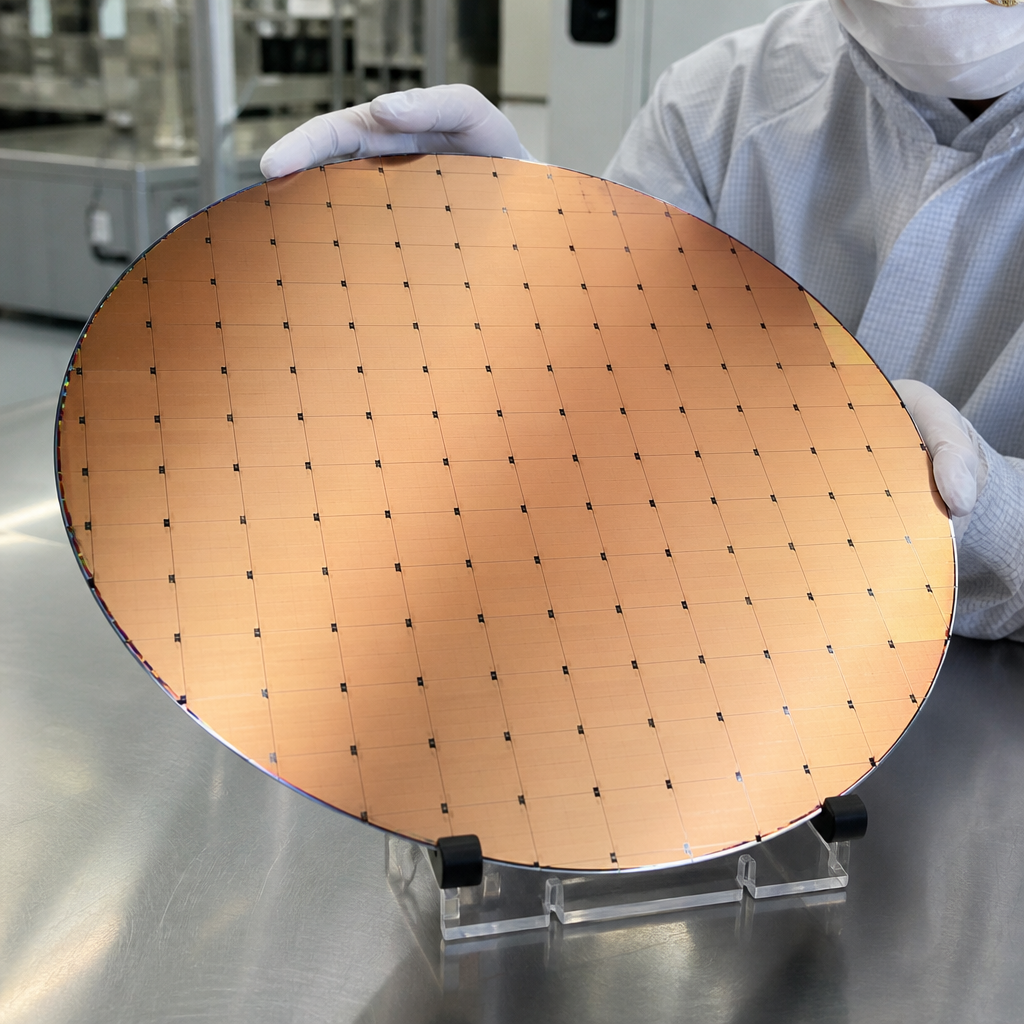
Cerebras Systems has built one of the boldest companies in AI compute and semiconductors by rejecting the assumption that more performance must come from packing ever more graphics processors into larger clusters. Instead, the company’s defining wager is wafer-scale computing: keeping an entire silicon wafer as a single chip and designing systems around that massive piece of silicon. For readers tracking AI infrastructure, this matters because the economics of model training and inference are now constrained as much by memory bandwidth, power delivery, networking, and software efficiency as by raw transistor counts. Cerebras sits at the center of that debate.
In practical terms, AI compute refers to the hardware and software stack used to train and run machine learning models, especially large language models and other deep neural networks. Semiconductors are the physical chips that perform those computations, while accelerators are processors optimized for matrix math rather than general-purpose workloads. Traditional AI computing usually means clusters of GPUs linked by high-speed interconnects, plus CPUs, storage, and orchestration software. Cerebras challenges that model with a wafer-scale engine, weight-streaming architecture, and tightly integrated systems intended to reduce communication overhead and simplify scaling.
I have worked with teams evaluating accelerators for large-model pipelines, and the recurring issue is rarely only FLOPS. It is whether data can reach compute units fast enough, whether memory limits force model sharding, and whether distributed training complexity slows research. Cerebras matters because it attacks those bottlenecks directly. As this hub for AI compute and semiconductors, the article explains what Cerebras Systems is, how wafer-scale chips differ from conventional accelerators, where the company fits against Nvidia, AMD, and cloud providers, and what its approach reveals about the future of AI infrastructure.
What Cerebras Systems Actually Built
Cerebras Systems, founded in 2016, became known for the Wafer-Scale Engine, often abbreviated WSE. Rather than cutting a processed silicon wafer into many separate dies, Cerebras uses the full wafer as one processor. The WSE-3, announced in 2024, contains roughly 4 trillion transistors, about 900,000 AI-optimized cores, and 44 GB of on-chip SRAM, according to company disclosures. The physical scale is striking, but the important point is architectural: a huge amount of compute and fast memory reside on one piece of silicon, connected by an on-wafer fabric that minimizes off-chip communication.
That design addresses a core weakness in conventional AI systems. In a GPU cluster, once a model is large enough, training efficiency depends heavily on moving activations, gradients, and parameters between many chips over NVLink, InfiniBand, or Ethernet. Every hop adds latency, synchronization cost, and software complexity. Cerebras instead tries to keep more of the workload local to the wafer, so communication happens across the chip fabric rather than across a rack-scale network. For workloads that fit its execution model, this can improve utilization and shorten development cycles because engineers spend less time tuning parallelism strategies.
Cerebras does not sell only chips. It packages the wafer-scale engine into complete systems and software. The company’s CS systems, memory appliances, and model-serving stack are meant to present developers with a simpler path for training and inference. That systems-first approach is important in semiconductors because silicon alone does not win adoption. Nvidia’s strength, for example, comes from CUDA, networking, libraries, and cloud availability as much as from the GPU die itself. Cerebras understands the same lesson: customers buy usable AI infrastructure, not transistor diagrams.
Why Wafer-Scale Computing Is a Real Alternative
The basic argument for wafer-scale computing is straightforward. Modern AI workloads are dominated by dense linear algebra and increasingly massive parameter counts. As models grow, data movement becomes one of the biggest performance and energy problems. Moving bits across package boundaries or between servers costs more time and power than moving them on-chip. By turning an entire wafer into one processor, Cerebras increases local bandwidth and reduces dependence on external interconnects. This is not a cosmetic advantage; in large-scale AI, communication overhead is often the hidden tax that erodes theoretical performance.
There are also manufacturing reasons wafer-scale chips were historically avoided. Defects occur on every wafer, and conventional chipmaking improves yield by cutting around faulty regions. Cerebras had to engineer around that reality with redundancy and routing strategies that let the giant chip function even when some areas are imperfect. That is one reason the company is notable within semiconductors broadly, not just AI compute narrowly. It revived an idea long considered impractical and made it commercially credible enough to attract enterprise customers, government labs, and model builders.
The tradeoff is that wafer-scale systems are specialized. GPUs remain more general, more widely available, and better supported across existing machine learning frameworks and cloud marketplaces. Cerebras must therefore prove not only that its hardware is fast, but that it saves total time and cost on meaningful production workloads. In my experience, that is the correct lens for buyers. Benchmark headlines matter less than questions such as: Can a team train a model with fewer distributed systems experts? Can inference latency stay predictable? Can utilization remain high without elaborate tuning? Those are the questions wafer-scale computing tries to answer.
How Cerebras Compares With Traditional AI Computing
Traditional AI computing is dominated by Nvidia GPUs, with AMD trying to expand share and hyperscalers developing custom silicon such as Google TPUs and AWS Trainium. Cerebras differs from all three camps. Nvidia excels through an ecosystem strategy built on CUDA, DGX systems, NVLink, and networking assets from Mellanox. AMD competes on open software and price-performance with Instinct accelerators. Hyperscalers design chips to optimize their own cloud economics. Cerebras, by contrast, is built around minimizing multi-chip complexity through a radically larger single processor and a software stack that abstracts many parallelization headaches.
One useful way to frame the difference is to compare where the bottleneck lives. In a large GPU cluster, the bottleneck often shifts from compute to interconnect and memory orchestration as the job scales. In a Cerebras system, the emphasis is on keeping work close to the wafer and streaming weights efficiently so larger models can run without the same degree of model partitioning. This does not mean network design disappears; clusters still need storage, scheduling, and data pipelines. But it changes the optimization target from distributed synchronization toward local throughput and simplified execution.
| Platform approach | Main strength | Main limitation | Best fit |
|---|---|---|---|
| GPU clusters | Broad software ecosystem and cloud availability | Complex scaling across many chips | General AI training and mixed workloads |
| Wafer-scale systems | High on-chip bandwidth and reduced communication overhead | Smaller ecosystem and specialized deployment model | Large models needing simpler scaling |
| Cloud custom accelerators | Tight integration with provider infrastructure | Usually tied to one cloud environment | Teams standardized on a specific hyperscaler |
For semiconductor buyers, this comparison clarifies the competitive landscape. Cerebras is not trying to become a drop-in replacement for every accelerator. It is aiming at a subset of AI compute where conventional scaling becomes painful enough that an unconventional architecture can win.
Products, Use Cases, and Performance Claims
Cerebras has expanded beyond the original wafer-scale processor into a broader platform that includes systems for training, high-speed memory services, and inference offerings. Its Andromeda supercomputer, built from multiple CS systems, was positioned as an AI supercomputing environment accessible to customers without forcing them to assemble giant GPU fleets themselves. The company has also emphasized model serving, including low-latency inference for large language models. That matters because the AI market has shifted from pure training bragging rights toward the recurring economics of deployment.
Real-world use cases often include foundation model training, scientific computing, genomics, and defense-related research where model size and throughput matter more than fitting into mainstream cloud defaults. Government and research institutions have shown interest partly because procurement priorities can include sovereignty, deterministic performance, and the ability to run large jobs without dependence on scarce GPU inventories. In commercial settings, Cerebras has highlighted partnerships around healthcare, energy, and enterprise AI assistants, where reducing workflow complexity can be as valuable as reducing raw runtime.
Performance claims in this market should always be read carefully. Vendors choose benchmarks that favor their architecture, and comparisons are rarely perfectly apples to apples. The best evaluation method is workload-specific testing: same model class, same precision, same optimizer settings, same data pipeline, and clear reporting on time to train, energy use, operator effort, and inference quality. When teams run proof-of-concept evaluations this way, Cerebras often becomes most compelling when communication overhead dominates on conventional clusters or when engineering simplicity is a strategic priority.
What Cerebras Signals for the Future of AI Compute and Semiconductors
Cerebras Systems represents more than one startup’s attempt to challenge incumbents. It signals that AI compute and semiconductors are entering an architectural diversification phase. For years, the center of gravity moved toward bigger GPU clusters. That model will remain dominant, but it is no longer the only serious path. As model sizes rise and inference demand spreads across enterprises, the market is rewarding designs that attack memory bandwidth, power efficiency, packaging limits, and software complexity from different angles. Wafer-scale computing is one of the clearest examples.
The broader lesson for anyone following company spotlights in AI infrastructure is that the winning platforms will combine hardware innovation with operational usability. Novel chips fail when they require customers to rewrite everything or tolerate fragile tooling. Cerebras has a credible story because it pairs unusual silicon with a systems narrative: fewer distributed bottlenecks, integrated software, and direct alignment with large-model economics. The risks are also clear: entrenched ecosystems are hard to displace, capital requirements are enormous, and buyers want long-term roadmap confidence before standardizing on alternative architectures.
For readers using this article as a hub for AI compute and semiconductors, Cerebras is essential because it forces the right question: should the future of AI be built by networking more chips together, or by redesigning the chip itself to reduce the need for networking? The answer will likely be both. Still, Cerebras has already achieved something important by making wafer-scale computing a live commercial option rather than a historical curiosity. If you are mapping the next generation of AI infrastructure, put Cerebras on the shortlist and evaluate its architecture against your actual workloads.
Frequently Asked Questions
What makes Cerebras different from traditional AI hardware companies?
Cerebras stands apart because it rejects the standard scaling strategy used across much of AI computing. Most conventional systems improve performance by linking together growing numbers of GPUs, which creates larger and larger clusters that must constantly coordinate data movement, memory access, and inter-processor communication. Cerebras takes a fundamentally different approach with wafer-scale computing: instead of cutting a silicon wafer into many separate chips, it keeps the wafer intact and turns that entire surface into one massive processor. That architectural decision changes the problem from “how do we manage more chips?” to “how do we get more work done on one enormous chip?”
The practical significance is substantial. In traditional GPU clusters, performance is often limited not just by raw compute, but by the complexity of distributing workloads across many devices. Engineers have to think about networking bottlenecks, synchronization overhead, memory sharding, and software orchestration across racks of hardware. Cerebras aims to reduce those frictions by consolidating far more compute and on-chip resources into a single system footprint. For AI teams, that can translate into simpler scaling, less dependence on complex interconnect topologies, and potentially more predictable performance for large model workloads.
At a business level, Cerebras is also unusual because it is not merely selling a faster chip; it is promoting an alternative philosophy of AI infrastructure. The company’s wager is that as models become larger and training and inference become more expensive, architectural simplicity and reduced communication overhead may matter as much as, or more than, adding another layer of clustered accelerators. That makes Cerebras notable not only as a semiconductor company, but as a challenger to the dominant assumptions behind modern AI data center design.
What is a wafer-scale chip, and why is it such a bold idea for AI computing?
A wafer-scale chip is exactly what it sounds like: an entire silicon wafer used as a single computing device rather than being diced into many smaller chips after fabrication. In traditional semiconductor manufacturing, wafers are cut into individual dies because that has historically been the most practical way to manage manufacturing defects, packaging, thermal constraints, and cost. Cerebras deliberately breaks from that convention by designing a processor that spans the whole wafer and includes the interconnects, compute cores, and memory architecture needed to operate at that immense scale.
This is a bold idea because it runs against decades of semiconductor industry practice. The standard logic has long been that smaller chips are easier to manufacture economically and easier to deploy in modular systems. A wafer-scale processor introduces intimidating engineering challenges, including how to route signals across a massive piece of silicon, manage power delivery, handle cooling, and work around inevitable manufacturing imperfections. For Cerebras to make this viable, it has to solve not just chip design, but packaging, system architecture, reliability, and software integration in a coordinated way.
The reason the idea is compelling for AI is that AI workloads are hungry for parallelism and fast data movement. Large neural networks often suffer when computation is fragmented across many separate processors that must constantly exchange information. A wafer-scale design can keep much more of the computation local, reducing the need for off-chip communication that slows systems down and drives up operational complexity. In that sense, Cerebras is betting that for AI, one giant processor may be more efficient than a sprawling cluster of smaller ones, especially as the cost and difficulty of scaling traditional architectures continue to rise.
Why does reducing communication overhead matter so much in AI training and inference?
In modern AI systems, the bottleneck is often not the arithmetic itself, but the movement of data. Training and inference both require enormous volumes of parameters, activations, and intermediate results to be moved between memory and compute resources. In a conventional multi-GPU setup, that movement extends beyond a single chip and often beyond a single server, requiring high-speed interconnects and sophisticated scheduling. Every time a workload has to be partitioned across devices, the system pays a penalty in latency, synchronization, and software complexity.
That overhead becomes more severe as models grow. Large language models and other advanced neural networks are often too big or too bandwidth-intensive to fit neatly onto one traditional accelerator, so they are split across many devices. Once that happens, developers must manage tensor parallelism, pipeline parallelism, and data parallelism, each of which introduces communication costs. Even when the hardware is powerful, poor scaling efficiency can prevent teams from realizing the full theoretical benefit of adding more accelerators. In other words, a larger cluster does not automatically mean proportionally better performance.
Cerebras’ wafer-scale approach is designed to address exactly this issue. By concentrating an enormous amount of compute and memory bandwidth within a single unified processor environment, it aims to minimize the amount of data that needs to travel across separate chips or nodes. That can improve effective utilization and simplify the software stack needed to run large AI models. For organizations training frontier-scale models or deploying latency-sensitive inference workloads, cutting communication overhead can have meaningful effects on runtime, cost, energy use, and operational complexity. This is one reason Cerebras attracts attention: it focuses on a problem that increasingly defines the economics of AI infrastructure.
How could Cerebras change the economics of model training and inference?
The economics of AI are increasingly shaped by total system cost rather than chip performance alone. Training a major model involves compute expenses, power consumption, networking infrastructure, engineering labor, data center space, and the operational burden of managing large distributed systems. Inference adds another layer of pressure because organizations need to serve models repeatedly and efficiently at scale, often with strict latency and cost targets. Cerebras is relevant here because its architecture is intended to improve the cost-performance equation by attacking inefficiencies in the system as a whole, not just by offering more raw compute.
If wafer-scale systems can reduce the need for massive clusters and the networking overhead that comes with them, organizations may be able to train certain classes of models with fewer moving parts. That can affect capital expenditure by reducing reliance on elaborate multi-node infrastructure, and it can affect operating expenditure by improving utilization and lowering the complexity of deployment. There is also the engineering productivity angle: distributed AI training is notoriously difficult, and systems that simplify model execution can save time for highly paid research and infrastructure teams. For many companies, the true cost of AI is not only hardware procurement, but also the complexity tax imposed by the hardware architecture they choose.
For inference, the value proposition can be equally important. As enterprises look beyond experimentation and into production AI services, they need hardware that can serve workloads predictably and economically. If Cerebras can deliver strong throughput while reducing communication and orchestration overhead, it could make certain inference scenarios more attractive financially. That said, the economics will depend on workload fit, software maturity, pricing, and deployment model. Cerebras does not automatically replace every GPU cluster, but it raises an important possibility: that the next major gains in AI economics may come from rethinking architecture, not simply scaling conventional systems harder.
Is Cerebras trying to replace GPUs entirely, or is it targeting specific AI workloads?
Cerebras is best understood not as a universal replacement for GPUs, but as an alternative architecture aimed at workloads where the limits of traditional scaling are becoming especially painful. GPUs remain deeply entrenched because they benefit from mature software ecosystems, broad developer familiarity, extensive cloud availability, and strong performance across many AI and high-performance computing tasks. That installed base gives GPUs enormous practical advantages. Cerebras enters the market by arguing that for certain large-scale AI problems, especially those constrained by inter-device communication and distributed training complexity, the prevailing GPU-first model is no longer the only sensible option.
Its strongest appeal is likely in training and inference scenarios where model size, memory movement, and cluster orchestration dominate the performance profile. Research institutions, hyperscalers, national labs, and enterprises running demanding AI workloads may see value in a system that reduces partitioning headaches and offers a more unified computational environment. The company’s architecture may be especially relevant where fast iteration on large models matters and where infrastructure teams are searching for ways to avoid the diminishing returns that can come from simply adding more GPUs and more networking layers.
So the real story is not “GPUs versus Cerebras” in a simplistic winner-take-all sense. It is about architectural specialization in an era when AI workloads are diverging rapidly. Some applications will continue to run best on conventional accelerators because of ecosystem support, flexibility, and availability. Others may benefit from wafer-scale systems because they are bottlenecked by communication, scaling inefficiency, or deployment complexity. Cerebras’ significance lies in proving that there is room in the AI compute market for a radically different design philosophy—one that challenges the assumption that ever-larger GPU clusters are the inevitable future of machine learning infrastructure.