Nuro has evolved from a highly focused autonomous delivery startup into a broader autonomy platform company, and that shift says a great deal about where robotics and self-driving technology are headed. In practical terms, Nuro began by building compact driverless road vehicles designed specifically for local goods delivery, then expanded its software, hardware, and licensing strategy so its autonomy stack could support multiple vehicle types and commercial models. For readers tracking robotics and autonomy, Nuro matters because it sits at the intersection of artificial intelligence, automotive engineering, logistics, safety regulation, and business model innovation.
In my work reviewing autonomy companies, Nuro has consistently stood out for making an early strategic decision that many better-funded rivals avoided: it did not start with robotaxis or consumer passenger transport. Instead, it targeted middle-mile and last-mile delivery, where speed limits are lower, routes are more structured, and the vehicle can be purpose-built without the complexity of carrying people. That choice reduced certain operational risks while also aligning the product with growing e-commerce demand, grocery delivery, and local retail fulfillment.
To understand Nuro, it helps to define a few key terms. Autonomous delivery vehicles are self-driving machines that transport goods rather than passengers. An autonomy stack is the integrated combination of sensors, onboard compute, mapping, perception, prediction, planning, and control software that allows a vehicle to drive itself. A broader autonomy platform means the company is not only operating its own vehicles but also packaging its technology so partners can adapt it for commercial fleets, custom vehicle programs, and new use cases. That distinction is central to Nuro’s current position.
This company spotlight also functions as a hub for robotics and autonomy because Nuro’s story touches nearly every major industry theme: system design, safety validation, regulation, commercialization, partnerships, and scalable deployment. If you want to understand how autonomy companies move from a single flagship product to a platform strategy, Nuro is one of the clearest examples.
How Nuro Started and Why Its Vehicle Design Was Different
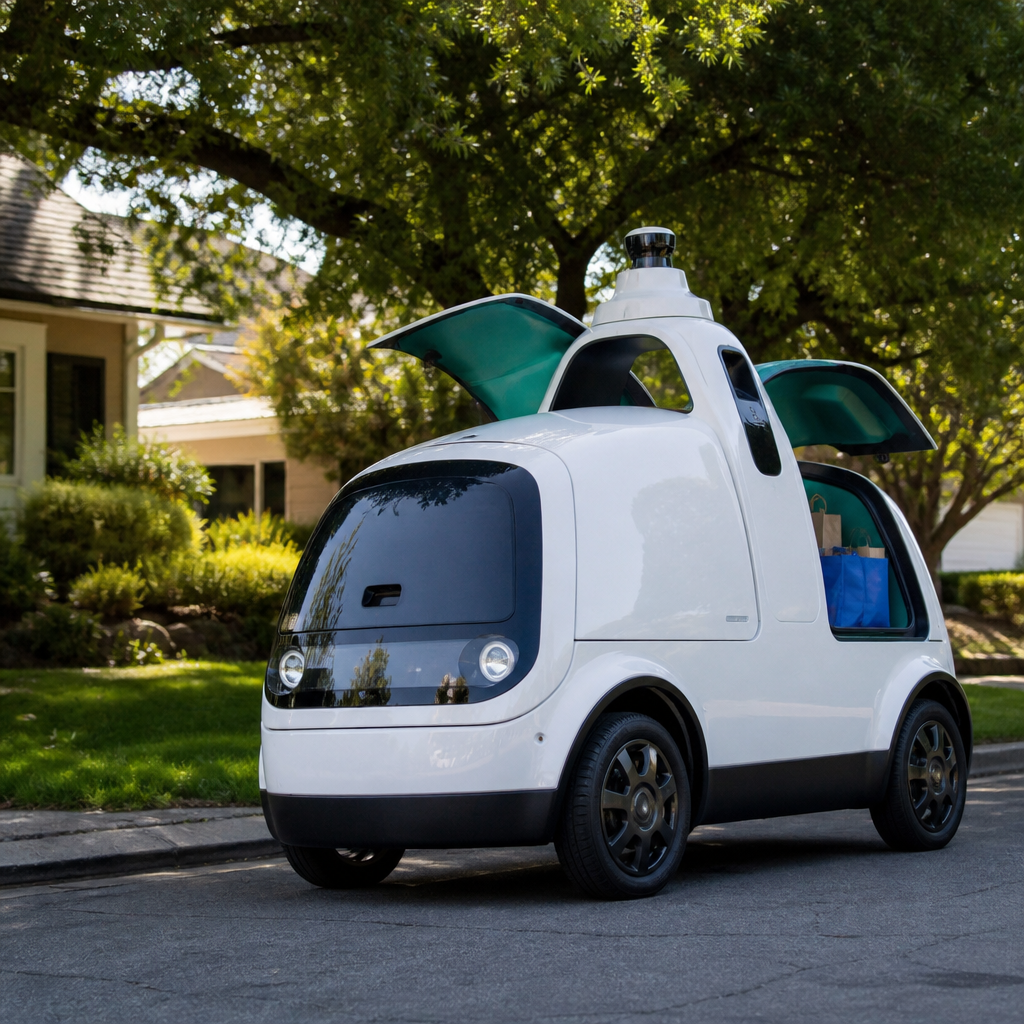
Nuro was founded in 2016 by Dave Ferguson and Jiajun Zhu, both former leaders from Google’s self-driving car program, later known as Waymo. Their background mattered. They brought deep experience in machine learning, robotic perception, and autonomous vehicle operations, but they also entered the market with a narrower thesis than many peers. Rather than building a general-purpose self-driving car, Nuro designed low-speed road vehicles specifically for goods delivery. The company’s early R1 and later R2 models reflected that philosophy with no driver seat, no passenger cabin, and a form factor optimized around cargo compartments.
This design choice had technical and regulatory implications. By removing human occupants, Nuro could prioritize external safety, low operating speeds, and payload efficiency over ride comfort and interior controls. In plain terms, the engineering problem changed. The vehicle still needed robust perception using lidar, radar, cameras, and redundant systems, but it did not need steering wheels, dashboard interfaces, or crash-protection layouts built for passengers. That created room for a smaller footprint and a clearer safety case for neighborhood operation.
It also supported a stronger logistics argument. Grocery chains, pharmacies, and restaurant operators do not primarily care whether a delivery vehicle looks like a car; they care about cost per drop, order integrity, route consistency, and service reliability. Nuro’s custom vehicles were built around those business requirements.
Core Autonomy Technology and the Platform Shift
Nuro’s broader significance now lies in its autonomy platform strategy. The company has spent years building software and systems that go well beyond one custom delivery robot. A modern autonomy platform includes high-resolution mapping, localization, sensor fusion, object detection, motion forecasting, behavioral planning, and actuation control, all supported by simulation, fleet learning, remote assistance tooling, and safety telemetry. Nuro has positioned these capabilities as reusable building blocks.
From an industry standpoint, this shift mirrors a hard lesson in robotics: capital-intensive hardware businesses often need software leverage to scale. Operating a branded fleet can prove a concept, but licensing autonomy technology, supporting partner vehicle integration, and supplying reference architectures can expand total addressable market without requiring ownership of every vehicle on the road. Nuro’s public messaging and partnerships indicate that it increasingly sees itself as an autonomy enabler, not only a delivery operator.
That matters because the same foundational stack can serve several domains with adaptation. A low-speed goods vehicle, a neighborhood delivery van, an airport support vehicle, or a commercial shuttle each require different operational design domains, but they share common autonomy primitives. In practice, companies that build mature perception and planning systems can port them more efficiently than companies starting from scratch for every vehicle class.
Commercial Partnerships and Real-World Deployments
Nuro gained early visibility through partnerships with recognizable brands including Kroger, Domino’s, Walmart, CVS, and 7-Eleven. These relationships were not just marketing wins. They served as operational test beds for core questions: Can autonomous delivery cut fulfillment costs? Will customers trust curbside robotic handoff? How do retailers integrate autonomous dispatch into existing order systems? Those are the details that determine commercial viability.
In my assessment, Nuro’s most important accomplishment was not the novelty of a driverless delivery pod; it was proving that major retailers were willing to experiment with autonomous logistics in live environments. That signal matters across robotics and autonomy because enterprise adoption typically begins with constrained pilots, then expands only if metrics such as on-time delivery, incident rates, and labor efficiency improve.
| Partner | Use Case | Why It Mattered |
|---|---|---|
| Kroger | Grocery delivery pilots | Tested cold-chain capable local fulfillment and repeat household orders |
| Domino’s | Autonomous pizza delivery | Showed consumer-facing handoff and time-sensitive food delivery potential |
| Walmart | Retail delivery experiments | Validated interest from a high-volume national retailer with dense logistics needs |
| CVS | Pharmacy and convenience delivery | Demonstrated suitability for small, urgent neighborhood orders |
| 7-Eleven | Local store delivery | Supported short-route deployment economics in suburban settings |
These pilots did not instantly transform local commerce, and that is an important reality check. Deployment economics in autonomy remain sensitive to utilization, weather, regulation, maintenance, and teleoperations support. Still, each partnership generated data, operational learning, and evidence that autonomy can fit real supply chains when the use case is narrow enough.
Safety, Regulation, and Why Nuro Earned Attention
Safety is the deciding factor for any autonomy company, and Nuro received notable attention because it worked through U.S. regulatory pathways for a vehicle unlike a conventional passenger car. The National Highway Traffic Safety Administration granted Nuro a temporary exemption for its R2 vehicle from certain low-speed vehicle requirements that were written around human drivers, such as mirrors and windshield-related features. That was a significant milestone because it recognized that purpose-built autonomous vehicles may require a different compliance framework than retrofitted cars.
However, exemption does not mean reduced safety expectations. If anything, scrutiny increases. A credible autonomy company needs a documented safety case, redundancy in critical systems, hazard analysis, cybersecurity controls, fallback behaviors, and structured validation across simulation, closed-course testing, and public-road operations. Standards such as ISO 26262 for functional safety, UL 4600 for autonomous product safety, and SAE J3016 terminology shape how sophisticated operators communicate these practices. Companies that cannot translate technical claims into a regulator-ready safety argument rarely scale.
Nuro’s emphasis on low-speed operation helped here. Lower kinetic energy reduces some crash severity risks, and tightly defined operating domains make edge cases more manageable. That does not eliminate danger, but it improves the probability of building a defendable deployment program.
What Nuro Reveals About Robotics and Autonomy as a Sector
Nuro’s trajectory illustrates several broader truths about robotics and autonomy. First, domain selection matters more than broad ambition. Companies that start with constrained environments often progress faster than companies chasing universal autonomy from day one. Second, purpose-built hardware can be a strategic advantage when the use case is specific enough. Third, software reuse and platformization are usually necessary if the economics of custom robotics are going to work at scale.
For anyone researching robotics and autonomy companies, Nuro is a strong hub case because it connects to adjacent subtopics that deserve deeper exploration: autonomous delivery economics, teleoperations, fleet management software, sensor stack tradeoffs, autonomy safety cases, robotic last-mile logistics, and the growing market for licensing self-driving systems to manufacturers. It also creates a useful contrast with companies focused on passenger robotaxis, warehouse robots, sidewalk delivery bots, agricultural autonomy, or industrial mobile robots.
There are limitations to keep in view. Local delivery is operationally fragmented, margins are often thin, and partner timelines can change quickly. The autonomy stack must perform not just in ideal suburban streets but also around construction zones, unusual driver behavior, and varied curbside conditions. Commercial success depends as much on integration and unit economics as on technical capability.
Why Nuro’s Next Phase Matters
Nuro’s next phase matters because it reflects a maturing autonomy market. The early era rewarded bold demos and concept vehicles. The current era rewards companies that can validate safety, survive regulatory review, integrate with enterprise operations, and turn autonomy into repeatable product infrastructure. By broadening from autonomous delivery vehicles to a wider autonomy platform, Nuro is pursuing a more durable position in the value chain.
For business leaders, the lesson is straightforward: autonomy adoption works best when it solves a defined operational problem with measurable return. For investors, Nuro shows why technical depth alone is not enough; go-to-market design and regulatory execution are equally important. For readers following company spotlights in robotics and autonomy, Nuro is a useful anchor because it demonstrates how a focused product can evolve into a platform strategy without abandoning its original commercial logic.
The key takeaway is that Nuro should be understood not only as a maker of driverless delivery pods, but as a company building transferable autonomy systems for real-world logistics and beyond. If you are mapping the robotics and autonomy landscape, use Nuro as a starting point, then explore the related themes it opens up across safety, deployment, infrastructure, and commercialization.
Frequently Asked Questions
1. What does it mean that Nuro has shifted from an autonomous delivery vehicle company to a broader autonomy platform company?
Nuro’s shift means the company is no longer defined only by the small, driverless delivery vehicles that first made it well known. In its early phase, Nuro was tightly focused on a specific use case: transporting local goods such as groceries, takeout, and pharmacy orders in purpose-built road vehicles with no human driver onboard. That narrow focus helped the company prove real-world autonomy in a controlled commercial setting and develop technology around safety, routing, perception, and low-speed urban operation.
As Nuro broadened into an autonomy platform company, the center of gravity moved from just building a single vehicle product to building a reusable autonomy stack. That stack includes the software, sensor integration, computing architecture, safety systems, simulation tools, and operational know-how required to enable autonomous operation across different vehicle formats and business models. In other words, instead of being only a manufacturer and operator of delivery robots, Nuro is positioning itself as a provider of autonomy capabilities that can be adapted, licensed, and deployed more broadly.
This matters because it reflects a larger industry reality. Robotics and self-driving companies often begin with a narrow vertical because autonomy is difficult to commercialize all at once. Once the technology matures, however, the greatest long-term value often comes from making that technology portable across applications. Nuro’s evolution suggests that the future of autonomy may belong not only to companies that operate their own fleets, but also to those that can supply the foundational intelligence and safety systems other businesses need.
2. Why did Nuro originally focus on autonomous delivery vehicles, and why was that strategy effective?
Nuro’s original focus on autonomous delivery vehicles was effective because it targeted a use case with clear commercial demand and a more manageable operating environment than full passenger transportation. Local goods delivery has obvious value for retailers, restaurants, grocers, and consumers, especially as on-demand commerce becomes more common. By concentrating on deliveries rather than transporting people, Nuro could design a vehicle around cargo, not comfort, and optimize for short trips, neighborhood routes, and lower-speed roads.
That focus also gave the company important engineering and regulatory advantages. A compact delivery vehicle has different requirements from a passenger car, and those differences can reduce complexity in meaningful ways. The vehicle can be smaller, lighter, and purpose-built for a constrained mission. The operating domain can be selected carefully. The company can concentrate on repeatable routes and commercial partnerships rather than attempting to solve every driving situation everywhere at once. This is one reason Nuro became a closely watched example of how autonomy might reach the market through a targeted application rather than a broad consumer rollout.
From a business perspective, the strategy was strong because it tied technical development to an actual revenue-generating problem. Nuro was not just demonstrating autonomy for its own sake; it was addressing last-mile logistics, one of the most expensive and operationally difficult parts of commerce. That made the company’s value proposition easier to understand. Even now, as Nuro expands into a platform approach, its delivery-first roots remain important because they provided a practical proving ground for the technology and established credibility in real-world deployment.
3. What is included in an autonomy platform, and how can Nuro’s technology apply to multiple vehicle types?
An autonomy platform typically includes far more than the visible driving behavior people associate with self-driving systems. At its core, it includes perception systems that interpret the environment using sensors, prediction models that estimate what surrounding road users may do next, planning software that decides how the vehicle should respond, and control systems that execute those decisions safely. Around that core sits a much larger technical ecosystem: sensor calibration, onboard compute, redundancy, remote operations support, mapping, validation frameworks, simulation environments, safety case development, and fleet management tools.
When a company like Nuro expands beyond a single vehicle, the goal is to make as much of that stack reusable as possible. The exact hardware package may change between platforms, and specific tuning will vary based on vehicle size, speed, braking behavior, and operating domain, but the underlying autonomy architecture can often be adapted rather than rebuilt from scratch. For example, the way a system detects pedestrians, interprets lane geometry, handles intersections, or responds to uncertain situations can be generalized across multiple vehicle categories with the right engineering approach.
This is what makes the platform idea strategically powerful. If Nuro can provide an autonomy system that supports different commercial use cases, it becomes relevant to a wider set of partners. Instead of betting entirely on the economics of one vehicle form factor, the company can participate wherever its technology fits. That broadens its addressable market and can make the business more resilient. For industry observers, it also signals a transition from product-specific robotics to modular autonomy infrastructure, where software, safety systems, and deployment expertise become assets that can travel across markets.
4. How does Nuro’s broader platform strategy reflect larger trends in robotics and self-driving technology?
Nuro’s evolution reflects a major pattern in advanced robotics: companies often begin with a constrained, highly specific application, then expand once they have a workable technical and commercial foundation. In self-driving, this progression is especially common because autonomy is extraordinarily difficult to scale universally. A focused application allows a company to narrow variables, validate safety, build operational discipline, and prove that customers will pay for the outcome. Once those pieces are in place, the next logical move is to extend the technology into adjacent opportunities.
This trend also highlights how the industry is maturing. Early self-driving narratives often centered on the idea of a single breakthrough that would suddenly unlock fully autonomous passenger transportation everywhere. In practice, the field has moved toward domain-specific deployment, layered commercialization, and platform thinking. Companies increasingly recognize that the long-term value may come from robust autonomy building blocks that can be integrated into different products and services. Nuro’s broader strategy fits squarely within that reality.
For robotics more generally, the lesson is that successful companies do not just build machines; they build systems. Those systems include hardware, software, operations, safety processes, and commercial partnerships. As those elements become more standardized and transferable, companies can move from offering one robotic product to offering a capability platform. Nuro’s path therefore says a great deal about where the sector is headed: toward autonomy as an enabling layer that can support multiple industries, rather than a one-off technology tied to a single robot or vehicle design.
5. Why should investors, operators, and technology watchers pay attention to Nuro’s transition?
Nuro’s transition is worth watching because it provides insight into how autonomy companies may create durable businesses. A narrowly focused product can be a strong entry point, but long-term scale often requires flexibility in how the technology is monetized. By broadening from operating its own delivery vehicles to supporting wider autonomy use cases and commercial structures, Nuro is potentially opening more paths to growth. That could include licensing, partnerships, embedded autonomy offerings, or other forms of technology deployment that do not depend exclusively on one fleet model.
For operators and commercial partners, the shift is important because it suggests greater adaptability. Companies interested in automation may not want to build a complete self-driving stack internally, and they may not need the exact delivery vehicle Nuro originally developed. What they may want is proven autonomy capability that can fit into their own vehicles, logistics workflows, or service offerings. A platform-oriented Nuro becomes more relevant to those organizations because it can meet them where they are rather than requiring adoption of a single predefined product.
For technology watchers, the bigger significance is strategic. Nuro’s story captures a broader truth about the robotics market: real value often emerges when specialized breakthroughs become reusable infrastructure. The companies that succeed may be those that can translate a hard-won niche advantage into a scalable platform. That is why Nuro’s transition matters beyond one company. It offers a practical example of how autonomous systems can move from a compelling demonstration to a broader commercial foundation, which is exactly the kind of shift that tends to define the next stage of an industry.