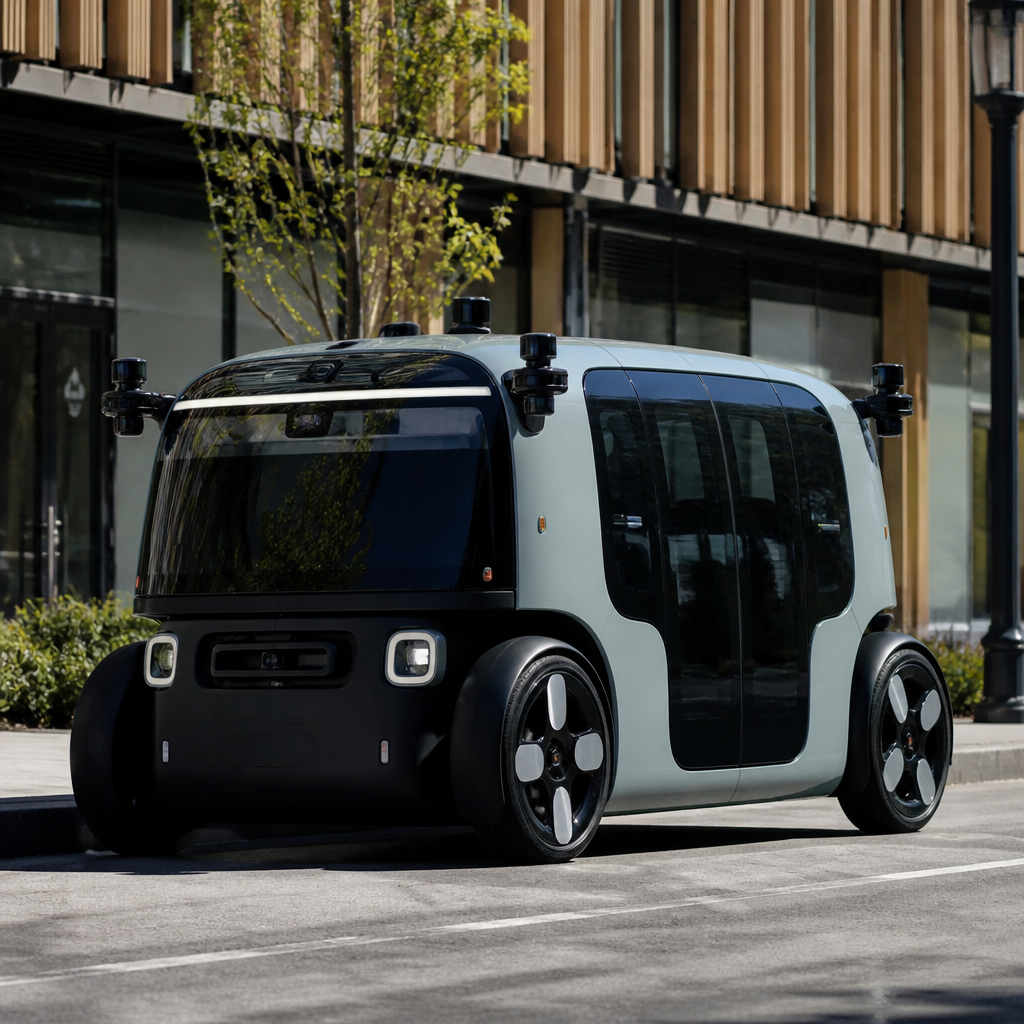
Zoox represents one of the clearest examples of a purpose-built robotaxi strategy, a model of autonomous transportation designed from the ground up for ride-hailing rather than adapted from conventional cars. In robotics and autonomy, that distinction matters. A purpose-built vehicle integrates sensing, compute, passenger layout, safety systems, fleet operations, and software architecture around a single job: moving people through dense urban environments without a human driver. After working through many autonomy programs and supplier stacks, I have seen how often retrofitted vehicles inherit compromises from legacy design. Zoox took the opposite route. Its robotaxi concept combines bidirectional driving, four-wheel steering, symmetrical design, and an electric platform intended for commercial fleet service. That makes Zoox an important company spotlight for anyone tracking robotics and autonomy because it captures the industry’s central question: is autonomy best delivered by modifying existing automobiles, or by creating a new machine around autonomous use from day one?
The company also matters because autonomous transportation is not just an automotive story. It sits at the intersection of robotics, machine perception, functional safety, machine learning, mapping, cloud operations, human-machine interaction, and municipal deployment. A robotaxi is effectively a mobile robot operating in an unstructured public environment with strict safety expectations and near-zero tolerance for error. In plain terms, it must perceive pedestrians, cyclists, emergency vehicles, lane markings, construction cones, and erratic driver behavior, then make acceptable decisions in real time. Zoox is notable within this field because it built both the vehicle and the autonomy stack, a vertically integrated approach more comparable to advanced robotics companies than to traditional automakers. For readers exploring Robotics & Autonomy as a topic hub, Zoox provides a useful anchor: it illustrates how sensing, planning, controls, hardware redundancy, regulation, and fleet economics come together in a real commercial program.
What Zoox Is and How Its Robotaxi Differs
Zoox was founded in 2014 and later acquired by Amazon in 2020, giving it access to substantial capital, operational talent, and long-term infrastructure support. Its core product is an autonomous, all-electric robotaxi built without a steering wheel or driver’s seat. Unlike most autonomous test vehicles, which start as standard SUVs fitted with sensors and computers, Zoox designed a cabin for riders facing each other, with no front or rear in the conventional sense. The vehicle can drive bidirectionally and use four-wheel steering, allowing tighter maneuvering and potentially easier operation in constrained urban spaces. These design choices are not cosmetic. They affect route planning, curbside pickup behavior, interior capacity, maintenance procedures, and the software assumptions governing the whole system.
That difference is strategically significant. Retrofitted vehicles benefit from existing manufacturing processes and regulatory familiarity, but they carry constraints such as fixed driver controls, limited packaging space for compute and thermal systems, and passenger layouts optimized for human operation. Zoox instead designed around autonomous service requirements. In my experience, this can reduce friction between hardware and software teams because sensor placement, wiring harnesses, braking redundancy, and occupant experience are treated as one system. A purpose-built robotaxi can also standardize fleet maintenance more effectively than a mixed vehicle base. The tradeoff is obvious: custom vehicles face a steeper path in manufacturing validation, certification, and unit economics. Zoox chose the harder engineering route in pursuit of a cleaner long-term operational model.
The Robotics Stack Behind Autonomous Transportation
Autonomous transportation depends on a robotics stack that usually includes perception, localization, prediction, planning, controls, system supervision, and remote fleet support. Zoox’s system uses a multi-sensor approach, commonly described across the industry as combining lidar, radar, cameras, and inertial sensing. Each modality solves a different problem. Cameras provide rich semantic information such as traffic light state, lane markings, and object classification. Radar helps with velocity estimation and performance in adverse visibility. Lidar delivers precise range data and three-dimensional scene structure. In mature robotic systems, sensor fusion matters more than any individual sensor because reliability comes from overlap, disagreement handling, and graceful degradation.
Localization is another essential layer. A robotaxi must know where it is to within tight tolerances, often using high-definition maps, onboard sensing, GNSS, and inertial measurement. Planning then converts that situational awareness into safe trajectories that respect traffic rules, comfort limits, and dynamic obstacles. This is where autonomous systems either feel natural or brittle. A vehicle may detect everything correctly and still behave poorly if prediction and motion planning are weak. Zoox’s emphasis on urban robotaxi service means its software must handle frequent unprotected turns, pickups near curbs, pedestrians crossing unpredictably, and interactions with human drivers who do not act consistently. Those are classic robotics problems in partial observability, uncertainty management, and real-time decision-making, not just automotive features.
Why Purpose-Built Design Changes the Economics and User Experience
A purpose-built robotaxi is not only an engineering philosophy; it is also an operating model. The cabin layout in Zoox’s vehicle is designed around passengers rather than a driver, which changes ingress, seating posture, social interaction, and perceived space efficiency. For short urban trips, riders care about easy entry, legroom, visibility, climate comfort, and whether the ride feels smooth and predictable. In fleet economics, operators care about utilization, cleaning, service intervals, battery charging strategy, and downtime per mile. When the vehicle is purpose-built, those concerns can be addressed at the architecture level instead of patched afterward.
The table below shows why this matters when comparing a purpose-built robotaxi with a retrofitted autonomous vehicle:
| Dimension | Purpose-Built Robotaxi | Retrofitted Vehicle |
|---|---|---|
| Interior layout | Designed for passengers only | Constrained by driver-centric cabin |
| Sensor integration | Packaged into vehicle architecture | Added onto existing body and systems |
| Maneuverability | Can optimize steering and symmetry for urban use | Limited by original chassis design |
| Maintenance | Standardized for fleet service from launch | Often adapted from consumer service models |
| Regulatory path | Potentially more novel and complex | Benefits from familiar vehicle baseline |
| Scalability risk | Higher manufacturing complexity upfront | Higher compromise over long-term operations |
In practice, I have seen fleet teams struggle when a vehicle was never meant to support autonomous hardware. Cooling loads, sensor cleaning access, wiring failures, and body repair complexity can quietly erode uptime. Zoox’s design seeks to minimize those friction points. Still, the economics only work if reliability reaches commercial levels and the vehicle can maintain high utilization within geofenced service areas. That is why purpose-built design is promising but not self-validating. Operational excellence must prove the thesis.
Safety, Regulation, and Deployment Realities
Safety is the hardest topic in autonomous transportation because the public wants a simple answer while the engineering reality is probabilistic and system-based. No serious autonomy company should claim perfection. What matters is whether the system is demonstrably safer than human driving under defined conditions, whether failure modes are understood, and whether mitigations are layered. Zoox’s approach reflects established safety principles used in robotics and automotive engineering: redundancy in braking and steering, continuous system monitoring, fallback behaviors, validation in simulation and on-road testing, and tightly defined operational design domains. Industry standards such as ISO 26262 for functional safety and UL 4600 for autonomous system safety cases shape how credible companies structure development and evidence.
Regulatory progress is equally important. Robotaxi deployment in the United States typically involves state motor vehicle authorities, local permitting, and, depending on vehicle configuration, federal exemption pathways or compliance strategies. Public trust can change quickly after a high-profile incident anywhere in the sector, even if a specific company was not involved. That means deployment is not purely technical. It includes community engagement, emergency responder training, data logging, incident review, and transparent safety communication. Zoox has tested in places such as California and Nevada, and like its peers, it must expand carefully from controlled pilots to broader commercial service. Geofencing is not a weakness; it is how responsible robotics programs constrain risk while improving performance in known environments.
Zoox Within the Wider Robotics and Autonomy Landscape
As a hub topic for Company Spotlights in Robotics & Autonomy, Zoox is best understood alongside broader industry patterns. Waymo emphasizes extensive operational deployment and a mature autonomous driving stack layered onto production-derived vehicles. Cruise pursued large-scale urban robotaxi operations before facing regulatory and operational setbacks that highlighted how fragile public trust can be. Nuro focused on low-speed autonomous delivery, showing that autonomy can succeed in narrower use cases before passenger transport reaches scale. Tesla has pushed a camera-heavy strategy tied to consumer vehicles and end-user ownership, a fundamentally different model from purpose-built fleet robotaxis. Mobileye has built a major business around driver assistance, mapping, and autonomy components. Each approach reflects a different answer to the same core challenge: how to align sensing, software, safety, regulation, and economics.
Zoox stands out because it treats the robotaxi as a new robotic product category, not simply an extension of the car. That framing matters for anyone studying autonomy. The future of robotic mobility may include warehouse robots, sidewalk delivery robots, autonomous trucks, port vehicles, and industrial mobile platforms, but they all share a systems lesson: success comes from matching embodiment to mission. Zoox embodies that principle clearly. If you are exploring robotics and autonomy, follow how the company advances vehicle validation, fleet deployment, safety evidence, and rider experience. Those signals reveal whether the purpose-built robotaxi model can move from compelling concept to durable transportation business, and they offer a practical lens for understanding the next generation of autonomous mobility.
Frequently Asked Questions
What does it mean that Zoox uses a purpose-built robotaxi instead of adapting a conventional car?
When Zoox is described as a purpose-built robotaxi company, it means the vehicle was designed from the start for autonomous ride-hailing rather than retrofitted from a traditional passenger car. That distinction is important because it changes nearly every engineering decision. Instead of beginning with a car originally made for a human driver and then adding sensors, compute hardware, and self-driving software, Zoox builds the entire platform around one mission: transporting passengers safely and efficiently in urban environments without a human behind the wheel.
In practical terms, a purpose-built design allows Zoox to rethink the cabin layout, safety architecture, sensor placement, and operational model as a unified system. The vehicle does not need to prioritize driver ergonomics, steering wheel placement, or front-facing seating in the same way a conventional car does. That opens the door to a more symmetrical passenger experience, better use of interior space, and a layout tailored to short urban trips. It also means sensing and compute can be integrated more cleanly into the vehicle body instead of appearing as external add-ons.
From an autonomy perspective, this approach can reduce compromises. Adapted cars often carry legacy assumptions from traditional automotive design, while a purpose-built robotaxi can align hardware, software, and fleet operations more directly with autonomous service goals. For a company like Zoox, that creates a clearer path toward optimizing reliability, maintainability, rider comfort, and urban maneuverability all at once. The result is not just a car with self-driving technology, but a transportation system intentionally engineered around autonomous mobility.
Why is a purpose-built robotaxi strategy especially relevant for dense urban transportation?
Dense cities are among the most demanding environments for autonomous transportation. Streets are crowded, traffic patterns are unpredictable, and vehicles must interact safely with pedestrians, cyclists, delivery vehicles, buses, construction zones, and complex intersections. In that setting, a purpose-built robotaxi strategy makes sense because the vehicle and the autonomy stack can be optimized specifically for those challenges rather than forced to inherit design choices from consumer automobiles.
Zoox’s approach is relevant here because urban ride-hailing is not simply about getting a car to drive itself. It is about creating a repeatable mobility service that can handle frequent stops, tight turns, curbside pickups, changing traffic conditions, and continuous fleet utilization. A purpose-built vehicle can be designed with compact dimensions, excellent visibility through sensor placement, and passenger access suited to frequent entry and exit. It can also be engineered with durable interiors and systems intended for high daily usage instead of private, occasional ownership.
There is also an operational advantage. In cities, fleet efficiency matters as much as vehicle intelligence. Autonomous transportation in an urban context depends on dispatch systems, remote support tools, maintenance workflows, and software updates working in concert with the vehicle itself. By designing the robotaxi around fleet service from day one, Zoox can align the onboard systems with the realities of commercial urban transportation. That makes the model more than a technical experiment; it becomes a service platform intended for real-world city mobility.
How does Zoox’s vehicle design support autonomy, passenger experience, and safety at the same time?
One of the central ideas behind Zoox is that autonomy, passenger comfort, and safety should not be treated as separate layers added one after another. In a purpose-built robotaxi, those elements are developed together. The vehicle’s form, interior arrangement, sensing strategy, and core safety systems all support the same objective: enabling dependable autonomous transportation that people are willing to use regularly.
For autonomy, the design can support sensor coverage and computing integration in a way that is cleaner and more deliberate than many retrofitted vehicles. Because the platform is not constrained by the assumptions of a human-operated car, components can be positioned to maximize situational awareness and redundancy. That is important because autonomous systems rely on consistent perception and decision-making across many driving scenarios, especially in complex urban environments.
For passengers, the absence of a traditional driver-focused layout allows the interior to be shaped around rider comfort and social use. Seating can be arranged to make the cabin feel more like a shared mobility space than a conventional front-and-back automobile. This can improve comfort, accessibility, and the overall perception that the vehicle was designed for riders, not just converted for them. That matters in a ride-hailing service where user trust and comfort are critical to adoption.
Safety ties everything together. In a purpose-built system, structural choices, operational safeguards, system redundancy, and software behavior can be coordinated as part of one architecture. Rather than asking how to preserve the familiar structure of a normal car while adding autonomy, Zoox can ask what safety should look like in a driverless urban vehicle from first principles. That systems-level thinking is one of the strongest arguments for the purpose-built robotaxi model.
What are the potential advantages of Zoox’s model compared with self-driving systems built on standard vehicles?
Zoox’s model offers several potential advantages, especially when viewed through the lens of long-term autonomous service operations. The first is integration. When the vehicle, the software stack, the sensor suite, and the fleet model are all designed together, the company can optimize performance across the whole system rather than trying to reconcile components that were developed for different purposes. That can improve efficiency, simplify maintenance, and reduce the engineering tradeoffs that often come with retrofitting existing vehicles.
Another advantage is user experience. A robotaxi built specifically for ride-hailing can deliver a more intentional passenger environment, from entry and exit flow to seating layout and interior durability. This is valuable because autonomous transportation is not judged only by whether the vehicle can drive itself. Riders also evaluate comfort, convenience, perceived safety, and whether the experience feels trustworthy and intuitive. A purpose-built vehicle can address those expectations more directly than a converted consumer car.
There are also operational benefits. Standard vehicles are usually designed for private ownership, not around-the-clock commercial service. Zoox’s approach allows the company to consider maintenance access, cleaning, software deployment, usage cycles, and fleet coordination as core design inputs. For a robotaxi business, those details strongly influence economics and scalability. If a vehicle is easier to service, better suited to repetitive short trips, and more closely aligned with dispatch software and autonomy systems, the entire service model can become more viable.
Finally, a purpose-built platform may provide stronger long-term strategic clarity. Rather than pursuing autonomy as an added feature on top of conventional automotive assumptions, Zoox is developing a transportation product centered entirely on driverless urban mobility. That focus can be a significant advantage in an industry where the hardest challenge is often not just technical autonomy, but turning autonomy into a coherent transportation service.
What does Zoox reveal about the broader future of autonomous transportation and robotaxi development?
Zoox highlights an important idea in the evolution of autonomous transportation: success may depend not only on self-driving software, but on designing the entire mobility stack around autonomy from the ground up. In earlier phases of the autonomous vehicle race, many efforts focused heavily on making existing cars drive themselves. Zoox represents a different philosophy, one that suggests true robotaxi services may work best when the vehicle, service model, passenger experience, and operational infrastructure are all purpose-built together.
This matters for the broader industry because autonomous transportation is a systems problem, not just a driving problem. A viable robotaxi network must combine perception, planning, safety engineering, real-time operations, customer experience, regulatory readiness, and commercial fleet management. Zoox demonstrates how a company can approach those pieces as an integrated product instead of a collection of loosely connected technologies. That does not guarantee success, but it does reflect a mature understanding of what large-scale autonomous mobility requires.
Zoox also points toward a future in which urban transportation vehicles may diverge more sharply from personally owned cars. If autonomous ride-hailing becomes more common, the vehicles serving that market may increasingly be designed for shared, repetitive, city-based transport rather than personal driving versatility. In that sense, Zoox is not just building a self-driving car; it is exploring what a new category of transportation machine might look like when human driving is no longer the central assumption.
For readers trying to understand where robotaxis are headed, Zoox is a useful case study because it illustrates the strategic value of starting with the service goal and designing backward from it. The broader lesson is simple: in autonomous transportation, the companies that align vehicle design, autonomy, and fleet operations most effectively may be the ones best positioned to shape the future of urban mobility.