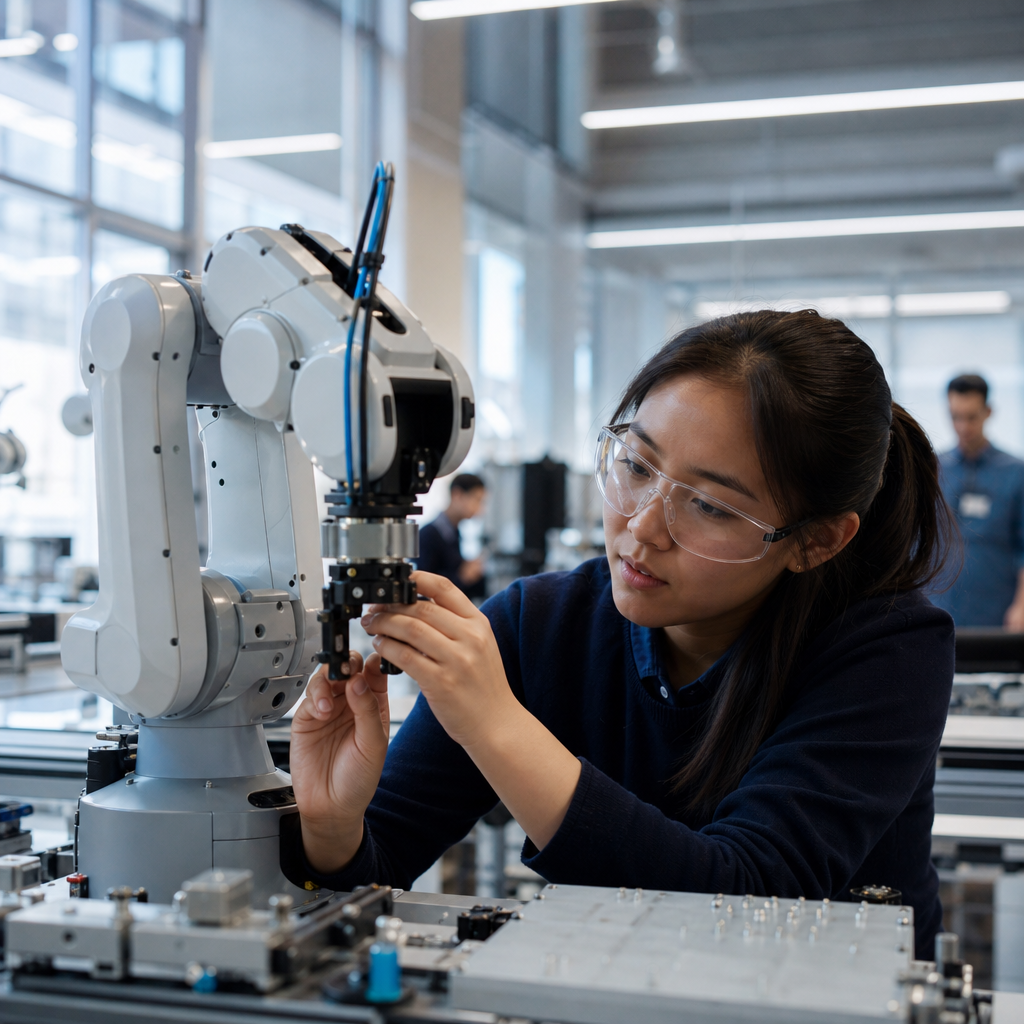
Robotics and automation are reshaping how people learn, work, and solve problems, and Silicon Valley has become the clearest example of future-focused learning built around these technologies. In education, robotics refers to the design, programming, and operation of machines that sense, decide, and act in the physical world. Automation refers to systems that perform tasks with limited human intervention, often through software, sensors, control logic, and artificial intelligence. Together, they form a practical learning pathway that combines engineering, computer science, design thinking, and workforce preparation. I have seen students who struggled to stay engaged in lecture-based classes become deeply focused when asked to build a line-following robot, troubleshoot a motor controller, or automate a simple process with sensors. That transformation matters because modern careers increasingly reward applied problem solving, interdisciplinary fluency, and comfort with fast-changing tools.
Silicon Valley’s influence comes from more than its concentration of technology companies. It has built a culture where schools, universities, startups, makerspaces, and employers treat technical learning as iterative, collaborative, and closely tied to real-world use. Educational programs in the region often connect classroom concepts to robotics kits, fabrication labs, coding platforms, and internships, giving learners a direct path from theory to application. This matters for expanding knowledge and skills because robotics and automation do not teach only one subject. They teach systems thinking, mathematics in context, structured experimentation, data analysis, communication, ethics, and resilience. A student programming a robotic arm must understand geometry, sequencing, safety, and feedback loops. A worker learning industrial automation must interpret process maps, evaluate downtime, and collaborate across operations and IT. As a hub topic within educational resources, this article explains the core concepts, learning models, tools, and pathways that make robotics and automation one of the strongest engines for lifelong skill development.
Why Robotics and Automation Matter for Expanding Knowledge and Skills
Robotics and automation matter because they turn abstract learning into visible results. When a sensor fails, a wheel drifts, or a script does not trigger an action, learners get immediate feedback. That feedback loop accelerates understanding. In my experience designing technical learning programs, nothing sharpens comprehension like asking a learner to make a physical system work under constraints of time, budget, and safety. Robotics integrates mechanics, electronics, programming, and human-centered design. Automation expands that learning into workflows, quality control, logistics, cybersecurity, and analytics. The result is a broader skill profile than many single-discipline courses can offer.
The economic case is strong. According to the World Economic Forum and major labor market analyses, automation is changing job roles rather than simply eliminating them, increasing demand for workers who can configure systems, maintain equipment, analyze data, and improve processes. Manufacturers using collaborative robots still need technicians, programmers, safety specialists, and operators who understand handoff between humans and machines. Warehouses using autonomous mobile robots need staff who can manage fleet software, exception handling, and throughput targets. Hospitals deploying pharmacy automation or surgical robotics need professionals trained in reliability, compliance, and patient safety. For learners, this means robotics education supports both technical depth and career adaptability.
How Silicon Valley Built a Future-Focused Learning Model
Silicon Valley’s approach is distinctive because it treats learning as an ecosystem. Universities such as Stanford and San Jose State connect research with entrepreneurship. Community colleges feed local employers with technician training in mechatronics, electronics, and CNC systems. K-12 programs increasingly use project-based learning with platforms like VEX Robotics, LEGO Education SPIKE, Arduino, and Raspberry Pi. Outside formal institutions, makerspaces and incubators give learners access to laser cutters, 3D printers, CAD software, and mentors who have shipped products. This network shortens the distance between learning and application.
The region also normalizes iteration. In many traditional settings, mistakes signal failure. In robotics, mistakes are expected data. Teams prototype, test, measure, revise, and document. That mirrors engineering practice and startup culture. Students who build a robotic gripper learn quickly that elegant ideas must survive friction, power limits, calibration drift, and user behavior. Automation learners discover that a process map that looks efficient on paper may break when exceptions occur. This culture of testing creates stronger technical judgment than passive memorization.
Another defining feature is interdisciplinary collaboration. A robotics project can involve firmware, computer vision, mechanical design, cloud dashboards, and ethics review. Silicon Valley programs increasingly reflect that reality. Learners may use Python for control scripts, Fusion 360 or SolidWorks for modeling, GitHub for version control, and basic Agile methods to organize work. They also present demos, write technical documentation, and justify tradeoffs. These habits expand knowledge beyond narrow tool use and prepare learners to function on real teams.
Core Skills Learners Gain Through Robotics and Automation
Robotics and automation develop a stack of transferable skills. The first is computational thinking: breaking a problem into steps, identifying inputs and outputs, and designing logic that can be tested. The second is systems thinking: understanding how sensors, actuators, software, power, and environment interact. The third is troubleshooting. Good learners learn to isolate variables, read logs, check wiring, validate assumptions, and reproduce errors. These habits are valuable in every technical field.
Technical fluency also grows quickly. Learners encounter programming languages such as Python and C++, microcontrollers, PLC concepts, APIs, machine vision basics, kinematics, and control theory. They may not master all of these at once, but exposure builds confidence. Just as important are nontechnical skills. Teams must manage time, divide responsibilities, document procedures, and explain results to different audiences. In employer interviews, these examples often matter as much as grades because they show evidence of applied competence.
| Skill Area | What Learners Practice | Real-World Example |
|---|---|---|
| Programming | Writing logic, debugging, version control | Using Python to process sensor data for a mobile robot |
| Electromechanical Design | Motors, power, gearing, assembly | Building a robotic arm that can sort small parts |
| Automation Logic | Sequences, triggers, exception handling | Creating a conveyor workflow with photoelectric sensors |
| Data Analysis | Measuring performance and failure rates | Tracking cycle time to improve robot throughput |
| Collaboration | Documentation, presentations, teamwork | Delivering a design review to instructors and industry mentors |
Learning Pathways: From Classroom Curiosity to Career Readiness
The strongest robotics and automation education pathways are layered. Early learners benefit from approachable kits and visual programming environments that teach sequencing, sensors, and iteration without overwhelming syntax. Middle and high school students can move into text-based programming, CAD, electronics, and competition-based design. Programs like FIRST Robotics are especially effective because they combine engineering with deadlines, budgets, outreach, and sponsor interaction. I have watched students leave those programs with a better understanding of project management than many college graduates.
At the postsecondary level, pathways diversify. Some learners pursue engineering degrees with concentration in robotics, embedded systems, or control systems. Others choose shorter, more targeted routes through certificates in industrial automation, PLC programming, or mechatronics. This is an important distinction for educational planning: not every role requires a four-year degree. Maintenance technicians, field service specialists, automation integrators, and manufacturing support roles often value hands-on lab competency, safety training, and troubleshooting speed. Industry credentials from FANUC, Siemens, Rockwell Automation, or OSHA-aligned safety programs can strengthen employability.
For adult learners and career changers, modular upskilling works well. A useful sequence starts with electrical fundamentals and safe tool use, then adds microcontrollers, programming, pneumatics, sensors, and human-machine interface concepts. From there, learners can specialize in warehouse automation, industrial robotics, agricultural robotics, medical devices, or autonomous systems. The key is portfolio evidence. Employers respond to documented projects, Git repositories, wiring diagrams, test logs, and concise explanations of what was built, what failed, and how it was improved.
Tools, Standards, and Practices That Build Strong Foundations
High-quality robotics and automation learning depends on using the right tools and standards, not just exciting hardware. For beginners, accessible platforms like Arduino and Raspberry Pi lower barriers to experimentation. For more advanced work, learners should understand ROS, the Robot Operating System, which supports modular development in robotics research and industry prototyping. In industrial contexts, PLC environments, SCADA interfaces, and digital twin software become relevant. CAD and simulation tools help learners test designs before fabrication, reducing waste and improving accuracy.
Standards and safety cannot be optional. Programs that skip lockout concepts, guarding, emergency stops, risk assessment, or basic electrical safety create confidence without competence. In professional settings, robotics work is governed by safety frameworks such as ISO 10218 for industrial robots and ISO/TS 15066 for collaborative robot applications. Learners do not need to memorize every clause, but they should understand why payload limits, pinch points, speed restrictions, and workspace analysis matter. A cobot placed next to a person is not automatically safe; safe deployment depends on task design, end effector choice, force limits, and validation.
Documentation is another overlooked practice that separates hobby exposure from career readiness. Strong programs require wiring schematics, commented code, change logs, bill of materials tracking, and test records. These habits improve reproducibility and team handoff. They also mirror what employers expect when uptime, compliance, and maintainability are on the line.
Challenges, Equity, and What Effective Programs Do Differently
Robotics and automation education has real barriers. Equipment is expensive, instructors need specialized support, and access is uneven across districts and communities. Some programs also lean too hard on competition prestige or flashy demos while neglecting fundamentals. Others teach isolated coding exercises without connecting them to mechanics, controls, or workplace context. Effective programs address these gaps deliberately.
The best models widen participation through shared labs, loaner kits, scaffolded curricula, and partnerships with employers and community organizations. They recruit learners who may not already identify as technical and show multiple entry points: design, fabrication, coding, testing, documentation, and operations. They also teach ethics and social impact. Automation raises questions about workforce transition, surveillance, bias in AI vision systems, and responsible deployment. Learners should examine these tradeoffs directly. Future-focused learning is not just about building capable systems; it is about building judgment.
For schools and training providers building this hub area within educational resources, the practical next step is clear: map robotics and automation learning to age level, career stage, and local industry demand. Then connect learners to sequenced content, hands-on projects, safety practices, and credible credentials. Done well, this field expands knowledge and skills in a way few subjects can match. It teaches people to think in systems, work across disciplines, and turn ideas into reliable outcomes. Explore the related articles in this subtopic, identify the pathway that fits your goals, and start building experience with one project at a time.
Frequently Asked Questions
What does “future-focused learning” mean in the context of robotics and automation in Silicon Valley?
Future-focused learning is an educational approach that prepares students, professionals, and organizations for the realities of a technology-driven world rather than for outdated job models. In Silicon Valley, this idea is especially visible because robotics and automation are not treated as distant concepts or niche specialties. They are taught as practical, interdisciplinary tools for solving real-world problems. Learners are encouraged to combine coding, engineering, data analysis, design thinking, and systems-level problem-solving so they can understand how intelligent machines interact with the physical world.
In this context, robotics involves building and programming machines that can sense their environment, make decisions, and perform actions. Automation expands that idea by using software, sensors, control systems, and artificial intelligence to complete tasks with minimal human intervention. Future-focused learning connects both fields to hands-on experience. Instead of only studying theory, learners often prototype robots, automate workflows, test machine behavior, analyze outcomes, and refine systems based on performance data.
What makes Silicon Valley a strong example is its close connection between education, research, startups, and industry. Schools, training programs, and innovation hubs often emphasize experimentation, collaboration, and rapid iteration. That means learners are not only exposed to technical knowledge, but also to the mindset required for modern innovation: adaptability, curiosity, ethical awareness, and comfort with continuous change. In short, future-focused learning in robotics and automation is about teaching people how to think, build, and adapt in a world where intelligent systems increasingly shape everyday life and work.
Why are robotics and automation becoming so important in education and workforce development?
Robotics and automation are becoming central to education and workforce development because they reflect the way modern industries now operate. Manufacturing, healthcare, logistics, agriculture, transportation, and even service sectors increasingly rely on automated systems, robotics platforms, and AI-supported decision-making. As these tools become more common, learners need more than traditional subject knowledge. They need technical fluency, problem-solving ability, and an understanding of how digital and physical systems work together.
From an educational perspective, robotics is especially valuable because it naturally combines multiple disciplines. Students apply math to measurement and motion, science to sensors and energy, computer science to programming and logic, and engineering to design and testing. Automation adds another layer by showing how systems can be optimized for speed, accuracy, safety, and consistency. This makes learning more active and relevant. Instead of memorizing isolated facts, learners see how knowledge is applied in meaningful, measurable ways.
From a workforce perspective, the rise of robotics and automation does not simply eliminate jobs; it changes the skills needed to perform them. Many roles now require workers who can operate, maintain, troubleshoot, improve, or collaborate with automated systems. Even in non-technical positions, understanding digital workflows, process automation, and machine-assisted decision-making is becoming increasingly valuable. As a result, workforce development programs are placing greater emphasis on digital literacy, technical adaptability, systems thinking, and lifelong learning.
Silicon Valley’s influence reinforces this trend because it demonstrates how innovation ecosystems reward people who can move across disciplines and learn quickly. Robotics and automation education helps develop exactly those capabilities. It prepares learners not only for specific jobs, but also for emerging roles that may not yet be fully defined. That is why these fields are now seen as foundational to long-term economic resilience and career readiness.
How does Silicon Valley shape the way robotics and automation are taught and applied?
Silicon Valley shapes robotics and automation education by creating a culture where innovation is expected to be practical, fast-moving, and connected to real-world use. The region brings together technology companies, universities, research institutions, startup incubators, investors, and highly skilled talent, which creates a learning environment rooted in experimentation and application. This ecosystem affects not only what is taught, but how it is taught.
In many future-focused programs influenced by Silicon Valley, learners are encouraged to build, test, fail, revise, and improve. That mirrors the product development cycle common in the region. Instead of waiting until they have mastered every theoretical detail, students often begin with a prototype or a problem to solve. They might design a robot that navigates a room, build an automated sorting system, or create a sensor-driven process that responds to environmental conditions. Through that work, they learn programming, mechanics, electronics, data interpretation, and user-centered design in an integrated way.
Silicon Valley also influences the application side by emphasizing scalability and relevance. Robotics and automation are rarely framed as isolated technical exercises. They are connected to larger questions such as efficiency, safety, accessibility, sustainability, and business value. Learners are often asked to think about who benefits from a system, how it performs under real conditions, and what ethical or social consequences it may create. This broadens education beyond technical competence and helps learners understand the wider impact of innovation.
Another important factor is exposure to industry trends. Because Silicon Valley is often at the forefront of AI, machine vision, autonomous systems, and intelligent manufacturing, educational programs in and around this environment tend to evolve quickly. That keeps content current and aligned with emerging demands. In effect, Silicon Valley helps make robotics and automation education more agile, more interdisciplinary, and more tightly linked to the future of work.
What skills do learners gain from studying robotics and automation?
Learners gain a wide range of technical and transferable skills from studying robotics and automation, which is one reason these subjects are so valuable in modern education. On the technical side, students often develop experience in programming, electronics, sensor integration, control systems, mechanical design, data analysis, and basic artificial intelligence concepts. They learn how machines collect information, how systems process that information, and how actions are generated based on logic, feedback, and performance goals.
Just as important are the broader competencies these fields develop. Robotics and automation require structured problem-solving because systems rarely work perfectly on the first attempt. Learners must identify failures, isolate variables, test assumptions, and improve designs iteratively. This strengthens analytical thinking and resilience. They also build systems thinking skills by understanding how separate components—hardware, software, sensors, networks, and human inputs—work together as part of a larger process.
Collaboration is another major outcome. Robotics projects are often team-based, which means learners must communicate clearly, divide responsibilities, manage timelines, and integrate different areas of expertise. Creativity also plays a major role because designing effective automated solutions involves more than technical accuracy. It requires imagination, usability awareness, and the ability to adapt a solution to practical constraints.
In addition, learners often gain confidence working with emerging technologies, which can reduce fear of change and improve long-term adaptability. They become more comfortable with experimentation, continuous learning, and cross-disciplinary work. These abilities are highly valuable in Silicon Valley and beyond because today’s most important jobs often reward people who can combine technical understanding with communication, innovation, and strategic thinking. That makes robotics and automation education beneficial not only for aspiring engineers, but for future leaders, creators, and problem-solvers across many industries.
Are there challenges or ethical concerns associated with robotics and automation in future-focused learning?
Yes, there are important challenges and ethical concerns, and addressing them is a critical part of responsible future-focused learning. One of the most common concerns is workforce disruption. As automation expands, some tasks become more efficient and require fewer human steps, which can change job roles or reduce demand for certain types of routine labor. Education must therefore do more than celebrate innovation. It must also prepare people to adapt, reskill, and transition into new kinds of work where human judgment, creativity, oversight, and collaboration remain essential.
Another major issue is access and equity. Robotics and automation programs often require equipment, software, internet access, and specialized instruction, which are not equally available in every school or community. If these opportunities are concentrated only in well-funded environments, the benefits of future-focused learning can become unevenly distributed. Silicon Valley may model innovation, but it also highlights the need to expand access so that learners from diverse backgrounds can participate meaningfully in the technologies shaping the future.
There are also ethical concerns related to bias, privacy, safety, and accountability. Automated systems can reflect flawed data or biased assumptions, especially when artificial intelligence is involved. Robotics systems operating in physical environments must be designed with strong safety standards to prevent harm. Automated decision-making tools must be transparent enough for people to understand their limits and challenge incorrect outcomes. This is especially important in fields such as healthcare, education, hiring, and public services.
That is why strong robotics and automation education should include ethics alongside engineering. Learners should be taught to ask not only whether a system can be built, but whether it should be built in a certain way, who it affects, and how risks can be reduced. In Silicon Valley’s future-focused learning model, the most effective programs do not separate innovation from responsibility. They teach that technical progress is most valuable when it is thoughtful, inclusive, and aligned with human needs.