Silicon Valley’s approach to robotics and automation education treats learning as a pipeline, not a course catalog. In this model, students move from curiosity to competence through hands-on projects, interdisciplinary teaching, industry exposure, and repeated practice with real hardware and software. Robotics education means learning how sensing, control, mechanics, electronics, and programming work together in physical systems. Automation education expands that foundation into industrial processes, data flows, machine vision, safety, and human-machine interaction. The “learning curve” in this context is the structured progression from basic making skills to deployable technical judgment. It matters because robotics now shapes manufacturing, logistics, healthcare, agriculture, defense, and consumer products, and employers consistently need people who can connect theory to systems that operate outside the lab.
I have seen the gap firsthand between students who can solve textbook problems and those who can debug a motor controller at 7 p.m. before a demo. Silicon Valley institutions, bootcamps, maker programs, startups, and engineering teams close that gap by teaching through iteration. Learners are expected to prototype early, fail safely, document results, and improve quickly. This culture influences K–12 robotics clubs, university labs, workforce retraining programs, and corporate academies. It also explains why the region produces graduates who are comfortable with ROS, Python, CAD, PLC logic, embedded systems, and test procedures long before they hold senior titles. For anyone building a robotics learning path, understanding this regional model helps separate productive practice from passive study.
As a hub page for the Learning Curve topic, this article maps the major stages, methods, and decisions involved in robotics and automation education. It covers foundational skills, project-based learning, the role of industry partnerships, curriculum design, tools, assessment, and common bottlenecks. It also clarifies what beginners should learn first, how intermediate learners should specialize, and where advanced practitioners gain leverage. Whether the goal is a school program, a personal reskilling plan, or a workforce development initiative, the central lesson is consistent: robotics education works best when knowledge is built in layers and validated in real environments.
Why Silicon Valley Prioritizes Project-Based Robotics Learning
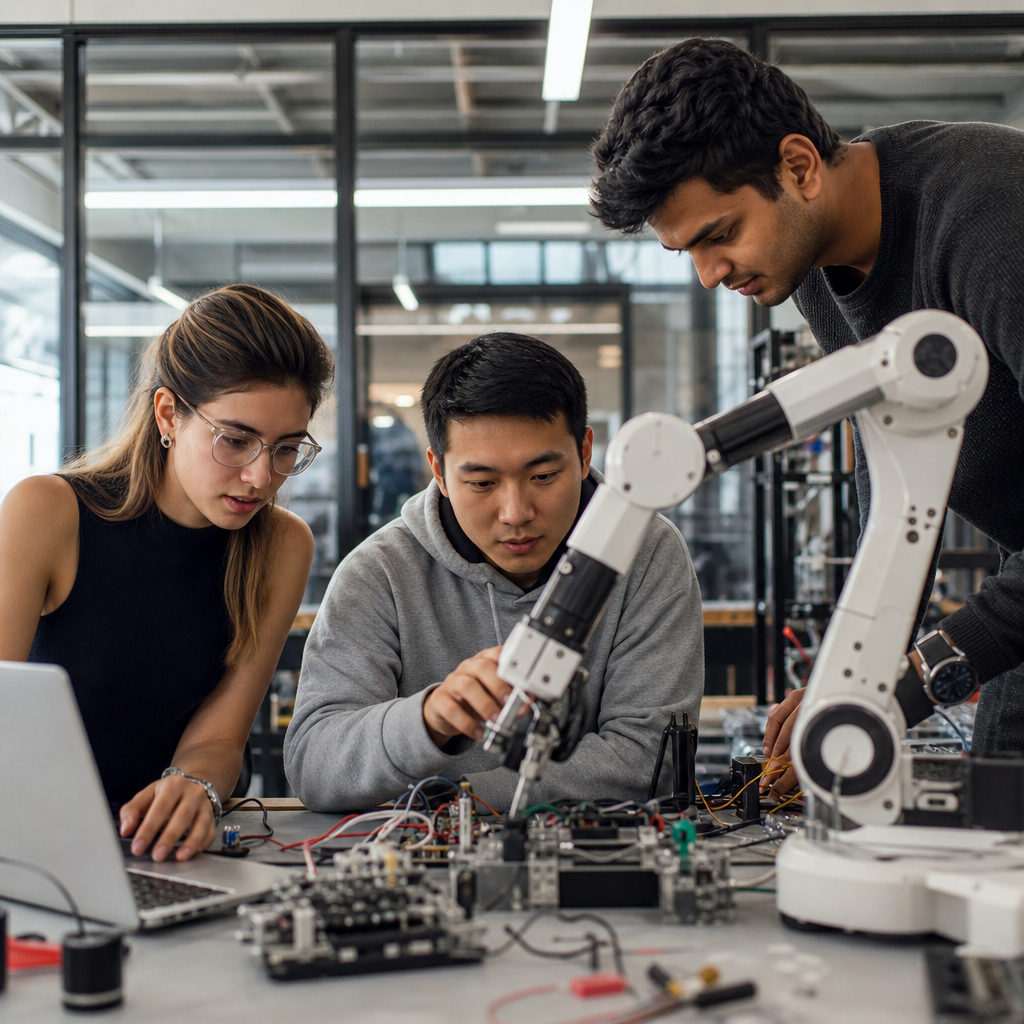
Project-based learning sits at the center of Silicon Valley’s robotics culture because robots expose weak understanding immediately. A student may understand kinematics in theory, but if a mobile robot drifts, stalls, or misses a waypoint, the team must diagnose the exact cause. That process teaches systems thinking better than isolated lectures. In effective programs, beginners start with constrained builds such as line-following robots, pick-and-place arms, or sensor integration tasks. These projects force them to wire components correctly, manage power budgets, calibrate sensors, and write code that responds in real time.
This method mirrors startup practice. Teams define a minimum viable system, test under realistic conditions, collect data, and revise fast. In education, that means students learn version control, experiment logging, unit testing, and basic risk management earlier than traditional engineering pathways often allow. FIRST Robotics, VEX, and university capstone labs are common entry points, but the regional difference is intensity: mentors often include practicing engineers from companies working on autonomous vehicles, warehouse automation, surgical robotics, or semiconductor equipment. Students do not just complete assignments; they learn professional habits around reliability, deadlines, and design tradeoffs.
The Learning Curve: From Fundamentals to System Integration
The learning curve in robotics and automation is steep because every project combines multiple disciplines. The most successful programs sequence this complexity deliberately. First comes core literacy: algebra, trigonometry, basic physics, Python or C++, circuits, and simple fabrication. Next comes subsystem competence: sensors, actuators, motor drivers, microcontrollers, control loops, and CAD. Only after those pieces are stable should learners tackle full integration, where perception, planning, controls, mechanical tolerances, and user interfaces interact.
In practice, I advise learners to think in layers. Layer one is “make it move.” Layer two is “make it repeatable.” Layer three is “make it safe and maintainable.” Layer four is “make it useful in a workflow.” That progression reflects how real robotics teams evaluate maturity. A prototype arm that moves once is not an automation solution. A cell that cycles reliably, logs faults, supports preventive maintenance, and can be serviced by technicians is far closer to production value. Silicon Valley education emphasizes that distinction early, which prevents learners from mistaking flashy demos for engineering readiness.
| Stage | Primary Skills | Typical Tools | Common Output |
|---|---|---|---|
| Beginner | Python basics, circuits, sensors, simple mechanics | Arduino, micro:bit, Tinkercad, breadboards | Line follower, obstacle-avoidance robot |
| Intermediate | CAD, embedded programming, PID control, ROS basics | Fusion 360, Raspberry Pi, Jetson, Git | Mobile robot with mapping or manipulator prototype |
| Advanced | System integration, machine vision, PLCs, safety, testing | ROS 2, OpenCV, SolidWorks, Siemens TIA Portal | Automation cell, autonomous subsystem, validated capstone |
Core Skills Every Robotics and Automation Student Needs
Strong programs teach a specific mix of technical and operational skills. Programming is nonnegotiable, especially Python for scripting, data handling, and robotics frameworks, plus C or C++ for embedded and performance-critical tasks. Mechanical design matters because poor tolerancing, weak fastening, and vibration can ruin otherwise sound software. Electronics matter because power distribution, grounding, signal integrity, and current limits directly affect reliability. Control theory matters because even a simple PID loop can determine whether a platform behaves smoothly or oscillates under load.
Automation adds another layer. Students need familiarity with PLCs, ladder logic, HMIs, industrial networks such as EtherNet/IP or PROFINET, and machine safety concepts governed by standards like ISO 10218 and ANSI/RIA R15.06. They should also understand basic machine vision, especially lighting, lens choice, and false-positive management, because vision failures are often environmental rather than algorithmic. Beyond technical content, documentation is a core skill. Engineers who can write a test plan, wiring diagram, troubleshooting guide, and change log become effective much faster on real teams.
How Industry Partnerships Accelerate Learning
Silicon Valley’s strongest advantage is proximity to working engineers, suppliers, and production problems. Partnerships with startups, manufacturers, research labs, and platform vendors compress the learning curve because students encounter real constraints. A warehouse automation company may provide datasets from barcode readers and depth cameras. A cobot integrator may let students inspect end effectors, safety scanners, and guarded cells. A semiconductor equipment firm may expose them to cleanroom protocols, precision motion, and failure analysis. These experiences build judgment that no slide deck can provide.
Internships and sponsored projects are especially valuable when they require measurable outcomes. I have seen student teams mature quickly when a company asks for cycle-time reduction, fixture redesign, or test automation instead of an open-ended “innovation” concept. The task becomes concrete: gather baseline data, propose alternatives, assess risk, and validate improvement. Industry mentors also correct unrealistic assumptions. For example, a vision model that works in a lab may fail under reflective packaging, dust, or variable shift lighting. Seeing those limitations early helps learners understand why robust automation depends on process engineering as much as clever code.
Curriculum Design: What Effective Programs Include
Effective robotics and automation curricula are cumulative, modular, and assessment-driven. They do not throw beginners into advanced autonomy topics before fundamentals are stable. A well-designed sequence starts with mechatronics basics, then introduces software architecture, controls, and design-for-manufacture, followed by specialization in areas like autonomous navigation, industrial automation, manipulation, or AI-enabled perception. The best programs also require repeated integration labs where students must combine hardware and software under time pressure and document what happened.
Course design should include simulation, but not as a substitute for hardware. Tools such as Gazebo, Isaac Sim, MATLAB/Simulink, and RoboDK help students test algorithms and cell layouts before deployment. However, friction, backlash, sensor noise, cable strain, thermal behavior, and operator misuse only become obvious on physical systems. That is why leading programs balance digital twins with bench testing. They also include design reviews, code reviews, safety reviews, and postmortems. These practices mirror engineering organizations and teach learners that technical quality is not just about whether a robot moves, but whether it can be trusted.
Common Learning Bottlenecks and How Programs Solve Them
Most learners struggle at the same transition points. The first bottleneck is moving from tutorials to independent builds. Following instructions feels productive, but it often hides conceptual gaps. Good instructors solve this by assigning constrained design problems with multiple valid solutions, forcing students to choose components and justify tradeoffs. The second bottleneck is debugging across domains. A robot may fail because of code, wiring, battery sag, timing jitter, frame misalignment, or a loose coupler. Silicon Valley-style programs teach structured debugging: isolate variables, reproduce the fault, check logs, and test one hypothesis at a time.
The third bottleneck is specialization. Many intermediate learners know a little about everything but cannot contribute deeply anywhere. Strong programs address this with tracks: controls, embedded systems, perception, industrial automation, or mechanical design. The fourth bottleneck is production readiness. Students may build impressive prototypes but ignore maintainability, cybersecurity, documentation, and operator safety. Mature programs introduce acceptance testing, fault trees, lockout principles, revision control, and serviceability reviews. These additions may seem less exciting than autonomous demos, but they are exactly what make automation deployable in factories, hospitals, and logistics centers.
Choosing the Right Learning Path for Students, Professionals, and Schools
The right path depends on the learner’s goal. A middle or high school student usually benefits from structured team robotics, accessible electronics, and competitions that reward iteration. A university student targeting robotics engineering should combine controls, software, and mechanical design rather than staying in a single silo. A technician moving into automation may get faster returns from PLCs, HMIs, sensors, and troubleshooting than from advanced research robotics. A software engineer entering the field should add embedded constraints, real-time behavior, and hardware integration to existing coding strengths.
Schools and training providers should design pathways around local demand and available equipment. A region with logistics employers may prioritize AMRs, barcode systems, and conveyor controls. A manufacturing corridor may emphasize robot cells, PLC programming, and vision inspection. Budget matters too. Excellent foundational training can begin with Arduino kits, low-cost actuators, open-source CAD, and refurbished industrial components. The key is sequencing, mentor quality, and repeated exposure to real failure modes. To build an effective robotics and automation education plan, start with fundamentals, progress through integrated projects, and connect every lesson to a practical system the learner can test, improve, and explain.
Frequently Asked Questions
What makes Silicon Valley’s approach to robotics and automation education different from traditional technical education?
Silicon Valley generally treats robotics and automation education as a connected learning pipeline rather than a set of isolated classes. Instead of asking students to memorize theories first and apply them later, programs often begin with building, testing, and troubleshooting real systems from the start. Learners are introduced to how sensors, actuators, controllers, software, electronics, and mechanical design interact in physical machines, which helps them understand that robotics is not one subject but a working combination of many disciplines. This approach reflects how products are actually developed in industry, where engineers rarely work in a single silo.
Another major difference is the emphasis on iteration. Students are expected to prototype, fail, diagnose the problem, improve the design, and repeat the process. That cycle builds technical skill, but it also builds engineering judgment. In traditional settings, a correct answer may exist mainly on paper. In Silicon Valley-style programs, the “correct” answer is often the one that works reliably in the real world under changing conditions. That makes hands-on lab time, team projects, and exposure to real hardware especially important.
Industry alignment also plays a central role. Many programs are shaped by the needs of robotics startups, advanced manufacturers, software firms, and automation companies. As a result, students are often exposed to current tools, programming environments, control systems, embedded platforms, and workflow practices that resemble professional engineering settings. The overall goal is not simply academic completion. It is to move students from curiosity to practical competence in a way that prepares them to contribute to modern robotics and automation teams.
Why is hands-on project work so important in robotics and automation education?
Hands-on project work matters because robotics and automation are inherently physical and systems-based fields. A student can understand control logic in theory, but until they connect a motor, read data from a sensor, tune a feedback loop, and see how noise, latency, friction, or misalignment affect performance, the lesson is incomplete. Real projects turn abstract concepts into practical understanding. They show learners what happens when code meets hardware and when design assumptions are tested by actual behavior.
Project-based learning also develops problem-solving skills that are difficult to teach through lectures alone. In a robotics build, students may have to debug wiring issues, revise mechanical tolerances, calibrate sensors, rewrite software, and adjust communication between components. That process trains them to think systematically across multiple layers of a system. It encourages persistence, analytical reasoning, and the ability to break large technical problems into smaller, solvable parts. Those habits are essential in both robotics development and industrial automation environments.
Just as important, projects help students build confidence and portfolio-quality experience. Completing a robotic arm, mobile robot, pick-and-place system, or automated inspection setup gives learners something concrete to discuss with instructors, mentors, or employers. It demonstrates not only that they studied robotics, but that they can integrate mechanics, electronics, controls, and programming into a functioning solution. In Silicon Valley’s education culture, that kind of evidence-based skill development is highly valued because it mirrors the way engineering capability is assessed in the workplace.
How do interdisciplinary teaching methods improve robotics and automation learning?
Interdisciplinary teaching is central to robotics and automation because no real robotic system operates within the boundaries of a single subject. A robot relies on mechanical structures for movement, electrical systems for power and signal flow, software for logic and behavior, sensors for perception, and control strategies for stability and precision. Automation systems add another layer through industrial processes, programmable logic, machine interfaces, networking, and production efficiency. Teaching these areas together helps students understand how each part influences the others.
For example, a student writing motion control code makes better decisions when they also understand motor characteristics, gearbox limitations, load distribution, and sensor reliability. Likewise, a learner designing an automated production cell benefits from understanding not only logic programming, but also safety systems, throughput analysis, human-machine interaction, and maintenance concerns. Interdisciplinary instruction creates engineers and technicians who can see the full system instead of optimizing one component while unintentionally causing problems elsewhere.
This broader perspective is especially valuable in Silicon Valley, where innovation often happens at the intersection of fields. Teams are expected to collaborate across hardware, software, manufacturing, and product design. Educational models that blend disciplines prepare students for that reality by helping them communicate across specialties, make informed tradeoffs, and solve practical challenges with a systems mindset. In the long term, interdisciplinary learning produces professionals who are more adaptable, more effective in teams, and better prepared for fast-changing technologies.
What role does industry exposure play in preparing students for careers in robotics and automation?
Industry exposure helps students connect classroom learning to real-world expectations. In robotics and automation education, this can include mentorship from working engineers, site visits, internships, collaborative projects with companies, guest lectures, and access to tools or workflows used in professional environments. These experiences show students how technical concepts are applied in product development, manufacturing, logistics, autonomous systems, and industrial control settings. They also help learners understand the pace, standards, and complexity of modern engineering work.
One of the biggest benefits of industry exposure is that it makes education more relevant. Students begin to see why reliability matters, why documentation is essential, why testing cannot be skipped, and why safety, scalability, and maintainability are not secondary concerns. In automation, for example, a system that works once in a lab is not enough. It must operate consistently, integrate with other equipment, and support production needs. Seeing these expectations early gives students a more mature understanding of what competence really means.
Industry engagement also improves career readiness by helping students build networks and identify skill gaps before entering the workforce. They may discover that beyond core robotics knowledge, employers value experience with PLCs, CAD tools, embedded systems, industrial networking, simulation software, or machine vision. Exposure to actual employers and use cases allows learners to shape their studies more strategically. In Silicon Valley’s ecosystem, where education and industry often influence each other closely, this connection is a major reason students can transition more effectively from learning environments into technical roles.
What skills should students expect to develop in a strong robotics and automation education program?
A strong robotics and automation education program should develop both technical depth and practical systems thinking. On the robotics side, students should learn the fundamentals of sensing, motion, control, programming, electronics, and mechanical integration. That includes working with microcontrollers or embedded platforms, reading and interpreting sensor data, controlling motors and actuators, designing or assembling mechanical structures, and writing software that coordinates behavior in real time. They should also become comfortable with debugging, calibration, testing, and iterative improvement, because those skills are essential to making physical systems work reliably.
On the automation side, students should expand that foundation into process-oriented thinking. This often includes learning how automated systems are designed for consistency, efficiency, safety, and scale. Depending on the program, that may involve PLC programming, industrial communication protocols, HMI design, machine vision, production workflow analysis, and integration of robotic components into larger operational systems. Students should come away understanding not just how to build an individual machine, but how automated equipment fits into a broader industrial or commercial environment.
Equally important are the professional skills developed through repeated practice. Strong programs teach learners how to document their work, collaborate on multidisciplinary teams, communicate technical decisions clearly, and manage projects from concept to implementation. They also foster adaptability, since robotics and automation technologies evolve quickly. In Silicon Valley’s model, the most valuable outcome is not simply familiarity with today’s tools. It is the ability to keep learning, keep building, and keep solving complex real-world problems as the field continues to change.