Silicon Valley’s push beyond software and smartphones has reshaped aerospace, and Blue Origin stands at the center of that shift. Founded by Amazon creator Jeff Bezos in 2000, Blue Origin is a privately held space company built around a long-term goal: enabling millions of people to live and work in space. In practical terms, that means developing reusable rockets, lunar landing systems, powerful engines, and the industrial capabilities needed to lower the cost of access to orbit. For readers exploring corporate giants, Blue Origin matters because it shows how technology capital, founder-led ambition, and patient private funding can influence an industry once dominated by governments and traditional defense contractors. I have followed commercial launch providers for years, and Blue Origin is one of the clearest examples of how a company can be both visionary and frustratingly opaque.
The company’s story also reveals a broader pattern in modern business. Unlike many fast-scaling Silicon Valley firms, Blue Origin did not begin with a software platform, a venture-backed blitz, or a race for quarterly growth. Bezos funded it largely with his own wealth, reportedly selling billions of dollars in Amazon stock over time to support development. That approach gave Blue Origin room to work on difficult hardware problems without immediate market pressure, but it also created a culture of secrecy and slower visible progress. Understanding Blue Origin therefore requires more than a timeline of launches. It requires looking at its strategy, technology, competitors, contracts, and public image as part of a larger corporate case study in how giant founder-driven firms enter frontier industries.
Blue Origin’s relevance extends beyond space tourism headlines. It competes in launch services, supports NASA’s lunar ambitions, and manufactures rocket engines used both internally and by partners. Its decisions affect supply chains, government procurement, and the future structure of the commercial space market. As a hub article in the Company Spotlights series, this guide explains where Blue Origin came from, what it builds, how it compares with rivals, and why its next decade may matter even more than its first. For anyone diving deeper into corporate giants, Blue Origin is not just a space company. It is a test case for whether Silicon Valley-style capital and long-range founder control can build enduring industrial power.
Origins, vision, and the meaning of “Gradatim Ferociter”
Blue Origin was established in Kent, Washington, and from the start its motto, “Gradatim Ferociter,” signaled the company’s operating philosophy: step by step, ferociously. That phrase is not branding fluff. It reflects a methodical engineering posture that prioritizes incremental milestones, testing, and reusability over dramatic public schedules. Bezos has consistently framed Blue Origin’s mission around preserving Earth by moving heavy industry into space and creating infrastructure for future generations. The concept resembles Gerard K. O’Neill’s space settlement ideas more than a simple rocket launch business. In corporate terms, Blue Origin was built around infrastructure first, applications second.
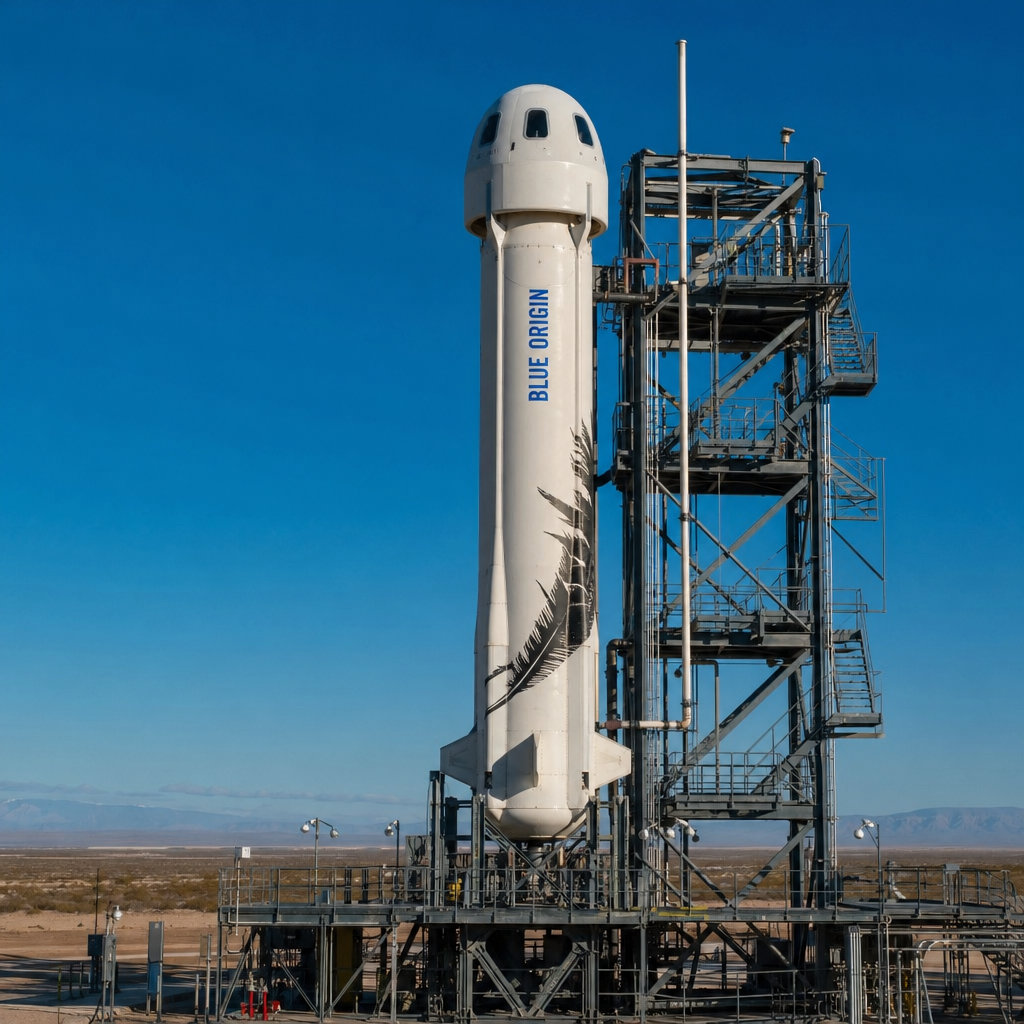
Early development focused on suborbital systems, vertical landing technology, and engine research. The company spent years out of public view at its West Texas test site, where it developed the New Shepard vehicle for human suborbital flights. New Shepard is named after Alan Shepard, the first American in space, and it became Blue Origin’s first operational system. In 2015, the booster completed a vertical takeoff and vertical landing, a milestone that helped validate the company’s reusable rocket architecture. While SpaceX had already transformed industry expectations with orbital reusability efforts, Blue Origin’s achievement still mattered because it showed that multiple private firms could make landing rockets a standard commercial capability rather than a one-off stunt.
As Blue Origin matured, it expanded beyond tourism and testing. The company announced New Glenn, a heavy-lift orbital rocket named after John Glenn, and later pursued lunar systems through the Blue Moon program. It also built the BE-3 and BE-4 engines, putting propulsion at the center of its business model. That diversified approach is significant. Many people know Blue Origin for celebrity suborbital flights, but the company’s deeper strategic importance lies in engines, launch infrastructure, and government partnerships. In other words, the public-facing product is only one part of the larger industrial plan.
Blue Origin’s business model and major programs
Blue Origin operates across several linked segments: reusable launch vehicles, rocket engines, human spaceflight, and lunar transportation. New Shepard serves the suborbital tourism and research market, carrying passengers and scientific payloads past the Kármán line, the internationally recognized boundary of space at 100 kilometers. The experience lasts only minutes in microgravity, but it has commercial value for high-net-worth travelers, academic researchers, and technology demonstrations. High ticket prices have not been publicly standardized, though early seat estimates often ran into the hundreds of thousands of dollars or more. That makes New Shepard a niche business today, but a visible one.
The more consequential program is New Glenn, a large orbital rocket designed for partial reusability. New Glenn’s first stage is intended to land on a sea-based platform, similar in broad concept to reusable systems already proven elsewhere in the market. Its payload class places it in competition for commercial satellite deployments, national security missions, and deep-space logistics. Delays, however, have defined the program’s public narrative. In aerospace, schedule slips are common, especially for new heavy-lift systems, but repeated postponements can erode customer confidence and create openings for rivals with demonstrated launch cadence.
Engines may be Blue Origin’s most strategically important asset. The BE-4, a liquefied natural gas and liquid oxygen engine, was selected by United Launch Alliance for the Vulcan rocket. That made Blue Origin not just a launch competitor but also a supplier to another major provider. The engine uses an oxygen-rich staged combustion cycle, a high-performance architecture historically associated with advanced Russian propulsion design and difficult engineering demands. Developing BE-4 has been expensive and time-consuming, but engine production creates leverage across the aerospace ecosystem.
| Program | Primary Purpose | Notable Detail |
|---|---|---|
| New Shepard | Suborbital human flight and research | Reusable booster and capsule for brief trips beyond the Kármán line |
| New Glenn | Orbital launch for satellites and government missions | Heavy-lift rocket with reusable first stage |
| BE-4 | Rocket propulsion | Supplies power for ULA’s Vulcan and Blue Origin systems |
| Blue Moon | Lunar cargo and landing architecture | Supports NASA-linked ambitions for Moon operations |
Blue Origin has also become a more serious lunar player. After initially losing NASA’s Human Landing System award to SpaceX, Blue Origin later won a separate contract to develop a crewed lunar lander for Artemis missions. That award changed the company’s position from outsider critic to core participant in the Moon return effort. For corporate analysis, this matters because it shows how persistence, political relationships, and technical repositioning can restore a company’s standing even after a high-profile procurement loss.
Competition, culture, and the challenge of execution
No Blue Origin profile is complete without comparing it with SpaceX, because the two companies represent different models of private space development. SpaceX emphasizes speed, vertical integration, frequent launches, and public iteration. Blue Origin emphasizes deliberation, private funding, controlled messaging, and long-horizon infrastructure. Neither model is inherently unserious, but the market has rewarded execution speed. SpaceX built a dense launch manifest, won major NASA contracts, deployed Starlink at scale, and normalized rapid hardware iteration. Blue Origin, by contrast, has often looked like a company with immense resources still trying to convert ambition into operational rhythm.
That gap has shaped public perception. Blue Origin is sometimes viewed as a slower, wealth-backed challenger rather than an industry-defining operator. Some of that criticism is fair. Repeated New Glenn delays, legal action following NASA’s initial lunar lander award, and periods of limited transparency damaged its reputation among space observers. At the same time, critics often overlook that propulsion development, human-rating systems, and large-scale manufacturing require long lead times and rigorous testing. I have seen this tension in many industrial sectors: outsiders reward momentum, while engineers know that hard-won reliability rarely arrives on a social-media schedule.
Internally, Blue Origin has also faced scrutiny over management culture. Former employees have publicly criticized aspects of workplace environment and decision-making, raising questions about leadership structure and organizational responsiveness. Those concerns matter because aerospace execution depends on communication discipline, talent retention, and clear technical accountability. A company can have money, facilities, and high-level contracts, yet still struggle if organizational processes slow decisions or discourage dissent. For Blue Origin, the next phase is not just about building hardware. It is about proving that its culture can sustain repeated delivery at industrial scale.
Why Blue Origin matters in the larger corporate landscape
Blue Origin is important because it illustrates how modern corporate giants extend influence into infrastructure-heavy sectors once considered outside the reach of consumer tech wealth. Bezos did not merely invest in a supplier or buy exposure through a fund. He attempted to build a full-stack aerospace enterprise from the ground up, combining founder capital, industrial facilities, regulatory engagement, and government contracting. That is a different level of corporate ambition. It parallels broader trends in which large technology fortunes move into health, energy, defense, and transportation, carrying software-era expectations into deeply physical industries.
For investors, policymakers, and business readers, Blue Origin offers three lessons. First, patient capital can unlock projects that venture timelines cannot support. Second, hardware industries punish weak execution far more harshly than digital markets do. Third, strategic significance often comes from upstream control points such as engines, launch access, and manufacturing capacity, not only from flashy end-user experiences. Blue Origin’s future will be determined less by celebrity passengers than by whether New Glenn flies reliably, BE-4 production scales smoothly, and lunar systems meet NASA requirements. Watch those indicators closely, then explore the related Company Spotlights articles to compare how other corporate giants turn bold vision into durable industrial advantage.
Frequently Asked Questions
What is Blue Origin, and why is it important in the story of Silicon Valley’s move into space?
Blue Origin is a private aerospace company founded by Jeff Bezos in 2000 with a mission that is far broader than launching a few rockets. Its long-term goal is to help build a future in which millions of people can live and work in space. That ambition makes Blue Origin a defining example of how Silicon Valley-style thinking has expanded beyond software, e-commerce, and consumer electronics into heavy industry and space infrastructure. Instead of treating space as a government-only domain, Blue Origin approaches it as a field where patient capital, advanced engineering, and long planning horizons can create entirely new markets.
What makes the company especially significant is the way it reflects a technology-industry mindset applied to aerospace. Blue Origin emphasizes iteration, long-term investment, vertical integration, and reusable systems designed to reduce costs over time. In that sense, it represents a major shift in the space sector: the idea that private companies, backed by wealthy founders and built with startup-era ambition, can develop launch vehicles, rocket engines, lunar systems, and other capabilities once associated primarily with national space agencies and large defense contractors.
Blue Origin also matters because it sits at the intersection of symbolism and strategy. Symbolically, it shows that Silicon Valley’s influence now reaches into one of the most technically demanding industries on Earth. Strategically, it is helping build the tools needed for a larger space economy, including launch services, in-space infrastructure, and technologies that could support future lunar and orbital activity. Even for readers new to the subject, Blue Origin is important because its story is really about a much bigger trend: the transformation of space from a government-led prestige project into a commercially driven frontier.
How does Blue Origin’s vision differ from that of a typical rocket company?
Blue Origin is not just trying to send payloads or people into space on a one-off basis. Its central idea is that space access must become far cheaper, more reliable, and more routine before humanity can truly expand beyond Earth. That is why the company often talks less about isolated launches and more about building the underlying infrastructure for a spacefaring future. In Blue Origin’s view, rockets are not the end goal; they are tools for creating a sustained human presence beyond the planet.
This distinction is important. A conventional rocket company might focus primarily on winning launch contracts, delivering satellites to orbit, or developing systems for government missions. Blue Origin does those kinds of things too, but its broader strategy includes reusable launch vehicles, high-performance rocket engines, lunar landing technology, and eventually industrial development in space. The company’s philosophy suggests that Earth should be zoned for residence and light industry while heavy industry gradually moves off-world, a concept that reflects Bezos’s long-standing interest in space habitats and large-scale economic expansion beyond Earth.
That long-range perspective affects how Blue Origin operates. The company is known for a patient, methodical development style rather than a purely rapid-growth startup approach. It has invested in foundational technologies that may take years to mature, such as reusable systems and propulsion platforms that can support multiple vehicles. For readers trying to understand Blue Origin’s identity, the key point is this: it is not simply in the launch business. It is trying to help create the economic and technological architecture of a future space civilization.
What role do reusable rockets play in Blue Origin’s strategy?
Reusable rockets are at the heart of Blue Origin’s plan because reusability is one of the most direct ways to reduce the cost of getting to space. In traditional spaceflight, major rocket components are often discarded after a single mission, which makes each launch extraordinarily expensive. Blue Origin’s strategy is based on the idea that rockets should work more like aircraft: they should be flown, recovered, refurbished, and flown again. If that model can be scaled effectively, the economics of space access change dramatically.
The clearest early example of this approach is New Shepard, Blue Origin’s suborbital vehicle designed for space tourism, research payloads, and repeated flight operations. New Shepard helped demonstrate that controlled vertical landing and reuse were not just theoretical ideas but practical engineering solutions. While suborbital flight is very different from orbital launch, the lessons learned from repeated booster recovery, refurbishment, and operations are valuable stepping stones toward more ambitious systems.
On the larger end of the spectrum, Blue Origin has also pursued orbital launch capability through New Glenn, a heavy-lift rocket intended to carry satellites and other payloads into orbit with substantial reusable elements. The broader strategic logic is straightforward: if launch costs come down, more companies, researchers, governments, and industries can afford to operate in space. That creates more demand, which in turn supports more infrastructure and more innovation. So when Blue Origin invests in reusability, it is not just improving one rocket design. It is trying to unlock a more sustainable and scalable space economy.
Beyond rockets, what technologies and programs is Blue Origin developing?
Although rockets receive the most public attention, Blue Origin’s work extends well beyond launch vehicles. One major area is propulsion. The company develops powerful rocket engines, including engines intended not only for its own vehicles but also for broader aerospace use. In the space industry, engines are a strategic capability because they determine performance, reliability, mission flexibility, and long-term independence. By investing in engine development, Blue Origin is strengthening its role as a core technology provider, not just a launch operator.
Another important area is lunar exploration. Blue Origin has been involved in efforts to build lunar landing systems and support technology for missions connected to renewed interest in the Moon. This matters because the Moon is increasingly viewed as a testing ground for deeper space operations, surface infrastructure, resource utilization, and long-duration human activity beyond low Earth orbit. A company that can help deliver cargo, equipment, or crews to the lunar surface is participating in one of the most significant next chapters of space development.
Blue Origin is also part of a larger push toward industrial capability in space. That includes thinking about habitats, in-space logistics, transportation systems, and the manufacturing base needed to support sustained off-world activity. While not all of these ambitions are realized yet, they are central to understanding the company’s identity. Blue Origin is building pieces of a larger ecosystem: launch systems to reach space, engines to power missions, and lunar technologies to extend human operations farther from Earth. In other words, its portfolio reflects a company trying to shape the future structure of space activity, not merely participate in isolated missions.
What challenges and opportunities define Blue Origin’s future?
Blue Origin’s future will likely be shaped by a combination of technical execution, competitive pressure, government partnerships, and the pace at which the broader space economy matures. The opportunities are substantial. If the company can successfully deploy reliable reusable launch systems, expand engine production, and contribute meaningfully to lunar and orbital infrastructure, it could become one of the foundational firms of the 21st-century space industry. There is growing demand for satellite deployment, national security launch, scientific missions, human spaceflight, and lunar logistics, all of which create potential markets for Blue Origin’s technologies.
At the same time, the challenges are equally real. Aerospace is unforgiving, development timelines are long, and even well-funded companies face delays, testing setbacks, manufacturing bottlenecks, and intense scrutiny. Blue Origin also operates in a highly competitive environment where other private space companies and legacy aerospace contractors are racing to secure launch contracts, engine business, and exploration partnerships. In this field, vision matters, but execution matters more. The companies that shape the future of space will be the ones that can turn ambitious plans into repeatable operational success.
For Blue Origin specifically, one of the biggest questions is whether it can translate its long-term philosophy into sustained leadership across multiple areas at once: launch, propulsion, exploration, and infrastructure. If it succeeds, it could play a central role in lowering the barriers to space access and helping move human activity beyond Earth in a lasting way. If it struggles, it will still remain an important case study in how Silicon Valley capital and ambition entered aerospace. Either way, Blue Origin’s story is already a major part of the modern shift toward commercial space development, and its next steps will help determine how quickly that future arrives.