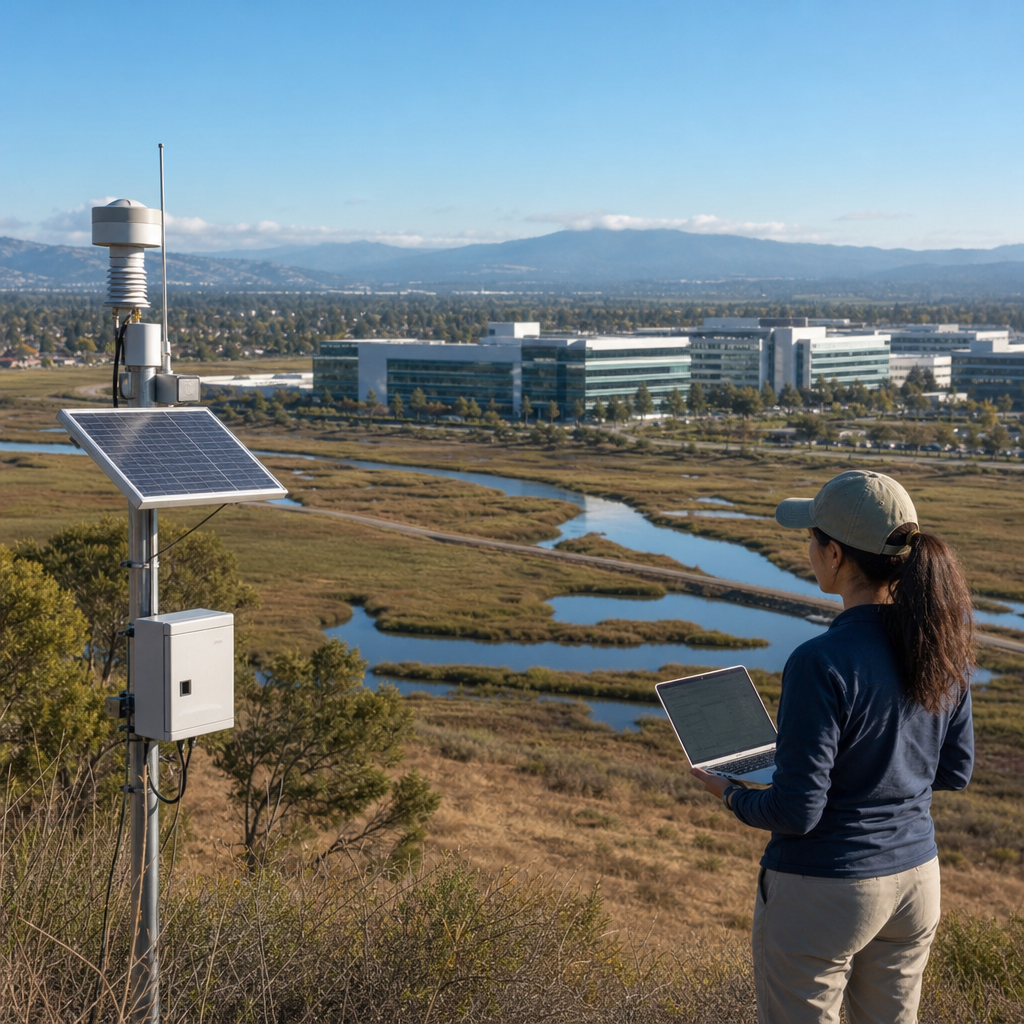
Silicon Valley is often described as the global center of digital innovation, but it is also one of the most important places to study how technology and environmental science can work together in practice. The intersection of technology and environmental science in Silicon Valley includes the tools, research methods, business models, and educational pathways that help people understand climate systems, reduce pollution, manage water, improve energy use, and build more resilient communities. For students, educators, professionals, and lifelong learners, this topic matters because it turns abstract sustainability goals into measurable skills and real careers.
In my work with technology-focused educational content, I have seen that people usually start with a narrow question: Is environmental science mainly about conservation, or is technology mainly about software? In Silicon Valley, the answer is neither. Environmental science is the study of natural systems such as air, water, soil, biodiversity, and climate, while technology includes hardware, software, sensors, data platforms, robotics, and computational models. When these fields meet, learners gain practical ways to solve local and global problems. A student can use satellite imagery to map urban heat islands, an engineer can deploy Internet of Things sensors to monitor water quality, and a policy analyst can combine emissions data with machine learning forecasts to guide planning decisions.
This hub article is designed to expand knowledge and skills across that full landscape. It introduces the core domains, explains the tools used in real organizations, and connects learning to action. Silicon Valley is a strong case study because it combines research universities, climate startups, venture funding, advanced manufacturing, public agencies, and communities directly affected by drought, wildfire smoke, sea-level rise, and transportation emissions. That mix creates a living laboratory where environmental science is not just studied; it is instrumented, modeled, funded, and deployed.
Why Silicon Valley Is a Unique Learning Environment
Silicon Valley offers unusual density across education, industry, and field application. Stanford University, San José State University, UC Berkeley nearby, NASA Ames Research Center, SLAC National Accelerator Laboratory, and Lawrence Berkeley National Laboratory all contribute scientific and technical expertise. At the same time, regional utilities, municipal water districts, semiconductor firms, mobility companies, and climate software startups create demand for people who can translate science into systems. This matters for expanding knowledge and skills because learning happens faster when theory, tools, and operational use cases are close together.
The region also faces environmental pressures that force innovation. California’s recurring drought cycles have pushed investment in smart irrigation, leak detection, advanced metering infrastructure, desalination research, and wastewater reuse. Wildfire risk has accelerated work in remote sensing, predictive analytics, distributed energy, and grid hardening. Transportation congestion and air quality concerns have driven electric vehicle infrastructure, battery research, and urban mobility analytics. These are not hypothetical classroom exercises. They are active problems with datasets, regulations, pilot programs, and public consequences.
For learners, that means the educational value is unusually concrete. You can study particulate matter monitoring and then examine PurpleAir sensor networks. You can learn geospatial analysis and then apply ArcGIS or Google Earth Engine to land use, flood mapping, or habitat monitoring. You can study life-cycle assessment and then evaluate the environmental impact of data centers, lithium-ion batteries, or semiconductor fabrication. A strong hub article must connect these examples because this subtopic is not one discipline. It is a skills ecosystem.
Core Knowledge Areas for Expanding Knowledge and Skills
Anyone exploring the intersection of technology and environmental science in Silicon Valley should build literacy in five foundational areas. First is climate and earth systems knowledge: carbon cycles, hydrology, atmospheric science, ecology, and environmental chemistry. Second is data literacy: statistics, uncertainty, data cleaning, visualization, and sensor calibration. Third is technical implementation: coding, cloud computing, databases, edge devices, and automation. Fourth is policy and governance: environmental regulation, permitting, reporting standards, and public sector procurement. Fifth is systems thinking: understanding how infrastructure, human behavior, economics, and ecosystems interact.
These knowledge areas reinforce one another. A learner analyzing urban heat cannot rely on coding skill alone; they need meteorological concepts, spatial data methods, and awareness of how zoning and tree canopy affect exposure. Someone building a carbon accounting platform must understand Greenhouse Gas Protocol scopes, emission factors, and data integration across procurement, logistics, and energy systems. In practice, the strongest professionals are translators. They can talk to scientists, software engineers, operations teams, and decision-makers without losing technical accuracy.
| Skill Area | What It Covers | Common Tools | Silicon Valley Use Case |
|---|---|---|---|
| Geospatial analysis | Mapping, remote sensing, spatial statistics | ArcGIS, QGIS, Google Earth Engine | Wildfire risk mapping and habitat monitoring |
| Environmental sensing | Air, water, soil, and energy monitoring | IoT devices, PurpleAir, low-power networks | Neighborhood air quality tracking |
| Data science | Forecasting, anomaly detection, optimization | Python, R, SQL, Jupyter | Energy demand prediction for smart grids |
| Carbon management | Emissions accounting and reduction planning | GHG Protocol methods, ERP integrations | Corporate Scope 1, 2, and 3 reporting |
| Clean technology engineering | Energy storage, electrification, materials | Simulation tools, lab instrumentation | Battery optimization and grid resilience |
Technologies Transforming Environmental Science
Several technologies now shape how environmental science is practiced in Silicon Valley. Remote sensing is one of the most influential. Satellites, drones, and aircraft-based LiDAR can detect vegetation stress, methane leaks, shoreline change, and urban heat patterns at scales that were impossible a generation ago. Machine learning has improved the classification of land cover, the prediction of wildfire spread, and the detection of anomalies in utility systems. Cloud platforms allow researchers and companies to process terabytes of earth observation data quickly, which is essential when analyzing long time series or running regional climate scenarios.
Sensor networks are equally important because they bring environmental measurement closer to daily life. Low-cost air quality monitors can reveal street-by-street differences in exposure to PM2.5, ozone, or wildfire smoke. Water sensors can monitor pH, conductivity, dissolved oxygen, and turbidity in near real time. Smart buildings use occupancy data, HVAC controls, and energy dashboards to reduce waste while maintaining comfort. I have seen learners grasp environmental science much faster when they move from static textbook charts to live sensor data because feedback becomes immediate and operational.
Another major area is clean energy and electrification. Silicon Valley companies and research groups work on battery chemistry, grid software, building electrification, EV charging management, and distributed energy resources. Environmental science informs these systems by modeling emissions reductions, resource use, materials impacts, and grid behavior under stress. The technical challenge is not simply inventing a greener device. It is optimizing across cost, performance, lifecycle impact, and reliability. That is why interdisciplinary training matters so much in this field.
Education Pathways, Programs, and Practical Learning
Expanding knowledge and skills requires clear learning pathways. For students, common entry points include environmental science, computer science, civil engineering, public policy, geography, and data science. In Silicon Valley, the most effective programs increasingly blend these subjects through project-based coursework, lab research, capstone partnerships, and field data collection. A student might learn Python in one course, watershed science in another, and then combine both in a project that models runoff or stormwater pollution.
Short-form education is also valuable. Professional certificates in GIS, sustainability analytics, energy management, lifecycle assessment, or environmental compliance can help working professionals pivot quickly. Bootcamps and extension programs often cover practical tools such as SQL, Tableau, Python, remote sensing workflows, and dashboard design. For employers, these applied credentials matter when paired with a portfolio showing real analysis, not just course completion. A well-documented GitHub repository, an ArcGIS StoryMap, or a case study on building energy benchmarking often demonstrates readiness better than a generic résumé line.
Experiential learning is the bridge between knowledge and employability. Internships with cleantech firms, utility companies, city sustainability offices, water districts, and research labs teach learners how environmental decisions are actually made. They also expose a crucial reality: data is messy. Sensors fail, metadata is incomplete, regulations change, and operational teams care about implementation constraints. Learning to work through those constraints is one of the most important skills this hub topic should emphasize.
Careers, Industry Applications, and Ongoing Challenges
The career landscape at the intersection of technology and environmental science in Silicon Valley is broader than many learners expect. Roles include sustainability analyst, climate data scientist, environmental engineer, GIS specialist, air quality researcher, energy systems modeler, water resources analyst, product manager for climate software, environmental health specialist, and ESG data architect. Some positions sit in startups building carbon accounting or grid optimization tools. Others exist in public agencies, consulting firms, utilities, manufacturing companies, or nonprofit research organizations.
Industry applications are equally varied. Semiconductor manufacturing requires water management, chemical safety, and energy efficiency. Data centers need power optimization, cooling strategies, and emissions tracking. Transportation companies use route optimization and electrification planning to reduce fuel use. Agriculture technology firms deploy sensors and computer vision to improve irrigation and soil management. Real estate and smart building operators apply building automation, benchmarking, and retro-commissioning to lower energy demand. Each domain rewards people who can connect environmental metrics to operational decisions.
Still, this field has real challenges. Low-cost sensors can produce noisy data without careful calibration. AI models can appear authoritative while hiding poor assumptions or biased training data. Climate software platforms are only as good as the source systems feeding them. Even well-funded sustainability programs can struggle with fragmented ownership across facilities, procurement, finance, and compliance teams. The lesson for learners is clear: technical skill must be matched by domain judgment. Ask where the data comes from, what standard is being used, what uncertainty remains, and who is accountable for action.
Silicon Valley shows that expanding knowledge and skills in this area is not about chasing trends. It is about building durable capabilities in science, data, engineering, and decision-making. Learners who understand environmental systems, use modern analytical tools, and communicate findings clearly can contribute across research, business, government, and community projects. The main benefit of this hub topic is practical readiness: you gain a framework for understanding how innovation can reduce environmental harm while creating measurable value. Use this page as your starting point, then go deeper into the linked subtopics, build a project portfolio, and turn interdisciplinary learning into real-world impact.
Frequently Asked Questions
What does the intersection of technology and environmental science in Silicon Valley actually include?
The intersection of technology and environmental science in Silicon Valley includes far more than just clean energy startups or electric vehicles. It covers a broad ecosystem of digital tools, scientific research, engineering practices, public-private partnerships, and educational programs that help people better understand and respond to environmental challenges. In practical terms, this means using sensors, satellite data, artificial intelligence, cloud computing, geographic information systems, advanced materials, and software platforms to study climate patterns, monitor air and water quality, improve energy efficiency, reduce waste, and support more sustainable land use decisions.
Silicon Valley is especially important because it combines technical talent, venture capital, world-class universities, startup culture, and access to government and research institutions. That environment allows environmental science to move quickly from theory into application. A climate model can become a data platform. A water-monitoring experiment can become a commercial tool for utilities. A university research project on battery materials can evolve into a company focused on grid resilience or cleaner transportation. The result is a region where environmental challenges are not only studied, but actively addressed through product development, data analysis, and scalable deployment.
It also includes the human side of innovation. Environmental scientists, software engineers, policy experts, urban planners, and entrepreneurs often work together to solve interconnected problems. For example, improving air quality may involve sensor hardware, machine learning models, public health data, and local policy implementation all at once. That collaborative structure is one of the defining features of Silicon Valley’s role in environmental problem-solving. It shows how technology can support environmental science not as a separate industry, but as an integrated approach to building more informed, efficient, and resilient communities.
How is technology being used in Silicon Valley to address climate and environmental problems?
Technology is being used in Silicon Valley to address climate and environmental problems in highly practical and measurable ways. One major area is environmental monitoring. Low-cost sensors, remote sensing systems, drones, and connected devices are making it possible to collect real-time information about air pollution, water quality, soil conditions, urban heat, wildfire risk, and energy use. This data gives researchers, city leaders, and businesses a more accurate picture of what is happening on the ground, which improves both scientific understanding and decision-making.
Another important application is data analysis and prediction. Artificial intelligence and machine learning are increasingly used to process large environmental datasets that would otherwise be difficult to interpret quickly. These tools can help identify emissions patterns, forecast water demand, optimize building energy use, track changes in vegetation, and model how extreme weather events may affect infrastructure. In a region where software development is a core strength, these analytical capabilities are especially powerful. They allow environmental science to move from retrospective analysis toward predictive and preventive action.
Technology is also transforming how solutions are implemented. In energy, companies are developing smart grid systems, battery storage technologies, and software that helps utilities balance supply and demand more efficiently. In water management, digital platforms can detect leaks, improve irrigation practices, and support drought planning. In transportation, electric mobility systems, route optimization tools, and charging infrastructure are helping reduce emissions. In the built environment, smart building technologies can lower energy consumption while improving indoor comfort and operational performance. Together, these examples show that technology is not simply documenting environmental problems in Silicon Valley; it is becoming a central mechanism for solving them at scale.
Why is Silicon Valley uniquely positioned to connect environmental science with innovation?
Silicon Valley is uniquely positioned to connect environmental science with innovation because it brings together a rare concentration of resources that support rapid experimentation and commercialization. The region has deep expertise in software, hardware, semiconductors, data infrastructure, and product development. At the same time, it is closely linked to leading universities and research centers that contribute scientific knowledge in fields such as climate science, ecology, energy systems, materials science, hydrology, and environmental engineering. This creates a setting where scientific insight and technical execution can reinforce each other quickly.
Funding also plays a major role. Venture capital firms, corporate investors, philanthropic organizations, and government-supported innovation programs provide pathways for environmental ideas to move from the lab to the marketplace. While not every environmental solution fits the traditional startup model, Silicon Valley has helped expand interest in climate tech, resource efficiency, carbon management, and resilience-focused innovation. That financial support matters because many environmental technologies require long development cycles, testing, and cross-sector collaboration before they reach broad adoption.
The region is also shaped by real environmental pressures, which make innovation more urgent and more grounded in real-world conditions. Drought, wildfire smoke, energy reliability concerns, habitat loss, and transportation emissions are not abstract topics in Northern California. They are visible challenges that affect communities, businesses, and institutions directly. Because of this, Silicon Valley serves as both a laboratory and a test market. Companies and researchers can develop tools in response to immediate environmental needs, then refine and scale them for use in other regions. That combination of technical capability, research depth, capital access, and lived environmental urgency is what makes Silicon Valley such a significant hub for this intersection.
What kinds of careers and educational pathways exist at the intersection of technology and environmental science?
There are many careers and educational pathways available for people interested in working where technology and environmental science meet, and Silicon Valley offers one of the strongest ecosystems for exploring them. Students and professionals can enter this space through environmental science, computer science, engineering, data science, public policy, urban planning, geography, or sustainability studies. What matters most is often the ability to combine environmental understanding with technical problem-solving. Employers increasingly value people who can interpret environmental data, understand regulatory and ecological context, and also work with digital tools, models, software platforms, or hardware systems.
Common roles include environmental data analyst, climate tech product manager, sustainability software engineer, GIS specialist, clean energy systems engineer, water technology consultant, environmental sensor developer, carbon accounting analyst, and resilience planner. Some professionals work in startups building new products, while others work in research institutions, large technology companies, public agencies, utilities, consulting firms, or nonprofit organizations. For example, someone with a background in hydrology may work on smart water systems, while someone trained in machine learning may focus on emissions tracking or energy optimization.
Educational pathways are becoming more interdisciplinary as the field grows. Universities in and around Silicon Valley often offer programs or research opportunities that blend sustainability with computation, environmental engineering with entrepreneurship, or policy with data science. Boot camps, certificate programs, internships, and applied research labs can also help learners build specific skills in climate analytics, remote sensing, environmental modeling, and sustainability reporting. For those entering the field, the key advantage of this intersection is that it supports both mission-driven work and technical career growth. It allows people to contribute to urgent environmental issues while using modern tools that are highly relevant across industries.
What are the biggest challenges in using technology to solve environmental issues in Silicon Valley?
Although the opportunities are significant, there are also major challenges in using technology to solve environmental issues in Silicon Valley. One of the biggest is that environmental systems are complex, long-term, and deeply connected to public policy, infrastructure, and human behavior. A new app or device alone rarely solves a climate or pollution problem. Even when the technology is strong, adoption may be limited by regulation, cost, institutional resistance, data quality concerns, or the need for coordination across multiple stakeholders. Environmental progress often depends on governance and public trust as much as engineering.
Another challenge is scale and equity. Many promising technologies perform well in pilot projects but struggle when deployed across larger regions or more diverse communities. A water optimization system may work for one well-funded municipality but be difficult to implement in lower-resource areas. Similarly, smart environmental tools can unintentionally widen existing gaps if they are designed primarily for wealthy users, major corporations, or places with strong digital infrastructure. In Silicon Valley, where innovation can move quickly, there is an ongoing need to ensure that environmental technologies are not only efficient, but also accessible, transparent, and beneficial to a wide range of communities.
There is also the question of unintended environmental impact. Digital systems require energy, hardware production, supply chains, and data infrastructure, all of which have their own environmental footprints. For example, large-scale computing and battery manufacturing can create sustainability tradeoffs if they are not managed carefully. This is why environmental science remains essential: it provides the evidence-based framework needed to evaluate whether a technological solution is truly reducing harm overall. In the end, the most effective work in Silicon Valley happens when innovation is paired with rigorous science, realistic policy thinking, lifecycle analysis, and a clear understanding of social and ecological context.