Blue Origin has become one of the defining companies in modern commercial spaceflight, and its rise explains much about how private space exploration moved from a speculative idea to an operating industry. Founded by Jeff Bezos in 2000, Blue Origin describes its mission as building “a road to space” so millions of people can live and work there. In practical terms, that mission includes reusable rockets, suborbital tourism, lunar transportation systems, advanced engines, and the heavy-lift infrastructure needed for long-term industrial activity beyond Earth.
Private space exploration refers to space transportation, research, and infrastructure led by commercial companies rather than national agencies alone. That distinction matters because the business model changes the pace of innovation. When launch vehicles are designed for reuse, when engines are sold to other aerospace firms, and when spacecraft are developed for both government and private customers, the economics of access to space begin to shift. I have worked on aerospace content and technical company analysis long enough to see how often firms promise disruption without delivering hardware. Blue Origin stands out because it has translated a long-horizon philosophy into tested propulsion systems, flown missions, and government-backed programs with measurable milestones.
This matters well beyond headlines about celebrity flights. Blue Origin sits at the center of several important trends: lower launch costs through reusability, public-private partnerships with NASA and the U.S. defense sector, renewed lunar ambitions, and the emergence of a competitive ecosystem of launch providers. As a hub within a Company Spotlights series focused on movers and shakers, Blue Origin deserves attention not simply for brand recognition, but because its decisions influence suppliers, regulators, rivals, and the future shape of the commercial space market.
Origins, Mission, and Long-Term Strategy
Blue Origin was established in Kent, Washington, and developed under a deliberately quiet culture in its early years. That approach led some observers to underestimate the company, but the underlying strategy was consistent from the start: invest patiently in foundational technologies that reduce the cost of reaching space. The company’s Latin motto, Gradatim Ferociter, usually translated as “step by step, ferociously,” captures this model well. Instead of racing immediately toward orbital launches, Blue Origin built capabilities incrementally, proving propulsion, guidance, vertical landing, and operational safety before scaling upward.
That strategy differentiates Blue Origin from aerospace firms that pursue rapid market entry at the expense of manufacturing maturity. In my experience reviewing launch company roadmaps, the firms that last are usually the ones that treat engines, test infrastructure, and supply chain resilience as core assets rather than side issues. Blue Origin invested heavily in all three. It expanded beyond Washington into major facilities in Texas, Florida, and Alabama, creating an industrial footprint that supports engine testing, rocket assembly, astronaut training, and launch operations.
Its long-term vision also reaches beyond launch services. Blue Origin has repeatedly framed space not as a destination for isolated missions, but as an economic zone where energy-intensive industry can operate off Earth. That is why the company has backed concepts such as space habitats, lunar logistics, and in-space transportation. Whether every concept arrives on schedule is another question, but the strategic direction is unusually coherent: make access cheaper, build infrastructure, then enable a broader off-world economy.
New Shepard and the Business of Suborbital Flight
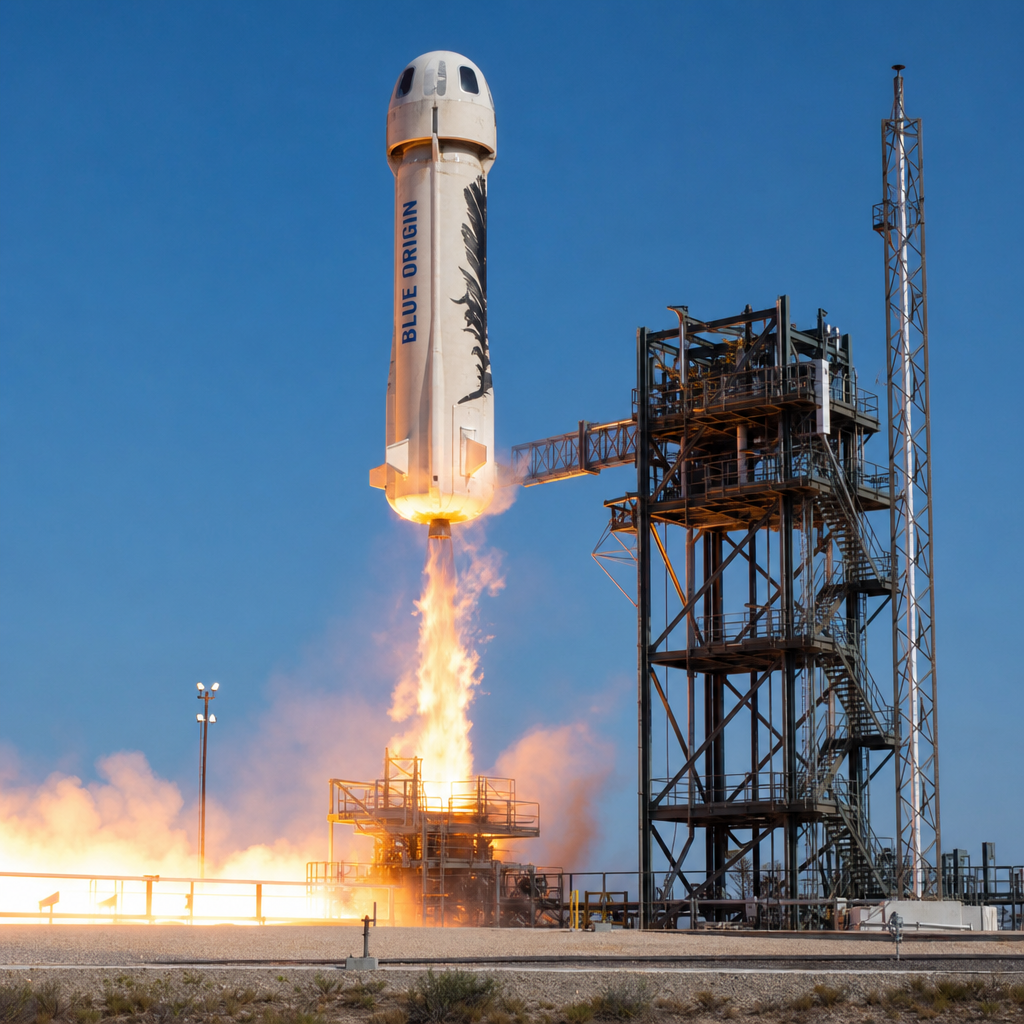
The company’s first widely recognized operational system was New Shepard, a reusable suborbital rocket named after astronaut Alan Shepard, the first American in space. New Shepard consists of a booster and a crew capsule designed for brief flights above the Kármán line, the commonly used boundary of space at 100 kilometers altitude. After launch, the booster returns vertically for reuse, while the capsule descends separately under parachutes. This architecture gave Blue Origin a practical way to validate precision landing, rapid refurbishment concepts, and crewed safety systems.
New Shepard is often discussed mainly as a space tourism vehicle, but that understates its significance. It serves at least three roles. First, it is a commercial astronaut experience for private passengers. Second, it is a microgravity research platform for science and technology payloads. Third, it is a public proof point for reusable rocketry. Those functions matter because a company that routinely flies, lands, refurbishes, and reflies hardware builds operational knowledge that no slide deck can substitute for.
Blue Origin’s crewed New Shepard missions drew broad attention because passengers included Jeff Bezos, William Shatner, and other high-profile civilians. Yet the more meaningful takeaway is technical reliability across repeated suborbital operations. The system includes an escape motor integrated into the crew capsule, designed to pull astronauts away from the booster during an emergency. That safety feature was demonstrated in an uncrewed in-flight abort test, a benchmark that serious aerospace observers consider more important than any celebrity manifest.
Suborbital flight does have limitations. It does not place payloads into orbit, and it does not generate launch revenue at the same scale as orbital missions. Still, it creates a testing and training environment with direct commercial value. Universities, researchers, and technology developers can use minutes of high-quality microgravity without the cost and scheduling constraints of orbital programs. For Blue Origin, New Shepard has been both a revenue stream and a systems-learning platform.
BE Engines, New Glenn, and Orbital Ambitions
If New Shepard introduced Blue Origin to the public, its engine program is what established the company as a serious industrial player. The BE-3 engine, which powers New Shepard, uses liquid hydrogen and liquid oxygen and is notable for deep throttling capability, a critical trait for controlled landings. The BE-4 engine is even more consequential. Fueled by liquefied natural gas and liquid oxygen, the BE-4 was selected by United Launch Alliance for the Vulcan rocket, giving Blue Origin influence beyond its own launch fleet.
That outside engine supply relationship is strategically important. In aerospace, companies that become trusted propulsion providers gain durable leverage in the market because engines are among the hardest components to design, test, certify, and manufacture at scale. Blue Origin’s work on BE-4 has faced schedule pressure, and delays have been widely reported, but delivering flight-ready engines to a major launch partner showed that the company could operate as a core supplier, not just a standalone launch brand.
New Glenn is Blue Origin’s flagship orbital rocket and a central measure of its competitive position. Named after John Glenn, the heavy-lift vehicle is designed to carry large payloads to low Earth orbit and beyond, with a reusable first stage intended to land on a seagoing platform. The rocket targets commercial satellite deployments, national security missions, and deep-space cargo opportunities. In market terms, New Glenn places Blue Origin into direct competition with other major orbital launch providers, where schedule certainty, payload performance, and price discipline matter more than publicity.
| Program | Primary Role | Key Technology | Why It Matters |
|---|---|---|---|
| New Shepard | Suborbital crew and research flights | Reusable vertical landing booster | Proves flight operations, tourism demand, and microgravity access |
| BE-3 | Suborbital propulsion | Hydrogen-fueled deep-throttle engine | Supports precise landing and crewed mission control |
| BE-4 | Orbital-class propulsion | LNG/LOX staged combustion engine | Supplies Blue Origin and ULA, extending market reach |
| New Glenn | Heavy-lift orbital launch | Reusable first stage architecture | Positions Blue Origin in the core commercial launch market |
The transition from suborbital success to orbital reliability is where many space companies struggle. Orbital launch requires more than bigger hardware; it requires stricter mission assurance, tighter manufacturing control, and a stronger customer integration process. Blue Origin’s progress here has been closely watched because the company has the funding, infrastructure, and engine base to become a top-tier launch provider if execution matches ambition.
Lunar Programs, Partnerships, and Industry Influence
Blue Origin’s role in lunar exploration has grown through its Blue Moon lander concept and participation in NASA’s Artemis-era procurement landscape. The company has pursued cargo and crewed lunar transportation opportunities, arguing that sustained Moon operations will require regular delivery systems, not just symbolic missions. That view aligns with NASA’s broader shift toward using commercial partners for transportation layers while the agency focuses on exploration architecture and science objectives.
Partnerships are critical to understanding Blue Origin’s influence. NASA contracts validate technical credibility, while defense and civil space relationships create revenue diversity. The company has also worked with an extensive supplier network, supporting propulsion, structures, avionics, and lunar systems development across multiple states. In the broader movers and shakers conversation, this matters because major aerospace companies do not only shape their own balance sheets; they reshape regional manufacturing clusters, workforce pipelines, and procurement standards.
Blue Origin also affects competitors. Its development pace, recruiting power, and capital intensity push rival firms to sharpen their own roadmaps. At the same time, its presence gives government customers another strategic option in a market where supplier concentration can become a risk. A healthy launch and space systems sector benefits from credible alternatives, especially for national security missions and lunar logistics. Blue Origin is part of that diversification, even when its own timelines generate criticism.
Leadership, Challenges, and What Comes Next
No balanced assessment of Blue Origin should ignore its challenges. The company has faced criticism over development speed, internal culture questions, and the gap between its long-range vision and the cadence of delivered orbital capability. In aerospace, delays carry real consequences because launch manifests, customer satellite schedules, and government mission planning all depend on dependable execution. Blue Origin has not been immune to that reality.
Even so, the company remains one of the most consequential private space firms because it controls valuable assets that are difficult to replicate: tested engines, reusable flight heritage, major manufacturing and launch facilities, deep capital backing, and active positions in suborbital, orbital, and lunar markets. Few companies can credibly claim all of those at once. For readers exploring movers and shakers in commercial aerospace, Blue Origin is essential because it connects nearly every major theme shaping the sector today.
The key takeaway is straightforward: Blue Origin is not important merely because it is famous, but because it is building the infrastructure stack that private space exploration requires. From New Shepard’s reusable flights to BE-4 engine deliveries, from New Glenn’s orbital ambitions to lunar transportation efforts, the company is helping define how commercial spaceflight matures. Follow its launch milestones, engine programs, and NASA partnerships closely, because understanding Blue Origin is one of the clearest ways to understand where the space economy is heading next.
Frequently Asked Questions
What is Blue Origin, and why is it important in private space exploration?
Blue Origin is a private aerospace company founded by Jeff Bezos in 2000 with the long-term goal of making space more accessible, more routine, and ultimately useful for large-scale human activity. The company often describes this vision as building “a road to space,” meaning it is not focused on a single rocket or one high-profile mission, but on creating the transportation systems, engines, and infrastructure needed for sustained space operations. That broad mission has made Blue Origin an important player in the evolution of commercial spaceflight.
Its importance comes from the way it helped push private space exploration beyond theory and into a functioning industry. Blue Origin invested early in reusable rocket technology, an area that is now central to lowering launch costs and increasing flight frequency. By designing vehicles that can fly, land, and fly again, the company contributed to a larger industry shift away from disposable launch systems. That approach matters because lower-cost, repeatable access to space is widely seen as the foundation for everything from scientific missions and satellite deployment to tourism, lunar operations, and long-term human settlement beyond Earth.
Blue Origin is also significant because its work spans several layers of the commercial space ecosystem. It operates in suborbital human spaceflight through New Shepard, develops powerful rocket engines used in major launch systems, and is working on larger orbital and lunar transportation capabilities through projects such as New Glenn and lunar landing initiatives. In other words, Blue Origin is not just selling rides to space; it is trying to help build the architecture of a future space economy.
How does Blue Origin’s reusable rocket technology work, and why does it matter?
Reusable rocket technology is one of the defining ideas behind Blue Origin’s strategy. Traditionally, rockets were used once and then discarded, which made every launch extremely expensive. Blue Origin’s reusable systems are designed to recover major parts of the vehicle after flight, inspect them, refurbish them as needed, and fly them again. This mirrors the logic of commercial aviation: transportation becomes more practical when the vehicle is not thrown away after every trip.
The clearest example is New Shepard, Blue Origin’s suborbital launch system. It consists of a reusable booster and a crew capsule. During flight, the booster propels the capsule toward space, then separates and returns vertically to Earth for a controlled landing. The capsule also descends safely using parachutes. This system allows Blue Origin to repeat flights with the same hardware, demonstrating that rocket reuse can support more frequent missions while helping contain costs.
Why this matters goes far beyond engineering elegance. Reusability is a core economic principle in private space exploration because it changes the cost structure of launch. When launch providers can recover and reuse vehicles, they can reduce manufacturing demands, shorten turnaround times, and improve operational efficiency. That can make space access more affordable for research institutions, commercial customers, government agencies, and eventually private citizens. Blue Origin’s work in this area helped validate the idea that reusable rocketry is not a futuristic concept but a practical business and technological model that underpins the broader commercial space industry.
What is New Shepard, and how has it shaped space tourism?
New Shepard is Blue Origin’s suborbital rocket system designed to carry passengers and experiments above the Kármán line, the internationally recognized boundary of space at 100 kilometers above Earth. Unlike orbital spacecraft, New Shepard does not circle the planet. Instead, it provides a brief trip to space that gives passengers several minutes of weightlessness and sweeping views of Earth before returning to the ground. The system includes a reusable booster and a pressurized capsule designed with large windows to maximize the experience for travelers.
New Shepard has played a major role in shaping the modern idea of space tourism because it transformed the concept from science fiction and elite aspiration into an actual commercial service. Blue Origin demonstrated that private individuals, not just government astronauts, could travel to space on a purpose-built commercial vehicle. That shift is culturally significant because it expands who spaceflight is for and helps normalize the idea of civilian access to space.
Its influence is also practical. Space tourism creates revenue, public visibility, and operational experience that can support broader technological development. Each flight contributes data on human spaceflight operations, vehicle turnaround, safety procedures, passenger training, and in-flight systems. While critics sometimes see tourism as less consequential than scientific or exploration missions, supporters argue that early commercial passenger flights can help finance innovation and build public support for a larger space economy. In that sense, New Shepard is both a tourism platform and a stepping stone toward making human spaceflight more common and more commercially sustainable.
What are New Glenn and Blue Origin’s larger goals beyond suborbital flights?
While New Shepard introduced many people to Blue Origin through suborbital tourism, the company’s ambitions extend much further. One of its most important long-term projects is New Glenn, a heavy-lift orbital launch vehicle designed for far more demanding missions. Named after astronaut John Glenn, the rocket is intended to carry satellites, cargo, and potentially more advanced mission hardware into orbit. Unlike New Shepard, which performs short suborbital flights, New Glenn is part of Blue Origin’s effort to compete in the large-scale orbital launch market.
New Glenn matters because orbital transportation is where commercial spaceflight intersects most directly with global communications, national security, scientific research, and future deep-space missions. A heavy-lift rocket allows a company to serve customers that need to deploy large satellites, constellations, interplanetary payloads, or infrastructure for lunar and beyond-Earth operations. Blue Origin’s investment in this area shows that the company aims to be more than a niche tourism provider; it wants to become a foundational launch and logistics company in the broader space economy.
Beyond orbital launch, Blue Origin has also pursued lunar transportation and space infrastructure concepts. These efforts align with its larger vision of enabling millions of people to live and work in space over time. That may sound ambitious, but in practical terms it means developing engines, launch systems, landers, and supporting technologies that can make repeated activity beyond Earth feasible. Blue Origin’s larger goals point toward a future where private companies are not simply contractors for government missions but active builders of the transportation networks and industrial capabilities that make long-term space development possible.
How does Blue Origin compare to other private space companies, and what makes its approach distinctive?
Blue Origin is often compared with other major private space companies because they are all helping define the commercial space era, but its approach has some distinctive features. One of the most recognizable is its long-term, infrastructure-first mindset. Rather than focusing only on rapid public milestones, Blue Origin has often emphasized methodical development, engine manufacturing, reusable systems, and the gradual construction of a broader space transportation ecosystem. Its motto, “Gradatim Ferociter,” or “step by step, ferociously,” captures that philosophy well.
Another distinctive trait is the breadth of its ambitions. Blue Origin is active across multiple categories at once: suborbital human spaceflight, reusable launch vehicles, rocket engine development, orbital launch, and lunar systems. This gives the company a diversified role in the industry. For example, its engine work is strategically important because propulsion technology is one of the most critical and difficult elements of any launch architecture. A company that builds its own engines and larger transportation systems is not just operating flights; it is shaping the industrial base of private space exploration.
What ultimately sets Blue Origin apart is its emphasis on the very long horizon. The company’s stated mission is not limited to launching satellites or selling tickets for brief space experiences. It frames those activities as early steps toward a much larger goal: moving heavy industry into space, preserving Earth, and enabling large human populations beyond the planet. Whether or not that full vision is realized soon, it gives Blue Origin a strategic identity that stands out in the commercial space sector. It is a company focused not only on participating in the current space market, but on helping create the conditions for an entirely different future in space.