Exploring space tech in Silicon Valley reveals one of the most practical ways students, educators, founders, and career changers can expand knowledge and skills in a field that blends engineering, science, software, manufacturing, and policy. Space tech refers to the technologies, systems, and services used to design, build, launch, operate, and analyze spacecraft and their data. In Silicon Valley, that definition extends beyond rockets. It includes satellites, Earth observation platforms, semiconductors, autonomous systems, artificial intelligence for mission planning, advanced materials, additive manufacturing, radio communications, and climate analytics powered by orbital data. I have worked with startup teams, university programs, and technical communities across the region, and the pattern is clear: people who understand how these pieces connect find more educational pathways and stronger career options.
This matters because Silicon Valley is not just a startup brand; it is a dense learning ecosystem. Students can move from classroom theory to lab work, internships, hackathons, open source projects, and industry mentorship without leaving the region. Professionals can reskill through certificates, research collaborations, and short courses that map directly to jobs in satellite operations, embedded systems, geospatial analytics, mission software, and supply chain quality. For readers looking for educational resources, this hub is designed to explain the core opportunities, the skills employers value, the institutions shaping the field, and the practical ways to build a learning plan that turns curiosity into capability.
Space technology education in Silicon Valley is especially powerful because it is interdisciplinary by default. Aerospace still requires orbital mechanics, propulsion, and systems engineering, but modern programs increasingly rely on cloud infrastructure, machine learning, cybersecurity, and product development. A student studying computer science can work on flight software. A physics graduate can move into sensor calibration. A mechanical engineer can specialize in thermal design for satellites. Even nontechnical learners can enter through project management, export compliance, business development, science communication, or public policy. That breadth makes this subject a strong hub within educational resources: it connects multiple disciplines while giving learners a clear, motivating application.
Why Silicon Valley has become a space tech learning center
Silicon Valley became a space tech learning center because three forces converged: venture-backed innovation, research universities, and a supplier network capable of fast iteration. Legacy aerospace concentrated around long development cycles and large government contracts. Valley companies adapted software-style development, rapid prototyping, and commercial business models to satellite platforms, remote sensing, and launch-adjacent services. That shift created demand for learners who can think across hardware and software boundaries.
Stanford has long supplied talent through aeronautics, astronautics, electrical engineering, computer science, and design programs. Nearby institutions, including San Jose State University, Santa Clara University, UC Berkeley, and community colleges across the Bay Area, contribute technical training, laboratory access, and applied research. NASA Ames Research Center in Mountain View adds another layer through internships, collaborative research, small business engagement, and proximity to major robotics, autonomy, and planetary science work. Private organizations such as the SETI Institute, research labs, and commercial satellite companies further expand the educational landscape.
The result is an environment where learning is embedded in real work. A student can attend a cubesat seminar, join a university design team, contribute to an open source flight dynamics tool, and then intern with a company building Earth observation analytics. That density shortens the distance between theory and practice, which is why the region remains uniquely effective for expanding knowledge and skills in space technology.
Core educational pathways for students and professionals
The strongest space tech educational pathways combine structured study with project-based experience. Degree programs remain the foundation for many roles. Aerospace engineering teaches dynamics, control, structures, and propulsion. Electrical engineering supports power systems, RF design, sensors, and embedded electronics. Computer science opens doors in autonomy, simulation, data infrastructure, and mission software. Materials science, mechanical engineering, and physics remain essential for thermal systems, optics, and instrument development.
Certificates and short programs are increasingly valuable for professionals who do not need a new degree. In practice, I have seen engineers accelerate into space roles by completing focused coursework in systems engineering, satellite communications, Python for scientific computing, GIS platforms, or cloud-based data pipelines. Product managers and analysts often benefit from domain-specific training in remote sensing, geospatial analysis, or aerospace program management. These options matter because companies hire for demonstrated capability, not academic prestige alone.
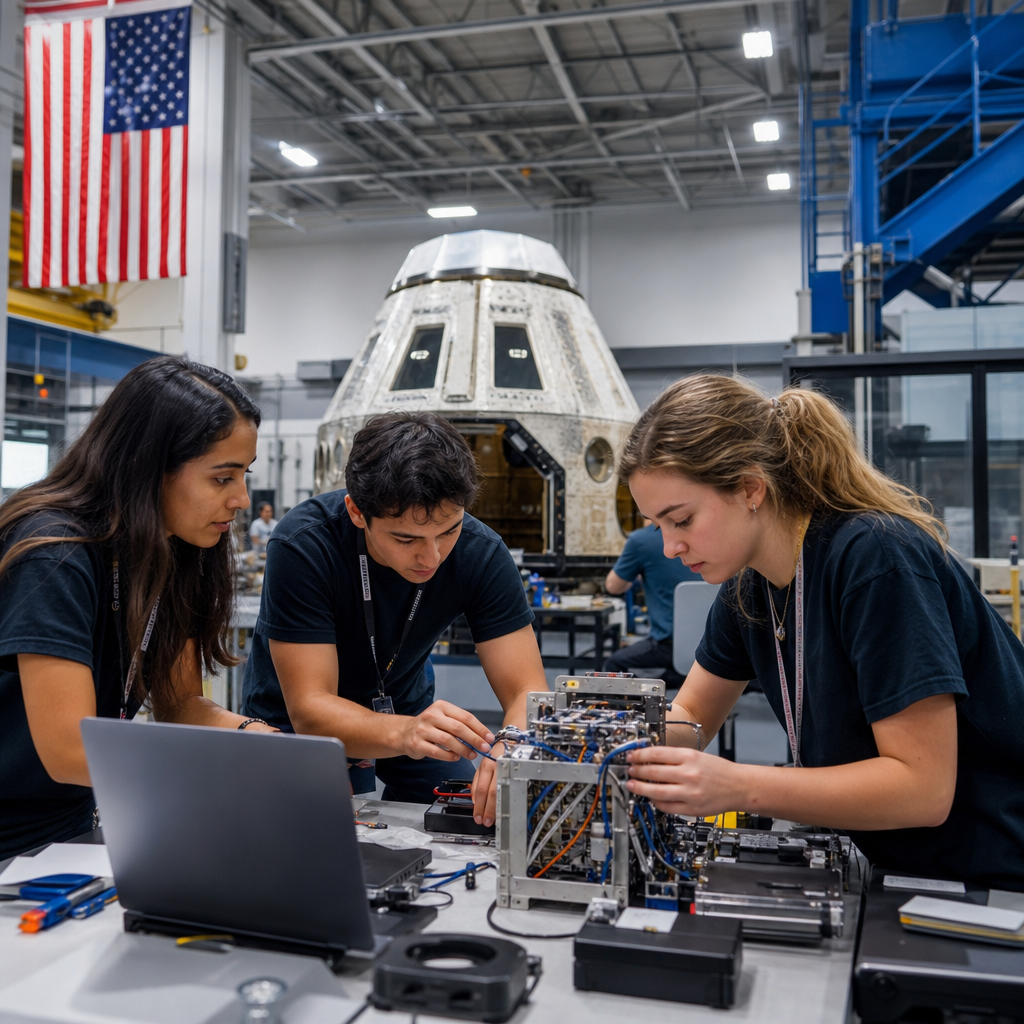
Experiential learning closes the gap. The most useful experiences include cubesat teams, robotics clubs, capstone projects, internships, payload competitions, and mission simulations. Hackathons are helpful when they produce artifacts such as code repositories, data dashboards, PCB designs, or technical presentations. Employers want proof that a learner can handle ambiguity, document work, collaborate across functions, and iterate under constraints. Those are educational outcomes as much as workplace skills.
| Pathway | What You Learn | Best Fit | Example Outcome |
|---|---|---|---|
| University degree | Fundamentals in engineering, science, and analysis | Students targeting technical depth | Capstone satellite or propulsion project |
| Certificate program | Focused skills in systems, software, GIS, or RF | Career changers and working professionals | Portfolio demonstrating job-ready specialization |
| Internship or co-op | Applied workflows, documentation, testing, teamwork | Learners needing real-world experience | Flight software module or test campaign contribution |
| Research lab participation | Experimental methods, publications, advanced tools | Students considering graduate study | Conference poster or prototype instrument |
Skills that expand knowledge and lead to real opportunities
When people ask which skills matter most in Silicon Valley space tech, the answer is systems thinking supported by concrete technical fluency. Systems engineering is central because spacecraft are tightly coupled systems with mass, power, thermal, software, communications, and mission constraints. Learners who understand requirements management, interface control documents, verification plans, and failure modes are immediately more useful.
Software skills are equally important. Python is common for data analysis, automation, and simulation. C and C++ remain relevant for embedded and performance-critical work. MATLAB and Simulink still appear in control systems and modeling environments. Git, Linux, containers, and cloud platforms are baseline tools in many teams. For geospatial and Earth observation roles, QGIS, ArcGIS, raster processing libraries, and remote sensing workflows matter. For hardware roles, CAD, PCB design, test instrumentation, and environmental qualification knowledge are valuable.
Communication is the multiplier. In actual project reviews, the difference between a promising learner and a trusted contributor often comes down to documentation quality, tradeoff reasoning, and the ability to explain risk clearly. Space programs require discipline. Good notes, clear diagrams, version control, and concise technical writing prevent mistakes. If you are building an educational plan, do not separate technical depth from communication skill. The market does not reward that split.
Key institutions, communities, and programs in the region
Several institutions anchor learning in the region. Stanford offers strong research and entrepreneurship connections, especially around satellites, robotics, and advanced engineering. San Jose State University provides accessible pathways into aerospace and related technical fields, often serving students who combine study with local industry work. UC Berkeley contributes strengths in EECS, materials, data science, and interdisciplinary research that connects well to space applications. Community colleges support transfer routes, technician training, electronics, machining, and foundational STEM preparation, which are often overlooked but highly practical.
NASA Ames is especially important because it exposes learners to mission-driven work at the intersection of science and engineering. Depending on the program cycle, students may find internships, research opportunities, and collaborative events tied to astrobiology, air traffic systems, small spacecraft, autonomy, and high-performance computing. Private-sector learning opportunities also matter. Companies across the region host technical talks, recruit interns, sponsor competitions, and publish engineering content that can guide self-study.
Community organizations are where many learners gain momentum. Space meetups, CubeSat groups, maker spaces, university clubs, and professional associations such as AIAA create weak ties that often become internships or collaborations. I have seen more than one early-career engineer land a role because a hackathon teammate remembered their reliability six months later. Educational opportunities are not only formal. In Silicon Valley, communities themselves function as learning infrastructure.
How to build a practical learning roadmap
A practical learning roadmap starts with a target role, not a vague interest in space. If you want to work in satellite operations, study orbital basics, communications, command workflows, anomaly response, and scripting. If you want Earth observation work, build skills in remote sensing data, image classification, GIS, and cloud processing. If your goal is hardware, focus on electronics, test procedures, reliability, and design for manufacturability. A clear destination prevents random course collecting.
Next, create a stack of evidence. One course is not enough. Build a small but serious portfolio: a mission analysis notebook, a cubesat subsystem design review, a geospatial dashboard using public satellite data, or a simulation with documented assumptions and results. Use public resources when possible. NASA data portals, USGS Landsat, ESA Sentinel datasets, GitHub projects, and open scientific libraries make it possible to learn without expensive tools. Then seek feedback from practitioners, not only classmates.
Finally, connect learning to the regional ecosystem. Attend technical events, ask informed questions, and follow organizations whose work aligns with your pathway. Reach out for informational interviews with a specific angle, such as test engineering workflows or payload integration challenges. The best educational resource in Silicon Valley is proximity to people doing the work now. Use that advantage deliberately, and revisit your roadmap every quarter so your skills stay aligned with real opportunities.
Silicon Valley offers unusually strong educational opportunities for anyone serious about exploring space tech and expanding knowledge and skills. The region combines universities, research centers, startups, technical communities, and public data resources in a way that turns abstract interest into measurable capability. The most effective learners understand that space technology is broader than launch. It includes software, sensors, semiconductors, geospatial analytics, manufacturing, systems engineering, and mission operations. That breadth creates multiple entry points for students, professionals, and career changers.
The main takeaway is simple: choose a direction, learn the fundamentals, build evidence through projects, and plug into the local ecosystem. Degrees, certificates, internships, research labs, and community groups all have value when they are tied to a clear skills plan. Employers respond to demonstrated competence, disciplined communication, and the ability to work across technical boundaries. If you treat this page as your hub, the next step is to map your target role and begin with one concrete project that proves you can apply what you learn.
Frequently Asked Questions
What does “space tech” include in Silicon Valley, and why is it such a strong place to study it?
In Silicon Valley, space tech is much broader than rockets and launch vehicles. It includes satellite design, Earth observation systems, spacecraft software, onboard electronics, sensors, communications infrastructure, autonomy, robotics, semiconductor technologies, advanced manufacturing, geospatial analytics, and the data platforms that turn space-based information into practical tools for agriculture, climate research, logistics, defense, and telecommunications. That broad definition matters because many educational opportunities in the region are not labeled strictly as “space” programs, even though they directly support careers in the sector.
Silicon Valley stands out because it combines research universities, startup culture, hardware expertise, venture capital, and proximity to companies working at every layer of the aerospace stack. Students and professionals can learn not only the theory behind orbital systems or remote sensing, but also how products are prototyped, funded, tested, scaled, and commercialized. This environment makes the region especially useful for people who want practical exposure. A learner might study embedded systems in one setting, machine learning in another, and then see how both are applied to satellite operations or imaging analytics through internships, labs, meetups, or industry events.
Another advantage is that Silicon Valley supports multiple entry points. Someone interested in mechanical engineering can explore spacecraft structures and manufacturing. A software developer can move into flight software, autonomy, mission operations, or geospatial data systems. A policy-minded student can study regulation, national security, spectrum issues, or the ethics of Earth observation. Because the local ecosystem is so interdisciplinary, educational pathways often mirror the realities of the industry itself: collaborative, cross-functional, and tied closely to emerging technology.
What kinds of educational opportunities are available for students and career changers interested in space technology?
The opportunities are diverse, which is one reason Silicon Valley is so attractive for space-tech learning. Traditional options include university degree programs in aerospace engineering, electrical engineering, computer science, materials science, physics, robotics, and data science. These disciplines form the technical backbone of the industry. However, many learners also build relevant skills through extension programs, professional certificates, short courses, engineering bootcamps, research labs, fabrication workshops, and startup incubator environments.
For students, hands-on learning is especially important. University labs, CubeSat projects, robotics teams, capstone engineering programs, and interdisciplinary design competitions can provide exposure to the systems thinking required in space work. These experiences teach more than technical content. They build comfort with testing, documentation, systems integration, troubleshooting, and teamwork under constraints. Those are the same skills employers often value in early-career candidates.
For career changers, the region offers practical ways to pivot without necessarily starting from scratch. A software engineer may transition into mission software, satellite data processing, or simulation tools. A manufacturing professional may move toward precision assembly, quality systems, or supply chain roles that support spacecraft production. People with backgrounds in AI, cybersecurity, cloud computing, semiconductors, GIS, or telecommunications may already possess highly relevant experience. The key is identifying the overlap between current skills and the specific needs of space-related companies.
In addition, industry talks, networking events, startup demo days, and technical communities can be educational in their own right. They help learners understand where the market is heading, which technologies are gaining traction, and what hiring managers actually look for. In a field evolving as quickly as space tech, these real-world signals can be just as valuable as formal coursework.
Which skills are most valuable for building a career in space tech today?
The most valuable skills tend to be both technical and interdisciplinary. On the technical side, strong foundations in software engineering, embedded systems, electronics, signal processing, mechanical design, control systems, data analysis, AI and machine learning, orbital mechanics, and systems engineering are highly relevant. Depending on the role, employers may also prioritize experience with simulation environments, sensor fusion, image processing, RF communications, semiconductor design, cloud infrastructure, cybersecurity, or advanced manufacturing methods.
That said, space tech is rarely about isolated expertise. Successful professionals usually understand how their work fits into a larger mission. For example, a software engineer writing code for a satellite subsystem benefits from understanding hardware constraints, reliability requirements, testing processes, and communications limitations. A data scientist working with satellite imagery gains an advantage by understanding sensor characteristics, calibration, geospatial workflows, and end-user applications. This systems-level thinking is one of the defining capabilities in the field.
Soft skills are also more important than many newcomers expect. Clear technical communication, collaborative problem-solving, documentation discipline, and the ability to work across engineering and business teams all matter. Space systems are complex, expensive, and often high-stakes, so organizations value people who can think carefully, communicate clearly, and contribute to reliable execution.
For learners in Silicon Valley, the smartest approach is often to build one deep specialization while developing working fluency in adjacent areas. A candidate does not need to master everything. But they should be able to show that they understand how modern space systems connect software, hardware, data, operations, and commercial reality. That combination of depth and context is often what makes someone stand out.
How can someone gain practical experience in space tech if they do not already work in the industry?
Practical experience can be built in several credible ways, even without a formal aerospace title. One of the most effective routes is project-based learning. Building small satellites, contributing to robotics systems, developing embedded applications, analyzing public Earth observation datasets, or creating software tools related to mission planning or telemetry can all demonstrate relevant capability. Employers often respond well to candidates who can point to concrete projects that show initiative, technical competence, and an understanding of real-world constraints.
Research and collaborative environments are another strong option. University labs, faculty-led initiatives, student engineering teams, and maker communities can offer exposure to testing, prototyping, and interdisciplinary teamwork. In Silicon Valley, these environments often connect naturally to startups, internships, and industry mentors. Even if a project is academic, the practical lessons can be highly transferable when the work involves sensors, software, communications, control systems, or hardware integration.
Internships and contract work also matter. Many people enter the sector through adjacent roles in software, electronics, data systems, manufacturing, or operations before moving into explicitly space-focused teams. That path is common and often strategic. It allows candidates to gain experience in the same technologies that space companies depend on, while building industry familiarity and credibility.
Finally, learners should not underestimate the value of public resources. Open satellite datasets, open-source software, technical papers, and recorded conference talks make it possible to build a surprisingly sophisticated self-directed education. If someone combines that learning with a portfolio, a GitHub repository, a hardware demo, or a documented case study, they can create evidence of readiness that goes far beyond simply listing interest on a resume.
Are Silicon Valley space-tech educational opportunities useful only for engineers, or are there paths for founders, educators, and nontechnical professionals too?
They are absolutely useful beyond engineering. Space tech is an ecosystem, not just a technical discipline. Founders can benefit from understanding satellite markets, launch economics, space data applications, manufacturing bottlenecks, procurement cycles, dual-use technologies, and regulatory constraints. Silicon Valley is especially valuable for this group because education often happens at the intersection of technology and commercialization. Founder-oriented learning may come through accelerators, venture networks, university innovation programs, and close observation of how space startups validate demand and secure partnerships.
Educators also have an important role. Space tech is a powerful gateway into STEM because it naturally combines physics, coding, electronics, climate science, robotics, mathematics, and design thinking. In Silicon Valley, educators can draw from a dense network of research institutions, public events, industry speakers, and project-based learning models. That makes it easier to translate abstract concepts into engaging classroom experiences tied to real missions and technologies.
Nontechnical professionals have meaningful pathways as well. Policy specialists, project managers, product managers, supply chain experts, regulatory analysts, sales professionals, geospatial strategists, and communications leaders all contribute to the space sector. A satellite company, for example, may need experts in customer discovery, government relations, data product positioning, compliance, international markets, and operational planning just as much as it needs engineers. The educational challenge for these professionals is not becoming aerospace engineers overnight, but learning enough about the domain to speak the language, understand the market, and make informed decisions.
That is one of Silicon Valley’s real strengths: it supports domain learning in context. People can study the technical fundamentals while also learning how organizations are built, funded, managed, and scaled. For anyone interested in participating in the future of space technology, that wider perspective is often what turns curiosity into a practical, durable career path.