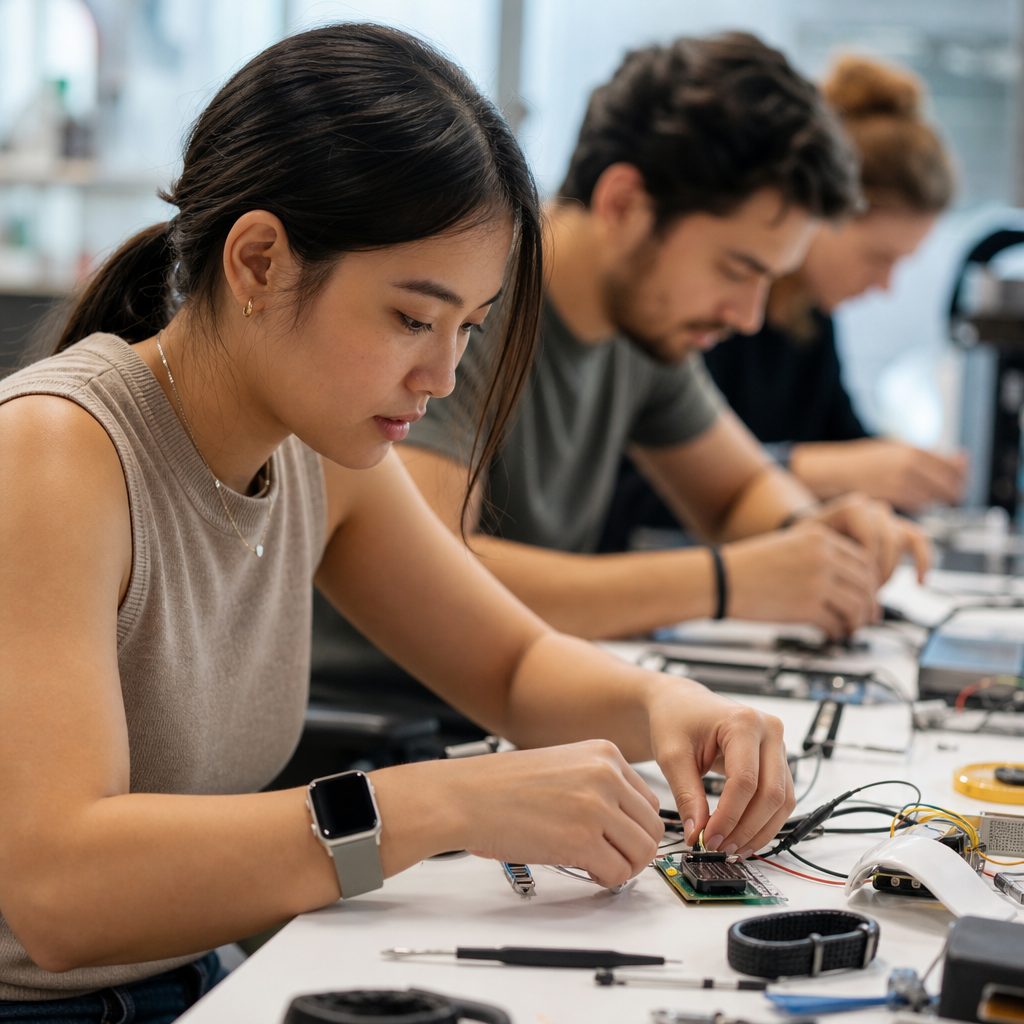
Wearable technology has moved from novelty to necessity, and Silicon Valley’s design and development courses now play a central role in preparing professionals to build products people actually use. In this context, wearables include devices worn on the body that sense, compute, communicate, or assist, from smartwatches and fitness bands to medical patches, AR glasses, smart clothing, and industrial safety sensors. Design and development courses are structured programs that teach the full product lifecycle: user research, hardware selection, embedded systems, firmware, mobile integration, interface design, prototyping, testing, compliance, and commercialization. I have worked with teams building connected devices, and the same pattern appears again and again: the winners are not simply strong engineers or talented designers, but cross-functional practitioners who understand human factors, electronics, software, manufacturing, and regulation in one workflow.
That is why this topic matters within Educational Resources. Wearables sit at the intersection of consumer electronics, digital health, data science, and product design, so the learning path is broader than a standard app-development curriculum. A serious course sequence helps learners expand knowledge and skills in practical ways, whether they are students entering the field, product managers moving into hardware, UX designers adapting to tiny interfaces, or engineers shifting from mobile apps to embedded systems. Silicon Valley is especially influential because its training culture reflects the realities of companies building connected products at scale: rapid prototyping, agile validation, interdisciplinary collaboration, and attention to platform ecosystems such as Apple HealthKit, Google’s Android wearable stack, Bluetooth Low Energy, and cloud analytics. A strong hub page should answer the central question directly: what should someone learn, in what order, and why does that sequence produce better wearable products?
The answer begins with scope. Effective wearable education teaches more than coding a sensor or sketching a watch face. It covers ergonomics, battery constraints, latency, privacy, accessibility, and behavior change. It also teaches learners how to evaluate tradeoffs: a medical wearable demands accuracy and compliance, while a consumer fitness device may prioritize comfort, engagement, and long battery life. Understanding those tradeoffs is the foundation for expanding knowledge and skills across this subtopic.
What Silicon Valley wearable courses actually teach
The best Silicon Valley wearable courses are built around product realities, not isolated lectures. A credible program usually starts with market framing and user research. Students learn how to define target users, identify use contexts, and map pain points that justify a body-worn device instead of a phone app. In workshops I have seen, teams often begin by shadowing runners, nurses, warehouse workers, or older adults, because context determines everything from attachment method to notification style. A cyclist using smart glasses needs glanceable information under bright sunlight, while an elder-care monitoring patch must stay comfortable for days and transmit reliable data through walls and across routines.
From there, instruction typically moves into hardware architecture. Learners study sensors such as accelerometers, gyroscopes, photoplethysmography modules for heart rate, temperature sensors, galvanic skin response components, and GPS chips. They also examine microcontrollers, low-power design, flexible printed circuits, enclosures, haptics, antennas, and charging methods. This is where Silicon Valley programs often stand out: they teach technical choices in relation to business constraints. Selecting Nordic Semiconductor or Qualcomm platforms, for example, is not only an engineering decision; it affects development speed, software support, certification effort, and future manufacturing options.
Software and interaction design form the next core block. Students learn firmware logic, event handling, Bluetooth pairing flows, mobile companion app design, cloud synchronization, and dashboards for data interpretation. On the design side, they work on tiny-screen hierarchy, gesture models, voice interactions, haptic feedback patterns, and accessibility standards. Instructors often use Figma for interface exploration, Arduino or ESP32 for rapid prototyping, and TensorFlow Lite when introducing on-device inference. When done well, the course makes one lesson unmistakably clear: wearables fail when hardware, software, and user experience are taught as separate disciplines.
Core skills learners need to expand knowledge and skills
Anyone using this page as a hub for expanding knowledge and skills should think in capability clusters rather than job titles. The first cluster is human-centered design. That means contextual inquiry, journey mapping, task analysis, usability testing, and comfort evaluation. Wearables are intimate products. A wrist device that looks sleek on a render may irritate skin, snag on sleeves, or demand too much attention in real life. Courses that ignore anthropometrics and wearability testing leave major gaps.
The second cluster is technical fluency. Learners do not all need to become electrical engineers, but they do need working knowledge of embedded systems, sensor fusion, power management, Bluetooth Low Energy, data sampling, APIs, and mobile operating system constraints. I have seen product teams lose months because one side assumed continuous sensing was easy while the other knew the battery budget made it impossible. Courses close that gap by teaching the language of constraints early.
The third cluster is product validation. Students should learn how to define meaningful metrics, run pilots, interpret signal quality, and separate vanity metrics from outcome metrics. If a stress-tracking wearable claims value, learners must ask how stress is being inferred, what the false positive rate looks like, and whether the user changes behavior because of the feedback. Those questions distinguish educational depth from gadget enthusiasm.
| Skill area | What students learn | Why it matters in wearables |
|---|---|---|
| User research | Context interviews, diary studies, field observation | Body-worn products succeed only when they fit real routines |
| Hardware basics | Sensors, microcontrollers, batteries, antennas | Physical constraints drive cost, size, and reliability |
| UX design | Tiny-screen layout, haptics, voice, accessibility | Limited attention and screen space demand clarity |
| Software integration | Firmware, BLE, mobile apps, cloud dashboards | Most wearable value comes from connected ecosystems |
| Validation and compliance | Testing protocols, privacy, medical and safety standards | Trust is essential for health, workplace, and consumer adoption |
How courses connect design, engineering, and business
One reason Silicon Valley remains a reference point is its insistence on cross-functional product development. Strong wearable programs teach students how design decisions change engineering effort and how technical architecture changes go-to-market strategy. For example, adding continuous blood oxygen monitoring may increase component cost, trigger more stringent validation expectations, and raise privacy questions about storing health-related data. That single feature can affect industrial design, app permissions, legal review, and customer support.
Good courses also make prototyping tangible. Students may build a first proof of concept using off-the-shelf modules, then iterate into custom boards and enclosure prototypes using CAD tools and 3D printing. Along the way, they learn design for manufacturability, ingress protection considerations, adhesive selection, and tolerance management. These are not abstract lessons. A wearable that passes a classroom demo can still fail in production because sweat degrades adhesion, a clasp breaks under repetition, or the antenna performs poorly near the body. Instructors with real shipping experience surface these failure modes early.
Business education is equally important. Learners should understand pricing models, channel strategy, reimbursement pathways for digital health, subscription economics, return rates, and customer retention. Companies such as Apple, Garmin, Oura, Fitbit, and Dexcom show that wearable success can come from very different models, but each relies on disciplined alignment between product promise and operational capability. The best educational resources teach students to evaluate that alignment before they overinvest in features.
Specializations within the wearable learning path
Wearables are not one market, and courses become far more useful when they clarify specialization paths. Consumer fitness programs emphasize engagement loops, gamification, battery efficiency, and companion app ecosystems. Digital health tracks focus on clinical evidence, data integrity, HIPAA-related considerations in the United States, interoperability, and risk management. Industrial wearable curricula may center on ruggedization, worker safety, voice interfaces in noisy environments, and fleet management. AR and mixed reality courses usually prioritize optics, latency, spatial interaction, thermal management, and content frameworks.
This distinction matters because expanding knowledge and skills requires depth in a chosen domain after broad fundamentals are in place. A student interested in remote patient monitoring should study IEC 62304 software lifecycle principles, usability for regulated environments, and verification protocols. Someone aiming for sports performance products should understand motion analysis, coaching feedback loops, and the limits of consumer-grade biometric interpretation. A fashion-tech learner needs materials knowledge, textile integration, and manufacturing methods that support both aesthetics and durability. Silicon Valley programs often expose students to all of these segments, then encourage portfolio projects aligned to one.
As a hub under Educational Resources, this article should guide readers toward deeper pages on prototyping, sensor selection, wearable UX, embedded development, compliance, and commercialization. That structure mirrors how professionals actually learn: broad overview first, then deliberate specialization based on role and product category.
How to choose the right course and build a strong portfolio
The right wearable course depends on career stage, technical background, and target industry. Beginners should prioritize programs that combine fundamentals with hands-on prototyping, because practical build experience reveals constraints faster than theory alone. Mid-career professionals should look for modular courses that fill specific gaps, such as BLE architecture, wearable interaction design, or medical device validation. Advanced learners benefit most from studio formats, capstones, and industry mentorship, where they can defend design choices using evidence.
Evaluate courses using a simple checklist. First, review the syllabus for end-to-end coverage rather than a narrow focus on either code or visuals. Second, look for named tools and standards, including Figma, CAD platforms, Git, BLE debugging tools, HealthKit, Android integration, and relevant compliance frameworks. Third, confirm that projects involve testing with users in realistic settings. Fourth, examine instructor backgrounds for shipped products, patents, startup or enterprise experience, and manufacturing exposure. Finally, assess whether the course teaches documentation, because hiring managers value portfolios that explain decisions, iterations, and outcomes, not just polished mockups.
A strong wearable portfolio should include one concise case study that demonstrates the full loop: problem definition, user insight, technical constraints, prototype architecture, testing results, and next-step recommendations. Show battery assumptions, signal limitations, onboarding challenges, and how feedback changed the product. That level of specificity proves skill expansion better than a glossy concept render ever could.
Silicon Valley’s design and development courses matter because wearable technology rewards integrated thinking. The professionals who build useful devices are the ones who understand people, electronics, software, testing, and business as one system. For readers exploring Educational Resources, this hub is the starting point for expanding knowledge and skills across that system: learn the foundations, choose a specialization, practice with real prototypes, and document decisions with evidence. If you want to work in wearables, do not wait for perfect mastery. Start with one credible course, build one honest project, and use that momentum to move deeper into the field.
Frequently Asked Questions
1. What do Silicon Valley wearable design and development courses typically cover?
Silicon Valley wearable design and development courses usually cover the entire product lifecycle, not just coding or industrial design in isolation. Strong programs introduce students to the major categories of wearable technology, including smartwatches, fitness trackers, medical wearables, augmented reality headsets, smart garments, and workplace safety devices. From there, coursework often moves into human-centered design, where students learn how to create products that are comfortable, useful, intuitive, and practical for real-life wear. That includes body placement, ergonomics, sizing, materials, battery constraints, thermal considerations, and how constant skin or body contact changes design decisions.
On the technical side, these courses commonly teach sensor integration, embedded systems, low-power electronics, wireless connectivity such as Bluetooth Low Energy, mobile app integration, cloud communication, and data processing. Students may work with accelerometers, gyroscopes, heart rate sensors, temperature sensors, GPS modules, and biometric components, depending on the program’s focus. More advanced courses often address prototyping workflows, firmware development, companion app design, data visualization, and interoperability between hardware and software.
Another major area is product strategy. In Silicon Valley especially, courses tend to emphasize market fit, rapid iteration, and cross-functional collaboration. Students are often taught how to evaluate user needs, define product requirements, validate assumptions, test prototypes, and refine concepts based on feedback. Many programs also discuss privacy, security, accessibility, compliance, and manufacturing readiness, which are especially important for wearables that collect sensitive data or operate in health and enterprise settings. In short, the best courses prepare learners to move from idea to functional prototype while understanding both the technical and human factors that determine whether a wearable succeeds.
2. Why is Silicon Valley considered such an important place to study wearable technology?
Silicon Valley holds a unique position in wearable technology because it brings together the exact mix of disciplines needed to build successful products: hardware engineering, software development, product design, venture funding, startup culture, manufacturing partnerships, and access to experienced mentors. Wearables are inherently interdisciplinary. They are not simply gadgets; they are physical products worn on the body, connected to digital ecosystems, and expected to function reliably in everyday life. Learning in an environment where these disciplines regularly intersect can give students a meaningful advantage.
Courses in Silicon Valley often reflect this ecosystem. They are more likely to be informed by current industry practices, emerging device categories, and the realities of building products at scale. Instructors may include engineers, founders, UX designers, researchers, and product leaders who have worked on consumer electronics, digital health platforms, AR systems, or connected device startups. That means students gain exposure not only to theory, but also to lessons drawn from products that have actually been shipped, tested, and used in the market.
Another reason Silicon Valley stands out is proximity to innovation. Students may benefit from networking opportunities, startup incubators, industry events, prototype labs, and connections to companies working on health tech, fitness platforms, industrial IoT, and immersive computing. This matters because the wearable field evolves quickly. A course grounded in a fast-moving innovation hub is more likely to address current design challenges such as battery optimization, sensor accuracy, user adherence, data trust, and AI-enabled personalization. For learners who want both technical preparation and insight into how wearable products are conceived, validated, and commercialized, Silicon Valley offers a particularly strong environment.
3. Who should take a wearable design and development course?
Wearable design and development courses can benefit a surprisingly wide range of professionals and aspiring creators. They are an excellent fit for product designers who want to move beyond screens and learn how physical form, body interaction, and sensor-driven experiences shape user behavior. They are equally valuable for software developers who want to understand embedded systems, companion apps, real-time data flows, and the constraints of low-power connected devices. Hardware engineers, UX researchers, industrial designers, and mobile developers also gain from this kind of cross-disciplinary training because wearable products rarely succeed when built from a single perspective.
These courses are also highly relevant for professionals in healthcare, sports performance, occupational safety, and digital wellness. For example, someone working in medical technology may want to learn how wearable patches, remote monitoring devices, or rehabilitation tools are designed for accuracy, comfort, and compliance. A founder exploring a fitness or health startup may need a practical understanding of prototyping, user testing, regulatory considerations, and how to turn sensor data into useful features. Even professionals outside traditional tech roles can benefit if they are involved in innovation, product strategy, or customer experience for connected devices.
Many Silicon Valley-style programs are designed to serve both beginners and experienced practitioners, though the level varies. Some focus on foundational principles and prototyping, while others assume knowledge of electronics, coding, or product design. The best candidate is someone who wants to understand not just how wearables function, but why people adopt them, trust them, and continue using them over time. Since wearables sit at the intersection of utility, behavior, design, and data, these courses are especially valuable for anyone aiming to build products that are technically sound and genuinely usable.
4. What skills can students gain from these courses that apply in the real world?
Students can gain a combination of practical, technical, and strategic skills that translate directly into wearable product development roles. On the practical side, many courses teach how to define a wearable use case, map user needs, create design requirements, and build prototypes that can be tested early. This is crucial because wearable products often fail when teams prioritize features over comfort, clarity, and sustained usability. By learning user-centered design methods, students become better at identifying friction points such as poor fit, confusing feedback, uncomfortable materials, or battery performance that does not align with actual daily use.
Technically, learners often develop skills in sensor selection, embedded programming, Bluetooth connectivity, firmware logic, hardware-software integration, and companion app workflows. They may also learn how to interpret movement, biometric, or environmental data and present it in ways that help users make decisions. In more advanced settings, students gain exposure to edge processing, machine learning applications, power management, and system architecture. These are highly relevant skills for companies building health trackers, smart glasses, connected apparel, and industrial wearables.
Just as important are the cross-functional skills. Real-world wearable teams must balance engineering feasibility, product goals, user experience, privacy, compliance, and manufacturing realities. Strong courses teach students how to collaborate across disciplines, communicate design tradeoffs, and make decisions based on evidence rather than assumptions. They may also cover validation testing, accessibility, secure data practices, and product storytelling for stakeholders or investors. As a result, graduates are often better prepared not only to contribute to a wearable project, but to lead one from concept through refinement and launch.
5. How do these courses help students create wearables people actually want to use?
The most effective wearable courses focus relentlessly on real-world adoption, which is what separates an interesting prototype from a successful product. People do not keep wearing devices simply because the technology is impressive. They wear them because the device fits comfortably into daily life, provides clear value, respects privacy, feels reliable, and does not create unnecessary friction. Silicon Valley programs often teach this explicitly by framing wearable development around human behavior, context of use, and iterative testing rather than around features alone.
Students learn to ask the right questions early. Where on the body should the device be worn? How often will someone charge it? What does the user gain from wearing it continuously? Is the feedback subtle enough for everyday life but strong enough to be useful? Does it work equally well across different body types, environments, and levels of technical familiarity? These questions matter because wearables must operate in motion, under physical constraints, and often over long periods of time. A product that looks innovative in a lab may fail quickly if it is awkward, inaccurate, bulky, or hard to trust.
Courses also help students understand retention and long-term engagement. A good wearable must create a dependable loop between sensing, interpretation, and action. That means the data must be meaningful, the interface must be understandable, and the recommendations or insights must feel relevant rather than overwhelming. In health and wellness contexts, trust is especially important, so programs often address transparency, data quality, and ethical design. By teaching students how to validate assumptions with users, refine prototypes based on evidence, and align product decisions with actual needs, these courses help future developers build wearables that are not just technically functional, but genuinely desirable and sustainable in everyday use.