Seagate Technology has shaped modern data storage by turning a basic business need—keeping information safe, accessible, and affordable—into a discipline of engineering innovation. Within the broader landscape of tech innovators and market leaders, Seagate stands out because storage sits underneath nearly every digital service people use, from cloud backups and video streaming to enterprise analytics and edge computing. When I have evaluated infrastructure stacks for content archives, surveillance workloads, and hybrid cloud environments, Seagate products regularly appeared in the short list because the company competes across capacity, performance, and total cost, not just raw drive shipments. That breadth makes Seagate a strong company spotlight and an essential hub topic for understanding how hardware leaders influence the wider technology market.
At its core, data storage refers to the technologies that record digital information for later retrieval. In Seagate’s case, that includes hard disk drives, solid-state drives, storage systems, and related services for data management and recovery. Innovation in this field means packing more bits into less space, improving durability, lowering power use per terabyte, and matching products to real workloads such as hyperscale cloud, network-attached storage, gaming, media production, and AI data pipelines. The stakes are high because global data creation continues to expand across consumer devices, industrial sensors, enterprise applications, and machine-generated logs. Any company that can reliably store that data at scale becomes strategically important to customers and to the technology ecosystem as a whole.
Seagate matters beyond its own balance sheet because storage economics affect the cost structure of other industries. A cheaper and denser drive can reduce the expense of cloud retention, accelerate digitization in healthcare, extend surveillance archives for public safety, or help AI teams keep larger training datasets online. Seagate also illustrates a wider pattern seen among market leaders: the strongest firms do not win by inventing one product and defending it forever. They evolve manufacturing methods, interface standards, firmware optimization, service models, and channel partnerships over decades. As a hub article under Company Spotlights, this overview explains Seagate’s business, its technologies, its competitive position, and the lessons it offers for studying tech innovators that lead through operational scale as much as through headline-grabbing disruption.
Company background and market position
Seagate Technology was founded in 1979 and became one of the defining names of the disk drive industry as personal computing expanded and enterprise data volumes climbed. The company built its reputation in hard disk drives, or HDDs, which use spinning magnetic platters and read-write heads to store information. While many early storage brands disappeared through consolidation, Seagate remained a major force by sustaining manufacturing expertise and adapting to shifts in form factors, interfaces, and buyer segments. Today it serves cloud providers, enterprises, small businesses, creative professionals, gamers, and consumers through a portfolio that ranges from mass-capacity drives for data centers to branded external storage products.
In practical market terms, Seagate operates in a concentrated industry where scale matters enormously. HDD manufacturing requires precision engineering, clean-room production, advanced materials science, and long qualification cycles with demanding customers. That creates high barriers to entry. Alongside Western Digital and Toshiba, Seagate is one of the few global companies capable of supplying high-volume hard drives to hyperscale and enterprise buyers. This position gives it relevance far beyond storage enthusiasts. When cloud companies plan new capacity or enterprises refresh backup infrastructure, Seagate’s product roadmap can influence procurement timelines, rack design assumptions, and long-term archive economics.
Core innovations in data storage technology
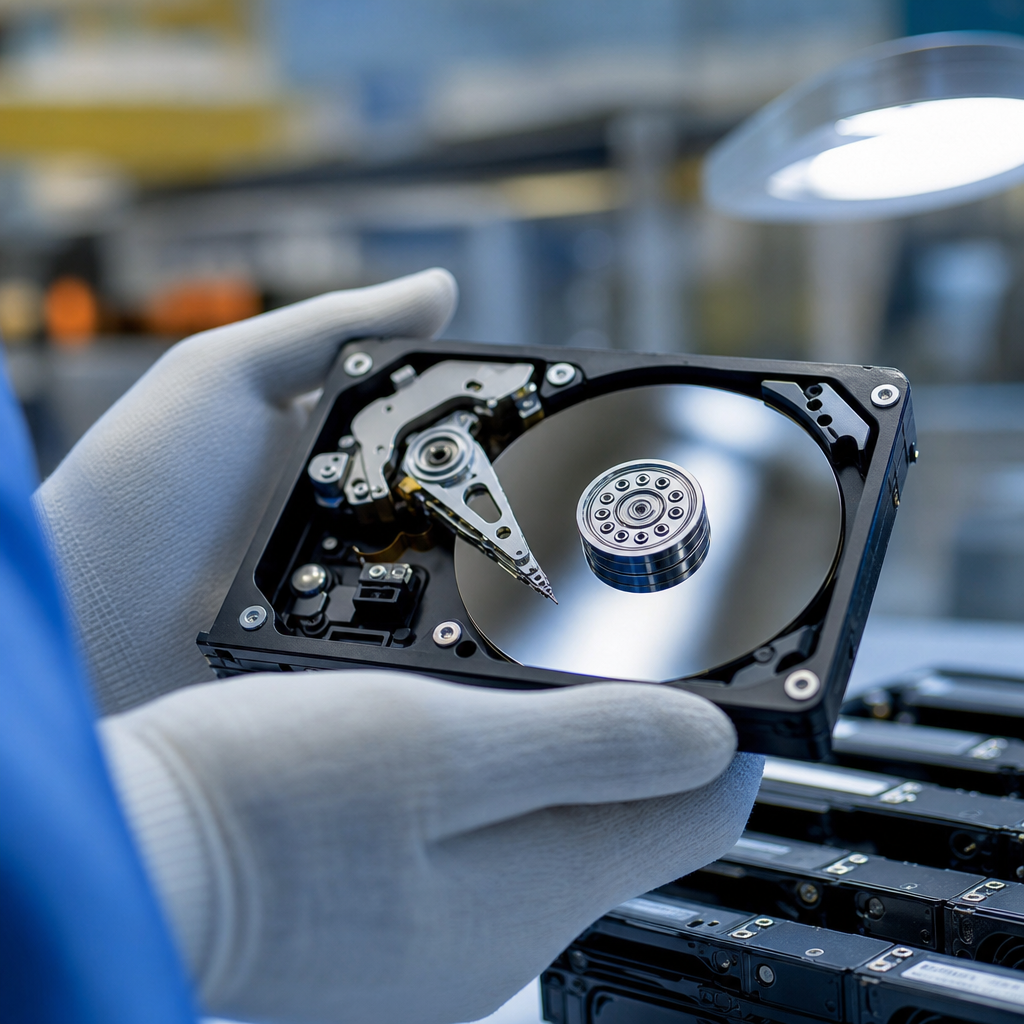
The most important driver of Seagate’s modern strategy is areal density, the amount of data stored on a given disk surface. Higher areal density lets Seagate increase drive capacity without proportionally increasing footprint, materials, or power draw. One major technique is heat-assisted magnetic recording, commonly abbreviated HAMR. HAMR briefly heats a tiny spot on the disk surface during writing, allowing the drive to use magnetic media with greater stability and therefore higher density. This is not a marketing flourish; it addresses a genuine physics challenge in conventional magnetic recording, where bits become harder to write as media stability increases. Seagate has invested heavily in bringing HAMR into commercial products because the economics of exabyte-scale storage depend on continued density gains.
Beyond media science, Seagate innovates through firmware, actuator design, caching behavior, vibration tolerance, and workload-specific optimization. Multi-actuator technology, for example, is designed to improve I/O performance by enabling more parallel access within a single drive. That matters for data centers where capacity alone is not enough; operators also care about throughput per slot and predictable latency under mixed workloads. In my experience reviewing storage deployments, this is where storage vendors separate themselves: not by one benchmark chart, but by how thoughtfully they tune hardware and firmware for real conditions such as RAID rebuilds, 24/7 operation, multi-bay vibration, and sustained sequential writes from surveillance cameras or backup jobs.
| Technology area | What it does | Why it matters |
|---|---|---|
| HAMR | Uses localized heat during writes to enable higher-density magnetic media | Raises capacity per drive and lowers storage cost per terabyte over time |
| Multi-actuator design | Allows more parallel data access inside one drive | Improves throughput for data-center and performance-sensitive workloads |
| Helium-sealed drives | Reduces internal turbulence compared with air-filled drives | Supports more platters, better efficiency, and cooler operation |
| Workload-tuned firmware | Optimizes caching, error handling, and command behavior | Improves reliability and performance in NAS, surveillance, and cloud use cases |
Product portfolio across consumer and enterprise markets
Seagate’s product strategy works because it spans several tiers of storage demand instead of chasing a single category. In the consumer market, the company is widely recognized for external drives and portable SSDs used for backups, gaming libraries, and creative workflows. These products matter because they turn an abstract storage brand into a familiar household name. A gamer using a branded expansion drive and a filmmaker moving footage on high-capacity externals may never think about hyperscale infrastructure, yet those touchpoints reinforce trust in the company’s engineering and support quality.
At the prosumer and small business level, Seagate’s IronWolf line targets network-attached storage environments where drives must handle multi-user access, always-on duty cycles, and vibration from multiple bays. For surveillance, SkyHawk drives are tuned for continuous recording and retention-heavy workloads. In enterprise and cloud settings, Exos drives address bulk data storage, large arrays, and demanding service-level expectations. Seagate also competes in SSDs and storage systems, though HDDs remain central to its identity because mass-capacity economics still strongly favor disks for warm and cold data. This segmentation is one reason Seagate belongs in any discussion of tech market leaders: it aligns product engineering with distinct workload profiles instead of pushing one generic solution everywhere.
Why Seagate remains important in the age of cloud and AI
A common question is whether cloud computing and artificial intelligence reduce the importance of traditional storage manufacturers. In practice, they make companies like Seagate more important, not less. Cloud does not eliminate physical storage; it aggregates demand into giant data centers that need enormous volumes of cost-efficient media. AI systems also create large storage requirements because training, fine-tuning, inference logging, model versioning, and governance all depend on keeping vast datasets accessible. Fast flash storage is crucial for some stages, but hard drives remain essential for bulk repositories, backup copies, and long-term retention because the cost per terabyte is far lower.
Seagate benefits from this reality because modern infrastructure is tiered. Hot transactional data may live on NVMe flash, but warm and cold data often migrate to high-capacity HDD pools. Media companies retaining raw footage, hospitals archiving imaging records, and enterprises preserving compliance logs all need this balance. The same pattern applies to AI pipelines. Teams may train on GPU clusters, yet the underlying corpus often sits on dense storage systems optimized for scale and endurance rather than maximum IOPS. Seagate’s relevance, then, is tied to a simple industry truth: as total data expands, inexpensive and reliable capacity becomes more strategic, not more obsolete.
Competitive strengths, risks, and strategic lessons
Seagate’s strongest competitive advantage is the combination of manufacturing scale, engineering depth, and customer trust built through long supply relationships. Large buyers do not switch storage vendors casually. Qualification programs are rigorous, firmware behavior is scrutinized, and failure characteristics are modeled over years. Seagate also benefits from a recognizable brand and a broad channel presence, from enterprise procurement teams to retail shelves. That said, the company faces real risks. Storage is cyclical, pricing can be volatile, and demand depends on broader spending patterns in cloud, PC, and enterprise markets. SSD adoption also places pressure on any vendor rooted in HDDs, particularly where latency and performance matter more than cost per terabyte.
The strategic lesson is not that Seagate is invulnerable. It is that durable market leaders survive by mastering tradeoffs. Seagate has had to balance research intensity with manufacturing discipline, pursue next-generation recording methods without abandoning current revenue lines, and manage investor expectations through supply-demand swings. For readers exploring tech innovators and market leaders more broadly, Seagate shows that innovation often looks incremental from the outside but is transformative at scale. A few percentage points of efficiency, density, or reliability improvement can reshape economics across the cloud, media, security, and enterprise software industries. That is exactly why this company deserves a central place in the Company Spotlights hub.
Seagate Technology demonstrates how foundational infrastructure companies drive progress even when they operate outside the consumer spotlight. Its importance comes from a clear value proposition: store more data, reliably, at a lower practical cost, while adapting products to the needs of cloud platforms, enterprises, creators, and consumers. The company’s record in HDD engineering, its push into technologies such as HAMR, and its workload-specific product lines make it a defining example of a tech innovator that leads through technical persistence and operational execution. In a market where every application eventually becomes a data problem, storage leadership has consequences far beyond one hardware category.
For anyone researching tech innovators and market leaders, Seagate is best understood as both a company and a case study in industrial resilience. It shows how deep specialization, standards-based engineering, and long-term R&D can sustain relevance through multiple technology cycles. It also reminds decision-makers to evaluate infrastructure vendors by fit, reliability, and economics rather than by hype. As you explore the wider Company Spotlights hub, use Seagate as a reference point for comparing how leading firms build advantage: through focused innovation, disciplined execution, and a clear understanding of the real workloads customers need to support. Continue to the related company profiles to see how other market leaders create value across the tech landscape.
Frequently Asked Questions
What makes Seagate Technology so important in the modern data storage industry?
Seagate Technology plays a foundational role in the modern digital economy because data storage is not a niche function anymore—it is the underlying layer that supports nearly every connected experience. From consumer laptops and gaming systems to hyperscale cloud platforms, video surveillance deployments, media archives, and enterprise data centers, organizations depend on storage systems that can reliably hold growing volumes of information without becoming prohibitively expensive. Seagate has remained important because it has consistently focused on solving that central challenge: how to store more data, more efficiently, with the reliability and performance required by real-world applications.
What distinguishes Seagate is its long-term commitment to engineering innovation in an area many people overlook until it fails. Storage is easy to take for granted, but every streaming library, backup repository, AI training dataset, and analytics platform depends on durable, scalable infrastructure. Seagate has helped shape that infrastructure through advances in hard disk drive technology, enterprise storage solutions, and increasingly sophisticated approaches to capacity optimization. In practical terms, that means helping businesses preserve massive content libraries, enabling cloud providers to scale cost-effectively, and giving organizations a path to manage exploding data volumes without losing control over access, uptime, or budget.
Seagate also matters because it serves a wide spectrum of needs rather than a single narrow market. The company’s technologies are used in edge environments, surveillance systems, network-attached storage, personal backup products, and large enterprise ecosystems. That broad relevance has kept Seagate central to discussions about digital transformation, because whenever data growth accelerates, storage strategy becomes a business strategy. In that sense, Seagate is not just a hardware manufacturer—it is one of the companies helping define how digital information is retained, protected, and made usable at scale.
How has Seagate driven innovation in data storage over time?
Seagate has driven innovation by continuously improving the balance between capacity, cost, reliability, and operational efficiency—four variables that determine whether storage technology is practical in the real world. Historically, the company became well known through advances in hard drive engineering, steadily pushing more data into the same physical footprint while improving performance and durability. That may sound incremental on the surface, but in infrastructure terms, those gains are transformative. A modest improvement in areal density or power efficiency, when multiplied across thousands of drives in a data center, can significantly affect total cost of ownership, rack utilization, cooling requirements, and deployment flexibility.
One of Seagate’s most important contributions has been its role in extending the usefulness of hard disk drives at massive scale. Even as flash storage has become increasingly important, HDDs remain essential for high-capacity, cost-sensitive environments such as cold storage, content archives, backup systems, and many cloud workloads. Seagate has invested in technologies designed to keep increasing HDD capacity, including innovations in recording methods and manufacturing precision. That work has helped organizations continue to store larger datasets economically, which is critical in industries where retention requirements and content generation are growing faster than budgets.
Innovation at Seagate also includes designing products for specific workload categories rather than treating all storage as interchangeable. Enterprise drives, surveillance drives, NAS-focused drives, and consumer external storage products each require different firmware tuning, endurance expectations, and performance behavior. By engineering for use case realities, Seagate has improved not just raw specifications, but operational fit. That kind of product strategy matters because a drive used in a 24/7 surveillance environment faces very different demands than one used for periodic desktop backup or heavy enterprise analytics. Seagate’s influence comes from recognizing those distinctions and building accordingly.
Beyond hardware itself, the company has contributed to how the market thinks about storage as an intelligent infrastructure layer. Businesses increasingly evaluate storage not only on capacity, but on lifecycle value, resilience, data accessibility, and sustainability. Seagate’s ongoing development efforts reflect that broader view, helping move storage from a passive repository model toward a more strategic, optimized component of digital systems.
Why does Seagate remain relevant when solid-state storage and cloud services are growing so quickly?
Seagate remains highly relevant because the rise of SSDs and cloud services has increased the importance of storage architecture rather than replacing it. Solid-state drives are excellent for speed-sensitive workloads, and cloud platforms abstract infrastructure for customers, but neither trend eliminates the underlying need for scalable, economical data retention. In fact, the explosion of cloud computing has dramatically increased demand for high-capacity storage in the backend. Cloud data still has to live somewhere, and a large portion of that data—especially archives, backups, media repositories, and less frequently accessed content—must be stored in ways that are financially sustainable at enormous scale. That is where Seagate continues to matter.
The most practical way to understand this is to look at workload tiers. Not every application needs the ultra-low latency of flash storage. Many organizations prioritize capacity, durability, and predictable cost per terabyte over maximum speed, particularly for long-term retention and large-scale content libraries. Seagate’s storage technologies are well suited to these environments, making them essential in hybrid architectures where SSDs handle performance-intensive tasks while high-capacity drives support bulk data storage. This layered approach is common across enterprises, media organizations, surveillance networks, and cloud providers.
Seagate is also relevant because cloud growth itself generates a storage multiplier effect. As more businesses digitize operations, they create more backups, more replicas, more compliance records, more telemetry, and more historical datasets. AI and analytics trends add even more volume by encouraging organizations to preserve information they might previously have deleted. That means cloud expansion does not reduce the need for companies like Seagate—it often increases it by creating backend demand for dense, cost-effective storage infrastructure.
In addition, Seagate’s continued presence in external drives, NAS solutions, enterprise systems, and specialized storage categories gives it resilience across changing technology cycles. Rather than being tied to a single storage format trend, the company remains relevant because it serves the enduring need beneath all digital transformation: the need to keep data safe, accessible, and manageable over time.
What industries and use cases benefit most from Seagate’s storage solutions?
A wide range of industries benefit from Seagate’s storage solutions, especially those that generate large data volumes, operate continuously, or require reliable long-term retention. Media and entertainment is one of the clearest examples. Video production, post-production, streaming libraries, and digital asset management systems all depend on storage that can handle large files, preserve content integrity, and scale as archives grow. In these environments, Seagate’s high-capacity solutions are valuable because raw media, finished projects, and backup copies can consume enormous amounts of space very quickly.
Video surveillance is another major use case. Modern surveillance deployments often run 24/7, producing continuous streams of footage from dozens, hundreds, or even thousands of cameras. The storage requirements are substantial, and they are further shaped by retention policies, regulatory expectations, and the need for dependable write performance over long periods. Seagate has developed products specifically tailored for surveillance workloads, where reliability under constant use and support for large-scale recording environments are critical.
Enterprise IT and cloud infrastructure also benefit significantly. Businesses running analytics platforms, file storage environments, backup systems, virtualized workloads, and archival repositories need storage that balances affordability with operational reliability. In these settings, Seagate supports data growth without forcing every workload onto more expensive high-performance media. That makes it possible to design tiered infrastructures that allocate resources intelligently while maintaining access to large datasets.
Other important sectors include healthcare, education, research, manufacturing, and edge computing. Healthcare organizations must retain imaging, records, and operational data securely. Educational institutions and research environments generate large datasets tied to learning platforms, scientific work, and administrative systems. Industrial and edge environments often need rugged, dependable storage for distributed data collection and local processing. In all of these cases, Seagate’s value lies in helping organizations match storage technology to actual operational demands rather than overpaying for performance they do not need or underinvesting in capacity they will inevitably require.
How should businesses evaluate Seagate when building a long-term storage strategy?
Businesses should evaluate Seagate within the broader context of workload requirements, data growth projections, recovery objectives, and total cost of ownership. The first step is to identify what kind of data the organization is storing and how often that data needs to be accessed. High-frequency transactional data may belong on faster storage tiers, while backups, surveillance footage, archived content, and historical datasets often fit better on high-capacity platforms optimized for economics and reliability. Seagate becomes especially compelling when the challenge is managing sustained data growth without letting storage costs overwhelm the rest of the infrastructure budget.
It is also important to think beyond simple capacity numbers. A strong storage strategy considers workload suitability, drive endurance, deployment environment, energy consumption, service expectations, and lifecycle management. For example, a business building a content archive or surveillance repository should ask whether the storage is designed for continuous operation, predictable long-term performance, and efficient scaling. A company expanding a NAS environment should consider compatibility, sustained usage patterns, and future growth. Seagate’s portfolio is broad enough that organizations can often select products aligned with these distinct operational realities rather than relying on a one-size-fits-all solution.
Another key factor is risk management. Storage decisions affect backup integrity, disaster recovery readiness, compliance retention, and service continuity. Businesses should assess Seagate products in terms of reliability history, warranty structure, monitoring capabilities