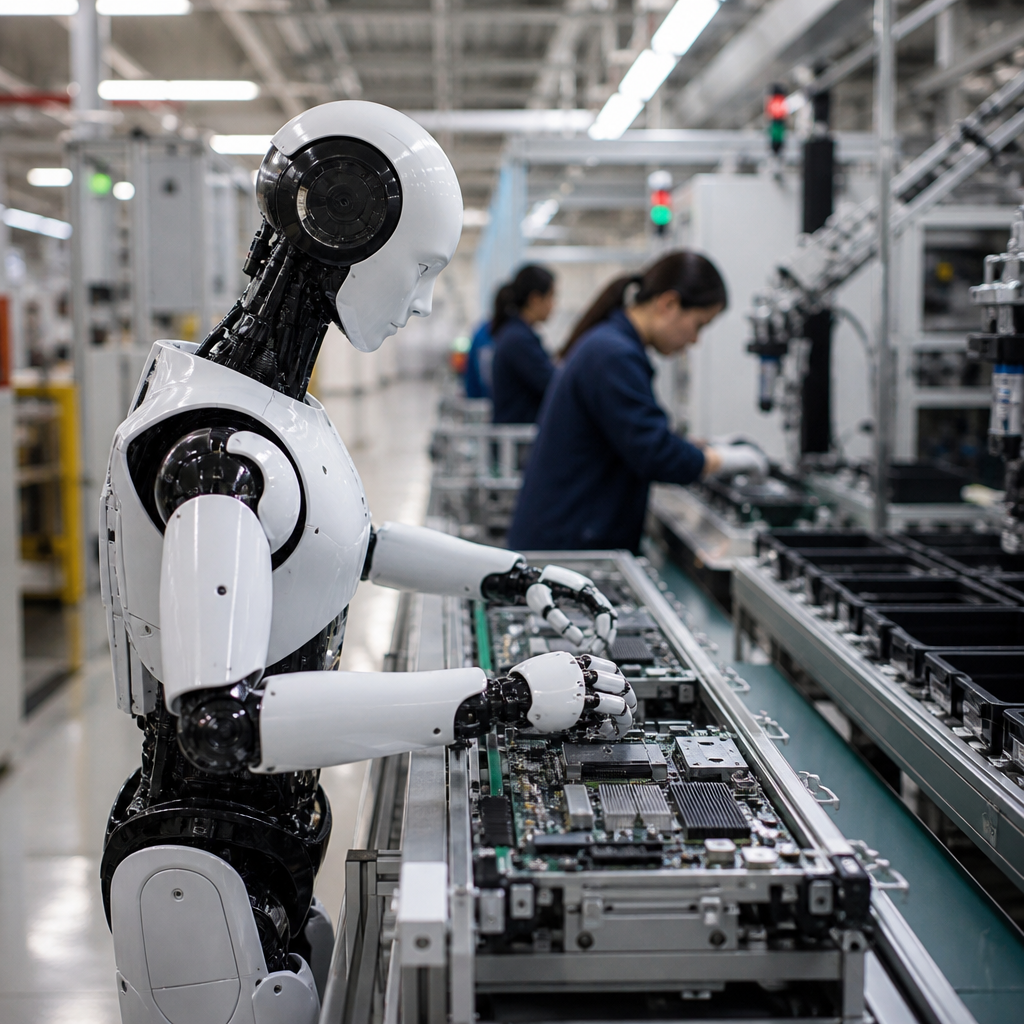
The economics of humanoid robots comes down to a simple business question: at what point does a machine that can move, grasp, inspect, and transport objects cost less over its useful life than paying people to do the same work? In practice, the answer depends on total cost of ownership, labor market conditions, task design, uptime, safety, and the speed at which modern physical AI improves real-world performance. As someone who has helped evaluate warehouse automation projects, I have seen companies focus too narrowly on sticker price. The better comparison is fully loaded hourly labor cost versus robot cost per productive hour, adjusted for utilization, maintenance, supervision, and error rates.
Humanoid robots are general-purpose machines shaped to operate in environments built for humans. Physical AI refers to the combination of perception, planning, control, and learning systems that let robots act in the real world instead of only in software. This matters because many factories, stores, hospitals, and logistics sites were not designed for fixed automation. They have stairs, narrow aisles, variable packaging, mixed tools, and workflows that change weekly. A humanoid robot can, in theory, use existing spaces, carts, racks, and hand tools with fewer facility modifications than a purpose-built robotic cell.
The topic matters now because three curves are moving at the same time. Hardware costs are falling for sensors, batteries, actuators, and compute. Labor costs are rising in many regions due to wage growth, turnover, and demographic pressure. Meanwhile, foundation models for vision, language, and control are improving robot adaptability. Investors and operators therefore want to know when the business case crosses from pilot novelty to hard-nosed unit economics. This hub article explains the break-even math, the industries most likely to adopt first, the limitations that still block deployment, and the metrics decision-makers should use when comparing humanoid robots with human labor and with conventional automation.
How to calculate when automation becomes cheaper than labor
The cleanest way to judge a humanoid robot is cost per productive hour. Start with acquisition cost, integration, software, charging infrastructure, maintenance, insurance, and remote operations support. Then spread that total over useful life and expected annual productive hours. Productive hours are not calendar hours. They exclude charging, downtime, failures, software updates, and tasks the robot still cannot complete reliably. On the labor side, use fully burdened cost, not base wage. In the United States, that often includes payroll taxes, benefits, overtime, hiring costs, training, absenteeism, and turnover. In warehousing, a worker earning $20 per hour can easily cost $28 to $35 per hour fully loaded, and night or peak-season shifts may run much higher.
A basic break-even formula looks like this: if robot total annual cost divided by annual productive hours is lower than human fully loaded hourly cost for the same output and quality level, automation is cheaper. Output parity matters. If a robot is slower, needs human intervention, or struggles with edge cases, its apparent hourly price can be misleading. I advise teams to model three scenarios: optimistic, expected, and stress case. Include a learning curve because early deployments almost always underperform vendor demos. Also include residual value and redeployment flexibility. A robot that can move from palletizing to tote transport or from backroom replenishment to simple inspection has a stronger economic profile than a machine locked to one narrow task.
What costs determine the real economics of humanoid robots
Most headlines focus on purchase price, but total cost of ownership decides the outcome. Capital expenditure includes the robot, end effectors, battery packs, spare parts, and safety systems. Deployment costs include site mapping, workflow redesign, integration with warehouse management systems, manufacturing execution systems, or hospital task software, plus employee training. Operating costs include electricity, maintenance, software subscriptions, teleoperation, cybersecurity, and compliance documentation. If the robot handles food, pharmaceuticals, or medical environments, validation and sanitation requirements add cost and time.
Utilization is the swing factor. A robot working one shift rarely beats labor economics unless wages are very high or turnover is severe. A robot working two or three shifts, with high uptime, can spread fixed cost dramatically better. This is why logistics centers, semiconductor facilities, and certain manufacturing sites are early candidates. They run around the clock and have measurable repetitive work. Another major factor is failure handling. If one worker must shadow three robots, labor savings shrink. If one remote operator can supervise twenty robots and intervene only occasionally, economics improve sharply. In my experience, the hidden costs usually sit in exception handling: dropped items, blocked paths, damaged packaging, and software changes after the workflow shifts.
| Cost factor | Human labor | Humanoid robot | Why it matters |
|---|---|---|---|
| Base hourly expense | Wages plus overtime | Amortized capital plus software | Core comparison starts here |
| Burden and overhead | Benefits, taxes, training, turnover | Maintenance, energy, support, insurance | Often changes the final answer |
| Utilization | Limited by shift scheduling and fatigue | Potentially multi-shift with charging windows | Higher utilization lowers robot hourly cost |
| Quality and errors | Variable by worker and shift | Consistent on stable tasks, weaker on edge cases | Rework can erase savings |
| Flexibility | High general problem-solving ability | Improving, but task boundaries still matter | Determines redeployment value |
Where humanoid robots reach break-even first
Humanoid robots will not become cheaper than labor everywhere at once. They reach break-even first in environments with repetitive material handling, labor shortages, safety risks, and expensive off-hours staffing. Warehousing is the clearest example. Tasks such as case picking from standardized shelves, trailer unloading assistance, cart movement, and returns sorting are physically taxing and have high turnover. If a site struggles to maintain staffing on second and third shifts, the economic threshold drops because the alternative is overtime, temporary labor, or missed service levels.
Manufacturing is another strong candidate, especially for intralogistics, machine tending support, kitting, and visual inspection. Automotive and electronics plants already measure cycle time, takt adherence, scrap, and downtime with precision, which makes robot return on investment easier to model. In hospitals and elder care, the case is more nuanced. Transporting linens, supplies, meals, or waste may pencil out before patient-facing assistance does, because the risk tolerance for direct human interaction is much lower. Retail backrooms could also adopt earlier than sales floors. Inventory movement, shelf scanning, and online order staging happen in constrained spaces with repeated routes and can be measured by picks per hour and out-of-stock reduction.
Why physical AI changes the labor equation
Traditional industrial robots succeed through repetition in controlled settings. Humanoid robots aim to succeed in semi-structured environments where object position, lighting, packaging, and human movement vary. Physical AI changes the labor equation because it reduces the engineering effort needed to handle variation. Modern systems combine depth cameras, force sensing, simultaneous localization and mapping, imitation learning, reinforcement learning, and large multimodal models that connect language instructions with perception and action. NVIDIA’s robotics stack, ROS 2, Isaac simulation tools, and digital twins are commonly used to train, test, and validate behaviors before field deployment.
The economic implication is significant. If a new task once required months of custom programming and fixture design, but can now be adapted through simulation, demonstration data, and policy updates, redeployment becomes faster and cheaper. That lowers switching cost between workflows and increases asset utilization over the robot’s life. However, claims of general-purpose autonomy should be treated carefully. Real facilities are full of long-tail exceptions: crushed cartons, reflective wrap, missing labels, wet floors, and unplanned obstacles. Humans still outperform robots on common-sense recovery. The winning deployments are therefore not magical replacements for all labor. They are tightly scoped systems that automate a cluster of adjacent tasks where perception and manipulation are now good enough for commercial reliability.
What decision-makers should measure before buying
Executives should ask six direct questions. First, what is the fully burdened hourly labor cost for the target task by shift and season? Second, what percentage of the process is standard versus exceptions? Third, how many productive hours per year can the robot realistically achieve after charging and downtime? Fourth, what intervention rate is expected, and who handles it? Fifth, what safety standard applies, such as ISO 10218 or ISO/TS 15066 for collaborative applications? Sixth, what is the backup plan when the robot fails during peak operations?
Good pilots start with baseline data. Measure units per hour, travel distance, ergonomic incidents, defect rates, absenteeism, and time to proficiency for new hires. Then run the robot in a limited lane with explicit success criteria: uptime above a target threshold, quality within tolerance, and intervention below an agreed rate. Compare against alternatives, not just labor. Fixed automation, autonomous mobile robots, conveyor changes, or better software may solve the same problem more cheaply. Humanoid robots are most compelling when the environment cannot easily be rebuilt, the task mix changes often, and labor is either scarce or expensive enough that flexibility has real monetary value.
The limits, risks, and likely adoption path
The biggest near-term constraint is reliability at scale. A pilot with one robot can impress; a fleet of fifty exposes maintenance systems, spare parts logistics, software version control, cybersecurity, and operator training gaps. Safety certification, liability, and worker acceptance also shape deployment speed. In unionized or tightly regulated environments, change management matters as much as hardware. The sound business case is augmentation first, substitution second. Robots take dull, dirty, and dangerous tasks, while people move into supervision, exception handling, maintenance, and higher judgment work.
Over the next several years, expect adoption to follow a staircase, not a switch. First come repetitive back-of-house tasks in logistics and manufacturing. Then broader intralogistics, inspection, and facility support as uptime improves and teleoperation costs fall. Full human replacement across mixed manual work remains unlikely in the near term because dexterity, safety assurance, and edge-case handling are still expensive. Yet the threshold where automation becomes cheaper than labor is already real in selected use cases. Companies that gather clean process data, model total cost honestly, and test robots against measurable operational goals will identify those opportunities earlier. If you oversee operations or invest in robotics, start with one workflow, build the economic model, and let the numbers decide.
Frequently Asked Questions
1. When does a humanoid robot actually become cheaper than human labor?
A humanoid robot becomes cheaper than human labor when its total cost of ownership over its useful life falls below the fully loaded cost of having people perform the same work. That comparison has to include far more than the robot’s purchase price. Companies need to account for integration, software, maintenance, charging or power consumption, spare parts, supervision, insurance, downtime, and the engineering effort required to deploy the system reliably. On the labor side, the true comparison is not just hourly wages. It also includes payroll taxes, benefits, overtime, training, turnover, absenteeism, workers’ compensation, supervision, and the cost of recruiting for physically demanding roles with high churn.
In practical terms, automation tends to cross the cost threshold first in environments with repetitive, structured tasks, multi-shift operations, and persistent labor shortages. If a robot can work across two or three shifts with acceptable uptime, the economics improve quickly because the fixed capital cost is spread over many more productive hours. By contrast, if the machine can only handle a narrow task for a few hours a day, or if the workflow is too variable and requires constant human intervention, the savings often disappear. The break-even point also depends on utilization. A robot that is idle half the time is much harder to justify than one that is continuously assigned to transport, inspection, picking support, or line-side material movement.
The simplest way to think about it is as a cost-per-productive-hour calculation. Once the robot’s cost per productive hour, adjusted for reliability and real output, drops below the equivalent cost of human labor for the same task quality and throughput, the robot is economically attractive. But the key phrase is “same task quality and throughput.” A machine that is technically cheaper but creates bottlenecks, safety concerns, or error costs is not truly less expensive. In serious evaluations, the question is never “Can the robot do the job?” It is “Can the robot do the job consistently enough, cheaply enough, and at sufficient scale to outperform the labor model over time?”
2. What costs should businesses include when calculating the economics of humanoid robots?
Businesses should evaluate humanoid robots using a full total cost of ownership framework rather than focusing narrowly on hardware price. The obvious costs include the robot itself, end effectors, batteries, charging systems, and any facility modifications needed for deployment. But many of the most important expenses show up after purchase. These include systems integration, workflow redesign, software licenses, fleet management tools, preventive maintenance, repairs, replacement parts, cybersecurity, operator training, and the technical staff needed to monitor performance. If the robot depends on cloud services, teleoperation support, or continual model updates, those recurring costs should also be included.
Implementation risk is another major economic factor that is often underestimated. A pilot that works in a demo zone may still fail to scale across a live warehouse or factory if lighting, floor conditions, product variability, or edge cases reduce reliability. That means managers should budget for testing, debugging, process tuning, and temporary productivity losses during rollout. In many real-world automation projects, the hidden cost is not the machine itself but the effort required to make operations predictable enough for the machine to succeed. A humanoid platform may reduce the need for fixed automation infrastructure, but it does not eliminate the need for operational discipline.
On the savings side, companies should look beyond direct headcount substitution. Humanoid robots may create value by reducing overtime, improving throughput consistency, lowering injury rates, extending operating hours, cutting turnover-related disruption, and allowing human workers to move into more skilled or supervisory roles. In some cases, the best economic outcome comes from augmentation rather than full replacement. For example, a robot that handles repetitive transport and low-value movement may allow a smaller human team to process more orders with less fatigue. That blended model can generate a better return than a simplistic one-for-one labor replacement assumption. The strongest business cases come from measuring all of these costs and benefits at the workflow level, not just at the individual worker level.
3. Why do uptime and real-world performance matter so much in the cost comparison?
Uptime and real-world performance matter because the economics of automation are determined by productive output, not theoretical capability. A humanoid robot may look impressive in controlled demonstrations, but businesses only capture value when it performs reliably in the messiness of actual operations. If the robot stops frequently, struggles with edge cases, requires resets, or needs human assistance too often, its apparent labor savings can evaporate. Every minute of downtime reduces the number of productive hours over which the system’s cost can be spread, and every intervention adds hidden labor back into the equation.
This is especially important because humanoid robots are often evaluated for tasks that humans handle with remarkable flexibility. People can adapt to misplaced inventory, packaging changes, partial obstructions, damaged goods, and shifting priorities with minimal instruction. A robot has to match enough of that adaptability to avoid becoming a source of friction. If its success rate drops whenever conditions vary, managers may need to assign workers to support or shadow it, which effectively increases the robot’s operating cost. That is why serious buyers look at metrics such as mean time between failures, intervention rate, task completion rate, recovery from exceptions, and throughput under live conditions rather than relying on vendor claims alone.
From an economic perspective, a robot with a lower sticker price but poor uptime may be more expensive than a higher-priced system that delivers dependable output every day. Reliability also affects downstream costs. In a warehouse, a delayed transport task can slow picking, packing, or replenishment. In manufacturing, inconsistent part movement can starve a line or force expensive buffers. The result is that uptime is not just a technical metric; it is a financial driver tied directly to labor savings, asset utilization, and service levels. As physical AI improves perception, planning, and manipulation in unstructured settings, the biggest economic shift will come not merely from lower robot prices, but from better reliability in the real world.
4. Which types of jobs and environments are most likely to reach the break-even point first?
The first jobs to reach the break-even point are usually the ones that are repetitive, physically demanding, measurable, and operationally structured. Warehousing, manufacturing support, internal logistics, pallet movement assistance, line-side replenishment, routine inspection rounds, and basic material transport are common examples. These tasks often involve predictable routes, clear rules, and high repetition, which makes them easier to automate than jobs requiring complex social interaction, delicate judgment, or highly variable object handling. If the environment is already semi-standardized and the task can be clearly defined, the odds of a favorable automation case improve significantly.
Labor market conditions also play a major role. In regions or industries with persistent staffing shortages, high turnover, rising wages, and heavy overtime usage, robots become economically attractive sooner. That is because the cost of maintaining adequate human staffing can be much higher than headline wage rates suggest. In facilities where managers struggle to fill night shifts or physically strenuous roles, a robot may create value even before it fully undercuts average labor cost, simply because it reduces operational risk and dependence on hard-to-source labor. The economics are not only about replacing the cheapest available worker; they are about stabilizing output in difficult labor markets.
Humanoid robots are especially interesting in environments built for people, because they may reduce the need for custom infrastructure compared with fixed automation or purpose-built mobile systems. However, that does not mean every human workspace is immediately robot-ready. The best early use cases still tend to be narrowly defined tasks within human-designed environments, not unrestricted general labor. A robot that can reliably move totes between workstations, perform repetitive checks, or handle simple transfer tasks may produce a solid return long before a fully general-purpose humanoid worker does. In other words, the economic transition is likely to happen task by task, not through a sudden replacement of entire occupations.
5. How is improving physical AI changing the timeline for humanoid robot economics?
Improving physical AI is changing the timeline by increasing the amount of useful work robots can perform without custom programming for every edge case. Historically, the biggest obstacle to broader automation was not just hardware cost but brittleness. Robots worked well in tightly constrained settings and poorly in dynamic ones. Advances in perception, foundation models, imitation learning, motion planning, and multimodal control are making machines better at recognizing objects, understanding instructions, adapting to variation, and recovering from minor disruptions. Economically, that matters because each improvement expands the range of tasks a single platform can perform and reduces the engineering effort required to deploy it.
As physical AI becomes more capable, the cost curve improves in several ways at once. First, robots can achieve higher utilization because they are able to switch among more tasks instead of sitting idle between narrow assignments. Second, intervention rates may fall, reducing the hidden labor needed to support the fleet. Third, deployment cycles can shorten, lowering integration costs and making it easier to replicate successful use cases across multiple sites. That combination can move automation from a bespoke capital project to something closer to a scalable operating model. When that happens, the economics become much more compelling, especially for large employers with repeatable workflows across networks of facilities.
That said, better AI does not eliminate the need for disciplined financial analysis. Companies should still ask whether performance gains are durable, whether safety standards are met, whether software dependencies create ongoing costs, and