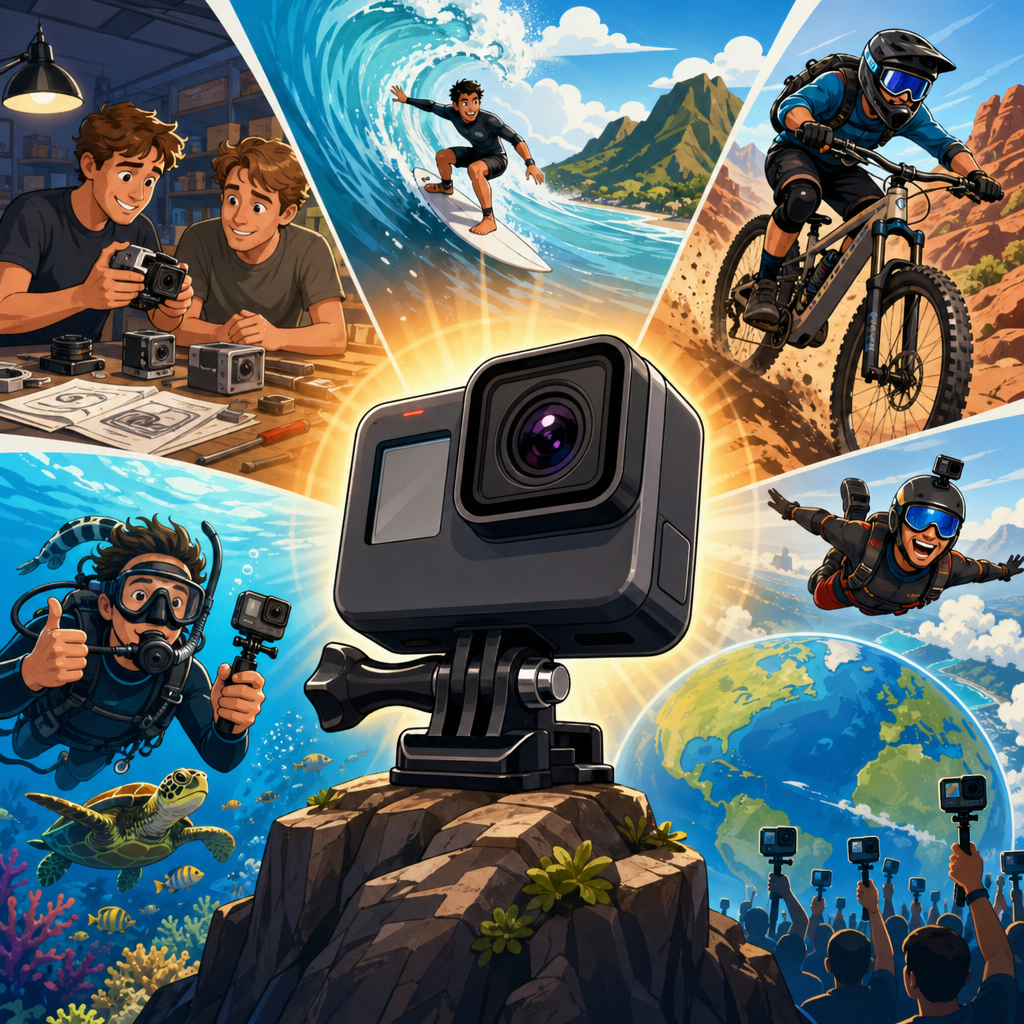
GoPro’s rise in action cameras is more than a startup success story; it is a case study in how a company can define a category, build a lifestyle brand, and reshape consumer expectations around visual storytelling. In the broader context of Company Spotlights and Diving Deeper into Corporate Giants, GoPro deserves close attention because its trajectory combines product innovation, community-led marketing, supply chain risk, public market pressure, and strategic reinvention. An action camera is a compact, durable, usually wide-angle camera designed to capture immersive footage during sports, travel, and high-movement activities. GoPro did not invent the desire to record adventure, but it turned that desire into a global habit. I have worked with brand teams that benchmarked GoPro’s launch strategy, and one lesson stood out repeatedly: the company sold identity before it sold hardware. Understanding GoPro matters because it shows how modern corporate giants can emerge from a narrow use case, dominate through storytelling, then struggle when growth expectations outpace category depth. It also offers a practical lens for evaluating product-market fit, creator ecosystems, and the limits of hardware-led expansion. For readers exploring corporate giants, GoPro is an ideal hub topic because its story connects product design, media economics, retail execution, and leadership decisions in a way few consumer electronics companies do.
How GoPro Created the Action Camera Category
GoPro was founded by Nick Woodman in 2002, initially inspired by a simple problem: surfers had no easy way to capture themselves in the water without expensive professional gear or another person shooting from shore. Early GoPro products were 35mm film cameras attached to the wrist, but the real breakthrough came with digital capture. By making cameras small, mountable, and rugged, GoPro transformed recording from a planned activity into a seamless part of the experience. That distinction was crucial. Consumers did not need to stop skiing, mountain biking, diving, or skydiving to document the moment. The camera became part of the activity.
GoPro’s product strategy was unusually disciplined in its early years. It focused on three attributes that mattered most to its core users: durability, mounting flexibility, and point-of-view immersion. The wide-angle lens created a visceral perspective that conventional compact cameras could not replicate. The mounting ecosystem, from helmet mounts to chest harnesses and surfboard attachments, turned the camera into a modular platform rather than a single device. This is why GoPro became synonymous with the category. Much as “Google” became shorthand for online search, “GoPro” became shorthand for action cameras.
The timing also helped. Improvements in image sensors, lithium-ion batteries, flash storage, and video compression made compact high-quality recording commercially viable in the late 2000s. GoPro capitalized on these enabling technologies faster than many legacy camera companies, which were still thinking in terms of traditional photography categories. By 2010, users could capture high-definition footage with a camera small enough to fit in a pocket and tough enough to survive a crash or wave impact. That practical advantage, not abstract innovation, drove adoption.
The Marketing Engine Behind GoPro’s Growth
GoPro’s real masterstroke was marketing. The company understood earlier than most hardware brands that the best advertisement for a camera is footage created by customers. Instead of relying solely on polished campaigns, GoPro built a distribution engine around user-generated content. Every breathtaking cliff dive, powder run, motocross jump, and reef swim became proof of the product’s value. This lowered creative costs while increasing authenticity. Audiences did not just see a device; they saw what life looked like through it.
I have seen few companies use community media as effectively. GoPro distributed content across YouTube, Instagram, retail displays, and event sponsorships, creating a constant loop between ownership and aspiration. Existing users supplied social proof, while potential buyers imagined themselves in the footage. This strategy aligned perfectly with the rise of social platforms, where short-form visual storytelling became a dominant language. In effect, GoPro did not simply market to athletes; it made ordinary consumers feel like athletes, explorers, and creators.
The company also benefited from retail theater. In stores, looping video walls showed crystal-clear, high-adrenaline footage that conventional packaging could never communicate. The demonstration was immediate: buy this camera and you might capture something like this. Red Bull partnerships, athlete sponsorships, and event integrations amplified that message. GoPro was not the official camera of every sport, but it became the unofficial visual standard for adventure.
| Growth Driver | What GoPro Did | Why It Worked |
|---|---|---|
| Category positioning | Focused on mountable, rugged POV cameras | Created a clear use case competitors ignored |
| User-generated content | Promoted customer footage across major channels | Delivered credible proof and endless fresh creative |
| Accessory ecosystem | Sold mounts, cases, straps, and specialized gear | Increased switching costs and expanded camera utility |
| Retail presentation | Used vivid in-store demo footage and premium displays | Turned technical features into emotional outcomes |
| Brand identity | Linked the product to adventure, travel, and self-expression | Made the camera aspirational, not merely functional |
Why GoPro Became a Corporate Giant So Quickly
GoPro’s scale came from the rare combination of hardware margins, accessory revenue, and cultural relevance. The company’s 2014 IPO marked a peak moment, with investors viewing it as a media-tech hybrid rather than only a device maker. That distinction mattered because media companies can command stronger growth narratives than hardware businesses, which are often cyclical and exposed to commoditization. For a period, GoPro looked like it might own both the camera and the content layer around it.
Its growth was reinforced by repeatable use cases across multiple verticals. Surfers, skiers, cyclists, travelers, parents, vloggers, divers, and even industrial users found practical value in a compact tough camera. Law enforcement and training teams also experimented with wearable capture, though those markets developed separately. The company was aided by a simple product promise: if the environment is rough, unstable, wet, or fast, this is the camera built for it.
Another reason GoPro expanded rapidly was operational clarity. The company did not try to become a full-spectrum electronics brand at first. It concentrated resources on image quality, stabilization, waterproofing, software improvements, and a strong annual upgrade cycle. In hardware, focus is often a competitive weapon. Canon and Nikon had broader portfolios; smartphone makers had scale; low-cost rivals had price. GoPro had specialization.
The Challenges Behind the Brand’s Public Success
The untold story of GoPro’s rise also includes strain, missteps, and structural limits. Consumer hardware is unforgiving. A hit product can drive explosive growth, but replacement cycles are slower than investors expect, and technological differentiation narrows over time. Smartphones steadily absorbed casual video capture, reducing the need for a dedicated camera for many users. GoPro remained superior in durability, mounting, and immersion, but superiority does not always equal mass-market necessity.
The company also stretched beyond its core. The Karma drone launch in 2016 is a widely cited example. Product recalls, battery issues, and fierce competition from DJI undermined the expansion. From a corporate strategy perspective, this was not just a product failure; it revealed how difficult it is for a category leader to extend into adjacent hardware without equivalent engineering depth and operational resilience. I often point to Karma when discussing adjacency risk: a strong brand can open doors, but it cannot override execution problems.
GoPro’s media ambitions also proved harder to monetize than expected. Owning attention is not the same as building a profitable media business. User videos generated engagement, but turning that engagement into predictable media revenue at scale required a different operating model. As the market matured, GoPro had to reset expectations and operate more like a disciplined hardware-and-subscription company than a runaway media disruptor.
How GoPro Adapted to Stay Relevant
GoPro remained important because it adjusted. The company improved its Hero lineup with features that solved real customer problems, including HyperSmooth stabilization, stronger waterproofing, better low-light performance, horizon leveling, and simpler editing workflows. These were not flashy additions for a spec sheet; they directly improved the odds of getting usable footage in difficult conditions. In action capture, reliability matters as much as resolution.
Its shift toward direct-to-consumer sales and subscription services also changed the economics. GoPro subscribers receive cloud backup, camera replacement benefits, discounts on accessories, and software features through the Quik ecosystem. This does two things corporate analysts value: it raises customer lifetime value and reduces dependence on retail channels. In a market where hardware alone rarely supports durable valuation multiples, recurring revenue matters.
GoPro also benefited from staying narrow where it counted. It did not beat smartphones by becoming a phone substitute. It defended its ground by serving moments smartphones handle poorly: underwater dives, helmet-mounted rides, chest-level hiking footage, off-road vibration, and high-impact environments. That is a realistic strategy for a mature specialist brand. The lesson is clear: corporate giants do not always win by expanding endlessly; sometimes they endure by becoming indispensable in a smaller but defensible domain.
What GoPro Teaches About Corporate Giants
For anyone studying Diving Deeper into Corporate Giants, GoPro offers several durable lessons. First, categories are often won by the company that simplifies behavior, not the one that invents the underlying technology. Second, community can be a stronger growth engine than traditional advertising when the product naturally generates shareable proof. Third, brand mythology is powerful, but operational discipline determines whether early momentum becomes staying power. Fourth, public markets can misread a focused hardware business as a limitless platform story, creating painful corrections later.
GoPro’s rise in action cameras remains one of the clearest examples of category creation through product design and customer storytelling. Its setbacks make the story more useful, not less. They show how even admired brands face pressure from smartphones, execution risk, and changing investor narratives. If you are exploring Company Spotlights, use GoPro as a starting point for understanding how modern corporate giants are built, challenged, and renewed. Then continue through this hub to compare similar patterns across other industry leaders.
Frequently Asked Questions
1. Why did GoPro become the defining brand in action cameras instead of just another electronics startup?
GoPro did not simply launch a camera; it helped create and popularize an entirely new consumer category. At a time when most cameras were designed for posed photos or traditional handheld video, GoPro focused on a very specific unmet need: capturing immersive footage during activities where ordinary devices were impractical or too fragile. That product vision gave the company a clear identity from the beginning. Its cameras were compact, mountable, rugged, and built around the idea that users could record experiences from their own point of view while surfing, skiing, biking, skydiving, or traveling.
What made GoPro especially powerful was that it paired hardware innovation with a strong emotional brand. It did not market its products as technical gadgets alone. Instead, it sold aspiration, adventure, and self-documentation. Consumers were not just buying a camera; they were buying a tool for storytelling and proof of experience. That distinction mattered. Many electronics companies compete on specifications, but GoPro competed on identity and lifestyle, which made the brand more memorable and culturally relevant.
Another major factor in GoPro’s rise was timing. The company grew alongside social media platforms, online video sharing, and a broader shift toward user-generated content. As YouTube, Instagram, and other platforms expanded, people wanted better ways to capture unique footage and share it instantly with audiences. GoPro became the device that enabled this behavior. The footage looked different from standard video, and that visual novelty gave users a compelling reason to post, share, and promote the brand organically.
In addition, GoPro built a powerful flywheel through community-led marketing. Its customers effectively became ambassadors. Spectacular clips made by athletes, travelers, creators, and everyday users doubled as advertisements, often at much lower cost than traditional campaigns. This helped the company scale brand awareness rapidly while reinforcing the message that GoPro was synonymous with action, authenticity, and first-person storytelling. In that sense, GoPro’s success was not just about making a good product. It was about defining the purpose of the product category before larger rivals fully understood its cultural value.
2. How did GoPro use branding and community marketing to grow so quickly?
GoPro’s marketing strategy stands out because it turned customer behavior into a core growth engine. Rather than relying only on polished corporate advertising, the company encouraged users to create and share their own footage. This was a remarkably effective move because action camera content is inherently demonstrative. When someone posts a breathtaking ski descent, a surfing barrel ride, or a mountain biking trail from a helmet-mounted perspective, the video does more than entertain. It shows exactly what the product can do in a way that feels credible and exciting.
This user-generated content model created authenticity that many consumer electronics brands struggle to achieve. Traditional product marketing often feels staged, but GoPro footage felt real, immediate, and personal. Viewers could imagine themselves in the scene, which made the leap from interest to purchase much smaller. The company amplified this by curating the best user submissions, featuring them on its own channels, and building a media ecosystem around extraordinary moments. In effect, GoPro became both a camera company and a content company.
The brand also benefited from a clear and consistent visual identity. GoPro associated itself with adventure sports, risk-taking, travel, exploration, and creative self-expression. That gave the company a strong emotional position in the market. Even people who did not immediately need an action camera often recognized the brand and what it represented. This kind of brand clarity is rare and valuable because it creates mental availability: when consumers think about capturing active experiences, GoPro comes to mind first.
Partnerships with athletes, creators, and event organizers reinforced that identity. These relationships gave the brand credibility within core enthusiast communities while also exposing it to broader mainstream audiences. Just as importantly, GoPro made its products feel accessible. While the footage could be extreme, the message was not limited to professionals. The brand suggested that anyone could document meaningful experiences, whether that meant a family trip, a bike ride, or a day on the water. That balance between elite aspiration and everyday usability helped expand the addressable market significantly.
3. What role did product innovation play in GoPro’s rise, and how did it shape consumer expectations?
Product innovation was central to GoPro’s growth because the company solved a practical problem in a way that changed how consumers thought about cameras. Before GoPro, most people expected cameras to be held in the hand or used carefully to avoid damage. GoPro challenged that assumption by designing devices that could be mounted almost anywhere, withstand harsh environments, and record stable, wide-angle footage from immersive perspectives. This made video capture far more dynamic and opened up creative possibilities that had previously required specialized equipment.
GoPro also helped normalize the idea that cameras should be purpose-built for movement. Features such as ruggedized construction, waterproof housings, mounting systems, portability, and later improvements in stabilization and image quality created a new standard for what consumers wanted from an action-oriented device. As the company iterated its products, it pushed the market toward expectations that had not been mainstream before: durability without bulk, high-quality video in compact form, intuitive controls, and the ability to capture point-of-view footage effortlessly.
Its innovation extended beyond the camera body itself. The broader ecosystem of accessories, mounts, editing tools, and companion software increased the usefulness of the hardware. That ecosystem strategy mattered because it made GoPro more than a one-time purchase. Users could adapt the product to multiple activities and situations, which deepened engagement and increased brand loyalty. Once a consumer invested in mounts, accessories, and workflows tied to the brand, switching became less attractive.
Perhaps most importantly, GoPro helped redefine visual storytelling for the consumer market. It made first-person, experience-based video more accessible and more desirable. In doing so, it influenced not just competitors in action cameras, but also smartphone makers, content creators, and media platforms that recognized the growing appeal of immersive footage. The result was a shift in consumer expectations: people no longer wanted only polished still photos or conventional video. They wanted perspective, motion, authenticity, and shareable experiences, and GoPro played a major role in making those expectations mainstream.
4. What challenges did GoPro face as it grew, especially around supply chains, competition, and public market pressure?
GoPro’s rise was impressive, but its path was far from smooth. One of the most significant challenges was that category-defining success can attract intense competition and unrealistic expectations at the same time. Once GoPro proved there was real demand for action cameras, it had to defend its leadership against rivals offering cheaper alternatives, adjacent devices, and feature overlap from smartphones. That created pressure to keep innovating while also protecting margins, a difficult balancing act in consumer electronics.
Supply chain complexity added another layer of risk. Hardware businesses depend on manufacturing execution, component sourcing, quality control, and accurate demand forecasting. If a company overestimates demand, it can end up with excess inventory, pricing pressure, and weaker profitability. If it underestimates demand, it can miss revenue opportunities and frustrate customers. GoPro, like many electronics firms, had to navigate these issues while maintaining product quality and release timing. In a market driven by seasonal sales and rapid technology cycles, even minor operational missteps could have outsized financial consequences.
Public market pressure amplified those challenges. After going public, GoPro was no longer judged only on brand strength or innovation potential. It was also judged quarter by quarter on revenue growth, profit margins, product cadence, and long-term market opportunity. Investors often expect sustained expansion, but hardware categories can mature quickly, especially when replacement cycles lengthen or when the most enthusiastic early adopters have already purchased the product. That mismatch between investor expectations and market reality can be punishing.
The company also faced the strategic difficulty of proving it was more than a single-product story. When a brand becomes strongly associated with one device type, expansion becomes both necessary and risky. New bets must feel adjacent enough to make sense but differentiated enough to create growth. GoPro’s efforts to evolve under these conditions illustrate a broader corporate lesson: building a category is hard, but sustaining leadership in that category under competitive, operational, and financial scrutiny can be even harder. Its experience shows how quickly a celebrated growth narrative can become a case study in execution risk and strategic reinvention.
5. What can businesses and entrepreneurs learn from GoPro’s story about building a category and staying relevant?
GoPro’s story offers several important lessons for companies trying to create or dominate a market. First, category leadership often begins with clarity of purpose rather than broad ambition. GoPro succeeded early because it understood a specific use case deeply and built around it with discipline. Instead of trying to be a camera for everyone in every setting, it became the best-known solution for active, immersive capture. That focus helped it stand out and gave its brand a strong point of view.
Second, the company demonstrates the value of aligning product design with emotional identity. Businesses often think of branding and product development as separate functions, but GoPro’s rise shows how powerful they can be when they reinforce each other. The product enabled a feeling, and the brand amplified that feeling. That is one reason the company became culturally significant rather than merely commercially visible. For entrepreneurs, the lesson