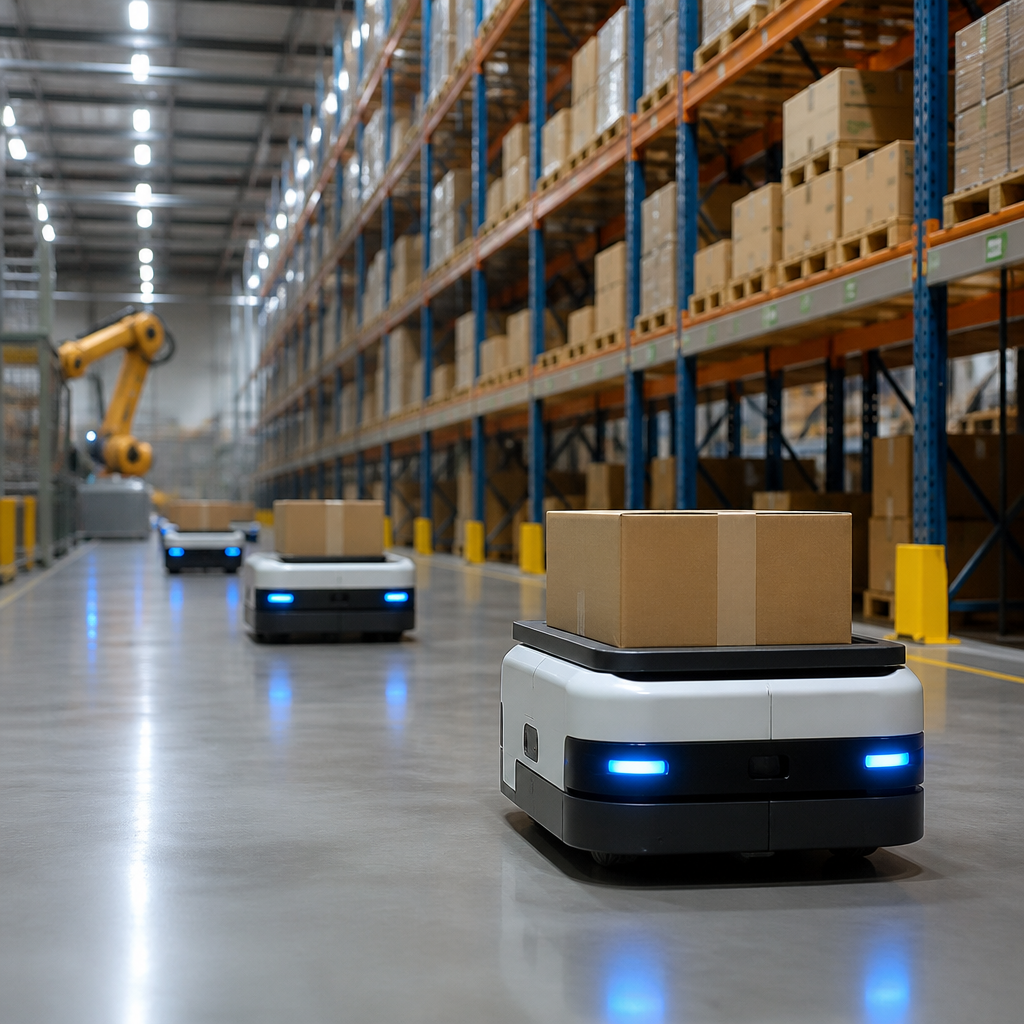
Warehouse robotics has moved far beyond conveyor belts and fixed robotic arms, and the new era of fulfillment automation is being shaped by artificial intelligence that can perceive, decide, and adapt in real time. In practical terms, warehouse robotics 2.0 refers to fleets of mobile robots, vision-guided picking systems, autonomous forklifts, and orchestration software that learn from operational data instead of following rigid scripts. This matters because fulfillment centers face relentless pressure from e-commerce growth, labor shortages, rising customer expectations, and tighter delivery windows. After working with distribution teams evaluating automation roadmaps, I have seen the same pattern repeatedly: facilities that once optimized around labor scheduling now optimize around machine coordination, inventory visibility, and exception handling. Physical AI, the application of machine intelligence to machines acting in the real world, sits at the center of that shift. It combines computer vision, machine learning, sensor fusion, and control systems to help robots understand shelf locations, detect obstacles, identify products, and complete tasks safely. For operators, the question is no longer whether warehouse automation is relevant, but which AI-enabled systems create measurable gains in throughput, accuracy, and resilience.
What Warehouse Robotics 2.0 Actually Includes
Modern warehouse automation is not one machine or one software platform. It is a layered system of physical equipment and decision intelligence working together across receiving, storage, picking, packing, sortation, and shipping. The most common category is the autonomous mobile robot, often called an AMR, which navigates dynamically using lidar, cameras, simultaneous localization and mapping, and onboard compute. Unlike automated guided vehicles that follow fixed paths or magnetic tape, AMRs reroute around congestion and can be redeployed when slotting plans change.
Another important category is robotic picking. These systems use 2D and 3D vision, force sensing, and gripper selection to identify and grasp individual items from totes, shelves, or bins. Piece-picking remains technically difficult because warehouses carry deformable bags, reflective packaging, mixed case sizes, and products with inconsistent presentation. Even so, vendors such as RightHand Robotics, Covariant, Berkshire Grey, and Plus One Robotics have demonstrated major gains in pick reliability by combining machine learning with carefully engineered end effectors and exception recovery workflows.
Autonomous forklifts and pallet movers represent a third layer. These machines automate horizontal transport, pallet putaway, replenishment, and trailer loading support. In large facilities, the time lost moving inventory between zones is substantial, so automating repetitive transport can create immediate labor relief. Layering AI over warehouse management systems and warehouse execution systems then allows supervisors to prioritize orders, rebalance work, and predict bottlenecks before service levels slip.
How AI Changes Fulfillment More Than Traditional Automation
Traditional warehouse automation is excellent at repeatable, high-volume tasks under controlled conditions. Fixed conveyors, sorters, and shuttle systems can deliver exceptional throughput, but they depend on stable product profiles and relatively predictable flows. AI changes the equation by making automation more tolerant of variability. When an item arrives slightly misaligned, a vision-guided robot can still recognize it. When a pick face is blocked, a mobile robot can route to another aisle. When demand spikes in one zone, orchestration software can reassign robots and labor based on current queue depth rather than yesterday’s assumptions.
The direct benefit is flexibility. The deeper benefit is decision quality. AI models can forecast slotting requirements, estimate travel time, sequence picks to reduce deadheading, and flag anomalies such as mispicks or inventory drift. In one omnichannel operation I observed, cycle counts improved after cameras on mobile platforms continuously scanned location labels during normal movement. That reduced the need for disruptive manual audits and helped the warehouse management system maintain cleaner inventory accuracy between formal counts.
Computer vision also changes safety and compliance. Modern systems can detect pedestrians, verify pallet dimensions, inspect package damage, and monitor forklift interactions in real time. This does not eliminate risk, but it adds machine-level consistency to environments where momentary inattention is costly. The strongest deployments treat AI as a force multiplier for standard work, not a replacement for process discipline.
Core Use Cases Across the Fulfillment Workflow
AI-powered warehouse robotics now spans nearly every step of fulfillment. The best starting point is understanding where each technology fits operationally, financially, and technically.
| Use case | AI capability | Operational benefit |
|---|---|---|
| Goods-to-person picking | Dynamic robot routing and queue optimization | Higher picks per hour and less worker travel |
| Piece picking | Vision recognition, grasp planning, exception learning | Better picking accuracy for mixed inventories |
| Putaway and replenishment | Location selection based on demand and congestion | Faster replenishment and improved slotting |
| Autonomous pallet movement | Sensor fusion and obstacle avoidance | Reduced nonproductive transport labor |
| Inventory scanning | Image capture and barcode or text recognition | More accurate stock visibility |
| Packing and sortation | Dimensioning, label verification, routing logic | Lower error rates and better carrier compliance |
Goods-to-person systems illustrate the value clearly. Instead of workers walking miles each shift, robots bring inventory pods or carts to ergonomic workstations. Amazon popularized this model through Kiva-based automation, but the concept is now widespread across retail, healthcare, and third-party logistics. AI improves these systems by reducing idle time, balancing robot traffic, and sequencing work according to carrier cutoffs and labor availability.
Returns processing is another expanding application. Vision systems can inspect condition, identify SKU variants, and recommend disposition paths such as restock, refurbish, or quarantine. Because reverse logistics is inconsistent and labor intensive, AI-driven robotics can create gains even where full automation is unrealistic.
The Technology Stack Behind Physical AI in Warehouses
Warehouse robotics 2.0 depends on a stack that combines hardware reliability with software intelligence. At the sensing layer, systems use lidar, depth cameras, RGB cameras, inertial measurement units, encoders, and force torque sensors. These inputs feed perception models that classify objects, estimate pose, and detect free space. Navigation engines then use mapping and localization to plan safe movement through constantly changing environments.
Above perception and motion sits orchestration. This layer connects robots to the warehouse management system, warehouse control system, order management platform, and sometimes enterprise resource planning software. Standards matter here. Mature deployments rely on clean APIs, robust event handling, and detailed telemetry, because a robot that cannot exchange real-time task status becomes an isolated asset rather than part of a coordinated operation.
Cloud and edge computing both play roles. Latency-sensitive controls usually run on edge devices or onboard processors, while training, analytics, and fleet optimization may occur in the cloud. NVIDIA’s work in simulation and accelerated computing has helped push digital twins into mainstream warehouse design. Operators can model layouts, test congestion scenarios, and validate robot behavior before changing the physical floor. That reduces commissioning risk and supports faster continuous improvement.
Data quality is the hidden differentiator. If SKU dimensions are wrong, location labels are inconsistent, or exception codes are poorly structured, even advanced AI will produce weak results. The most successful teams treat master data governance as part of automation, not as a separate IT cleanup project.
Business Impact, ROI, and the Real Constraints
Executives usually ask one question first: what is the return on investment for AI warehouse automation? The answer depends on labor costs, order profile, facility constraints, service levels, and existing systems, but several value levers are consistent. AI-enabled robotics can raise throughput per square foot, reduce unproductive travel, improve picking accuracy, stabilize output during labor shortages, and extend operations without proportional headcount growth. In facilities with strong baseline processes, these gains are material.
However, the constraints are just as important. Piece-picking robots still struggle with highly irregular items, transparent packaging, tightly packed bins, and cluttered presentation. AMRs can create congestion if aisle design, crossing logic, or replenishment timing is weak. Integration costs are frequently underestimated, especially when legacy warehouse management systems lack modern interfaces. Change management is another major factor. Associates need clear escalation paths, maintenance teams need spare parts and diagnostic skills, and supervisors need dashboards that show robot health in operational terms, not engineering abstractions.
Safety certification and governance cannot be treated as checkboxes. Operators should align deployments with recognized standards such as ISO 3691-4 for driverless industrial trucks and relevant functional safety practices. A practical rollout starts in a controlled zone, measures exceptions aggressively, and expands only after stable performance is proven across peak-like conditions.
What Comes Next for Smart Fulfillment Centers
The next phase of warehouse robotics will be defined less by standalone machines and more by coordinated intelligence across the building. Multi-robot orchestration will improve, allowing picking bots, pallet movers, and inspection systems to share context about congestion, replenishment urgency, and order priority. Foundation models tailored for industrial environments are likely to improve perception and exception handling, especially for long-tail item recognition and natural-language interfaces for supervisors.
Humanoid robots attract headlines, but in most warehouses the near-term winners will be task-specific platforms designed around clear economics. A robot does not need to look human to deliver value; it needs to move safely, recover from errors, and integrate cleanly with operational software. I expect stronger growth in robotic depalletizing, trailer unloading assistance, and AI vision layers that upgrade existing manual processes before fully autonomous systems take over.
For companies building a strategy around physical AI and robotics, the hub principle is simple: start with process visibility, target bottlenecks with measurable cost or service impact, and choose vendors whose systems can scale through integration, not just pilots. Warehouse robotics 2.0 is changing fulfillment automation because AI gives machines the ability to adapt to messy, real warehouse conditions. The result is not just faster movement, but better decisions, higher resilience, and more dependable execution. Assess your operation, map the highest-friction workflows, and build the roadmap now.
Frequently Asked Questions
What does “Warehouse Robotics 2.0” actually mean in a modern fulfillment operation?
Warehouse Robotics 2.0 refers to the shift from traditional, fixed-function automation to intelligent, adaptable systems that can respond to real-world warehouse conditions in real time. In older facilities, automation often meant conveyor belts, sortation systems, and robotic arms programmed to repeat a narrow set of actions in highly controlled environments. Those tools are still useful, but the newer generation of robotics is defined by AI-driven perception, decision-making, and continuous optimization.
In practice, this includes autonomous mobile robots that reroute around congestion, vision-guided picking robots that identify mixed inventory, autonomous forklifts that move pallets safely through dynamic spaces, and orchestration platforms that coordinate labor, inventory, and machine activity across the building. Instead of relying only on rigid scripts, these systems use sensor data, computer vision, and machine learning models to interpret what is happening and adjust accordingly. That flexibility is what makes the “2.0” label meaningful: the technology is no longer just automated, it is increasingly adaptive and context-aware.
For fulfillment operators, the value goes beyond novelty. AI-enabled robotics can improve throughput, reduce repetitive manual work, support faster order cycles, and help facilities handle demand variability without constantly redesigning workflows. It is best understood not as a single machine, but as an ecosystem of connected hardware and software that allows warehouses to operate with greater speed, accuracy, and resilience.
How is artificial intelligence changing warehouse robots compared with traditional automation?
Artificial intelligence changes warehouse robotics by allowing systems to perceive their surroundings, make informed decisions, and improve performance over time instead of following only preprogrammed instructions. Traditional automation works best when the environment is stable and predictable. If every box is the same size, every product is placed in the same position, and every path stays clear, then fixed automation can be extremely effective. The problem is that most modern fulfillment environments are not that tidy.
AI helps bridge that gap. Computer vision allows robots to identify products, read labels, detect obstacles, and confirm pick accuracy even when items are presented in inconsistent ways. Machine learning supports route optimization, task prioritization, and demand forecasting, helping robot fleets move where they are needed most. Decision engines can determine whether an order should be picked by a person, a robot, or a hybrid workflow based on current inventory location, congestion, urgency, and labor availability.
Another major change is adaptability. AI-powered systems can learn from historical operational data, such as which aisles tend to bottleneck, which SKUs are difficult to pick, or which times of day require different replenishment strategies. That means the warehouse becomes more responsive over time. Instead of automation being something that needs constant manual retuning, it can increasingly optimize itself within guardrails set by operators. The result is a fulfillment operation that is not only automated, but also more intelligent, scalable, and resilient under changing business conditions.
What kinds of warehouse tasks are best suited for AI-powered robotics today?
AI-powered robotics is especially well suited for repetitive, time-sensitive, and movement-intensive tasks that benefit from consistency and data-driven optimization. One of the most common applications is goods movement. Autonomous mobile robots can transport totes, cartons, and inventory between storage areas, picking zones, packing stations, and shipping docks. By reducing unnecessary walking for human workers, these systems can significantly increase productivity while also improving ergonomics.
Picking is another high-value use case, especially when combined with computer vision and advanced gripping technologies. Vision-guided robots can identify items in bins, verify barcodes, and support piece-picking workflows, although performance still depends on product diversity, packaging condition, and handling complexity. AI is also increasingly effective in pallet movement and putaway, where autonomous forklifts can manage repetitive transport routes and operate safely around people and other equipment.
Additional strong fits include cycle counting, inventory scanning, sortation support, trailer unloading assistance, replenishment, and quality inspection. AI is particularly useful in environments with fluctuating order profiles because it helps allocate tasks dynamically based on real-time conditions. That said, not every task should be automated immediately. Processes that involve extreme product irregularity, frequent exceptions, or delicate manual judgment may still be better handled by people or by collaborative workflows. The most successful operations usually start by identifying where robotics can remove friction, not by forcing automation into every corner of the warehouse.
Will AI-driven warehouse robotics replace human workers?
In most fulfillment environments, AI-driven robotics is more likely to reshape human work than eliminate it entirely. Warehouses still rely heavily on people for exception handling, supervision, maintenance, process improvement, inventory problem-solving, and tasks that require dexterity, judgment, or customer-specific decision-making. What robotics often replaces first is not the workforce as a whole, but the most repetitive, physically demanding, and low-value motion inside daily operations.
For example, if autonomous mobile robots bring inventory to workers instead of requiring workers to walk long distances, the human role becomes more focused on verification, packing quality, and throughput management. If autonomous forklifts handle predictable transport routes, lift truck operators may shift toward oversight, traffic coordination, or more specialized material handling. As AI systems become more capable, there is also growing demand for new roles tied to robot fleet management, systems integration, data analysis, safety governance, and technical support.
The bigger strategic issue is workforce augmentation. Facilities that use robotics effectively often do so to address labor shortages, reduce turnover in physically taxing roles, improve safety, and scale peak operations more reliably. Human-robot collaboration is becoming the core model. The question is usually not whether people or robots will run the warehouse, but how to design workflows where each does what it does best. Companies that approach robotics as a workforce multiplier rather than a simple headcount reduction tool generally see better long-term results.
What should companies consider before investing in AI-based fulfillment automation?
Before investing in AI-based fulfillment automation, companies should begin with operational clarity rather than technology excitement. The first step is understanding the exact business problem to solve: rising labor costs, order growth, space constraints, accuracy issues, peak-season volatility, safety concerns, or service-level pressure. AI robotics can deliver meaningful value, but only when matched to the right workflows, inventory characteristics, and throughput requirements.
It is important to evaluate process readiness in detail. That includes SKU profiles, order mix, facility layout, rack design, WMS integration, data quality, wireless infrastructure, and exception rates. A robot may perform well in a pilot but struggle in production if upstream inventory accuracy is poor or if physical pathways are inconsistent. Integration is often just as important as the robotics itself. Companies should assess how the system will connect with warehouse management software, labor planning tools, and existing automation assets, and whether the vendor can support phased deployment and long-term optimization.
Financial analysis should go beyond headline ROI. Decision-makers should consider implementation costs, software licensing, maintenance, training, change management, downtime risk, and scalability across multiple sites. Safety and governance matter as well, especially when autonomous equipment shares space with human workers. Finally, organizations should think in terms of roadmap, not one-time purchase. The strongest automation strategies usually start with a targeted use case, prove measurable gains, and expand based on data. AI-based warehouse robotics is most effective when treated as part of an evolving operating model rather than a standalone equipment decision.