Xilinx stands as one of the most influential names in programmable logic technology, shaping how engineers build adaptable computing systems for communications, automotive platforms, industrial control, aerospace, defense, and data centers. In the context of tech innovators and market leaders, Xilinx matters because it helped define the field of field-programmable gate arrays, or FPGAs, and then expanded that foundation into adaptive system-on-chip devices, hardware acceleration cards, and domain-specific platforms. Programmable logic technology refers to semiconductor devices that can be configured after manufacturing to perform custom digital functions, unlike fixed-function chips such as standard microcontrollers or many application-specific integrated circuits. That flexibility gives product teams a practical way to update features, optimize performance, and shorten development cycles without spinning entirely new silicon.
I have worked with programmable devices in product planning and technical content analysis, and Xilinx consistently appears where performance, latency, and long product lifecycles intersect. Its importance is not only historical. The company’s architectures changed how developers think about hardware as reconfigurable infrastructure rather than static circuitry. That shift matters for modern workloads that evolve quickly, including 5G baseband processing, machine vision, sensor fusion, packet inspection, and machine learning inference at the edge. Xilinx also became a strategic force through its acquisition by AMD, which broadened the reach of adaptive computing into larger CPU, GPU, and accelerator portfolios. For readers exploring company spotlights, this article serves as a hub by explaining what Xilinx pioneered, where it competes, how its products are used, and why its market position remains relevant across the wider landscape of technology leaders.
What Xilinx Built and Why It Changed Semiconductor Design
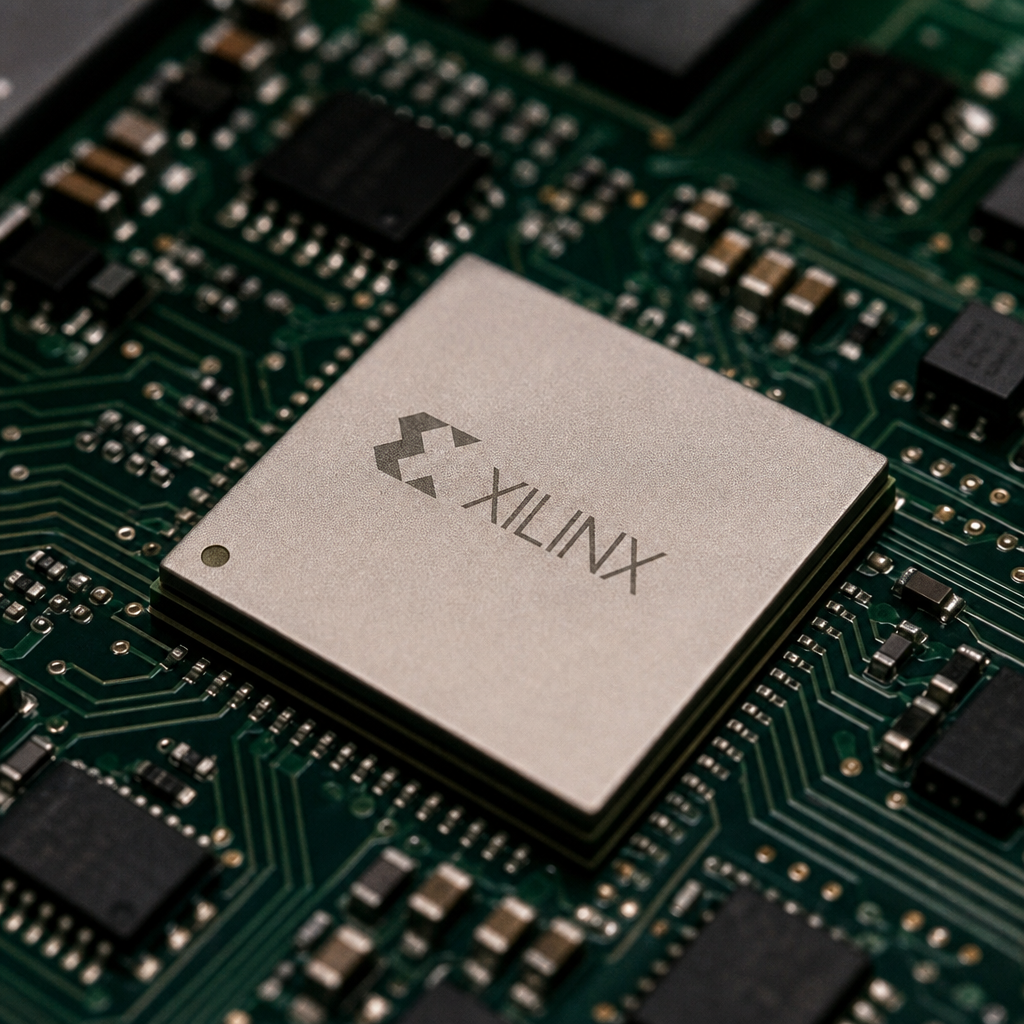
Xilinx was founded in 1984 and is widely recognized for commercializing the FPGA category. An FPGA contains configurable logic blocks, programmable interconnects, and input/output resources that designers can wire into a custom digital circuit after fabrication. In plain terms, engineers can make the chip behave like specialized hardware without waiting years for a custom ASIC. That ability transformed prototyping first, then production systems. Instead of committing early to fixed logic, teams could validate algorithms, update interfaces, and fix hardware behavior through reconfiguration.
The breakthrough was not just flexibility. It was flexibility with meaningful performance. Software running on a CPU executes instructions sequentially, while FPGA logic can process many operations in parallel with deterministic timing. In communications infrastructure, that difference is decisive. Base stations need tight latency budgets and heavy signal processing. In industrial systems, control loops and sensor inputs often require exact timing that software alone cannot guarantee. Xilinx understood these requirements early and built product families that addressed them across generations, from Spartan and Virtex to Zynq and Versal.
Xilinx also changed the design workflow by supporting hardware description languages such as VHDL and Verilog, later complemented by higher-level tools. Vivado became a core platform for synthesis, place-and-route, timing analysis, and IP integration. Vitis extended accessibility by letting software-oriented developers target acceleration workflows using C, C++, OpenCL, and domain libraries. These tools mattered because the hardware was powerful, but adoption depended on reducing development friction. In every major semiconductor wave, companies that pair silicon with practical toolchains gain staying power. Xilinx did that better than many rivals.
Core Product Families and Real-World Use Cases
Xilinx built a broad portfolio because programmable logic serves very different technical and commercial needs. Spartan devices historically targeted cost-sensitive applications such as consumer electronics, simple industrial controllers, and interface bridging. Virtex focused on high performance for networking, aerospace, advanced test systems, and bandwidth-heavy compute. Zynq combined ARM processing systems with programmable logic, creating a system-on-chip architecture that let developers place software and hardware acceleration on one device. Versal advanced the model further with adaptive compute acceleration platform architecture, integrating scalar engines, programmable logic, AI Engines in selected variants, and hardened connectivity resources.
Those distinctions are not marketing labels; they map directly to deployment choices. In automotive advanced driver assistance systems, a Zynq-based design can combine image pre-processing, sensor aggregation, and deterministic I/O while a software stack handles decision logic. In video broadcasting, Xilinx devices have powered encoding, transcoding, and low-latency transport equipment because they manage parallel data paths efficiently. In aerospace and defense, radiation-tolerant and high-reliability programmable devices support mission systems where standards evolve and field updates are essential. In finance, FPGA acceleration has been used for market data feed handling and ultra-low-latency trading infrastructure, where microseconds affect outcomes.
| Product family | Primary strength | Typical deployments |
|---|---|---|
| Spartan | Low cost and efficient logic integration | Embedded control, bridging, consumer and industrial devices |
| Virtex | High performance, bandwidth, and advanced transceivers | Networking, aerospace, test equipment, high-end compute |
| Zynq | Integrated ARM processing plus programmable logic | Robotics, automotive, vision systems, edge AI |
| Versal | Adaptive heterogeneous computing with AI-capable options | 5G, data center acceleration, advanced embedded platforms |
One reason Xilinx remained a market leader is that it did not treat the FPGA as a niche component. It positioned programmable logic as infrastructure that can sit between sensors and software, between networks and applications, or between CPUs and high-throughput workloads. That framing opened opportunities across many industries at once.
Xilinx in Data Centers, AI, and Embedded Systems
Xilinx gained strategic visibility when cloud and enterprise operators looked for accelerators that could improve throughput and power efficiency. GPUs excel at many parallel workloads, but FPGAs offer a different value proposition: reconfigurable pipelines tailored to exact dataflow requirements. Microsoft famously used Xilinx FPGAs in its Project Catapult effort to accelerate Bing search ranking and later broader Azure infrastructure. That case became an industry reference point because it demonstrated that programmable logic could operate at hyperscale, not just in labs or telecom racks.
In machine learning, Xilinx did not try to outmarket every GPU vendor on training. Instead, it focused on inference, edge deployment, and latency-sensitive acceleration. For computer vision in factories, retail analytics, or traffic systems, the ability to process streams locally with low power draw can matter more than raw training throughput. The Vitis AI stack and dedicated deep-learning processing approaches helped customers deploy quantized models efficiently. There are tradeoffs: FPGA development generally requires more hardware expertise than standard CPU or GPU software workflows, and not every neural network maps cleanly to reconfigurable logic. Still, when thermal budgets, latency ceilings, and interface diversity dominate the specification, Xilinx has often been the better fit.
Embedded systems are where Xilinx has been especially durable. Many products stay in service for years, interfaces change, and real-time constraints remain unforgiving. I have seen design teams choose Xilinx not because it was the cheapest part on day one, but because it reduced redesign risk over a product lifecycle. A medical imaging platform, for example, may need future sensor support, protocol changes, and deterministic image handling. Reprogrammable hardware gives that platform room to evolve without replacing the full compute architecture.
Competitive Position, Standards, and Industry Influence
Xilinx has long competed with Intel’s FPGA business, formerly Altera, along with Lattice in lower-power segments and specialized ASIC vendors in fixed-function markets. The competition is meaningful because customers choose among flexibility, unit cost, software simplicity, power consumption, and time to deployment. ASICs usually win on volume economics and absolute efficiency when requirements are stable. FPGAs win when standards move, product variants multiply, or deployment risk is high. Xilinx’s leadership came from understanding that practical balance and serving premium applications where adaptability justified the bill of materials.
The company also benefited from alignment with recognized development standards and ecosystems. Support for VHDL, Verilog, SystemVerilog flows, PCIe connectivity, Ethernet standards, DDR memory interfaces, JESD204 for converter links, and embedded Linux environments made Xilinx parts easier to integrate into serious systems. Tool support around AMD Xilinx Vivado, Vitis, PetaLinux, and extensive IP libraries gave engineering teams reusable building blocks rather than forcing every design from scratch. That ecosystem has real market impact. Semiconductor vendors do not win only through transistor counts; they win by reducing implementation uncertainty.
Following AMD’s acquisition of Xilinx in 2022, the strategic narrative became broader. Adaptive computing could now sit alongside x86 CPUs, GPUs, DPUs, and software ecosystems in one portfolio. For customers, that creates opportunities for heterogeneous architecture planning. For the market, it reinforces Xilinx as more than a legacy FPGA brand. It is now a central piece of how modern compute vendors approach workload-specific acceleration.
Why Xilinx Belongs at the Center of Company Spotlights
Any hub on tech innovators and market leaders should place Xilinx near the center because its influence reaches far beyond a single product category. It pioneered mainstream programmable logic, expanded it into adaptive computing, and proved that reconfigurable hardware solves real commercial problems in communications, embedded design, cloud infrastructure, and intelligent edge systems. Its product families serve distinct use cases, its tools lowered barriers to adoption, and its ecosystem aligned with the standards engineers rely on when building complex systems. Just as important, Xilinx showed that hardware flexibility can be a strategic advantage, not simply an engineering convenience.
The main takeaway is clear: Xilinx became the driving force in programmable logic technology by pairing configurable silicon with credible development platforms and by targeting markets where latency, determinism, bandwidth, and product longevity matter most. That combination explains its staying power and why it remains essential in any serious discussion of semiconductor leaders. If you are building a deeper view of company spotlights, use this hub as your starting point, then explore adjacent profiles covering AMD, Intel, NVIDIA, Lattice, and the broader adaptive computing market to understand how today’s leaders shape the future of electronics.
Frequently Asked Questions
What is Xilinx, and why is it considered so important in programmable logic technology?
Xilinx is widely recognized as one of the pioneering companies behind the commercial success of programmable logic, especially the field-programmable gate array, or FPGA. Its importance comes from the fact that it helped transform hardware design from a rigid, fixed-function model into one that could be reconfigured after manufacturing. That shift gave engineers the ability to update, optimize, and tailor hardware behavior for specific workloads without redesigning an entire chip from scratch.
What made Xilinx especially influential was not just the invention and advancement of FPGA technology, but the way it built an ecosystem around it. The company developed product families, design tools, intellectual property cores, and reference platforms that made programmable hardware more accessible to industries ranging from telecommunications and automotive to industrial automation, aerospace, defense, and cloud computing. In practice, that meant engineers could use Xilinx devices to accelerate signal processing, manage real-time control systems, implement custom networking functions, and support machine learning inference at the edge or in the data center.
Xilinx also played a central role in expanding the definition of programmable logic. It moved beyond standalone FPGAs into adaptive system-on-chip platforms that combine programmable fabric with CPUs, high-speed interfaces, memory controllers, and specialized acceleration engines. This broader approach helped position Xilinx not just as an FPGA company, but as a driving force in adaptive computing, where hardware can be tuned to changing application demands. That is a major reason the company remains so relevant in conversations about modern semiconductor innovation and flexible system design.
How do Xilinx FPGAs differ from traditional processors and ASICs?
Xilinx FPGAs differ from traditional processors and application-specific integrated circuits, or ASICs, in both architecture and design philosophy. A conventional CPU executes software instructions sequentially or across a limited number of cores, making it highly versatile for general-purpose computing. An ASIC, by contrast, is custom-built for a specific function and can deliver excellent performance and efficiency, but it is fixed at the time of manufacture. An FPGA sits between these two worlds by offering hardware-level configurability after production.
With a Xilinx FPGA, engineers can define custom logic pathways that operate in parallel rather than relying solely on instruction-driven execution. This parallelism is one of the biggest advantages of programmable logic. It enables very low-latency processing and high throughput for workloads such as digital signal processing, packet inspection, video processing, sensor fusion, encryption, and industrial control. Instead of adapting software to fit a standard processor, designers can adapt the hardware itself to fit the application.
Compared with ASICs, Xilinx FPGAs offer much greater flexibility and faster development cycles. Teams can prototype, test, and update designs in the field, which is particularly valuable in fast-moving sectors where standards evolve and product requirements change over time. While ASICs may ultimately deliver better unit economics at extremely high volumes, FPGAs are often preferred when adaptability, time-to-market, and post-deployment updates matter. Xilinx strengthened this value proposition by providing mature toolchains, extensive IP libraries, and scalable device families that support everything from entry-level embedded systems to high-performance acceleration platforms.
What industries and applications benefit most from Xilinx technology?
Xilinx technology is used across a remarkably wide range of industries because programmable logic solves problems that demand flexibility, deterministic performance, and hardware acceleration. In communications and networking, Xilinx devices are commonly used for baseband processing, packet processing, protocol bridging, and support for changing standards in wireless and wired infrastructure. This has made them highly relevant in areas such as 5G deployment, optical transport, and edge networking equipment.
In automotive systems, Xilinx platforms have been applied to advanced driver-assistance systems, in-vehicle networking, sensor processing, and real-time decision support. These applications benefit from the ability to process data from cameras, radar, lidar, and other sensors with low latency and high reliability. In industrial settings, Xilinx hardware is valuable for machine vision, robotics, motion control, predictive maintenance, and factory automation, where deterministic behavior and long product lifecycles are often critical requirements.
Aerospace and defense organizations also use Xilinx devices for radar, secure communications, electronic warfare, satellite payloads, and mission-critical embedded systems. In these markets, reconfigurability and high-performance signal processing are especially attractive. Meanwhile, in data centers, Xilinx has been important in hardware acceleration for AI inference, database search, compression, video transcoding, and financial computing. What ties all of these use cases together is the need for hardware that can be optimized for a task while still remaining adaptable as requirements change. That combination is exactly where Xilinx has built its reputation.
What does Xilinx mean by adaptive computing, and how did the company evolve beyond basic FPGAs?
Adaptive computing refers to the idea that hardware platforms should be able to change and optimize themselves for different workloads, operating conditions, and application requirements. Xilinx advanced this concept by moving beyond traditional FPGA products and developing more integrated platforms that combine programmable logic with processors, memory subsystems, high-speed connectivity, and domain-specific acceleration engines. Instead of asking designers to choose between fixed-function devices and raw programmable fabric, Xilinx created solutions that blended both approaches.
This evolution became especially visible with adaptive system-on-chip and accelerator-oriented product families. These devices allow software-programmable processing and hardware-programmable acceleration to work together in one platform. For developers, that means they can partition workloads intelligently: control-oriented tasks can run on embedded CPUs, while latency-sensitive or massively parallel tasks can be offloaded into programmable logic or specialized engines. That is a major advantage in modern embedded systems and data-intensive applications, where performance, power efficiency, and workload diversity all matter.
The strategic importance of this shift is that it aligned Xilinx with broader industry trends. Computing is no longer dominated by one-size-fits-all architectures. AI, edge computing, smart infrastructure, and real-time analytics all require different forms of acceleration. By championing adaptive computing, Xilinx positioned itself as a company that could serve these heterogeneous workloads more effectively than purely fixed architectures in many scenarios. That helped expand its role from FPGA supplier to a broader technology leader in configurable and accelerated computing systems.
Why do engineers and technology companies continue to choose Xilinx platforms for innovation?
Engineers and technology companies continue to choose Xilinx platforms because they offer a compelling combination of flexibility, performance, scalability, and ecosystem support. At the hardware level, Xilinx devices allow designers to build highly customized processing pipelines that can deliver real-time responsiveness and efficient parallel execution. This is especially valuable when standard processors cannot meet latency targets or when fixed-function silicon would limit future adaptability.
Another key reason is development practicality. Xilinx spent years building robust software and hardware development environments, along with reusable IP, evaluation kits, documentation, and partner support. For engineering teams, that ecosystem reduces risk and speeds up development. It allows companies to prototype quickly, refine architectures iteratively, and deploy systems that can often be updated after installation. In markets where standards change, workloads evolve, or long field lifetimes are expected, that reconfigurability is a powerful strategic advantage.
Xilinx also appeals to innovators because its platforms can scale across many classes of applications. A company might begin with a prototype in a lower-cost FPGA, then move to a more capable device for production, or expand into adaptive SoCs and acceleration cards as product requirements grow. That continuity supports long-term product planning and architectural consistency. Ultimately, Xilinx remains attractive because it enables engineering teams to create differentiated systems rather than settling for generic compute solutions. For organizations that view hardware as a source of competitive advantage, Xilinx has consistently provided the tools and technology to turn that idea into reality.