Climate tech for data centers sits at the intersection of digital infrastructure and industrial sustainability, because every AI query, cloud workload, video stream, and business application depends on facilities that consume large amounts of electricity, reject significant heat, and often rely on water-intensive cooling. In practice, climate tech for data centers means the systems, designs, and operating strategies that reduce energy use, cut carbon emissions, conserve water, and improve resilience without compromising uptime. I have worked with operators evaluating utility contracts, cooling retrofits, and metering upgrades, and the pattern is consistent: the biggest gains come from treating power, cooling, water, and carbon as one connected operating model rather than four separate projects.
This topic matters because demand is rising faster than many grids can decarbonize. The International Energy Agency has repeatedly noted that data center electricity consumption is significant and growing, especially as AI accelerates server density. At the same time, communities and regulators increasingly scrutinize local water use, backup diesel emissions, and the true carbon impact of “green” claims based only on annual renewable matching. Investors, enterprise customers, and hyperscale tenants now ask sharper questions: What is the facility’s power usage effectiveness, or PUE? How much water is consumed per kilowatt-hour of IT load? Is carbon measured with hourly granularity or broad annual averages? Can the site ride through grid stress without burning diesel?
As the hub for climate and energy tech in data centers, this article maps the field clearly. Power covers efficiency, grid interconnection, batteries, and clean energy procurement. Cooling includes airflow management, liquid cooling, heat reuse, and controls. Water spans evaporative systems, alternative cooling approaches, treatment, and siting risk. Carbon includes embodied emissions from construction and equipment, operational emissions from purchased electricity and generators, and the measurement frameworks needed for credible decisions. Across all four areas, the goal is not simply lower utility bills. The goal is a more efficient, lower-risk, regulation-ready facility that can support higher compute demand in a carbon-constrained world.
Power: efficiency, flexibility, and cleaner electricity procurement
Power is the first lever because every other climate outcome starts with electrical demand. The foundational metric is PUE, defined by The Green Grid as total facility energy divided by IT equipment energy. A lower PUE indicates less overhead from cooling, power conversion, lighting, and ancillary systems. In mature sites, however, chasing PUE alone can become misleading. I have seen facilities improve PUE modestly while making far larger progress through server utilization, higher inlet temperature setpoints aligned with ASHRAE guidance, and better uninterruptible power supply loading. In other words, total energy and carbon matter more than one ratio in isolation.
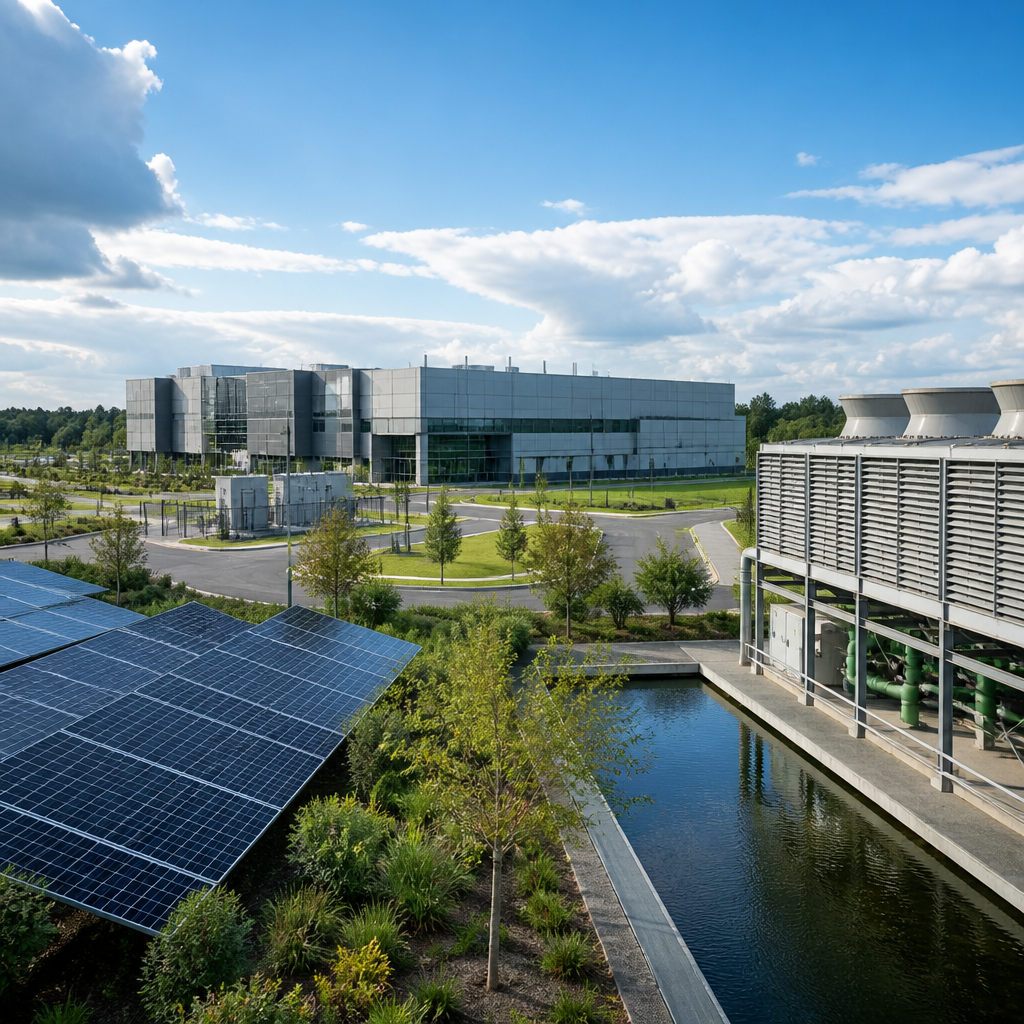
Modern climate tech on the power side includes high-efficiency UPS systems, lithium-ion battery strings replacing some valve-regulated lead-acid banks, advanced switchgear monitoring, branch-circuit metering, and software that aligns workload placement with energy availability. Hyperscalers increasingly use power capping, demand response participation, and battery energy storage systems to reduce peak demand charges and support grid stability. Behind-the-meter solar can help in some markets, but because roof area is limited relative to load, on-site generation rarely supplies a large share of a major data center’s annual consumption. Long-term power purchase agreements, utility green tariffs, and hourly carbon-aware procurement are typically more material.
The shift from annual renewable matching to time-based matching is especially important. A facility can claim 100 percent renewable electricity on paper while drawing fossil-heavy grid power during many hours of the year. Carbon-aware scheduling and 24/7 clean energy procurement address that gap by matching consumption with cleaner generation profiles more closely. Google has popularized this approach, but the principle applies broadly: a megawatt-hour matters differently depending on where and when it is consumed. For operators, this means energy procurement teams, facility engineers, and sustainability staff need a common data model, not separate dashboards that tell conflicting stories.
Cooling: from airflow discipline to liquid systems for high-density compute
Cooling is usually the largest non-IT energy load in a data center, so it offers some of the fastest operational gains. The basics still matter enormously: hot-aisle or cold-aisle containment, blanking panels, cable management, leakage reduction under raised floors, variable-speed fans, and calibrated temperature and pressure sensors. In audits, simple airflow corrections often deliver better returns than expensive new equipment because they eliminate bypass air and hot spots that force operators to overcool the entire room. ASHRAE thermal envelopes provide the guardrails, but disciplined commissioning is what turns guidance into lower fan energy and stable inlet conditions.
Higher rack densities are changing the cooling stack. Traditional air cooling can support many enterprise deployments, but AI clusters with GPUs often exceed the practical limits of room-level air systems. That is why liquid cooling is moving from niche to mainstream. Rear-door heat exchangers, direct-to-chip cold plates, and eventually immersion cooling all remove heat more efficiently than pushing ever-larger volumes of air. Direct-to-chip designs are currently the most common path for high-density halls because they can coexist with existing white-space layouts while capturing a large share of server heat at the source. The tradeoff is added plumbing complexity, leak detection requirements, and closer coordination with OEM warranty conditions.
Controls are the hidden climate technology in cooling. A chiller plant with variable-frequency drives, optimized sequencing, condenser water reset, and continuous fault detection can outperform newer hardware run with poor controls. Digital twins and building management analytics help operators test setpoint changes safely before implementing them live. In one project pattern I have seen repeatedly, raising chilled water temperature by a small increment, while tightening airflow management and validating server inlet temperatures, cut compressor energy without increasing thermal alarms. The lesson is practical: cooling efficiency is not one device purchase; it is an ongoing control strategy grounded in telemetry, commissioning, and change management.
Water: balancing heat rejection, local risk, and technology choice
Water is often the most misunderstood dimension of data center sustainability. Evaporative cooling can reduce electricity consumption compared with fully mechanical refrigeration, especially in favorable climates, but those energy gains may come with substantial water use. The right metric is not only total site water consumption; it is water use effectiveness, or WUE, typically expressed as liters per kilowatt-hour of IT energy. Local context matters even more. A highly efficient evaporative design in a water-stressed basin can create more stakeholder risk than a less water-intensive design with slightly higher electrical demand in a region with cleaner grid power.
Operators now evaluate water strategy through both engineering and geography. Air-cooled chillers, indirect evaporative systems, hybrid cooling, reclaimed water sourcing, and advanced treatment each change the balance among energy, water, capital cost, and maintenance. Reuse of municipal reclaimed water can reduce potable demand, but it introduces chemistry and reliability considerations that must be designed into treatment systems. Blowdown management, drift control, leak detection, and side-stream filtration can materially reduce losses. In drought-prone markets, I advise teams to model annual and peak water consumption under extreme weather scenarios rather than relying on a normal weather year that understates operational risk.
| Priority area | Common technologies | Main climate benefit | Key tradeoff |
|---|---|---|---|
| Power | High-efficiency UPS, batteries, power monitoring, clean energy contracts | Lower energy waste and lower operating emissions | Interconnection limits and contract complexity |
| Cooling | Containment, variable-speed drives, liquid cooling, controls analytics | Reduced non-IT energy and support for higher rack density | Retrofit disruption and system integration |
| Water | Hybrid cooling, reclaimed water, treatment optimization, leak detection | Lower potable water use and better drought resilience | Water chemistry management and local permitting |
| Carbon | Hourly emissions tracking, low-carbon materials, generator alternatives | More credible emissions reduction across operations and construction | Data quality gaps and higher upfront planning effort |
Carbon: measuring what matters across operations, backup power, and embodied impacts
Carbon accounting for data centers must include more than purchased electricity. Operational emissions include grid electricity, refrigerant leakage, and generator testing or emergency runtime. Embodied carbon includes concrete, steel, electrical equipment, batteries, and server hardware manufacturing. The Greenhouse Gas Protocol remains the standard frame for organizing these impacts, but the practical challenge is data quality. Utility emission factors can vary hourly, generator fuel records may be fragmented, and suppliers often provide inconsistent product disclosures. Strong programs therefore start with metered energy, auditable fuel data, and procurement specifications that require environmental product declarations where available.
Backup power is a growing focus. Diesel generators remain dominant because they are proven and bankable, yet they create local air pollution and carbon emissions. Alternatives such as hydrotreated vegetable oil, renewable diesel, fuel cells, and long-duration batteries are advancing, but each has constraints around availability, cost, runtime, or permitting. No single substitute has displaced diesel universally. A realistic strategy is staged: reduce testing emissions through smarter maintenance regimes, pair generators with batteries to shave transient loads, evaluate cleaner fuels where supply chains are credible, and design electrical architectures that can eventually accommodate lower-emission standby technologies as they mature.
Embodied carbon deserves equal attention because rapid construction can lock in emissions before a facility even opens. Low-carbon concrete mixes, recycled steel content, modular construction, and circular IT asset management all help. So does extending server life where performance per watt remains acceptable. The broader point is that climate tech for data centers is now a systems discipline. The best operators combine power efficiency, advanced cooling, water stewardship, and granular carbon accounting into one roadmap with clear thresholds, owners, and reporting cadence. If you manage, invest in, or buy data center capacity, start with a baseline, identify your highest-impact constraints, and prioritize projects that improve reliability while cutting energy, water, and carbon together.
Frequently Asked Questions
What does climate tech for data centers actually include?
Climate tech for data centers includes the technologies, design decisions, and operating practices that lower the environmental impact of digital infrastructure while maintaining reliability and performance. In practical terms, that spans power systems, cooling equipment, software controls, building design, water management, and carbon accounting. It can include high-efficiency UPS systems, advanced power distribution, renewable energy procurement, on-site energy storage, heat reuse, liquid cooling, free cooling, closed-loop water systems, real-time monitoring, and AI-assisted controls that continuously optimize operations.
The goal is not simply to make a facility “greener” in a general sense. It is to improve measurable outcomes such as energy efficiency, carbon intensity, water use effectiveness, resilience during grid stress, and the ability to support growing compute loads without driving proportional increases in environmental impact. Because modern data centers support AI inference, cloud computing, content delivery, enterprise applications, and edge services, even small efficiency gains can scale into major reductions in power demand, emissions, and resource consumption.
Importantly, climate tech in this sector is not one product category. It is a systems approach. A data center may use efficient chillers, but if airflow is poorly managed, servers are underutilized, or power comes from a carbon-intensive grid, the overall sustainability profile may still be weak. The strongest strategies integrate facility engineering, IT architecture, software intelligence, and procurement decisions so that power, cooling, water, and carbon are managed together rather than in isolation.
Why are power and cooling such critical sustainability issues in data centers?
Power and cooling are central because they define both the operational cost and environmental footprint of a data center. Every workload running inside the facility consumes electricity, and nearly all of that energy eventually becomes heat. That heat must then be removed to keep servers, storage, and networking equipment within safe operating ranges. As a result, there is a direct relationship between compute activity, electrical demand, thermal load, and cooling requirements.
From a sustainability perspective, electricity matters because it often represents the largest source of a data center’s emissions, especially when grids are still dependent on fossil fuels. Cooling matters because it can consume a substantial share of total facility energy and, depending on the system design, can also require significant amounts of water. When operators improve cooling efficiency, they are often reducing both electricity use and resource strain at the same time.
This issue becomes even more important with the rise of AI and high-density computing. Accelerators and modern GPU clusters can draw far more power per rack than traditional enterprise environments, which pushes up thermal density and can strain legacy air-cooling designs. That is why climate tech for data centers increasingly focuses on integrated power management, high-efficiency thermal systems, and dynamic controls that can respond in real time to changing load conditions. In short, power and cooling are not side concerns; they are the physical foundation of both digital service delivery and sustainability performance.
How can data centers reduce water use without compromising cooling performance?
Data centers can reduce water use by rethinking both the type of cooling system they deploy and the way that system is operated. One of the most effective steps is moving away from once-through or highly water-intensive designs toward closed-loop systems that recirculate water rather than consuming large volumes continuously. Operators can also optimize cooling towers, improve water treatment, reduce blowdown, capture rainwater where appropriate, and use reclaimed or non-potable water instead of drinking-quality municipal supplies.
Another major strategy is selecting cooling architectures that fit local climate conditions. In some regions, air-side or waterside economization can reduce the need for mechanically intensive cooling during cooler parts of the year. In others, liquid cooling or direct-to-chip systems can improve heat removal efficiency and reduce dependence on broad room-level cooling. These designs can support higher compute densities while limiting unnecessary water and energy consumption, especially when combined with precise environmental controls and continuous telemetry.
The key is balance. Water reduction should not be treated as a single metric pursued in isolation. A system that saves water but substantially increases electricity demand on a carbon-heavy grid may create a different environmental tradeoff. Leading operators therefore evaluate water use effectiveness alongside power usage effectiveness, carbon intensity, site location, seasonal conditions, and resilience requirements. The best outcomes come from optimizing across all of these factors so that water conservation strengthens, rather than undermines, overall sustainability and reliability.
What role does carbon reduction play in data center strategy?
Carbon reduction is becoming a core strategic priority because data centers are expanding rapidly at the same time that companies, investors, regulators, and customers are demanding credible climate action. For most operators, the biggest carbon lever is electricity: reducing total consumption, improving efficiency, and shifting procurement toward cleaner energy sources. That can include long-term renewable power purchase agreements, hourly carbon-aware workload management, energy storage, demand response participation, and on-site generation where it makes sense operationally and economically.
However, carbon strategy extends beyond utility power. It also includes embodied carbon in construction materials, backup power systems, cooling equipment, and IT hardware. A truly comprehensive approach examines both operational emissions and the emissions associated with building and maintaining the facility. That means choosing lower-carbon materials where feasible, extending equipment life through better maintenance and utilization, and designing spaces that can evolve with future workloads rather than requiring frequent carbon-intensive retrofits.
Just as important is measurement. Carbon claims are only as strong as the data behind them. Data center operators increasingly need granular visibility into energy sourcing, load patterns, asset efficiency, and emissions factors across different geographies and times of day. That enables more accurate reporting and better decision-making. In practice, carbon reduction is not a marketing layer applied after the fact. It is a planning, design, procurement, and operational discipline that shapes how modern digital infrastructure is financed, built, and run.
How does climate tech improve data center resilience as well as sustainability?
One of the most important points to understand is that sustainability and resilience often reinforce each other in data centers. Efficient systems generally produce less waste heat, require fewer resources, and operate with better visibility and control. That can make facilities more stable during periods of peak demand, equipment stress, water scarcity, or grid volatility. For example, advanced monitoring and automated controls can detect inefficiencies early, redistribute loads, and prevent failures before they escalate into outages.
Climate tech also strengthens resilience by diversifying how a facility manages power and cooling. On-site storage, grid-interactive controls, and flexible backup strategies can help operators respond to utility interruptions or price spikes. High-efficiency cooling systems, liquid cooling loops, and modular thermal designs can better support dense computing loads without pushing infrastructure to unsafe limits. Water-smart systems can reduce dependence on constrained local supplies, which becomes especially valuable in drought-prone regions or during heat waves when cooling demand rises sharply.
In other words, climate tech is not just about lowering impact under ideal conditions. It is about building data centers that can continue performing under real-world pressure, including climate-related disruptions. As compute demand accelerates, especially from AI and high-performance workloads, facilities need to be both cleaner and tougher. The most forward-looking operators recognize that energy efficiency, water stewardship, carbon reduction, and operational resilience are not separate agendas. They are part of the same infrastructure strategy.