Physical AI is the application of artificial intelligence to machines that sense, move, and act in the real world, and it is rapidly becoming the next major computing platform after mobile and cloud. In practical terms, it combines perception models, planning systems, control software, sensors, actuators, and onboard or edge compute so a robot can turn digital predictions into physical action. I have worked with teams evaluating warehouse robots, mobile manipulators, and vision systems, and the pattern is consistent: once AI leaves the screen and touches inventory, roads, factories, hospitals, or homes, the technical bar rises sharply and the economic upside does too. That is why investors, chipmakers, cloud providers, and startup founders are treating physical AI and robotics as a platform shift rather than a niche hardware category.
The phrase matters because it clarifies a change in scope. Traditional software can recommend a route, summarize a contract, or classify an image. Physical AI must interpret a messy environment, make decisions under uncertainty, and execute safely despite latency, wear, lighting changes, network loss, and human unpredictability. A warehouse picking robot, for example, needs computer vision to identify an item, grasp planning to choose contact points, motion planning to avoid collisions, force control to adjust in real time, and a feedback loop that learns from failures. That stack is much harder than a chatbot, but it also creates stronger moats because integration, data collection, and safety validation are difficult to replicate quickly.
For Silicon Valley, the significance is strategic. Robotics extends AI demand into semiconductors, simulation, industrial software, logistics, autonomy, and labor productivity. It also creates a new interface for computing: not just apps on phones, but intelligent agents embedded in forklifts, surgical systems, delivery vehicles, agricultural equipment, and humanoid robots. The winners will not come from one breakthrough model alone. They will come from companies that align hardware reliability, software iteration speed, unit economics, and compliance with standards such as ISO 10218 for industrial robots and ISO 13482 for personal care robots. Understanding physical AI now helps founders, operators, and investors evaluate where defensible value is being built.
What physical AI includes and how the technology stack works
Physical AI includes any AI system that closes the loop between perception, decision-making, and action in the physical world. The core layers are sensing, world modeling, planning, control, and learning. Sensors may include RGB cameras, depth cameras, lidar, radar, force-torque sensors, encoders, microphones, GPS, and inertial measurement units. Those inputs feed perception models that detect objects, estimate pose, segment scenes, localize the robot, or predict motion. The system then builds a representation of the world, whether through occupancy grids, point clouds, digital twins, or task-specific state graphs. Planning modules generate goals and trajectories, while low-level controllers translate those plans into motor commands that obey dynamics, safety constraints, and timing requirements.
The difference between a demo and a deployable product usually appears in these interfaces between layers. A robot can identify a box in ideal conditions yet fail when shrink wrap reflects light or when the box is slightly crushed. In field deployments, teams rely on redundancy and calibration discipline. Simultaneous localization and mapping helps autonomous mobile robots navigate changing facilities. Model predictive control stabilizes movement by recalculating actions against a horizon of expected states. Sensor fusion combines lidar with cameras or radar to reduce blind spots. Edge inference matters because round-trip latency to the cloud can be unacceptable for manipulation, emergency stopping, or vehicle control. In my experience, most schedule slips come not from the model benchmark but from integration work across firmware, networking, mechanical tolerances, and exception handling.
Why robotics is becoming Silicon Valley’s next platform shift
A platform shift happens when new capabilities reorganize the technology stack and create broad opportunities across infrastructure, applications, and business models. Physical AI fits that definition. First, the enabling inputs have improved at the same time: compute has become cheaper per performance unit, foundation models have expanded perception and planning capabilities, simulation has matured, and battery systems, electric drives, and sensors have improved. Second, labor-intensive sectors such as logistics, manufacturing, construction, elder care, and agriculture face persistent shortages, wage pressure, and safety concerns. Third, enterprises now expect software-like analytics from machines, which means recurring revenue from fleet management, remote operations, maintenance, and workflow optimization can sit on top of hardware sales.
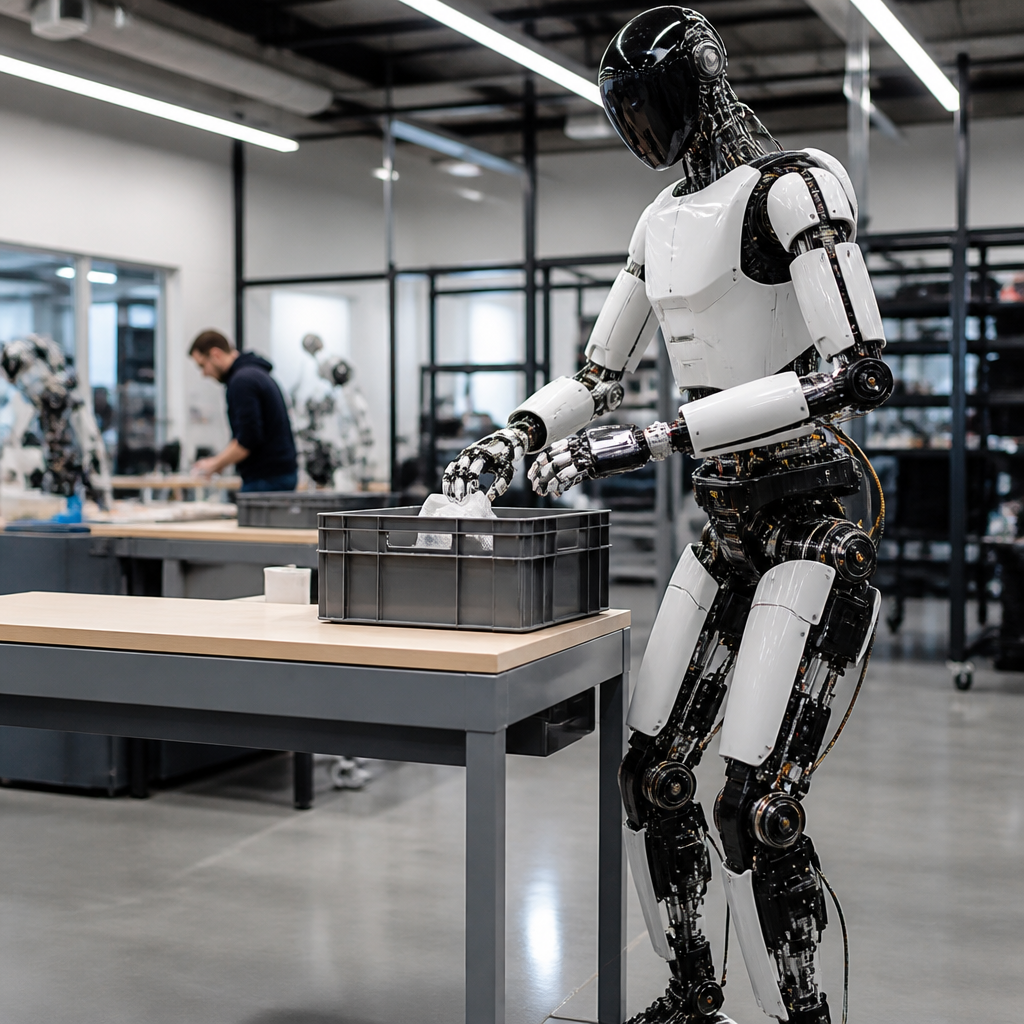
NVIDIA’s push into robotics platforms, Tesla’s work on Optimus and autonomous systems, Amazon’s warehouse robotics expansion after Kiva, and startups like Covariant, Figure, Agility Robotics, Skild AI, and Zipline all illustrate the breadth of the shift. The common thread is not humanoids alone. It is the migration from fixed-function automation to adaptable machine intelligence. Earlier industrial automation excelled in structured environments with repeatable tasks. Physical AI expands automation into semi-structured settings where objects vary, humans share space, and rules change daily. That widens the addressable market dramatically. Silicon Valley cares because the opportunity spans chips, middleware, model tooling, vertical applications, and data infrastructure, creating multiple control points rather than a single winner-take-all layer.
Where physical AI is creating value today
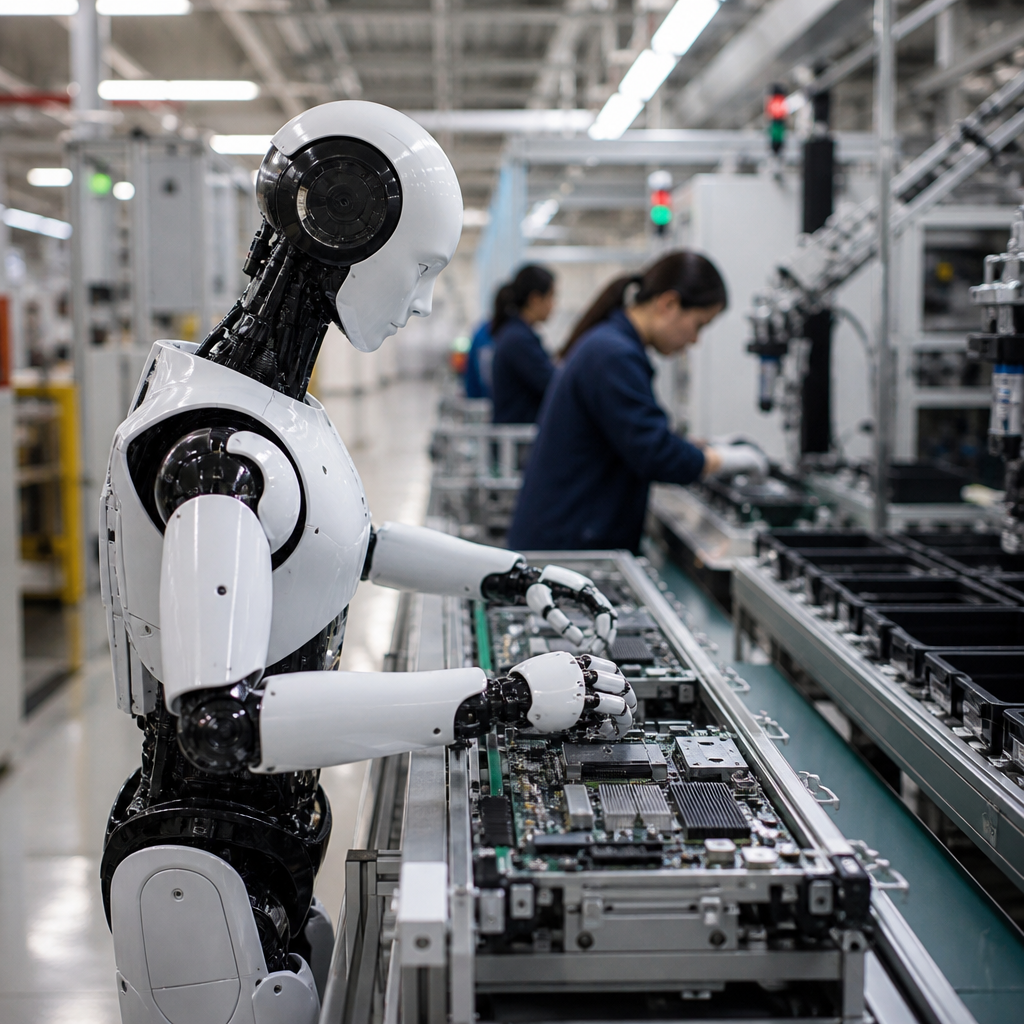
The strongest current use cases are the ones where tasks are repetitive, environments are constrained enough for reliability, and return on investment is measurable within one to three years. Warehousing is the clearest example. Autonomous mobile robots move inventory, robotic arms sort parcels, and vision systems detect damage or count stock. In manufacturing, machine vision catches defects, cobots assist with screwdriving or packaging, and autonomous forklifts reduce idle time. In healthcare, surgical robotics improves precision in procedures such as minimally invasive operations, while hospital robots transport linens, medications, and lab samples. Agriculture uses computer vision for crop monitoring, precision spraying, and autonomous harvesting in specific produce categories.
| Sector | Typical physical AI application | Main value driver | Key limitation |
|---|---|---|---|
| Warehousing | Picking, pallet movement, inventory scanning | Higher throughput and lower labor variability | Irregular objects and exception handling |
| Manufacturing | Inspection, assembly assistance, material transport | Quality consistency and uptime | Integration with legacy lines |
| Healthcare | Surgical assistance, internal logistics | Precision and staff efficiency | Regulation and clinical validation |
| Agriculture | Weeding, spraying, selective harvesting | Input reduction and labor relief | Weather and crop variability |
| Mobility | Delivery drones, autonomous driving stacks | Asset utilization and service speed | Safety, mapping, and regulation |
These examples show why the market is real now, not merely speculative. Companies buy robots when the workflow bottleneck is clear, the payback period is acceptable, and the machine can be supported at scale. The lesson for startups is simple: start with a narrow wedge where the environment is manageable and the economics are obvious, then expand capabilities over time. Broad ambition without a constrained first deployment usually fails.
The hard problems: safety, reliability, data, and economics
Physical AI is promising precisely because it is difficult. Safety is non-negotiable. Robots operating near people need fail-safe design, emergency stop systems, geofencing, functional safety architectures, and rigorous validation. Reliability is equally unforgiving because one bad grasp or false obstacle detection can stop an entire workflow. Unlike web software, patching in production can carry physical risk. Data is another bottleneck. Internet-scale text is abundant, but high-quality robotics data is expensive because it requires synchronized sensor streams, action labels, simulation alignment, and logs from edge cases such as occlusions, slippery surfaces, or tool wear. Many companies therefore use simulation environments like Isaac Sim, MuJoCo, Gazebo, or Unity-based digital twins to generate training data and test policy behavior before field rollout.
Economics decides adoption. A robot is not valuable because it is impressive; it is valuable when total cost of ownership beats alternatives. Buyers ask about hardware gross margin, installation time, mean time between failure, maintenance labor, software subscription value, and facility changes required for deployment. Humanoid robots capture attention, but in many environments a purpose-built mobile manipulator or fixed arm is cheaper and more reliable. This is where disciplined operators separate from hype. They know that reducing one minute of cycle time across thousands of picks per day can matter more than adding a flashy general-purpose capability. The best teams measure success with throughput, uptime, safety incidents, and payback period, not with viral videos.
How startups, investors, and enterprises should evaluate the space
For startups, the strongest strategy is to own a painful workflow rather than just a model. That means understanding the customer’s process map, exceptions, and integration points with warehouse management systems, manufacturing execution systems, enterprise resource planning tools, and safety procedures. Defensible companies usually combine proprietary operational data, deployment know-how, and a system architecture that improves after every site installation. For investors, the key diligence questions are straightforward: Can the product reach reliable autonomy in a bounded task? How much teleoperation is needed? What is the gross margin path? Does the company depend on custom hardware that slows scale? Are there regulatory barriers? Can software revenue rise as the fleet expands?
Enterprises evaluating physical AI should pilot with a defined operational metric and a constrained environment. Start with one facility, one shift, one workflow, and a clear baseline for throughput, errors, and labor hours. Require integration plans, fallback procedures, and service-level commitments. Physical AI works best when leaders treat it as process redesign, not gadget procurement. The larger point is that robotics is becoming a foundational layer of modern industry. Companies that learn how to deploy, supervise, and continuously improve intelligent machines will gain durable advantages in productivity, resilience, and service quality.
Physical AI matters because it moves artificial intelligence from prediction to execution. It turns software into a system that can lift, drive, inspect, deliver, assemble, and assist in the real world. That shift is why robotics is emerging as Silicon Valley’s next big platform opportunity. The technology stack is maturing, the commercial demand is visible, and the strategic value spans nearly every major industry. Yet success will not belong to the loudest demo or the broadest claim. It will belong to teams that solve constrained problems safely, integrate deeply with customer operations, and prove unit economics with real deployments.
For readers following tech innovations and startups, this subtopic is worth close attention because it sits at the intersection of AI, hardware, labor, and industrial transformation. As you explore physical AI and robotics further, focus on the concrete signals: reliability, deployment speed, safety architecture, operational data, and return on investment. Those are the markers of lasting companies and meaningful adoption. If you are building, investing, or buying in this market, start with one workflow where intelligent machines can create measurable value, then expand from evidence rather than excitement.
Frequently Asked Questions
What is Physical AI, and how is it different from traditional software AI?
Physical AI refers to artificial intelligence systems that do not just analyze information on a screen but use that intelligence to sense, decide, and act in the physical world. In practice, that means combining machine learning models with robotics hardware, perception systems, planning software, control loops, sensors, actuators, and onboard or edge computing. A Physical AI system might identify an object with a camera, estimate its position in space, plan a safe path to reach it, and then command motors to pick it up or move around it. The key distinction is that the output is not only a prediction or recommendation. It is a real-world action with real-world consequences.
Traditional software AI often operates in digital environments where the cost of error is relatively low and the world is structured. A chatbot can regenerate a response. A recommendation engine can show a different product. By contrast, Physical AI must handle uncertainty, timing, safety, physics, and incomplete information. Lighting changes, objects shift, floors are uneven, and people move unpredictably. That makes Physical AI fundamentally harder and much more valuable when it works well. It is the bridge between intelligence as computation and intelligence as embodied action, which is why many investors, operators, and engineers see it as a major platform shift rather than just another software trend.
Why is robotics being described as Silicon Valley’s next big platform shift?
Robotics is increasingly being framed as the next platform shift because it extends computing beyond phones, browsers, and cloud infrastructure into the real economy of labor, logistics, manufacturing, healthcare, construction, and field operations. Earlier computing waves digitized communication, information, and workflows. Physical AI aims to automate tasks that require movement, manipulation, navigation, inspection, and interaction with changing environments. That opens a much larger category of use cases because so much of GDP still depends on physical work that software alone cannot perform.
Several technology trends are converging to make this moment possible. Perception models have improved dramatically. Edge compute is more capable and energy efficient. Sensors and cameras are cheaper and better. Simulation tools are stronger. Planning and control systems are becoming more robust. At the same time, labor shortages, rising fulfillment expectations, reshoring efforts, and industrial efficiency pressures are creating real market demand. In sectors such as warehouses and manufacturing, teams evaluating mobile robots, manipulators, and vision systems are no longer asking whether automation matters. They are asking which systems can deploy reliably, integrate with operations, and produce measurable return on investment. That shift from research interest to operational buying behavior is one reason the category now looks like a true platform transition.
What technologies make Physical AI work in the real world?
Physical AI is not a single model or a single robot. It is a tightly integrated stack. At the sensing layer, robots rely on cameras, depth sensors, lidar, force sensors, encoders, IMUs, and other inputs to understand their environment and their own state. On top of that, perception systems process raw sensor data to detect objects, estimate pose, classify scenes, track motion, and build environmental maps. Then planning systems determine what the robot should do next, whether that is navigating a warehouse aisle, avoiding a human worker, selecting a grasp point, or sequencing a set of tasks.
Control software is what turns those plans into smooth, reliable movement. It translates high-level intent into low-level commands for motors, joints, grippers, and wheels while constantly correcting for noise, drift, obstacles, and changing conditions. Actuators provide the actual force and motion. Compute happens either onboard, at the edge, or in hybrid architectures depending on latency, connectivity, power, and safety requirements. In many practical deployments, the hard part is not just building each piece but getting them all to work together consistently under messy real-world conditions. A robot can have excellent object detection, for example, and still fail operationally if grasp planning is weak, controls are unstable, or integration with warehouse workflows is incomplete. That is why the strongest Physical AI systems are engineered as full-stack products rather than isolated AI demos.
Where is Physical AI creating value today, and which use cases are most promising?
Today, the most promising Physical AI applications tend to be in environments where tasks are repetitive, economically important, and constrained enough to support reliable deployment. Warehouses are a leading example. Mobile robots can transport goods, vision systems can improve identification and tracking, and mobile manipulators can assist with picking, sorting, pallet movement, and inventory workflows. Manufacturing is another strong category, especially for machine tending, quality inspection, assembly assistance, and material handling. In these settings, the economics can be attractive because labor is costly, throughput matters, and the environment is more structured than a public sidewalk or an open construction site.
Beyond logistics and manufacturing, there is growing momentum in healthcare support, agriculture, security, infrastructure inspection, and field service. The most compelling use cases usually solve a narrow but painful operational bottleneck rather than aiming immediately for general-purpose autonomy. Buyers care about uptime, safety, deployment speed, maintenance burden, workflow compatibility, and total cost of ownership. That is why successful Physical AI companies often win by focusing on one high-value job to be done and proving that they can execute repeatedly in production. Over time, as hardware improves and models become more adaptable, those narrow deployments can expand into broader platforms. But the value today is already real where the task environment, system reliability, and ROI equation line up.
What are the biggest challenges facing Physical AI and robotics adoption?
The biggest challenge is reliability in the real world. Physical environments are noisy, variable, and full of edge cases. A robot may perform well in a clean demo and still struggle in production because lighting changes, pallets are misaligned, objects are damaged, pathways get blocked, or human behavior is unpredictable. In software, many errors are recoverable with little cost. In robotics, mistakes can create downtime, damage inventory, or introduce safety risk. That makes robustness, fail-safes, exception handling, and human oversight essential parts of the product, not optional features.
Adoption also depends on economics and integration. Companies do not buy Physical AI because it is futuristic. They buy it when it improves throughput, reduces labor constraints, increases consistency, or solves a problem existing systems cannot address. That means vendors need to show clear ROI, manageable deployment timelines, interoperability with existing software and equipment, and a support model that can sustain operations after installation. There are also technical constraints involving battery life, compute limits, connectivity, maintenance, and regulatory or workplace safety requirements. The firms most likely to lead this platform shift will be the ones that combine AI capability with operational discipline: strong systems engineering, practical workflow design, realistic safety architecture, and a deep understanding of where automation creates measurable business value.