Robot foundation models are changing physical AI by giving machines a broad base of skills instead of training them for one narrow task at a time. In robotics, a foundation model is a large model trained on diverse data—video, text, sensor traces, control logs, simulations, and robot demonstrations—so it can generalize across tasks, environments, and hardware. Rather than coding every movement or building a separate policy for picking, folding, driving, or inspecting, teams train one adaptable system that can interpret instructions, predict actions, and improve with more experience. I have worked with robot learning pipelines where the hardest problem was not motion planning itself, but the constant rebuilding required whenever a gripper changed, a camera moved, or a warehouse shelf looked different from the training set.
That is why robot foundation models matter. They promise a practical path from brittle automation to reusable machine competence. The concept borrows from language and vision systems, but the physical world adds friction, latency, safety constraints, and messy feedback. A chatbot can generate ten wrong sentences with little consequence; a robot can drop a box, damage equipment, or injure a person after one poor action. The stakes are higher, yet the opportunity is enormous. Manufacturers need flexible automation, logistics companies need robots that can handle package variety, hospitals need mobile assistants that adapt to changing layouts, and homes remain the hardest frontier because no two kitchens, floors, or routines are truly identical.
Understanding robot foundation models also helps explain the broader landscape of physical AI and robotics. This field combines perception, reasoning, planning, control, simulation, and embodied learning. It includes humanoids, warehouse arms, autonomous mobile robots, drones, field robots, and service machines. For readers following Tech Innovations & Startups, this is the hub topic because nearly every robotics startup now frames its long-term moat around data, models, and deployment loops rather than mechanical design alone. Hardware still matters, but the companies gaining attention are building systems that can learn many tasks, transfer skills, and keep getting better after deployment.
What Robot Foundation Models Are and How They Work
A robot foundation model is a general-purpose model for embodied behavior. It ingests multimodal inputs such as RGB video, depth maps, proprioception, force signals, joint states, language commands, and maps, then produces useful outputs like action sequences, task plans, grasp points, or world-state predictions. Many systems combine transformer architectures with diffusion policies, imitation learning, reinforcement learning, and world models. The goal is not a single algorithmic recipe. The goal is a reusable representation of the physical world that supports many downstream robotic tasks with limited retraining.
The standard training stack usually has four layers. First, a perception layer turns raw observations into object, scene, and state representations. Second, a reasoning or planning layer maps goals to subgoals. Third, a control layer converts intent into trajectories and torque-safe motion. Fourth, a continual learning loop captures successes and failures from deployment. Companies such as Google DeepMind, NVIDIA, Covariant, Skild AI, Figure, and Tesla have all pushed variations of this strategy. Open research projects like RT-2, Open X-Embodiment, Octo, and diffusion-policy work have shown that scale and diversity improve performance, especially when the same model sees many robots and task formats.
The defining capability is generalization. If a robot has learned to pick cups, bowls, and cans from clutter, a strong model should transfer some of that knowledge to picking toy blocks or medicine bottles, even if the exact objects were not labeled during training. That transfer does not happen by magic. It emerges from broad data coverage, consistent action representations, and training objectives that reward useful abstractions.
Why General-Purpose Skills Matter in Real Robotics
Traditional robotics has delivered huge value in structured environments. Automotive assembly, semiconductor handling, and palletizing work because the parts, fixtures, and timing stay tightly controlled. The problem appears when variation rises. In e-commerce fulfillment, one shift may include rigid boxes, slippery bags, plush toys, and damaged packaging. Rule-based systems degrade quickly because every edge case becomes a custom integration project.
General-purpose robot skills reduce that fragility. A robot with strong visual grounding, language-conditioned planning, and dexterous manipulation can be reassigned without weeks of reprogramming. In practice, that means a warehouse arm can switch from singulation to induction, a mobile robot can navigate around temporary obstructions, or a field robot can recognize crop changes after weather events. Startups pursue this because labor shortages, rising fulfillment costs, and aging populations create urgent demand for flexible machines, not single-use robots that sit idle when workflows change.
The strongest business case is labor leverage. If one operator can supervise several adaptable robots through exception handling instead of teleoperating each step, utilization rises and deployment economics improve. That is why investors watch metrics such as task success across unseen scenarios, mean time between interventions, and data flywheel efficiency, not just demo videos.
The Data Problem: Demonstrations, Simulation, and Embodiment at Scale
Data is the central bottleneck in physical AI. Language models can train on internet-scale text, but robots need grounded action data tied to consequences in the real world. Collecting that data is expensive because hardware breaks, human demonstrations take time, and environments are inconsistent. In projects I have seen, dataset quality matters more than headline size when labels, timestamps, and calibration drift are poor.
Teams usually combine three sources. Human teleoperation provides high-quality demonstrations for manipulation. Simulation generates safe, cheap variation for navigation, contact, and recovery behaviors. Fleet data from deployed robots captures long-tail failures that never appear in curated lab settings. Domain randomization helps, but simulation alone is not enough because friction, deformable objects, sensor noise, and partial observability create a reality gap.
| Data source | Main advantage | Main limitation | Common use |
|---|---|---|---|
| Teleoperation demonstrations | High-quality task examples | Slow and labor intensive | Grasping, insertion, dexterous manipulation |
| Simulation | Cheap scale and safe failure | Reality gap | Navigation, recovery, policy pretraining |
| Deployed fleet logs | Real long-tail edge cases | Noisy, uneven labels | Continual improvement and monitoring |
The most promising efforts standardize robot data across embodiments. Open X-Embodiment showed that pooling demonstrations from many labs and platforms can improve generalization. That matters because a two-arm system, a wheeled manipulator, and a fixed arm may share useful latent knowledge about objects, contacts, and task sequences even when kinematics differ.
Key Capabilities: Perception, Planning, and Control
For a robot foundation model to be useful, it must connect seeing, deciding, and acting. Perception means more than object detection. The robot needs affordance understanding: where to grasp, which surfaces are stable, which doors are pull versus push, and how an object may move under force. Planning means decomposing goals into executable steps under uncertainty. Control means executing those steps while staying stable, collision-aware, and responsive to feedback.
Modern systems often pair a high-level model with lower-level controllers. A language-conditioned policy might infer “pick the red mug from the second shelf and place it beside the kettle,” while a motion planner such as RRT, CHOMP, or TrajOpt generates feasible paths and a model-predictive controller handles final execution. This layered design remains important because end-to-end learning alone still struggles with safety guarantees, sparse rewards, and sample efficiency in contact-rich tasks.
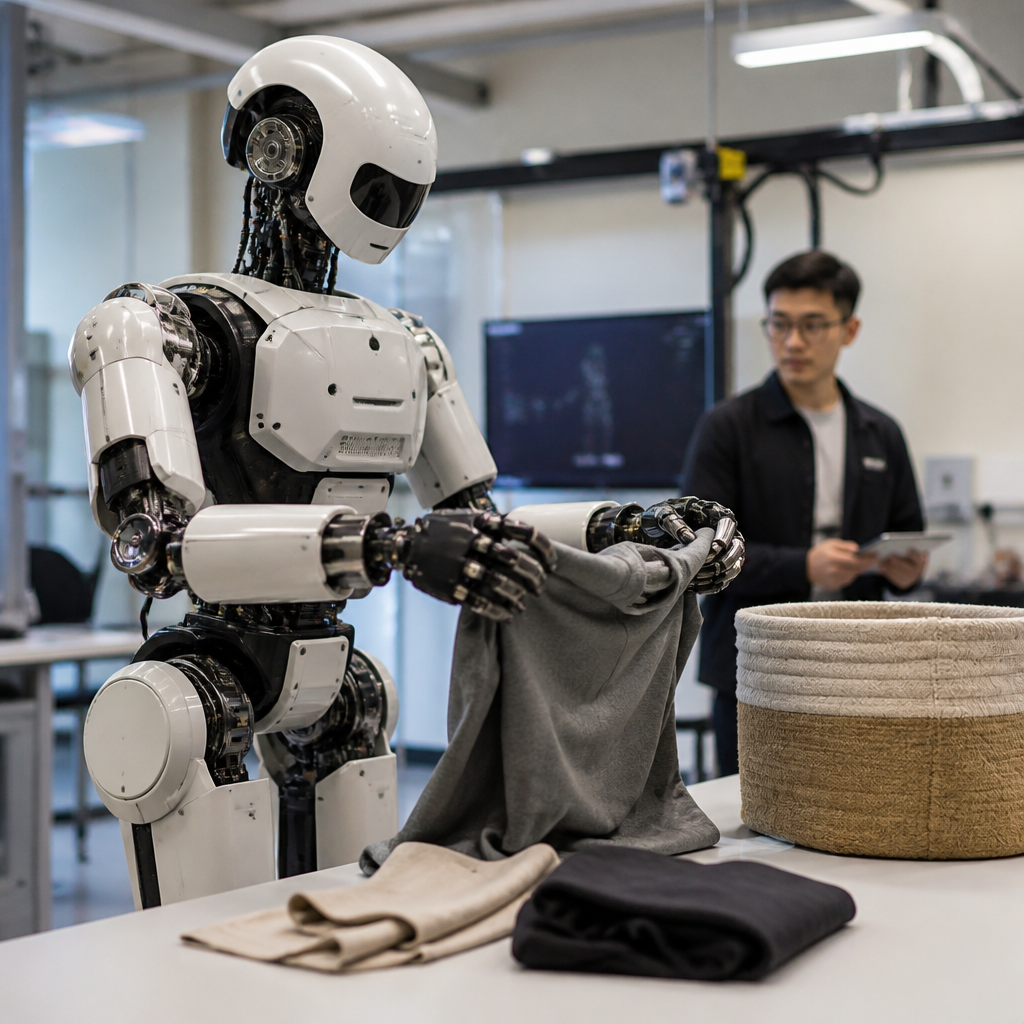
Humanoids make these challenges visible. They need bipedal balance, whole-body coordination, hand manipulation, and scene understanding at once. Companies such as Figure, Apptronik, and Agility Robotics emphasize generality because a humanoid is only commercially defensible if it can perform many workflows in spaces built for people. That requires foundation-model thinking, not narrow scripting.
Where Robot Foundation Models Are Already Showing Value
The near-term wins are appearing in warehouses, manufacturing support, inspection, and mobile service robotics. Covariant has shown how broad picking policies help warehouse automation handle SKU diversity. Google’s RT-series research demonstrated robots interpreting natural language commands and transferring visual-semantic knowledge into action selection. NVIDIA’s robotics stack links simulation, synthetic data, and policy training, making it easier for developers to test embodied AI workflows before touching expensive hardware.
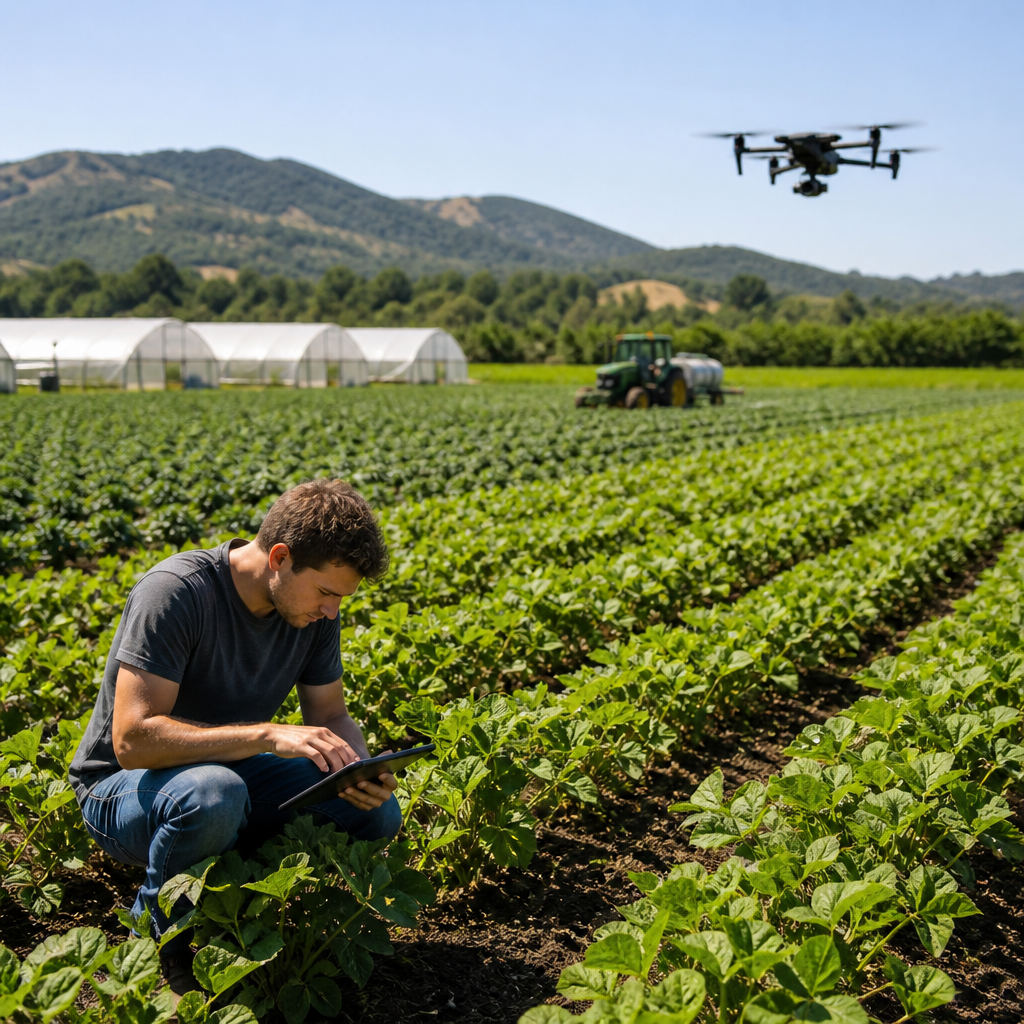
Outside manipulation, autonomous mobile robots benefit from generalized scene understanding and recovery behaviors. In hospitals, a delivery robot must reroute around carts, visitors, and temporary room closures. In agriculture, robots need to identify fruit readiness, branch occlusion, and terrain changes. In industrial inspection, drones and quadrupeds use multimodal models to detect anomalies from thermal, visual, and depth data while following mission constraints.
The practical pattern is consistent: general models handle variation better, but they still need task-specific wrappers, safety layers, and operational tooling. No serious deployment team skips calibration, monitoring, fallback states, or human override.
Limits, Risks, and What Startups Must Get Right
Robot foundation models are powerful, but they are not plug-and-play intelligence. Reliability remains the hardest hurdle. Success rates that look impressive in research can still fail commercial thresholds when a system must work all day across lighting changes, wear, network latency, and human interference. Safety certification is another barrier, especially in collaborative settings governed by standards such as ISO 10218 and ISO/TS 15066.
Startups also face hard economics. Compute for training large multimodal models is expensive, and robot data infrastructure is even more specialized than standard machine learning pipelines. Teams need synchronized logging, calibration management, rollout review tools, and retraining workflows that connect software updates to hardware behavior. The winners will likely be companies that treat deployment as a continuous systems-engineering discipline, not a one-time model release.
For founders and operators, the clearest takeaway is simple: robot foundation models matter because they turn physical AI and robotics from a collection of bespoke automations into a scalable learning platform. The strongest systems combine broad data, multimodal models, classical robotics, and rigorous safety engineering. They will not replace every specialized controller, but they will become the coordination layer that gives machines reusable skills across tasks and environments.
As this hub for Physical AI & Robotics grows, use it as your starting point for deeper topics such as humanoid robotics, warehouse automation, robot simulation, embodied AI startups, and industrial safety. Watch the companies that can collect better data, generalize across embodiments, and prove dependable uptime in the real world. That is where general-purpose machine skill becomes commercial reality.
Frequently Asked Questions
What is a robot foundation model, and how is it different from traditional robot programming?
A robot foundation model is a large AI model trained on many different kinds of data so a machine can learn broad, reusable capabilities instead of mastering only one tightly defined behavior. In robotics, that training data can include video, natural-language instructions, sensor readings, robot control logs, simulation rollouts, and demonstrations of people or robots completing tasks. The goal is not just to memorize one procedure, but to build a general understanding of how actions, objects, environments, and goals relate to one another in the physical world.
That is very different from traditional robot programming, where engineers often hand-code rules or train separate task-specific policies for each job. In older workflows, one model might be built for grasping, another for navigation, and another for inspection, with each system requiring extensive tuning when the environment changes. Robot foundation models aim to reduce that fragmentation. A single adaptable system can potentially interpret a new instruction, recognize an unfamiliar setting, and apply prior knowledge to solve a task it was not explicitly programmed for in exactly that form.
In practical terms, this shift matters because real-world robotics is messy. Warehouses change layouts, household objects vary in shape and texture, and industrial conditions are rarely identical from one day to the next. A foundation model gives robots a broader prior understanding, making them more resilient when the task, hardware, or setting changes. Instead of starting from scratch each time, teams can fine-tune or prompt a general-purpose model, which can dramatically speed up deployment and improve flexibility.
Why are robot foundation models considered important for general-purpose physical AI?
Robot foundation models are important because they move robotics closer to general-purpose physical intelligence rather than narrow automation. For years, robots have been very effective in controlled environments where every object, motion path, and safety condition is carefully defined. The challenge has been getting machines to operate reliably when tasks become varied, instructions are open-ended, or environments are unpredictable. Foundation models address that challenge by learning from diverse experiences and transferring that knowledge across situations.
This matters because most valuable real-world use cases are not repetitive in the same way a factory welding cell is repetitive. A home robot may need to tidy, retrieve, open, sort, and assist. A warehouse robot may need to pick items it has never seen before, reroute around people, and adapt to changes in shelving. A field robot may inspect equipment under different weather, lighting, and terrain conditions. A model trained on broad multimodal data can connect visual cues, language goals, and motor actions in a way that supports this kind of flexibility.
Foundation models also improve the economics of robotics development. Instead of building and maintaining isolated systems for every new workflow, teams can reuse a common model backbone and adapt it to multiple applications. That can lower training costs, shorten iteration cycles, and make it easier to scale robot deployments across sites and tasks. In that sense, robot foundation models are not just a research milestone; they are becoming a strategic platform for how physical AI systems are built, updated, and expanded.
What kinds of data are used to train robot foundation models?
Robot foundation models are trained on a rich mixture of data sources because no single type of information is enough to teach robust physical behavior. Visual data such as videos and images help models understand scenes, objects, motion, and human demonstrations. Text data provides semantic grounding, allowing a robot to connect instructions like “pick up the blue container” or “inspect the left panel for damage” with physical actions. Sensor data, including force feedback, joint states, tactile input, depth maps, and inertial readings, gives the model a more complete view of how the world feels and responds during interaction.
Control logs and teleoperation traces are also essential. These records show what actions were taken by a robot or a human operator and what outcomes followed, helping the model learn action consequences over time. Robot demonstrations can come from scripted tasks, human-guided manipulation, or remote operation, each contributing examples of how to solve practical problems. Simulation data is another major component because it allows teams to generate huge numbers of safe, inexpensive training scenarios that would be slow or risky to collect in the physical world.
The reason this diversity matters is that robot intelligence is fundamentally multimodal. A capable machine must combine perception, language, action, and feedback into a unified understanding. For example, folding a towel is not just a vision problem or just a control problem. It requires recognizing cloth state, interpreting the task goal, predicting how the fabric will move, and adjusting grip and force in real time. Broad training data helps foundation models form these cross-domain connections, which is why they can generalize better than systems trained on a narrow stream of examples.
Can a robot foundation model really generalize across tasks, environments, and hardware?
Yes, that is the core promise of robot foundation models, but it is important to be precise about what “generalize” means. These models are designed to transfer knowledge across related tasks and conditions rather than being magically competent at everything. A robot foundation model may learn shared concepts such as grasp stability, obstacle avoidance, object permanence, spatial relationships, and action sequencing. That common knowledge can then support many downstream tasks, from picking and placing to opening doors, sorting items, or performing simple inspections.
Generalization across environments means the robot can handle variation without requiring a full retraining cycle every time something changes. If lighting is different, a shelf layout shifts, or the object category is slightly unfamiliar, a strong foundation model may still perform well because it has seen a wide range of examples during training. Generalization across hardware is more challenging, but researchers are making progress by training models that represent actions and observations in ways that can transfer between robot arms, mobile platforms, and grippers with different physical characteristics.
That said, generalization is not unlimited. Real-world deployment still requires adaptation, evaluation, and safeguards. A model may transfer well between similar manipulation platforms but struggle when moved to a robot with very different kinematics or sensing. It may do well in simulation-rich domains yet need additional fine-tuning for cluttered, safety-critical physical settings. The big advantage is not perfection out of the box; it is that teams can start from a powerful general base, then specialize more efficiently than they could with a narrow, single-task system.
What are the biggest challenges and limitations of robot foundation models today?
The biggest challenge is that physical intelligence is harder than digital intelligence because mistakes happen in the real world. A language model can generate a wrong sentence with limited consequences, but a robot can drop an object, damage equipment, or create a safety hazard. That means robot foundation models must be judged not only on flexibility and generalization, but also on reliability, controllability, and safe behavior under uncertainty. Building that level of trust remains one of the field’s toughest hurdles.
Data quality and data collection are also major constraints. Robotics data is expensive to gather, especially high-quality demonstrations tied to rich sensory inputs and successful task outcomes. Unlike internet text, physical interaction data often requires hardware, supervision, labeling, and maintenance. There is also a simulation-to-reality gap: models can learn a lot in simulation, but not every physical nuance transfers cleanly to the real world, especially when contact dynamics, deformable materials, or edge cases are involved.
Another limitation is compute and deployment complexity. Large models can be resource-intensive to train and run, which creates challenges for real-time control on embedded robotic systems. Teams must often balance model size, latency, accuracy, and onboard hardware limits. Finally, there are open questions around benchmarking, interpretability, and standards. The field still needs better ways to measure broad robot competence, compare systems fairly, and understand why a model succeeds or fails. Even with these challenges, the trajectory is clear: robot foundation models are becoming a central approach for teaching machines general-purpose skills, and each improvement brings physical AI closer to practical, scalable use.