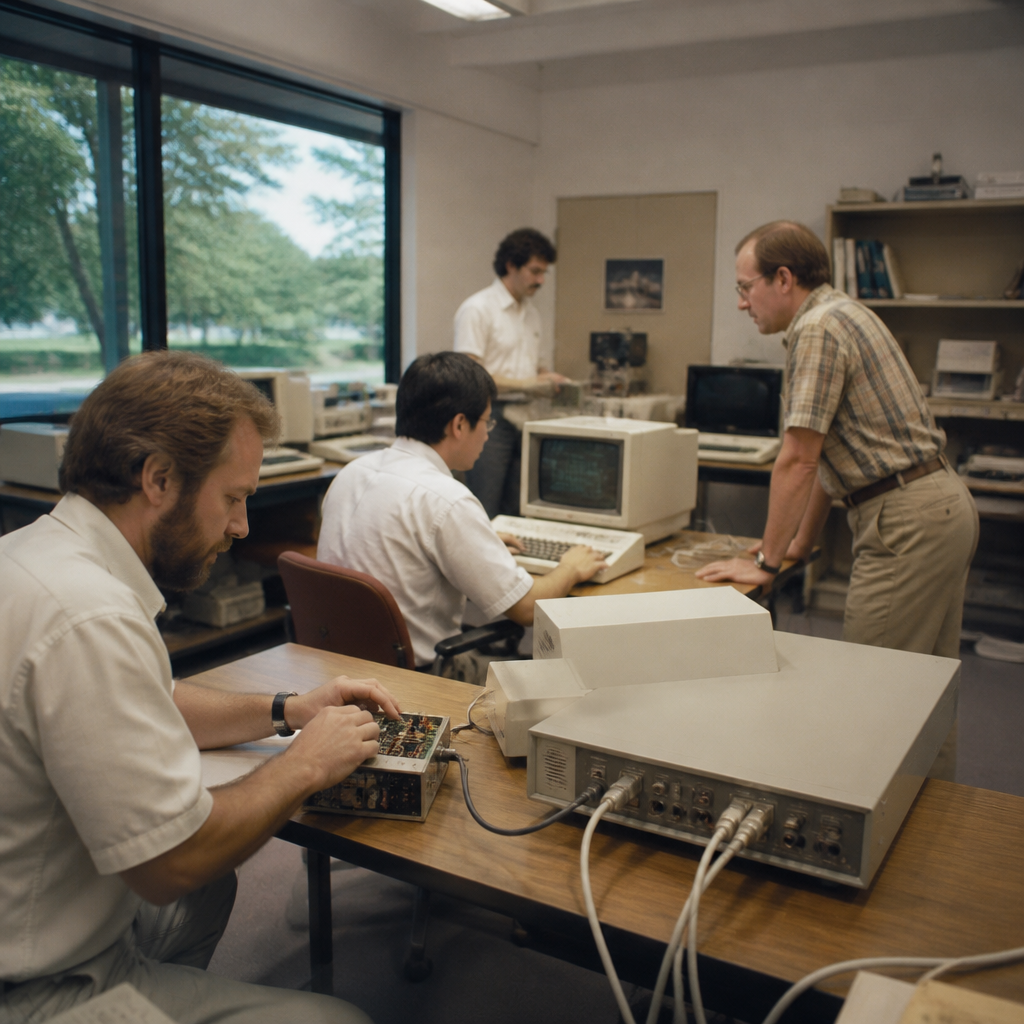
Ethernet at Xerox PARC began as a practical fix for a messy office problem and grew into the dominant language of local networking worldwide. In the early 1970s, researchers at Xerox Palo Alto Research Center were building the Alto, laser printers, and file servers, and they needed those machines to share data quickly inside one building. Existing communications systems were expensive, centralized, and poorly suited to dozens of small computers talking at once. Ethernet answered that need with a simple idea: connect devices on a shared medium, let them transmit in packets, and recover gracefully when two speak at the same time. That design solved a local problem, but it also established principles that shaped modern computing, storage, and internet infrastructure.
To understand why Ethernet matters, define a few terms clearly. A local area network, or LAN, links devices across a limited physical space such as an office, campus, or factory. A packet is a structured unit of data sent across that network. Media access control determines how devices take turns using the same cable or radio spectrum. Interoperability means equipment from different vendors can communicate reliably because they follow the same standard. Ethernet’s importance lies in combining these concepts into a system that was cheap enough to deploy broadly, robust enough for business use, and flexible enough to improve across generations without breaking the basic model. I have worked with networks from coaxial Ethernet through switched gigabit deployments, and that continuity is striking: the frame format, MAC addressing, and layered design still connect current systems to PARC’s original insight.
This historical perspective also serves as a hub for the broader story of computing, storage, and the internet. Local networking changed personal computing because standalone machines became collaborative tools. It changed storage because file servers, network-attached storage, and later storage area technologies depended on fast, reliable links. It changed the internet because routers, servers, and data centers ultimately relied on Ethernet as their internal fabric. If you want to understand why modern offices, cloud platforms, and home broadband equipment work the way they do, Ethernet is one of the foundational threads. Its development at Xerox PARC shows how research prototypes can become standards, standards can become ecosystems, and ecosystems can reshape the technical and economic direction of the entire industry.
Why Xerox PARC Needed a New Kind of Network
Xerox PARC was not trying to invent a global standard for its own sake. It was trying to make a new style of office computing usable. The Alto workstation, introduced in 1973, offered a graphical interface, bitmapped display, mouse input, and document-centric workflows that were years ahead of mainstream commercial systems. Those capabilities created demand for shared resources: printers had to receive page images, users needed access to common file repositories, and software developers wanted machines that could exchange code and messages rapidly. Mainframe-era terminals relied on centralized host connections, but PARC’s environment was distributed. The network needed to support peer-to-peer traffic, high throughput for the time, and easy attachment of many devices.
Robert Metcalfe, drawing on his doctoral work and concepts related to packet radio networks such as ALOHAnet, helped formulate the approach. The crucial adaptation was to make a shared wired network practical in an office. Unlike radio, a cable offered a more controlled medium, but collisions still occurred when two stations transmitted simultaneously. Ethernet handled this with carrier sense multiple access with collision detection, usually shortened to CSMA/CD. Each device listened before sending, transmitted only if the line appeared idle, detected collisions, then stopped and retried after a randomized backoff interval. That mechanism sounds modest today, but it was elegant engineering: decentralized, inexpensive, and effective for bursty traffic generated by office systems.
How Early Ethernet Worked in Practice
The first experimental Ethernet ran at 2.94 megabits per second over thick coaxial cable. Devices attached to the cable and shared the same broadcast medium, meaning every frame was visible to all stations, though only the intended recipient would process it fully. Ethernet frames carried source and destination MAC addresses, a type field, payload data, and error-checking information through a frame check sequence. This packaging made the network general-purpose. It did not care whether the payload represented a file transfer, printer job, remote login session, or later an internet packet. That neutrality became one of Ethernet’s great strengths, because the same transport could support many higher-level protocols over time.
In the systems I have maintained, the practical lesson from classic shared Ethernet is that simplicity lowers deployment friction. A single cable segment was easy to understand, and the frame model was stable even as physical media evolved. Early Ethernet did have tradeoffs. Shared bandwidth meant performance could degrade under heavy contention. Cable faults could disrupt multiple devices. Distance limits mattered. Even so, for offices and labs, the economics were compelling compared with proprietary networking alternatives. Cheap interfaces, straightforward troubleshooting, and protocol independence made Ethernet attractive to organizations that wanted networking without committing to one computer vendor’s entire stack.
From PARC Prototype to Open Standard
Ethernet became globally important only after it escaped the lab. In 1980, Xerox, Digital Equipment Corporation, and Intel published the DIX Ethernet specification, a decisive step that gave manufacturers a concrete implementation target. Standardization followed through the IEEE 802.3 working group, which formalized Ethernet for broad industry adoption. This transition mattered as much as the original invention. Many good technologies fail because they remain proprietary or underspecified. Ethernet succeeded because vendors could build compatible network interface cards, repeaters, transceivers, and management tools at scale.
The standardization process introduced discipline around frame formats, signaling methods, media types, and conformance testing. It also created room for evolution. Thicknet gave way to thinnet, then twisted-pair cabling such as 10BASE-T, which moved Ethernet from a linear bus topology to star-wired hubs and eventually switches. Fiber variants extended reach and increased bandwidth. Speeds rose from 10 megabits per second to 100 megabits, 1 gigabit, 10 gigabits, 40, 100, 400, and beyond. Throughout these transitions, Ethernet preserved enough backward compatibility to protect investment while delivering better performance. That balance between continuity and change is one reason it displaced competing LAN technologies including Token Ring, ARCNET, and FDDI.
Why Ethernet Won Against Rival LAN Technologies
Ethernet did not become dominant because it was the only option. It won because its total system advantages compounded over time.
| Technology | Core Approach | Strength | Limitation | Why Ethernet Prevailed |
|---|---|---|---|---|
| Ethernet | Shared or switched packet LAN | Low cost, flexible, widely standardized | Early shared media contention | Cheap components and rapid speed upgrades |
| Token Ring | Token passing in a logical ring | Predictable access under load | Higher cost and vendor concentration | Ethernet became faster and simpler to manage |
| FDDI | Dual fiber ring | High reliability and long distance | Expensive deployment | Switched fiber Ethernet delivered similar benefits cheaper |
| ARCNET | Token-based LAN | Early simplicity | Limited ecosystem and lower long-term performance | Ethernet attracted broader vendor support |
By the 1990s, switching eliminated most collision-related drawbacks by giving each device a dedicated link to a switch port. Full-duplex operation meant simultaneous send and receive with no CSMA/CD on that link. Once switched Ethernet matured, many theoretical advantages of token-based systems stopped mattering in ordinary business networks. At the same time, semiconductor volume pushed Ethernet interface costs down dramatically. That price-performance curve was decisive. Network managers could buy faster ports, mix vendors, and expand incrementally. Standards plus economies of scale beat architectural elegance alone.
How Ethernet Reshaped Computing, Storage, and the Internet
Ethernet’s broadest impact is visible in the way it linked three domains that are often discussed separately. In computing, it enabled distributed client-server architectures, departmental servers, collaborative software, and eventually virtualization clusters. In storage, it carried network file protocols such as NFS and SMB, supported backup over LANs, and later underpinned iSCSI and many converged data center designs. In internet infrastructure, Ethernet became the default way to connect hosts to routers, connect servers inside facilities, and build the leaf-spine fabrics behind cloud services. Even when wide-area links use different transport technologies, the edge and interior of most digital environments still speak Ethernet.
Consider a concrete example. A modern office laptop connects by Ethernet or Wi-Fi to a switch, reaches a file server or cloud gateway, authenticates to directory services, and accesses documents stored on networked systems. In a data center, racks of servers connect through top-of-rack or leaf switches using high-speed Ethernet optics; storage traffic, east-west application traffic, and virtual machine migrations all traverse that fabric. Internet companies from Amazon to Google have long depended on Ethernet inside their facilities because it is modular, automatable, and supported by a vast supply chain. The direct line from PARC’s office printer problem to hyperscale networking is not rhetorical. It is technical and historical fact.
The Lasting Lessons from Xerox PARC
Ethernet at Xerox PARC matters because it demonstrates how enduring standards emerge. The original design solved a real user need, not an abstract benchmark. It was packet-based, layered, and media-agnostic enough to outlive its first cabling. It moved from research environment to open specification, then to formal standard, giving the industry confidence to invest. And it improved continuously: hubs to switches, copper to fiber, megabits to hundreds of gigabits, office LANs to cloud fabrics. Few technologies maintain relevance across so many eras without losing their conceptual identity.
For anyone exploring historical perspectives in computing, storage, and internet development, Ethernet is an essential hub topic because it connects invention, standardization, economics, and infrastructure in one story. The key takeaway is simple: local networking became a global standard when a practical, interoperable design met open adoption and relentless iteration. That pattern still shapes modern technology markets. To go deeper, use this article as your starting point for related histories on personal computing, file systems, enterprise networking, and the architecture of the internet itself.
Frequently Asked Questions
What problem was Ethernet originally created to solve at Xerox PARC?
Ethernet was created to solve a very specific and very practical office problem inside Xerox PARC in the early 1970s. Researchers there were developing advanced personal workstations such as the Alto, along with laser printers and shared file servers, and they needed all of those machines to exchange data rapidly within the same building. At the time, most communications systems were built around centralized mainframes or expensive point-to-point links. Those approaches worked poorly in an environment where many independent computers needed to send short bursts of data whenever they wanted, rather than waiting their turn in a rigid hierarchy. PARC needed something cheaper, faster, and far more flexible for local communication.
Ethernet answered that need by introducing a shared local network that allowed multiple devices to use the same communication medium. Instead of requiring a dedicated connection between every machine, Ethernet let many devices attach to one network and communicate efficiently across it. That design dramatically reduced complexity while supporting the collaborative, distributed style of computing that PARC researchers were pioneering. In other words, Ethernet was not invented as an abstract theory first and a product second. It emerged because the existing networking options did not match the way modern office computers were beginning to work together.
How did Ethernet work in its earliest form at Xerox PARC?
Early Ethernet used a shared cable as a common channel that every connected machine could listen to and transmit on. The fundamental idea was simple but powerful: any device could send data when the line appeared clear, which made the system far more decentralized than traditional communications networks of the era. If two machines happened to send at the same time, their signals would collide. Rather than making that a fatal flaw, Ethernet was designed to detect those collisions and recover from them automatically. This became known as carrier sense multiple access with collision detection, or CSMA/CD.
In practice, each machine first checked whether the cable was already in use. If it was idle, the machine transmitted. If a collision occurred, the devices involved stopped, waited for a brief randomized interval, and tried again. That random backoff was crucial because it prevented the same machines from colliding over and over in lockstep. For a busy office full of workstations, printers, and servers, this method proved remarkably effective. It was not perfect in the mathematical sense, but it was elegant, affordable, and well suited to bursty local traffic. That balance between simplicity and performance helped Ethernet succeed long before it became a formal global standard.
Why did Ethernet succeed over other networking technologies?
Ethernet succeeded because it combined technical practicality with economic realism. Many competing systems were either too specialized, too expensive, or too dependent on centralized control. Ethernet, by contrast, was modular and adaptable. It could be implemented using relatively straightforward hardware, it supported a growing number of devices on the same local network, and it fit naturally into office environments where computers needed to communicate frequently but unpredictably. It also scaled well enough for real-world use, which mattered more than theoretical perfection.
Another major reason for Ethernet’s success was standardization. What began as a Xerox PARC innovation eventually moved beyond one laboratory and one company. Collaboration among Xerox, DEC, and Intel helped define an early specification, and later IEEE standardization made Ethernet a stable, open framework that many vendors could build around. That open ecosystem was decisive. Once businesses could buy compatible equipment from multiple suppliers, Ethernet became less risky to adopt and easier to expand. Over time, faster versions of Ethernet appeared, but the core concept remained familiar enough that organizations could upgrade without replacing everything at once. That continuity helped Ethernet outlast rival local networking systems such as Token Ring and become the default language of wired networking worldwide.
What role did Xerox PARC play in turning Ethernet from an internal solution into a broader networking model?
Xerox PARC was the birthplace of Ethernet not just in the sense of invention, but in the sense of proving that the idea worked in a demanding real environment. PARC was not a theoretical lab isolated from practical needs. It was a place where experimental personal computers, networked printing, and shared digital resources were being used to support daily research work. That made it an ideal testing ground. Ethernet had to function under real load, with real users, and across a growing collection of devices. The success it demonstrated at PARC gave the technology credibility beyond the lab.
Just as important, PARC helped establish the conceptual model of local area networking itself. Ethernet showed that networking did not have to revolve around a single central computer. It could connect peers across an office, allowing distributed computing to flourish. As the design moved outward through technical papers, partnerships, and formal standards efforts, its principles became influential far beyond Xerox. In that sense, PARC’s contribution was twofold: it produced the original engineering solution and also showcased a new vision of how computers in workplaces could be connected. That vision became foundational to modern networking.
Why is Ethernet still important today if networking technology has changed so much since the 1970s?
Ethernet remains important because it evolved rather than disappeared. The original PARC-era versions were built for one building and modest data rates, but the underlying framework proved flexible enough to support decades of growth. Ethernet moved from shared coaxial cable to twisted-pair wiring, from hubs to switches, and from megabit speeds to gigabit, multi-gigabit, and far higher rates in enterprise and data center environments. While many of the implementation details changed, the broad compatibility and familiar operating model gave Ethernet extraordinary staying power.
Its importance also comes from how deeply it shaped the infrastructure of digital communication. Ethernet became the standard way to connect desktops, servers, printers, wireless access points, industrial systems, and countless other devices. Even when users rely on Wi-Fi, the wireless network usually connects back into a wired Ethernet backbone somewhere behind the scenes. In businesses, campuses, factories, and data centers, Ethernet remains the trusted foundation because it is reliable, widely supported, and continuously updated through standards development. The story that began at Xerox PARC matters today precisely because it shows how a local fix for an office networking problem became one of the most durable and universal technologies in modern computing.