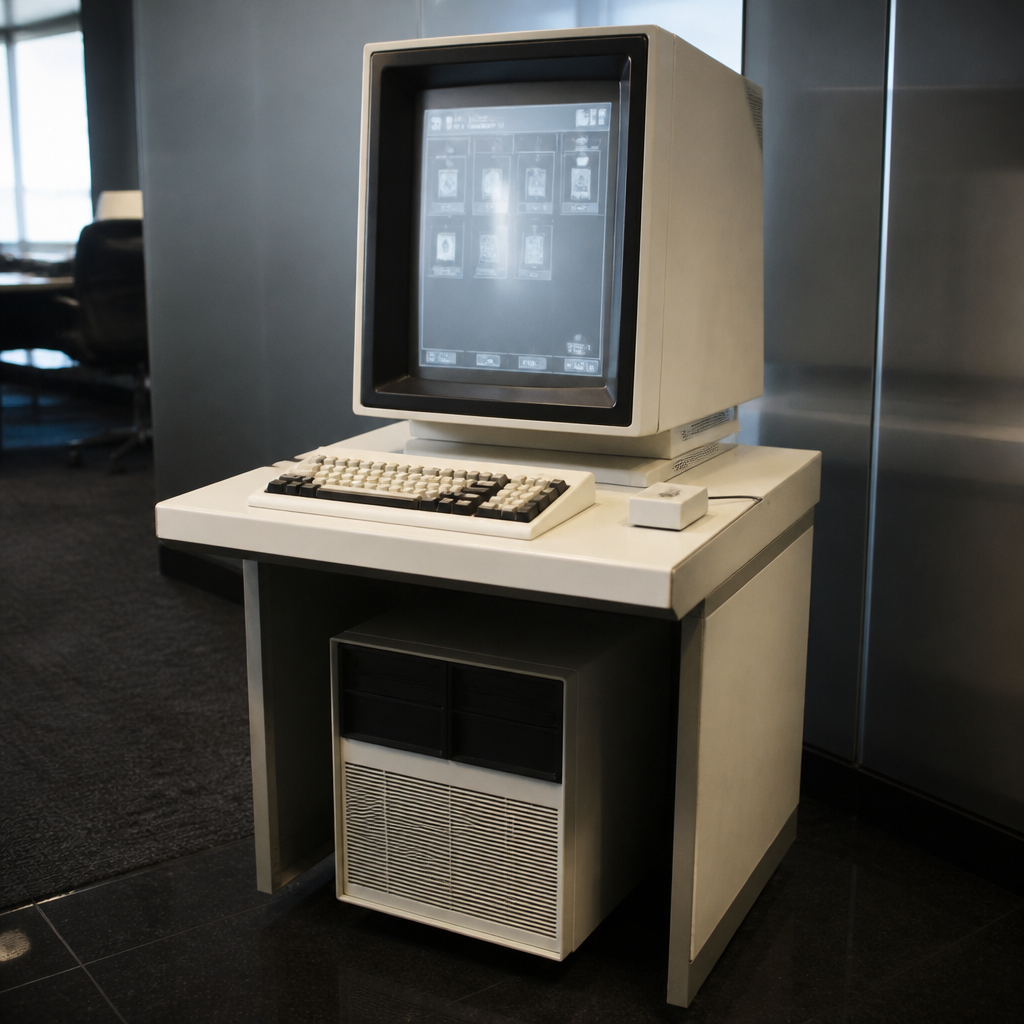
The Xerox Alto stands as one of the most important computers most people never used, because it introduced a practical model for personal computing years before the mainstream market caught up. First built in 1973 at Xerox PARC, the Alto brought together a bitmap display, a mouse, overlapping windows, networked file sharing, and document-centric software in one working system. When people talk about the origins of the graphical user interface, they often jump straight to the Apple Macintosh or Microsoft Windows, but the Alto is where many of the ideas were proven in daily use. For anyone studying computing, storage, and internet history, this machine is a central hub because it connects advances in hardware design, user interfaces, local networking, printing, and collaborative work.
To understand why the Xerox Alto matters, it helps to define a few terms clearly. A graphical user interface, or GUI, is a way of interacting with a computer through visual elements such as windows, icons, menus, and pointers instead of typing every command at a text prompt. A bitmap display means the screen is addressed as individual pixels, allowing flexible graphics and mixed text and images rather than fixed character cells. Ethernet, another PARC innovation closely tied to the Alto, is a local area networking method that let machines share files, printers, and messages over coaxial cable. In practical terms, the Alto was not just a computer with a screen; it was an integrated workstation designed for interactive office computing.
I have spent years working through early workstation documentation, software histories, and surviving demonstrations, and the Alto consistently stands out because it was not a speculative prototype. Researchers, programmers, and administrative staff actually used it for writing, illustrating, email, programming, and printing. That distinction matters. Many machines can claim to be first in one narrow feature, but the Alto combined several breakthroughs into a usable environment. It showed that personal computing could be visual, networked, document-focused, and collaborative. That combination shaped later systems across the computing, storage, and internet stack, which is why this article serves naturally as a hub within Historical Perspectives.
What the Xerox Alto Was and Why 1973 Changed Computing
The Xerox Alto was developed at Xerox Palo Alto Research Center, known as PARC, beginning in 1973 under the influence of researchers including Butler Lampson, Charles Thacker, Alan Kay, and others. It was never sold as a mass-market product in the way later personal computers were. Instead, roughly two thousand units were built for Xerox labs, universities, and select organizations. Yet its influence far exceeded its distribution because it demonstrated an entire model of modern computing before the commercial ecosystem was ready for it. In one machine, the Alto answered questions the industry had barely begun asking: What if every worker had a display workstation? What if documents looked on screen like they would on paper? What if computers were connected by default?
Technically, the Alto used a microcoded design with a custom central processor architecture rather than a single off-the-shelf CPU. It typically included 128 KB to 512 KB of RAM depending on configuration, a removable disk cartridge, a vertical portrait-oriented display of about 606 by 808 pixels, a three-button mouse, and a chorded keyset on some systems. The portrait screen was a practical choice for document work because it resembled a printed page. This mattered for office computing, especially at Xerox, where the larger strategic goal involved the future of documents, publishing, and networked knowledge work. The Alto therefore sits at the intersection of computing and storage history: it treated digital files as active office documents, not merely numeric data or programming artifacts.
The timing also matters. In 1973, most people still associated computing with batch processing, time-sharing terminals, and command-line interaction. Mainframes and minicomputers dominated organizations, while hobbyist personal computers had not yet emerged. The Alto challenged that structure by putting computational power, display output, storage, and networking at the individual desk. This workstation model did not immediately win commercially, but it set expectations later fulfilled by the Lisa, Macintosh, Sun workstations, and eventually Windows PCs connected through office networks and the internet.
The Alto’s Interface: Bitmap Graphics, Windows, and the Mouse
The Alto helped define the GUI era because it proved that visual interaction could be efficient for serious work, not just novel. Its bitmap screen allowed software developers to render proportional fonts, line drawings, icons, and page layouts directly in memory. That flexibility enabled applications that felt far more natural than text-only interfaces. Users could point at objects with a mouse, select commands from pop-up menus, edit documents on screen, and move among different tasks in windows. Not every Alto program looked like later desktop systems, and the Alto did not invent every interface concept from scratch, but it created a working environment where these ideas became routine.
One of the clearest examples was Bravo, often described as the first true what-you-see-is-what-you-get document editor. In Bravo, text formatting such as margins, fonts, and layout appeared on screen much as they would print. That seems obvious now, but at the time it was transformational. Another example was Draw, which supported on-screen illustration and manipulation of graphical objects. Smalltalk, developed in the PARC environment, went even further by advancing overlapping windows, object-oriented programming, and direct manipulation concepts that deeply influenced later interface design. Across these systems, the Alto demonstrated that pixels, pointing, and visual hierarchy were not luxuries; they were productivity tools.
The mouse deserves special attention because the Alto normalized it in everyday work. Douglas Engelbart had demonstrated a mouse earlier in the 1968 “Mother of All Demos,” but PARC integrated pointing into a broader software ecosystem where it solved daily interaction problems. That is an important historical distinction. Technologies become influential when they fit workflows. On the Alto, selecting text, activating commands, and navigating graphics with a mouse was faster for many tasks than memorizing command syntax. Apple later translated these lessons into a consumer-friendly product strategy, while Microsoft expanded them across a mass software platform.
Storage, Networking, and the Foundations of Connected Computing
The Alto is equally important in storage and internet history because it was designed as a networked node, not an isolated box. Its removable disk packs supported local file work, but the more significant story was how Altos interacted through Ethernet. PARC researchers including Robert Metcalfe and David Boggs developed Ethernet in the 1970s to link Alto systems, file servers, and laser printers across buildings. This created a shared environment for distributed computing. Users could access remote resources, send messages, and collaborate in ways that foreshadowed later office networks and, at a broader scale, internet culture.
Before connected personal computing became normal, the Alto environment showed why local networking mattered. File servers reduced duplication and improved access to shared documents. Network printing made high-quality output available to many users from one device. Electronic mail inside the PARC ecosystem changed communication speed and work coordination. In modern terms, the Alto anticipated a client-server office, where the personal workstation handled interface-heavy tasks while shared infrastructure handled storage and output. That model remains visible today in cloud software, shared drives, and managed print services, even though the underlying technologies are very different.
| Capability | Alto Era Example | Modern Equivalent |
|---|---|---|
| Bitmap document editing | Bravo on Alto | Word, Google Docs, Pages |
| Shared local networking | Ethernet between Altos | Office LAN and Wi-Fi |
| Network file access | PARC file servers | NAS, SharePoint, cloud drives |
| High-quality shared output | Laser printer integration | Network printers and PDF workflows |
| Graphical development environment | Smalltalk tools | IDEs with visual interfaces |
The laser printing link is especially important. PARC paired the Alto with early laser printers and page-description workflows, laying groundwork for desktop publishing. This was more than a convenience feature. It connected computation, storage, networking, and physical output into one information system. Once users could create, revise, store, transmit, and print rich documents within a connected environment, office work changed permanently.
Why the Alto Did Not Dominate the Market but Still Shaped It
If the Alto was so advanced, why did it not become the standard personal computer of the 1970s? The short answer is that research success does not automatically produce commercial success. Xerox viewed PARC as a research organization, not a consumer computer division. Alto hardware was expensive, specialized, and built in relatively small numbers. Its software was powerful but often designed for technically sophisticated users in research settings. Turning that environment into a broadly marketable product would have required lower costs, clearer packaging, stronger distribution, and executive commitment that Xerox did not fully provide.
Xerox did attempt commercialization through the Xerox Star, introduced in 1981. The Star carried forward many PARC ideas, including icons, folders, networking, and document-centric interaction. However, it was costly and targeted at enterprise customers. Apple, after visiting PARC in 1979, adapted key concepts into the Lisa and then the far more influential Macintosh. Microsoft subsequently generalized GUI ideas for a huge third-party hardware ecosystem with Windows. The lesson is not that Xerox failed to innovate. It is that innovation, product strategy, pricing, developer ecosystems, and timing all matter equally in computing history.
The Alto’s influence therefore spread indirectly. Many computer scientists trained on or inspired by PARC carried its ideas into later companies and standards. Ethernet became a foundational networking technology. WYSIWYG editing became normal across office software. Mouse-driven interfaces became expected. Object-oriented programming tools matured. Even concepts around collaborative digital work, versioned documents, and shared resources trace a line back to environments the Alto helped make practical. In that sense, the Alto was less a product category winner than a blueprint for the industry that followed.
The Xerox Alto’s Lasting Legacy in Computing, Storage, and Internet History
The Xerox Alto matters today because it shows how major technological eras are often defined before they are commercialized. Long before homes filled with PCs and offices connected through Ethernet and the internet, the Alto demonstrated what that future could look like. It integrated computing power, visual interaction, local storage, shared networks, file servers, electronic mail, and high-resolution printing into a coherent daily workflow. That is why it belongs at the center of any historical perspective on computing, storage, and internet development.
The key takeaway is simple: the Alto did not merely inspire the GUI; it validated an entire model of personal, connected, document-based computing. Later systems made those ideas cheaper, simpler, and more scalable, but the conceptual leap was already there in 1973. If you are exploring Historical Perspectives, use the Alto as your anchor point. From here, the next useful step is to dive deeper into Ethernet, early laser printing, the Xerox Star, the Macintosh, and the rise of networked office software.
Frequently Asked Questions
What made the Xerox Alto so revolutionary in 1973?
The Xerox Alto was revolutionary because it combined several ideas that had existed separately into one coherent, usable personal computing system. In 1973, most people interacted with computers through punch cards, text terminals, or batch processing systems that felt distant and impersonal. The Alto changed that model by giving one person direct control over a machine with a high-resolution bitmap display, a keyboard, and a mouse. Instead of treating the computer as a remote corporate resource, the Alto treated it as a personal workstation designed for everyday, hands-on use.
What truly set it apart was not just one feature, but the way its features worked together. The bitmap screen allowed the computer to display text and graphics in flexible ways rather than being limited to fixed character grids. The mouse provided a practical pointing method that let users interact with on-screen elements more intuitively. The Alto also supported overlapping windows, document editing, graphical interfaces, and early networking through Ethernet, which was also developed at Xerox PARC. In effect, it introduced a realistic preview of modern desktop computing years before the consumer market was ready for it.
That is why historians often describe the Alto as less of an isolated experiment and more of a prototype for the future of personal computing. It did not merely suggest what computers could become; it showed that a graphical, networked, document-centered computing environment could actually work in practice.
Did the Xerox Alto invent the graphical user interface?
The answer is slightly more nuanced than a simple yes or no. The Xerox Alto did not create every underlying concept from scratch, because many interface ideas had earlier roots in research computing. For example, work by pioneers such as Douglas Engelbart explored the mouse, on-screen interaction, and new ways of managing information before the Alto appeared. However, the Alto was one of the first systems to bring these concepts together into a complete, practical environment that people could actually use for real work.
That distinction matters. The Alto helped define the graphical user interface as a functioning model rather than a loose collection of experimental ideas. Its use of windows, icons, menus, on-screen document editing, and mouse-driven interaction demonstrated that graphical computing could be efficient, productive, and understandable. It moved interface design away from purely textual command input and toward visual manipulation, which became a defining principle of later personal computers.
So while it is not perfectly accurate to say the Alto single-handedly invented the GUI, it is very accurate to say it was one of the foundational systems that shaped the GUI era. It provided the blueprint that later machines refined, simplified, and commercialized for a mass audience.
How did the Xerox Alto influence later computers like the Apple Lisa and Macintosh?
The Xerox Alto’s influence on later personal computers was profound, especially in the way it demonstrated how a computer could present information visually and interactively. Engineers and designers who saw PARC systems in action encountered a radically different model from the command-line systems that dominated the period. They saw windows, icons, mouse-based navigation, and document editing that felt much closer to modern computing than to the typical machines of the 1970s.
Apple is the most commonly discussed example because members of its team visited Xerox PARC and observed technologies that informed later Apple products. The Apple Lisa and Macintosh did not simply copy the Alto directly, but they clearly drew inspiration from the PARC vision of graphical computing. Apple’s contribution was to streamline and productize many of those ideas for broader use. The Lisa and Macintosh transformed research concepts into consumer-facing products with more polished software, more standardized interfaces, and stronger commercial execution.
Beyond Apple, the Alto’s influence extended into workstation design, office networking, digital publishing, and the broader expectation that computers should be visually interactive. Many of the assumptions people now make about desktop computing—clicking on things, moving windows around, editing documents on screen, sending files over a network, and treating the display as a flexible canvas—can be traced back in meaningful ways to the environment the Alto helped establish.
If the Xerox Alto was so advanced, why did it not become a mainstream commercial success?
The Xerox Alto was extraordinarily influential, but it was not designed as a mass-market consumer product in the way later personal computers were. It emerged from Xerox PARC as a research and development machine intended primarily for internal use, experimentation, and advanced office computing. That meant it was built in relatively small numbers, used largely by researchers and institutions, and never positioned for widespread retail adoption.
Cost was also a major factor. The Alto was expensive and sophisticated for its time, with hardware far beyond what the average home or small business user could afford in the 1970s. Even though its ideas were forward-looking, the broader ecosystem needed to support them was still immature. Mainstream software markets, consumer expectations, and low-cost manufacturing had not yet caught up to the vision PARC had created.
There is also the business question. Xerox was already dominant in copiers and office systems, and it did not move aggressively enough to turn the Alto into a defining commercial platform. In hindsight, that hesitation looks historic, because PARC had developed ideas that others would later commercialize more effectively. So the Alto’s limited market impact was not a sign of weak design; it was a consequence of timing, cost, and corporate strategy. Its legacy became larger than its sales.
Why does the Xerox Alto still matter in the history of computing today?
The Xerox Alto still matters because it marks a turning point in how computers were imagined and built. Before systems like the Alto, computing often meant specialized access, technical expertise, and text-based interaction. The Alto presented a different path: a computer designed around the user, the document, and the screen as a visual workspace. That shift helped redefine what personal computing could be.
Its importance also lies in how many core elements of modern computing it anticipated. The Alto showed the value of a graphical display, direct manipulation through a mouse, multiple windows, networked collaboration, and software built around creating and editing documents. Those are not minor historical footnotes. They are foundational expectations that still shape desktop and laptop experiences today, and they continue to influence tablets, design software, publishing tools, and collaborative work environments.
Perhaps most importantly, the Alto reminds us that technological revolutions do not always begin with mass-market products. Sometimes they begin in research labs where future possibilities are tested years before the public recognizes their significance. The Alto was one of those rare machines that made the future visible early. Even though most people never touched one, the world of computing they eventually inherited owed a great deal to what Xerox PARC had already proven possible in 1973.