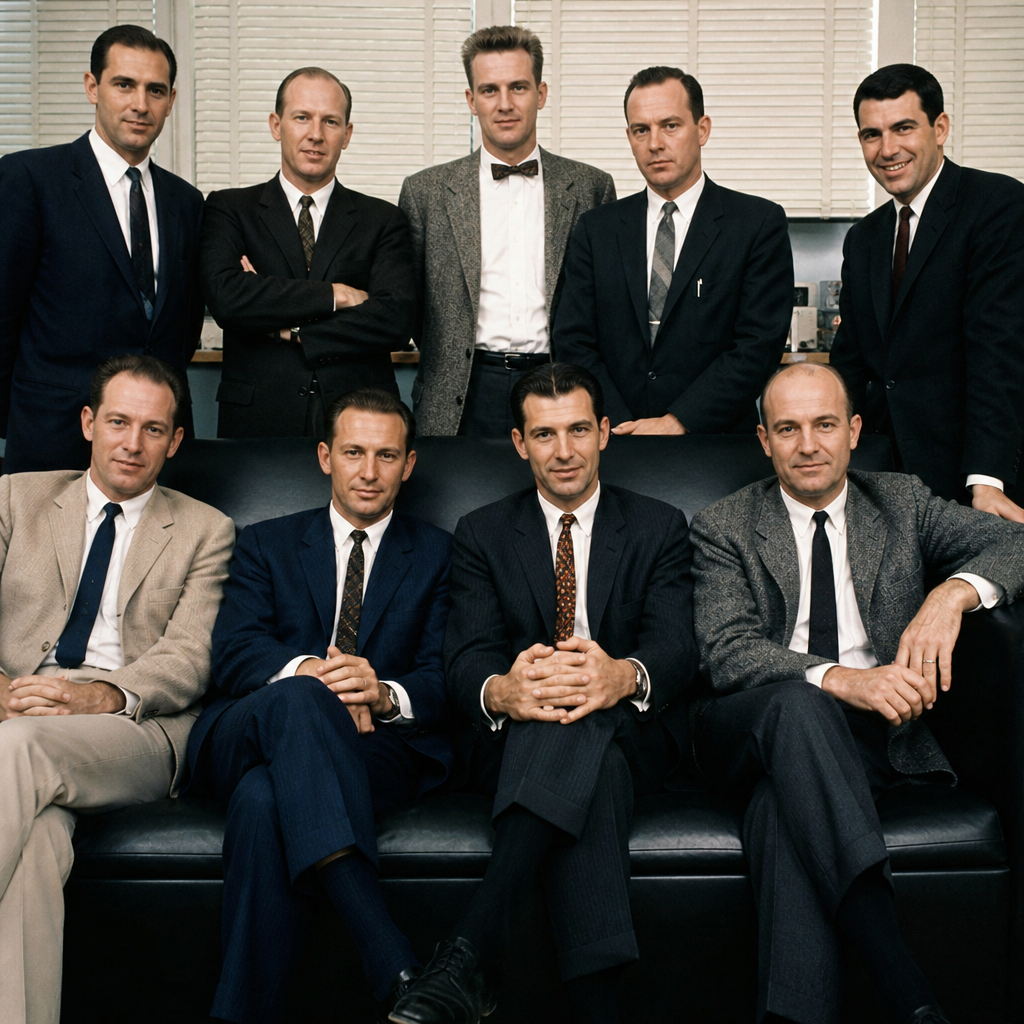
The Traitorous Eight were the group of young engineers and scientists who left William Shockley’s troubled laboratory in 1957 to create Fairchild Semiconductor, a company that became the seedbed of Silicon Valley and the launch point for modern semiconductor manufacturing. In semiconductor history, the phrase refers specifically to Julius Blank, Victor Grinich, Jean Hoerni, Eugene Kleiner, Jay Last, Gordon Moore, Robert Noyce, and Sheldon Roberts. Their break with Shockley was not a colorful side story; it was a structural turning point that reshaped how chips were designed, financed, manufactured, and commercialized. If you want to understand the semiconductor roots of today’s computing industry, you start here.
The key terms matter. Shockley Semiconductor Laboratory was the startup founded by Nobel Prize winner William Shockley in Mountain View, California. Fairchild Semiconductor was the company the eight formed with backing from Fairchild Camera and Instrument. Silicon Valley, before it became a global technology center, was a loose ecosystem of defense contractors, university talent, materials suppliers, and electronics pioneers concentrated around Stanford and the Santa Clara Valley. The “traitorous” label came from Shockley himself, who saw their departure as betrayal. History has judged the split differently: their exit unlocked better management, faster innovation, and a corporate lineage that produced Intel, Advanced Micro Devices, National Semiconductor, and dozens of other firms through what historians call the Fairchildren.
I have worked through enough semiconductor company histories to say this episode stands apart because it joins science, personality, finance, and manufacturing discipline in one decisive event. The eight were not simply rebels. They were process experts, device physicists, circuit thinkers, and production-minded engineers who recognized that technical brilliance could not compensate for destructive leadership. Shockley had co-invented the transistor at Bell Labs, but his management at his own company was erratic, secretive, and often counterproductive. Instead of focusing his team on practical silicon transistors, he became fixated on his four-layer diode and fostered distrust inside the lab. In an industry where yield learning, clean process control, and rapid iteration decide survival, that kind of environment is fatal.
Shockley Semiconductor and the Crisis That Drove the Split
To see why the Traitorous Eight matter, you need the context of 1950s semiconductor competition. Bell Labs had invented the transistor in 1947, but converting laboratory discovery into reliable mass production was still an open challenge. Texas Instruments was pushing commercial transistors. Bell alumni and military-funded firms were racing to improve germanium and silicon devices for radios, missiles, computers, and communications systems. Shockley returned to California to build a world-class semiconductor business near Palo Alto, recruiting unusually strong young talent. On paper, it was a dream team.
In practice, the laboratory struggled. Shockley was intellectually formidable, but he managed by suspicion and abrupt shifts in direction. Accounts from participants consistently describe loyalty tests, intrusive behavior, and a fixation on ideas that distracted from near-term market needs. Rather than building momentum around diffusion techniques and practical transistor lines, the company lost time. Engineers who could have become the core of a leading device manufacturer found themselves blocked by indecision and internal tension. For a field moving as quickly as semiconductors, delay meant irrelevance.
The crisis sharpened because the team knew they had something valuable: a concentration of talent capable of building better silicon devices than most competitors. They sought a solution short of revolt, even trying to replace Shockley with professional management. When that failed, they made the harder choice to leave together. That collective resignation was rare and risky. In 1957, there was no established venture capital machine waiting to fund defecting chip engineers. Their plan succeeded only because they found financial and legal support through Sherman Fairchild and the industrial structure of Fairchild Camera and Instrument.
Who the Eight Were and What Each Brought
The eight were not interchangeable. Robert Noyce was a physicist and natural leader who later co-invented the monolithic integrated circuit and helped define the open, fast-moving management style associated with early Silicon Valley. Gordon Moore was a chemist and physicist with deep process understanding; he later articulated Moore’s Law, the empirical observation that transistor density on integrated circuits rises on a predictable curve. Jean Hoerni was the brilliant Swiss physicist who invented the planar process, the manufacturing breakthrough that made reliable, scalable silicon devices possible.
Jay Last brought physics training and strong execution in transistor and integrated circuit development. Sheldon Roberts contributed metallurgical and semiconductor process expertise. Julius Blank was exceptional in equipment and manufacturing know-how, a crucial capability in an era when production tools often had to be designed or modified in-house. Victor Grinich focused on engineering and product development, later becoming known for his work in integrated electronics education. Eugene Kleiner combined engineering ability with business judgment and would eventually become a pivotal venture capitalist at Kleiner Perkins.
What united them was not ideology but competence. Semiconductor progress depends on a chain of interlocking disciplines: crystal growth, oxidation, diffusion, photolithography, metallization, packaging, testing, and yield improvement. Weakness in any link can derail a product line. The eight collectively covered those links unusually well for such a small team, which is why their departure had such outsized consequences.
Founding Fairchild Semiconductor and Building a Better Model
Fairchild Semiconductor began as the semiconductor division of Fairchild Camera and Instrument in 1957. The financing structure mattered. Sherman Fairchild gave the group a path to operate with far more autonomy than they had under Shockley, while still providing corporate backing, facilities, and access to customers. In effect, Fairchild created one of the first templates for scaling a semiconductor startup: recruit elite technical founders, pair them with capital, and let product execution drive growth.
What changed immediately was managerial climate. Fairchild’s culture was not perfect, but it was more collaborative, more commercial, and more realistic about what the market wanted. The company concentrated on silicon mesa transistors and then moved toward the planar transistor. This sounds like a technical distinction, but it was commercially decisive. Mesa structures exposed junction edges and were harder to protect. Hoerni’s planar process used silicon dioxide passivation, allowing more stable devices and paving the way for photolithographic patterning at scale. That process was the bridge from discrete transistors to integrated circuits.
Noyce recognized that Hoerni’s planar approach could also solve the interconnection problem inside an integrated circuit by using deposited metal lines on the same wafer. That insight helped make the practical silicon integrated circuit possible. Around the same period, Jack Kilby at Texas Instruments demonstrated an early integrated circuit in germanium. Both contributions were foundational, but Fairchild’s planar silicon route proved especially manufacturable and scalable. In semiconductor history, manufacturability is often the difference between invention and industry.
Why Fairchild Became the Root System of Silicon Valley
Fairchild mattered not just because it made products, but because it trained people and normalized a repeatable pattern of innovation. Employees learned that strong process engineering, clear product focus, and equity-linked ambition could generate both breakthrough technology and new companies. That lesson propagated outward for decades. Noyce and Moore later left Fairchild with Andy Grove to found Intel in 1968. Kleiner became a premier venture capitalist. Alumni spread into National Semiconductor, AMD, Signetics, and numerous instrumentation and component firms.
This branching effect explains why historians treat Fairchild as the central trunk in Silicon Valley’s corporate genealogy. The region already had Stanford, Hewlett-Packard, military electronics work, and transistor research, but Fairchild accelerated the ecosystem by showing that top engineers could leave, secure backing, commercialize advanced devices, and then do it again. That spinout culture became one of the valley’s defining operating principles.
| Figure or Firm | Role in the Semiconductor Roots Story | Lasting Impact |
|---|---|---|
| William Shockley | Recruited elite talent to Mountain View | Helped place semiconductor R&D in Santa Clara Valley |
| Traitorous Eight | Left Shockley to found Fairchild Semiconductor | Created the managerial and technical model for future chip startups |
| Fairchild Semiconductor | Commercialized planar silicon devices and IC methods | Became the parent of numerous spinouts, the “Fairchildren” |
| Intel | Founded by Fairchild alumni | Extended Fairchild’s lineage into microprocessors and memory |
Semiconductor Roots: The Technical Legacy Behind the Story
As a hub for Semiconductor Roots, this story connects directly to several foundational themes. First is the shift from germanium to silicon. Germanium enabled early transistor products, but silicon offered superior thermal performance and, crucially, a native oxide useful for surface passivation and device fabrication. Second is the rise of the planar process, which underpins modern wafer manufacturing. Third is the move from discrete components to integrated circuits, where fabrication precision, repeatability, and wafer-level interconnection transformed electronics economics.
It also connects to the rise of specialized capital and regional networks. The Fairchild story is not only about materials science; it is about how technical teams, patient financing, military demand, and university-adjacent talent pools combine to create industrial clusters. When readers explore related Semiconductor Roots subjects, they should look next at Bell Labs and transistor invention, Texas Instruments and early integrated circuits, the planar process, the founding of Intel, and the emergence of venture capital on Sand Hill Road. Those are not side topics. They are the surrounding structure that makes the Traitorous Eight understandable.
There is also an important caution in this history. Great inventors are not automatically great operating executives. Shockley’s scientific achievements were genuine and monumental, but his company became a case study in how poor leadership can repel talent and suppress execution. Fairchild, by contrast, shows that semiconductors reward organizations that combine research insight with disciplined production, customer awareness, and trust among technical teams.
What the Traitorous Eight Still Teach Today
The main lesson is straightforward: semiconductor progress is collective, and institutions matter as much as inventions. Modern chip companies still live by principles visible in 1957: recruit interdisciplinary talent, shorten feedback loops between design and manufacturing, protect process knowledge, and align incentives so people stay focused on execution. Whether the product is a power semiconductor, a CMOS image sensor, or a leading-edge logic chip, the organizational truths are remarkably consistent.
The Traitorous Eight transformed a management failure into the founding event of a new industrial order. They proved that a small, highly skilled team could leave a dysfunctional lab, secure strategic funding, and build a company whose influence extended far beyond its first products. For anyone studying Historical Perspectives or the deeper Semiconductor Roots story, this is the hub because it links the transistor era, the birth of Silicon Valley, the rise of venture-backed technology firms, and the manufacturing logic behind modern electronics. Read the related topics in this series next, and the entire semiconductor family tree starts to make sense.
Frequently Asked Questions
Who were the “Traitorous Eight,” and why were they given that name?
The “Traitorous Eight” were eight young engineers and scientists who left William Shockley’s semiconductor laboratory in 1957 and went on to found Fairchild Semiconductor. The group consisted of Julius Blank, Victor Grinich, Jean Hoerni, Eugene Kleiner, Jay Last, Gordon Moore, Robert Noyce, and Sheldon Roberts. In the history of semiconductors, the phrase refers very specifically to these eight men and to the turning point their departure created.
The name itself came from William Shockley, the brilliant but increasingly difficult Nobel Prize-winning physicist who had founded Shockley Semiconductor Laboratory. He viewed their coordinated exit as a betrayal and labeled them “traitorous.” The term stuck, but history has largely inverted its meaning. What Shockley saw as disloyalty is now widely recognized as one of the most consequential acts of entrepreneurship in modern technology. Rather than a petty office dispute, their departure represented a break from a dysfunctional management culture that was stifling innovation at a critical moment in electronics history.
Today, the label “Traitorous Eight” is remembered less as an insult and more as a historical shorthand for the moment Silicon Valley’s culture of technical ambition, startup formation, and spinout innovation began to take recognizable shape. Their story sits at the intersection of science, business, and regional economic history, which is why it remains so important in discussions of the origins of the semiconductor industry.
Why did the Traitorous Eight leave William Shockley’s laboratory?
The eight left primarily because Shockley’s management had become deeply unstable, unproductive, and demoralizing. Although Shockley was a towering scientific figure and one of the inventors of the transistor, he proved to be an extraordinarily poor leader of a growing engineering organization. Employees complained that he was suspicious, erratic, controlling, and increasingly disconnected from what his team believed the company should be building. Instead of creating an environment where talented researchers could do their best work, he fostered mistrust and internal conflict.
One of the biggest problems was Shockley’s fixation on projects that many of his top people considered commercially misguided. The team wanted to pursue silicon transistors and practical semiconductor devices with real manufacturing potential. Shockley, however, became preoccupied with other ideas, including the four-layer diode, and he often dismissed or overruled the judgment of the very people he had recruited for their expertise. This strategic mismatch made it difficult for the laboratory to move forward in a coherent way.
Equally important was the workplace atmosphere. Shockley was known for invasive management practices and a tendency to pit employees against one another. He reportedly used loyalty tests and created a culture in which people felt watched rather than trusted. For highly capable young scientists and engineers in a fast-moving technical field, that environment was intolerable. Their departure was not a dramatic personal feud for its own sake; it was a practical decision driven by the belief that meaningful innovation required better leadership, clearer direction, and a healthier organizational structure.
In that sense, the breakup was historically significant because it showed that technical talent would not remain trapped under dysfunctional authority, even when that authority belonged to one of the most famous scientists in the world. The lesson was simple but powerful: in high-technology industries, management quality can matter just as much as scientific brilliance.
How did the Traitorous Eight go from leaving Shockley to founding Fairchild Semiconductor?
Once the eight engineers decided they could no longer work under Shockley, they began searching for financial backing to start a new company. This was not an easy step in 1957, because the modern venture capital system was still in its infancy. Their effort eventually led them to Sherman Fairchild, the industrialist behind Fairchild Camera and Instrument. He agreed to support the group, and the result was the creation of Fairchild Semiconductor, a new enterprise designed to develop and manufacture advanced semiconductor devices.
The deal itself was historically important because it became an early model for technology startup financing. The eight were not simply walking away from a bad employer; they were attempting to build a company around technical capability, product vision, and growth potential. Fairchild’s backing gave them the resources, equipment, and institutional legitimacy needed to compete in a young but rapidly expanding market for semiconductor components.
At Fairchild Semiconductor, the group was finally able to pursue the kinds of silicon-based devices and manufacturing methods they believed had real commercial promise. The company quickly distinguished itself through technical excellence and process innovation. In particular, Fairchild became central to the development of planar manufacturing techniques and the practical production of reliable silicon transistors and integrated circuits. That combination of research skill and manufacturing discipline helped transform semiconductors from a specialized technology into the foundation of modern electronics.
The founding of Fairchild is often treated as one of the seminal moments in business and technology history because it did more than create a successful firm. It established a template: talented people leave a rigid organization, secure backing, build a better company, and then generate further waves of innovation. That pattern would become one of the defining features of Silicon Valley.
Why is Fairchild Semiconductor considered so important to Silicon Valley and the modern chip industry?
Fairchild Semiconductor is considered one of the foundational companies of Silicon Valley because it became both a technological powerhouse and a breeding ground for future entrepreneurs. Technically, Fairchild played a crucial role in improving silicon transistor production and advancing integrated circuit manufacturing. Its breakthroughs helped make semiconductor devices more reliable, scalable, and suitable for mass production, which is exactly what the electronics industry needed in order to grow beyond laboratory novelty into global infrastructure.
Just as important was Fairchild’s cultural and organizational impact. The company became the seedbed for an extraordinary number of later ventures, often called “Fairchildren.” Employees and founders who passed through Fairchild went on to launch or shape many of the region’s most influential firms. Robert Noyce and Gordon Moore later co-founded Intel, for example, and Eugene Kleiner became a major venture capitalist through Kleiner Perkins. In that sense, Fairchild did not just make products; it created a talent network, a management style, and a startup ethic that spread across the Valley.
Fairchild also helped normalize the idea that innovation could be commercialized quickly through spinouts, stock incentives, and aggressive product development. Those practices now seem standard in technology, but they were far less established in the 1950s. By combining elite engineering talent with ambitious manufacturing goals and investor support, Fairchild demonstrated how a regional ecosystem for high-tech entrepreneurship could function.
That is why historians often describe Fairchild as the true launch platform of Silicon Valley. While many organizations contributed to the region’s rise, Fairchild stands out because it connected invention, production, finance, and talent mobility in a way that permanently changed the industry. Modern computing, consumer electronics, communications, and digital infrastructure all owe something to the manufacturing and organizational model that Fairchild helped pioneer.
What did each of the Traitorous Eight contribute, and what was their broader legacy?
Each member of the Traitorous Eight brought a distinct set of skills, and that diversity was part of why the group proved so effective. Julius Blank was a gifted mechanical and manufacturing specialist, crucial in turning technical ideas into workable production systems. Victor Grinich contributed deep expertise in electronics and device engineering. Jean Hoerni became especially famous for the planar process, one of the key innovations that made modern semiconductor manufacturing practical. Eugene Kleiner combined technical understanding with business instincts and later became one of the most influential venture capitalists in Silicon Valley. Jay Last played a major role in physics, device development, and integrated circuit work. Gordon Moore became one of the era’s defining technologists and later gave the world “Moore’s Law,” the observation that became a guiding principle for chip progress. Robert Noyce emerged as one of the most important leaders in the integrated circuit revolution. Sheldon Roberts brought valuable knowledge in metallurgy and semiconductor materials.
Their broader legacy goes far beyond the fact that they left Shockley together. They demonstrated that breakthrough industries are built not only by lone inventors, but by teams with complementary strengths who know how to pair scientific insight with execution. They also helped establish an enduring pattern in the technology sector: when talented people are constrained by poor leadership, they often create something better elsewhere. That dynamic has repeated again and again in Silicon Valley.
In historical terms, the Traitorous Eight matter because their decision created a chain reaction. Fairchild Semiconductor led to major advances in chip manufacturing, and Fairchild’s alumni went on to create companies that shaped the modern digital world. So when people ask why this group is remembered, the answer is not simply that they quit a difficult boss. It is that their departure helped build the industrial and entrepreneurial architecture of Silicon Valley itself.