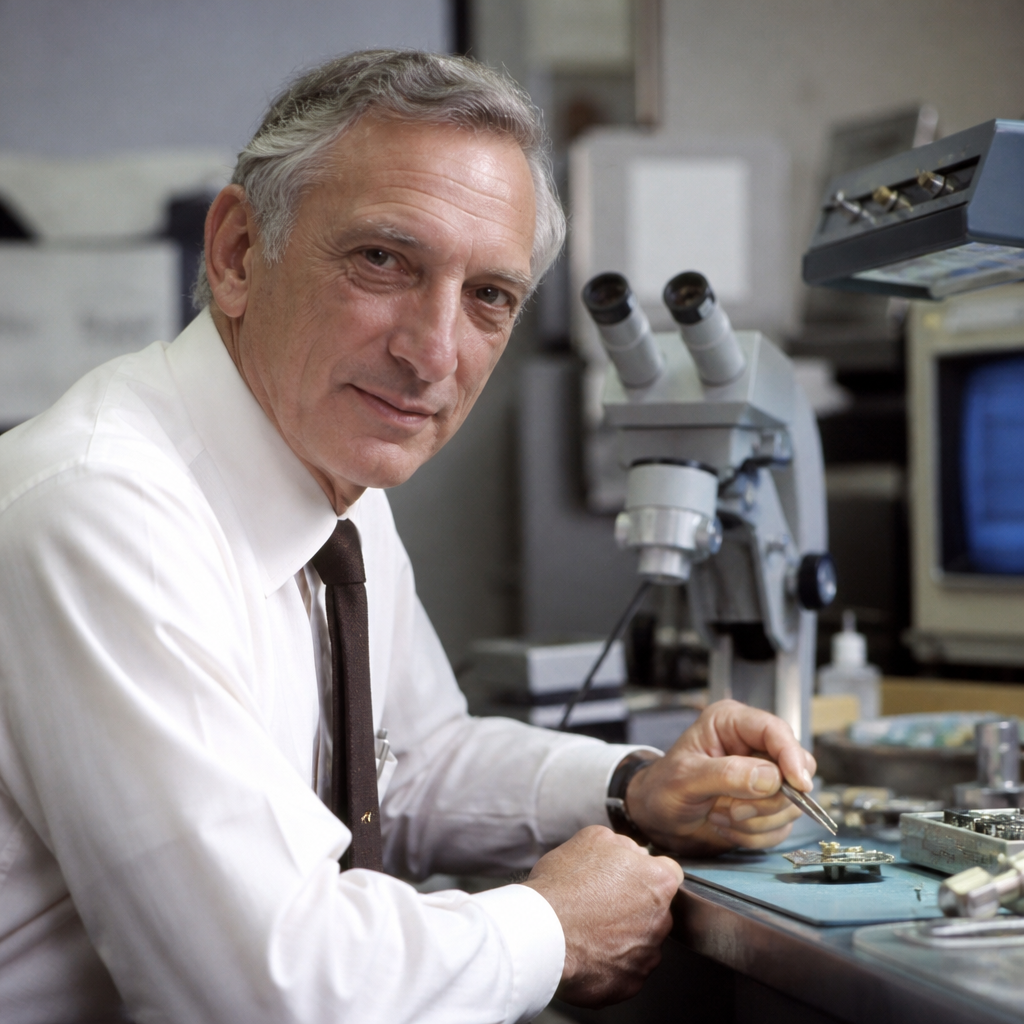
Robert Noyce helped invent the modern electronics industry by turning semiconductor theory into manufacturable products, then building the company that defined Silicon Valley’s culture and pace. Any serious look at semiconductor roots begins with Noyce, because his career connects the transistor era, the birth of the integrated circuit, the rise of venture-backed startups, and the creation of Intel. He was not simply a brilliant engineer with a famous patent. He was a practical physicist, a skilled manager, and a founder who understood that breakthroughs matter only when they can be fabricated reliably, sold at scale, and improved generation after generation.
In semiconductor history, key terms matter. A semiconductor is a material, usually silicon, whose electrical conductivity can be controlled. A transistor is a semiconductor device used to switch or amplify electrical signals. An integrated circuit places multiple electronic components on a single piece of semiconductor material. Planar processing is the manufacturing approach that protects and patterns the silicon surface so devices can be built consistently. These concepts converged in Noyce’s work. When people ask who invented the microchip, the technically accurate answer includes both Jack Kilby and Robert Noyce, but for silicon-based mass production, Noyce’s contribution proved foundational.
This matters because nearly every digital tool now depends on the manufacturing logic Noyce advanced. Smartphones, data centers, medical devices, cars, satellites, and artificial intelligence hardware all rely on integrated circuits produced through descendants of the planar silicon process. I have worked through semiconductor history with engineers, patent records, and fabrication case studies, and Noyce repeatedly appears at the point where abstract possibility became industrial reality. His career also explains why Silicon Valley developed its unusual mix of technical ambition, employee mobility, stock options, and fast company formation. To understand semiconductor roots comprehensively, this hub starts with Noyce.
From Iowa to Fairchild: How Robert Noyce Entered Semiconductor History
Robert Noyce was born in 1927 in Burlington, Iowa, and trained as a physicist at Grinnell College and the Massachusetts Institute of Technology. That educational path mattered. Unlike some later startup founders who entered technology through software or finance, Noyce came from deep laboratory science during the period when solid-state electronics was replacing vacuum tubes. After MIT, he joined Philco, then moved to Shockley Semiconductor Laboratory in Mountain View, California. That move placed him at the center of a new industry just as William Shockley, co-inventor of the transistor, was trying to commercialize semiconductor devices.
Shockley’s lab is important for one reason beyond its products: it produced the “Traitorous Eight,” the group of engineers who left in 1957 to found Fairchild Semiconductor. Noyce was one of them, alongside Gordon Moore and Jean Hoerni. Fairchild became the proving ground for modern semiconductor business practices. At Fairchild, Noyce served not only as a technical contributor but as a leader able to align research, manufacturing, and commercial priorities. In practical terms, that meant pushing ideas that could survive yield problems, contamination risk, and cost constraints inside the fab.
Fairchild’s early success came from silicon transistors, especially for military and aerospace use, where reliability justified higher prices. This customer base gave the company room to refine process technology. The significance of this period is often underestimated. Semiconductor roots are not just about invention dates; they are about learning how to make repeatable devices in volume. Noyce excelled in that environment. He had the temperament to move between concept and execution, which is why his later work on the integrated circuit had lasting impact.
The Integrated Circuit: Why Noyce’s Version Changed the Industry
The integrated circuit emerged from a specific engineering problem known as the “tyranny of numbers.” As electronic systems became more complex in the 1950s, wiring together large numbers of discrete transistors, resistors, and capacitors created reliability and assembly problems. In 1958, Texas Instruments engineer Jack Kilby demonstrated a working integrated circuit made from germanium. In 1959, Robert Noyce described a silicon integrated circuit that used Jean Hoerni’s planar process and metallized interconnections on the chip itself. That distinction was decisive for manufacturing.
Noyce’s insight was not merely that components could share one substrate. It was that a practical integrated circuit needed a fabrication method compatible with photolithography, oxide protection, and scalable interconnection. Silicon offered advantages over germanium, particularly through the stable silicon dioxide layer used in planar processing. This oxide layer allowed device regions to be masked and protected during diffusion steps, dramatically improving consistency. In plain terms, Noyce’s approach made the microchip something factories could produce repeatedly, not just something a gifted engineer could demonstrate once on a bench.
Patent history reflects this nuance. Kilby and Noyce both received recognition, and the legal disputes between Texas Instruments and Fairchild were eventually settled through cross-licensing. Historians generally credit Kilby with the first integrated circuit demonstration and Noyce with the monolithic silicon integrated circuit design that fit modern production. That balanced view is the most accurate. If you are tracing semiconductor roots, the key takeaway is straightforward: Noyce helped bridge invention and manufacturability, and that bridge is where the industry was truly born.
Planar Processing and Semiconductor Roots in Mass Production
Jean Hoerni’s planar process and Robert Noyce’s integrated circuit concept are inseparable in practice. Hoerni developed the planar method at Fairchild, using silicon dioxide as a protective layer and allowing patterns to be transferred onto wafers through photolithography. Noyce recognized that this same framework could connect multiple devices on one chip using deposited metal lines. Together, these advances solved one of the biggest barriers in electronics: how to manufacture tiny components with precision while protecting them from contamination and environmental damage.
In fabrication terms, planar processing enabled better yields, easier scaling, and more reliable packaging. Before this shift, semiconductor devices were fragile and difficult to assemble consistently. After it, fabs could process many chips on a wafer using standardized steps such as oxidation, diffusion, etching, and metallization. These principles still underlie semiconductor manufacturing, even though today’s process nodes use ion implantation, chemical mechanical planarization, EUV lithography, and fin-shaped transistors. The vocabulary has evolved, but the production logic traces back to Fairchild’s breakthroughs.
| Development | Key Figure | Why It Mattered |
|---|---|---|
| Point-contact and junction transistor era | Bardeen, Brattain, Shockley | Replaced vacuum tubes with solid-state switching |
| Planar process | Jean Hoerni | Enabled protected, repeatable silicon device fabrication |
| Monolithic integrated circuit | Robert Noyce | Allowed on-chip interconnection suited to mass production |
| Moore’s Law era | Gordon Moore | Drove predictable scaling and industry roadmaps |
| Microprocessor commercialization | Intel team | Put computing power on a single chip |
When I explain semiconductor roots to nonengineers, I use a simple analogy: Noyce did for electronics what standardized machine tooling did for manufacturing in the Industrial Revolution. A component that can be built once is a scientific success. A component that can be built millions of times with acceptable yield is an industry. That is why Noyce belongs at the center of this historical subtopic. His work shaped both the device and the production system.
Intel and the Business Model That Defined Silicon Valley
In 1968, Robert Noyce and Gordon Moore left Fairchild to co-found Intel, originally focused on semiconductor memory. Andrew Grove soon became the operational force who helped scale the company. Intel’s early products included SRAM and DRAM, but the company’s long-term fame came from microprocessors. The 4004, introduced in 1971, is commonly cited as the first commercial microprocessor, followed by the 8008, 8080, and the x86 line that later dominated personal computing. Noyce was not the sole architect of these chips, but he built the institution that made them possible.
Intel mattered because it combined technical depth with strategic discipline. Memory prices were volatile, manufacturing was capital intensive, and process leadership demanded relentless reinvestment. Noyce understood that semiconductor companies needed strong links between design teams, process engineers, and market timing. He also helped normalize a management style that became associated with Silicon Valley: flatter hierarchies, open technical debate, meritocratic hiring, and equity incentives. This culture was not perfect, but it encouraged speed, experimentation, and spinouts across the region.
Noyce’s influence reached beyond Intel’s balance sheet. He became a public symbol of the engineer-founder, someone equally comfortable discussing diffusion physics, patents, and startup financing. That model shaped later generations of technology leadership. Venture capital firms on Sand Hill Road, the dense network of talent movement between firms, and the expectation that employees might become founders all grew in an ecosystem he helped legitimize. For a hub article on semiconductor roots, this point is essential: the semiconductor revolution changed not just products, but the organizational DNA of modern technology.
Legacy, Limits, and Why Noyce Still Matters
Robert Noyce died in 1990, but his legacy remains active wherever integrated circuits are designed, fabricated, packaged, or embedded into larger systems. He is often called the “Mayor of Silicon Valley,” a nickname that captures both his prominence and his collaborative style. His achievements are clear: co-founding Fairchild, advancing the integrated circuit, co-founding Intel, and shaping startup culture. Yet it is also important to avoid hero mythology. Semiconductor progress was cumulative and collective. Kilby, Hoerni, Moore, Grove, Shockley, and many others made indispensable contributions.
That balanced perspective strengthens Noyce’s significance rather than weakening it. He stands out because he repeatedly appeared where separate streams needed to be joined: physics with manufacturing, invention with commercialization, and technical leadership with institution building. If you are exploring semiconductor roots, his story is the best central thread because it links the earliest practical silicon breakthroughs to the companies and methods that still govern chipmaking today. The core lesson is simple. Modern computing did not emerge from a single flash of genius. It emerged from disciplined process innovation, and Noyce was one of its clearest champions.
Use this Historical Perspectives hub as your starting point for deeper reading on Fairchild Semiconductor, the planar process, Jack Kilby, Gordon Moore, early chip patents, and the rise of Intel’s manufacturing strategy. Understanding Robert Noyce gives you a practical map of the semiconductor age: where it began, why silicon won, how integrated circuits scaled, and how Silicon Valley learned to turn labs into industries. If you want to understand today’s chip shortages, AI hardware races, or foundry competition, begin here, because the roots still explain the present.
Frequently Asked Questions
Who was Robert Noyce, and why is he considered a foundational figure in Silicon Valley?
Robert Noyce was an American physicist, engineer, entrepreneur, and executive whose career sits at the center of the modern technology industry’s origin story. He is widely considered a foundational figure in Silicon Valley because he helped transform semiconductor science from a laboratory pursuit into a scalable business that could produce reliable, affordable electronic components in large volumes. That shift changed everything. It made possible the progression from bulky, failure-prone electronics to compact, high-performance devices that eventually led to personal computers, smartphones, and the digital infrastructure of everyday life.
Noyce’s importance comes from more than one achievement. He was a co-founder of Fairchild Semiconductor, one of the most influential companies in technology history, where he played a key role in advancing silicon transistor manufacturing and in the development of the integrated circuit. Later, he co-founded Intel, the company that became synonymous with the microprocessor era and helped define the modern computing economy. Between those milestones, Noyce also became a symbol of a new style of technology leadership: technically gifted, ambitious, collaborative, and comfortable taking risks to build entirely new markets.
He is also central to Silicon Valley’s culture. Noyce helped establish the startup pattern that would later become standard in the region: talented engineers leaving established firms, securing backing from investors, building fast-moving companies, and creating innovations that spawn still more companies. In that sense, Robert Noyce was not just a semiconductor pioneer. He was one of the people who made Silicon Valley itself possible.
What exactly did Robert Noyce contribute to the invention of the integrated circuit?
Robert Noyce is credited as one of the co-inventors of the integrated circuit because he helped solve a crucial practical problem in electronics: how to manufacture multiple circuit elements together on a single piece of semiconductor material in a way that could be produced reliably at scale. While earlier electronic systems were assembled from separate components such as transistors, resistors, and capacitors connected by wires, that approach created limits in size, speed, cost, and reliability. The integrated circuit offered a fundamentally better path by combining those elements into one compact structure.
Noyce’s specific contribution was especially important because it was manufacturable. Working at Fairchild Semiconductor, he recognized that the planar process developed by Jean Hoerni could be used not only to protect silicon transistors but also to connect multiple components directly on the chip using deposited metal interconnections. This was a decisive leap. It turned the integrated circuit from an ingenious concept into a practical production method. In simple terms, Noyce helped show how integrated electronics could be made consistently in silicon using processes that industry could adopt and improve.
That is why discussions of the integrated circuit often mention both Jack Kilby and Robert Noyce. Kilby demonstrated an early integrated circuit concept, but Noyce’s design was more aligned with large-scale manufacturing and the future direction of the semiconductor industry. His work helped establish silicon-based integrated circuits as the foundation of modern electronics. Without that practical manufacturing framework, the chip revolution would have developed far more slowly, if at all in the form we know today.
How did Fairchild Semiconductor shape Robert Noyce’s legacy and the development of the tech industry?
Fairchild Semiconductor was the company where Robert Noyce’s talents as both an engineer and a leader became fully visible, and it is impossible to understand his legacy without understanding Fairchild’s role in technology history. Founded in 1957 by Noyce and the group famously known as the “Traitorous Eight,” Fairchild emerged after the team left Shockley Semiconductor amid management and organizational frustrations. That break was historically significant because it established one of Silicon Valley’s defining patterns: top technical talent leaving a troubled organization to build something faster, more innovative, and more commercially effective.
At Fairchild, Noyce helped guide breakthroughs in transistor production and integrated circuit development. The company became a center of semiconductor innovation, pushing silicon devices into practical commercial use and setting new standards for manufacturing excellence. Just as importantly, Fairchild became a training ground for future founders and executives. Many of the people who passed through the company went on to launch or lead other major technology firms, creating what is often called the “Fairchild diaspora.” That ripple effect gave Fairchild an influence far beyond its own products.
Noyce’s leadership style at Fairchild also mattered. He was known for encouraging openness, informality, and respect for engineers, which contrasted with more rigid corporate hierarchies common at the time. That management philosophy became part of Silicon Valley’s identity: flatter organizations, technical merit, speed of execution, and a willingness to challenge established players. So Fairchild was not only where Noyce built devices that shaped the future. It was also where he helped define the organizational DNA of the modern tech industry.
Why is Robert Noyce so closely associated with Intel, and what was his role in the company’s success?
Robert Noyce is closely associated with Intel because he co-founded the company in 1968 with Gordon Moore, and his presence gave the new venture instant credibility in both technical and business circles. By that point, Noyce was already a highly respected figure due to his work at Fairchild Semiconductor and his role in the integrated circuit’s development. Intel began as a semiconductor memory company, but under the leadership of Noyce, Moore, and later Andy Grove, it evolved into one of the most important companies in the history of computing.
Noyce’s role at Intel extended beyond engineering. He was a strategic co-creator of the company’s direction, culture, and identity. He helped assemble elite technical talent, attract investor confidence, and shape an environment where innovation could move quickly. Intel embodied many of the values Noyce had helped normalize in Silicon Valley: ambitious technical goals, relatively informal management structures, and a belief that small teams of highly capable people could outperform larger, more bureaucratic organizations.
Although Gordon Moore and Andy Grove are often especially associated with Intel’s operational and strategic evolution, Noyce remained a central figure in its formative years. He was a bridge between the invention era of semiconductors and the industrial scaling of computing hardware. Intel’s breakthroughs in memory chips and eventually microprocessors placed it at the heart of the computer revolution, and Noyce helped make that possible by creating the institutional foundation on which those advances could be built. In that sense, his importance to Intel was not just that of a co-founder. He was one of the architects of the company’s innovative character and long-term influence.
What is Robert Noyce’s lasting impact on modern electronics, entrepreneurship, and Silicon Valley culture?
Robert Noyce’s lasting impact is enormous because it spans three connected areas: the technology itself, the business structures that commercialized it, and the regional culture that accelerated future innovation. In electronics, his contribution to the integrated circuit helped establish the path toward ever more compact, powerful, and affordable devices. Nearly every part of modern digital life traces back to that foundational shift. Computers, telecommunications systems, medical devices, industrial controls, consumer electronics, and internet infrastructure all depend on the chip-based world that Noyce helped make practical.
In entrepreneurship, Noyce helped prove that world-changing technology companies could be built outside the traditional corporate establishment by teams of engineers backed by risk-tolerant investors. That sounds normal today, but in Noyce’s era it was still a developing model. His success at Fairchild and Intel helped validate the venture-backed startup as a powerful engine of innovation. This became one of Silicon Valley’s defining mechanisms: ideas moving quickly from lab to company to market, often through founder-led teams willing to challenge incumbents.
Culturally, Noyce is remembered as one of the figures who gave Silicon Valley its distinctive tone. He represented a blend of scientific seriousness, practical problem-solving, optimism, competitiveness, and informal leadership. He believed talented people did their best work when trusted, challenged, and given room to experiment. That philosophy influenced not only the companies he helped build but also the wider expectations of how technology firms could operate. For that reason, Robert Noyce’s legacy is not confined to one patent, one company, or one era. It lives on in the way chips are made, startups are funded, and innovation ecosystems are organized around the world.