Liquid cooling for AI data centers is moving from niche engineering choice to core infrastructure strategy as Silicon Valley confronts the heat generated by modern accelerators. In practical terms, liquid cooling uses water or dielectric fluids to remove heat from servers far more efficiently than traditional air systems. That matters because AI infrastructure and data centers now support dense clusters of GPUs, high-bandwidth memory, and fast interconnects that can draw tens of kilowatts per rack. I have watched teams that once optimized hot aisle containment suddenly redesign entire mechanical plants because training workloads changed the thermal equation. This hub explains the technologies, economics, design tradeoffs, and operational implications behind that shift, so readers can understand how AI infrastructure and data centers are being rebuilt for the next generation of computing demand.
Why AI workloads are breaking the air-cooling model
Traditional enterprise halls were designed around relatively modest rack densities, often between 5 and 15 kilowatts. AI changes that baseline. A single NVIDIA H100 or H200 system can push rack power into ranges that make air distribution, raised floors, and computer room air handlers increasingly inadequate. Once racks approach 30, 50, or 80 kilowatts, fans alone become an expensive and space-hungry way to move heat. The fundamental issue is physics: liquids carry heat more effectively than air because they have much higher thermal conductivity and volumetric heat capacity.
Operators are not adopting liquid cooling because it sounds innovative; they are adopting it because compute density now outruns air-cooling economics. Large language model training clusters, recommendation engines, and inference farms all depend on accelerator utilization. If chips throttle due to temperature or if spacing requirements reduce the number of systems per hall, the business case for premium silicon deteriorates. In my experience, that is the turning point for executives: once they realize thermal design directly affects revenue per square foot, cooling stops being a facilities afterthought.
Silicon Valley companies are also responding to power constraints. Utility interconnection delays, local capacity limits, and sustainability targets make it harder to simply build larger sites with lower density. Higher density per megawatt becomes essential. Liquid cooling helps support that goal by reducing fan energy, enabling warmer water loops, and opening paths to heat reuse. These are not abstract advantages. They influence site selection, capital planning, and how quickly new GPU clusters can be deployed.
How liquid cooling works in AI infrastructure and data centers
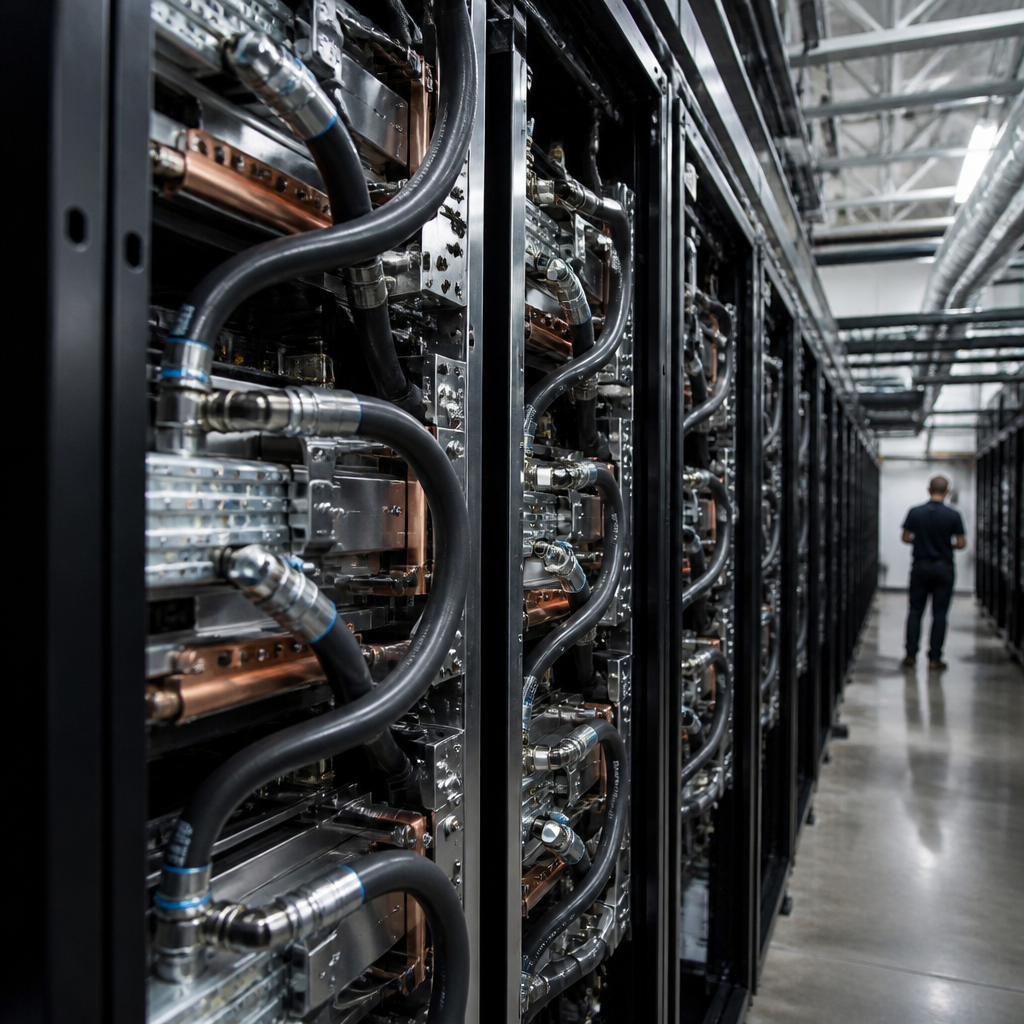
There are three primary approaches used in AI infrastructure and data centers: direct-to-chip cold plates, rear-door heat exchangers, and immersion cooling. Direct-to-chip systems circulate liquid through cold plates mounted on processors, GPUs, and sometimes memory modules. Heat transfers from the silicon package into the plate, then into a facility water loop through a coolant distribution unit. This is currently the most common path for enterprise AI deployments because it integrates with familiar rack layouts while handling high thermal loads.
Rear-door heat exchangers are another option. In these systems, heated server exhaust passes through a liquid-cooled door mounted at the back of the rack. They are less invasive because standard servers can often remain largely unchanged, but they usually capture only the heat already moving through the chassis. For moderate density upgrades, they can be useful. For the highest-density AI racks, direct liquid contact at the component level is generally more effective.
Immersion cooling takes a more radical approach by submerging servers in dielectric fluid. In single-phase immersion, the fluid absorbs heat and is pumped through a heat exchanger. In two-phase systems, the fluid boils at low temperatures, and vapor condenses on a coil above the bath. Immersion can support extremely high densities and may reduce moving parts, but it requires specialized hardware handling, revised maintenance workflows, and confidence in fluid compatibility across materials, connectors, and warranties.
| Cooling method | Best use case | Main advantage | Main limitation |
|---|---|---|---|
| Direct-to-chip | High-density GPU clusters | Targets hottest components efficiently | Requires liquid-ready server designs |
| Rear-door heat exchanger | Retrofits and mixed-density rooms | Works with familiar rack layouts | Less effective at extreme densities |
| Immersion cooling | Ultra-dense specialized deployments | Excellent thermal performance | Operational change and hardware compatibility concerns |
Why Silicon Valley is investing now
The timing is driven by a convergence of technical and financial pressures. First, accelerator roadmaps from NVIDIA, AMD, Intel, and custom silicon providers continue to increase thermal design power. AI servers are no longer occasional specialty systems; they are becoming the anchor tenants of new builds. Second, colocation providers and hyperscalers need repeatable designs that can scale across campuses. Liquid-ready halls are becoming a market signal, much like redundant power and fiber diversity were in earlier eras.
Third, investors now scrutinize infrastructure efficiency. Metrics such as power usage effectiveness remain useful, but they do not tell the whole story for AI. Operators are paying closer attention to energy proportionality, water strategy, rack utilization, and time to deploy additional megawatts. A site with slightly higher mechanical complexity can still win if it supports more productive compute per unit of power and floor space. That is why firms from startup GPU clouds to established operators are building liquid cooling into the initial design rather than treating it as a retrofit.
Silicon Valley also has a talent advantage. Mechanical engineers, chip architects, thermal simulation specialists, and data center operators are collaborating earlier in the design cycle. I have seen procurement teams ask server vendors for manifold details, leak detection specifications, and coolant chemistry data during the first architecture review, not months later. That level of integration signals a maturing market, not an experiment.
Design tradeoffs: power, water, reliability, and cost
Liquid cooling is not a universal cure. It introduces meaningful design tradeoffs that smart operators evaluate carefully. Water consumption is a major point of concern, especially in drought-sensitive regions such as California. Some systems use closed loops that minimize direct water loss, while others depend on cooling towers with higher evaporation. The right choice depends on climate, utility pricing, sustainability commitments, and local regulation. A liquid-cooled site can reduce electricity use yet still face criticism if its water profile is poorly managed.
Reliability is another consideration. Critics often focus on leak risk, but in practice modern systems use quick disconnects, dripless couplings, redundant pumps, pressure monitoring, and leak detection cables to reduce exposure. The real operational challenge is process discipline. Technicians need clear service procedures, spare part inventories, and training for draining, filling, and isolating loops. In well-run environments, liquid systems can be highly reliable. In poorly prepared ones, minor maintenance errors become outages.
Capital costs can be higher upfront. Operators may need coolant distribution units, facility water loops, reinforced floors, and new monitoring systems. Yet total cost of ownership often improves when density rises enough to avoid building expansion, reduce fan energy, or increase compute output per hall. The business case is strongest when organizations model the entire stack: chip utilization, rack count, real estate, power delivery, mechanical plant capacity, and expected refresh cycles. Focusing only on cooling equipment cost misses the economic reality of AI infrastructure and data centers.
Operational impact across the AI data center lifecycle
Cooling choices influence everything from site selection to decommissioning. During planning, teams must align IT load forecasts with mechanical design assumptions. Overestimating density inflates capex; underestimating it creates expensive rework. During deployment, liquid-cooled racks can change logistics because weight, piping clearance, and manifold placement affect row design. During operations, telemetry becomes critical. Temperature delta, flow rate, pressure, and coolant quality need continuous monitoring alongside standard server metrics.
Maintenance models also evolve. Air-cooled rooms often emphasize filter changes and airflow management. Liquid-cooled environments add water treatment, fluid sampling, connector inspection, and more formal change control. Vendors such as Vertiv, Schneider Electric, CoolIT Systems, Supermicro, and Lenovo have expanded liquid-cooling offerings precisely because customers need integrated support, not isolated components. Standards bodies and organizations including ASHRAE and the Open Compute Project help by publishing thermal guidance, facility recommendations, and interoperable design concepts that reduce deployment risk.
This is why the topic matters as a hub within AI infrastructure and data centers. It touches chip packaging, rack architecture, facility engineering, sustainability, supply chains, and cloud economics. It also connects to adjacent subjects readers should explore next, including GPU cluster design, power distribution for high-density racks, modular data center construction, digital twins for capacity planning, and heat reuse strategies for urban campuses.
What comes next for cooling in AI infrastructure and data centers
The industry is moving toward hybrid environments where liquid handles the hottest components and air remains responsible for residual heat and room conditions. That mixed approach is practical because it balances serviceability with density. Over time, standards will improve, component interoperability will expand, and more facilities will be built with warm-water loops from day one. Expect rack power levels to keep rising as model sizes grow and inference demand spreads into enterprise and edge environments.
Another important shift is the closer coupling of hardware and facilities planning. Future buyers will evaluate servers not just by benchmark results but by heat rejection profile, coolant temperature tolerance, and integration with building systems. AI infrastructure and data centers are becoming multidisciplinary assets where thermal design influences competitive advantage. Companies that master that integration will deploy capacity faster, use power more productively, and extend the useful life of expensive accelerator investments.
Liquid cooling for AI data centers is ultimately about enabling more compute in the real world, not chasing novelty. It solves a specific problem created by modern silicon: extraordinary heat density. The best implementations pair sound mechanical engineering with disciplined operations and clear economic modeling. If you are mapping the future of AI infrastructure and data centers, start with cooling, because heat now determines what scale is possible. Use this hub as your foundation, then go deeper into power, networking, cluster architecture, and facility strategy to build a complete view.
Frequently Asked Questions
What is liquid cooling in AI data centers, and why is it becoming so important?
Liquid cooling is a method of removing heat from servers by transferring that heat into water or specialized dielectric fluids instead of relying primarily on chilled air and large fans. In AI data centers, this matters because modern accelerators such as GPUs, high-bandwidth memory, and high-speed networking components generate far more heat per rack than traditional enterprise servers. As compute density rises, air cooling becomes harder, less efficient, and more expensive to scale. Liquid can absorb and move heat much more effectively than air, which allows operators to support dense AI clusters without overwhelming the facility’s thermal limits.
The reason Silicon Valley and the broader data center industry are rethinking cooling is simple: AI workloads have changed the power profile of the modern server room. Training and inference infrastructure often runs at sustained high utilization, which means systems produce intense, continuous heat loads rather than occasional spikes. In many cases, a single rack can draw tens of kilowatts, and in advanced deployments the number can go much higher. Liquid cooling helps keep these systems within safe operating temperatures, improves hardware reliability, and can reduce the energy overhead associated with fans and mechanical cooling. That is why it is no longer viewed as a niche engineering choice, but as a core infrastructure strategy for AI at scale.
How does liquid cooling compare with traditional air cooling for high-density AI workloads?
The biggest difference is heat transfer efficiency. Air cooling works by moving large volumes of cool air across hot components and then exhausting the warmed air out of the rack or room. That model can work well for lower-density environments, but it becomes increasingly difficult when racks are packed with power-hungry accelerators. Air simply does not carry heat away as efficiently as liquid, so operators need larger cooling units, more aggressive airflow management, and more fan power to keep temperatures under control.
Liquid cooling addresses that limitation by bringing the cooling medium much closer to the actual heat source. In direct-to-chip systems, cold plates are attached to processors and other hot components, allowing fluid to absorb heat at the point where it is generated. In immersion systems, entire servers are submerged in a non-conductive fluid that captures heat directly from the equipment. Both approaches can support much higher rack densities than conventional air cooling and often enable more stable thermal performance across the data hall.
There are also meaningful operational benefits. Liquid cooling can lower the amount of energy spent on moving air, reduce hot spots, and support more predictable performance from AI hardware that would otherwise throttle under thermal stress. It can also help data center operators use floor space more efficiently because they can deploy more compute capacity in the same footprint. Air cooling is not disappearing overnight, but for dense AI clusters, liquid cooling is increasingly the more practical and future-ready option.
What are the main types of liquid cooling used in AI data centers?
The two most commonly discussed approaches are direct-to-chip cooling and immersion cooling. Direct-to-chip cooling uses metal cold plates mounted on high-heat components such as CPUs and GPUs. A liquid coolant flows through those plates, absorbs heat, and then carries it away to a heat exchanger or facility water loop. This method is gaining momentum because it can be integrated into familiar rack and server designs while targeting the components that produce the most heat. For many AI deployments, direct-to-chip offers a balance between thermal performance, serviceability, and compatibility with existing data center practices.
Immersion cooling takes a more dramatic approach by placing servers, or server boards, into tanks filled with dielectric fluid. Because the fluid is non-conductive, electronic components can operate while submerged. The fluid absorbs heat directly from nearly every part of the system, making immersion extremely effective for very high-density and specialized environments. It can also reduce the need for internal server fans and simplify some aspects of airflow management. However, it may require purpose-built hardware, new maintenance procedures, and a stronger operational shift than direct-to-chip systems.
Some facilities also use rear-door heat exchangers or hybrid designs that combine liquid and air cooling. These can act as transitional solutions for operators who want better thermal control without fully redesigning rack architecture. The right choice depends on workload density, facility design, budget, supply chain considerations, and how aggressively the operator plans to scale AI infrastructure over the next several years.
What are the business and operational advantages of liquid cooling for AI infrastructure?
From a business perspective, liquid cooling can unlock more compute capacity per rack, per room, and sometimes per site. That is especially important in markets where space and power are constrained. Instead of spreading GPUs across more racks to stay within air-cooling limits, operators can consolidate high-performance hardware into denser clusters. This can improve utilization of expensive real estate and accelerate the deployment of new AI capacity. For organizations racing to build or rent infrastructure for training large models, that density advantage can be strategically significant.
Operationally, liquid cooling can improve thermal consistency and reduce the likelihood of performance degradation caused by overheating. AI accelerators are expensive assets, and their value depends on sustained performance. If cooling limitations force hardware to throttle or create uneven thermal conditions across a cluster, the effective return on that infrastructure drops. Liquid cooling helps protect that investment by supporting stable operation under heavy, continuous load.
There can also be efficiency benefits. By reducing dependence on high-volume airflow and, in some designs, enabling warmer water temperatures, liquid cooling can lower the energy needed for heat rejection. In the right environment, operators may even be able to capture and reuse waste heat. That said, the business case depends on implementation details. Upfront capital costs, plumbing design, service models, and retrofit complexity all matter. Even so, as AI power densities rise, many operators are concluding that the long-term operational and strategic gains outweigh the initial transition costs.
What challenges should companies consider before adopting liquid cooling in a data center?
Adopting liquid cooling is not just a hardware decision; it is a facility, operational, and procurement decision as well. One major consideration is infrastructure readiness. Operators need to evaluate whether the building can support the necessary water loops, pumps, heat exchangers, leak detection, and monitoring systems. Retrofitting an older data center can be more complex than designing a new AI-ready facility from the ground up. Planning must account for redundancy, maintenance access, water quality management, and integration with existing building systems.
Another challenge is standardization. The ecosystem is improving, but liquid cooling still introduces variations in connector types, manifold designs, coolant specifications, and service procedures. Companies need alignment between server vendors, rack integrators, and facility teams to avoid deployment delays or support issues. Staff training is also essential. Technicians who are comfortable replacing air-cooled hardware may need new procedures for servicing liquid-connected equipment safely and efficiently.
Risk perception is another common concern, especially around leaks, maintenance complexity, and compatibility with fast-moving AI hardware roadmaps. In practice, modern liquid cooling systems are designed with containment, quick disconnects, and monitoring controls to reduce those risks, but they still require disciplined engineering and operations. Organizations should also consider total cost of ownership rather than focusing only on the cooling equipment itself. The right evaluation includes power density goals, site constraints, expected AI growth, energy efficiency targets, and how quickly the organization needs to scale compute capacity. For many companies, liquid cooling is less about following a trend and more about preparing their infrastructure for the realities of next-generation AI workloads.