Artificial intelligence is colliding with a physical limit that software alone cannot solve: electricity. The AI data center power problem sits at the center of modern computing because every breakthrough model, every cloud inference request, and every burst of startup experimentation ultimately runs through power-hungry servers, cooling systems, and grid connections. In practical terms, AI infrastructure now depends as much on megawatts and transmission queues as on model architecture and chip design. That shift matters to founders, cloud buyers, policymakers, and enterprise technology leaders because it is changing where data centers get built, how fast capacity comes online, and what AI services will cost.
When people talk about AI infrastructure and data centers, they usually mean the physical and digital stack that supports training and serving machine learning models. That includes graphics processing units, high-bandwidth networking, storage arrays, backup systems, uninterruptible power supplies, chillers, and the buildings that house them. Power usage effectiveness, usually shortened to PUE, measures how efficiently a facility uses electricity beyond the servers themselves. Load factor, rack density, and interconnection timelines are equally important terms because they determine whether a site can support today’s dense AI clusters. In projects I have worked on, the biggest surprise for nontechnical executives was not the cost of GPUs; it was the time and capital required to secure reliable power at utility scale.
This topic matters now because AI demand is rising faster than energy infrastructure can expand. Hyperscalers are signing multigigawatt agreements, colocation providers are redesigning halls for liquid cooling, and utilities are reassessing forecasts that suddenly look outdated. The bottleneck is not abstract. If a data center cannot obtain enough power, the chips sit idle, the project slips, and customers wait longer or pay more. Understanding this bottleneck is essential for anyone following AI infrastructure and data centers, because it explains market consolidation, regional site selection, and the growing importance of energy strategy in tech.
Why AI workloads consume so much electricity
AI workloads draw extraordinary amounts of electricity because they combine dense computation with continuous utilization. Traditional enterprise applications often produce variable loads, but large AI training jobs run thousands of accelerators near full capacity for days or weeks. A modern GPU can consume several hundred watts by itself; an entire rack configured for AI can push far beyond the power density that older facilities were designed to handle. Add high-speed networking, memory, storage, and redundancy overhead, and the total demand rises quickly.
Training is the most obvious power-intensive task, yet inference is becoming just as important. Once a model is deployed, millions of user prompts, recommendations, search results, and automated workflows must be answered in real time. That shifts AI from occasional bursts into persistent electricity demand. In my experience planning infrastructure budgets, teams often underestimate inference growth because each request looks small in isolation. At scale, however, the aggregate load becomes enormous, especially for multimodal models processing text, images, audio, and video.
Cooling compounds the issue. Dense AI clusters generate concentrated heat that air cooling struggles to remove efficiently. Facilities increasingly use direct-to-chip liquid cooling or rear-door heat exchangers, but pumps, heat rejection systems, and water management add complexity and power overhead. This is why electricity use is not just about the servers. The whole supporting environment must expand with them.
How the grid became the real constraint
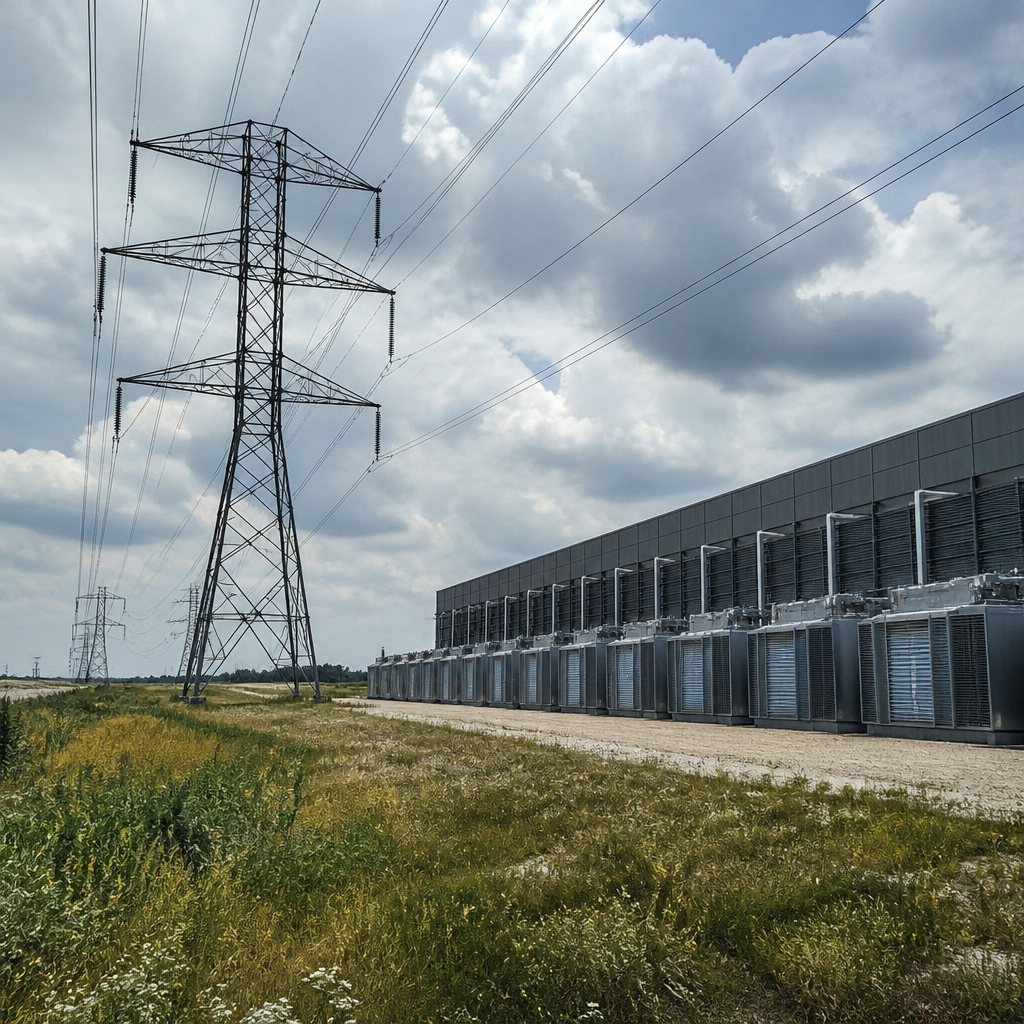
The biggest limit on AI data center growth is often the electric grid, not server supply. Utilities must balance generation, transmission, distribution, and reliability standards, and those systems were not built for sudden, concentrated jumps in demand from a single campus. In several major North American markets, developers can secure land and financing faster than they can obtain a firm interconnection date. Waiting periods of multiple years are no longer unusual.
Interconnection is the process of connecting a large electricity user to the grid in a way that preserves stability and safety. That can require substation upgrades, new transmission lines, transformer procurement, and regulatory approvals. High-voltage transformers alone have experienced long lead times, creating another bottleneck. The result is a queue problem: data center operators line up for capacity, utilities study the impact, and only a fraction of projects move ahead on the original schedule.
This dynamic is reshaping geography. Northern Virginia remains a key hub because of network density, but power constraints there have pushed interest toward markets such as Texas, Ohio, Georgia, and parts of the Midwest with available land and stronger power development prospects. In Europe, countries are weighing data sovereignty and renewable integration against local grid stress. The common theme is simple: the best AI site is no longer just the place with fiber and tax incentives. It is the place where power can actually be delivered.
Why power changes data center design and economics
Electricity influences every layer of data center economics, from capital expenditure to customer pricing. A facility designed for 10 kilowatts per rack looks very different from one engineered for 80 kilowatts or more. Busways, switchgear, backup generation, cooling loops, and floor layouts must all be upgraded. Those changes increase upfront costs, but they also determine whether a provider can host next-generation AI clusters competitively.
Operators now evaluate projects using a mix of utility rate structures, demand charges, PUE targets, and expected utilization. Cheap power on paper is not enough if the utility cannot guarantee delivery during peak conditions. Reliability matters because model training interruptions are expensive and can waste reserved compute time. That is why leading operators negotiate long-term power purchase agreements, invest in on-site generation, or pair facilities with energy storage where regulations permit.
| Infrastructure factor | Why it matters for AI data centers | Typical effect on cost or timeline |
|---|---|---|
| Grid interconnection | Determines when utility power becomes available | Can delay projects by years |
| Rack power density | Sets requirements for electrical and cooling systems | Raises build cost per megawatt |
| Cooling method | Controls heat removal for dense GPU clusters | Impacts PUE, water use, and retrofits |
| Power price structure | Affects operating margin and customer rates | Changes long-term service economics |
| Backup architecture | Protects uptime during outages or grid instability | Adds capital cost and permitting complexity |
For startups buying cloud capacity, these infrastructure economics eventually show up as product constraints. Limited regional capacity can mean higher GPU rental prices, stricter reservation terms, or slower deployment. For enterprises building private AI environments, it can mean scaling plans must align with facility engineering realities rather than software roadmaps.
What companies are doing to solve the bottleneck
No single fix will solve the AI data center power problem, so operators are pursuing several strategies at once. First, they are improving efficiency. Better scheduling, model optimization, inference compression, and higher server utilization reduce wasted energy per useful computation. Techniques such as quantization, pruning, and retrieval augmentation can lower compute intensity for some applications without unacceptable performance loss.
Second, providers are redesigning facilities around dense AI loads. Liquid cooling is moving from niche deployment to mainstream planning for new AI halls. Advanced power distribution, warm-water cooling loops, and modular designs help operators deploy capacity faster than traditional custom builds. I have seen projects gain schedule certainty simply by standardizing repeatable power blocks instead of treating each expansion as a bespoke engineering exercise.
Third, major cloud and colocation players are going upstream into energy procurement. Long-term renewable power purchase agreements remain common, but firms are also examining natural gas peaker support, battery storage, and, in some cases, advanced geothermal or nuclear partnerships. The reason is straightforward: if power availability determines revenue, energy sourcing becomes a core operating capability rather than a back-office procurement task.
Fourth, the software stack is adapting. Workload orchestration increasingly considers where power is available, how carbon intensity changes by hour, and which sites can meet latency requirements at the lowest energy cost. This is especially relevant for less latency-sensitive training jobs that can shift across regions. The industry is learning that AI infrastructure and data centers must be managed as integrated systems, not separate hardware, software, and utility decisions.
What this means for startups, investors, and policy
For startups, the power bottleneck changes competitive strategy. Teams that rely heavily on third-party GPUs need procurement discipline, workload efficiency, and realistic assumptions about availability. It is no longer safe to assume that cloud capacity will always appear on demand in every region. Startups building infrastructure tools, cooling technologies, energy management software, and grid-aware orchestration may find durable opportunity because they address a hard physical constraint, not a passing software trend.
Investors should watch utility access, permitting risk, and energy contracts with the same seriousness they apply to chip supply and recurring revenue. A promising AI infrastructure company without a credible power strategy may struggle to scale regardless of technical merit. Conversely, operators with secured interconnection rights, experienced engineering teams, and disciplined expansion plans can create significant defensibility.
Policy also matters. Governments that want domestic AI capacity need faster interconnection processes, transmission investment, clearer permitting, and incentives for efficient facility design. At the same time, communities are right to ask about land use, water consumption, emissions, and grid impacts. The best outcomes come from transparent planning and realistic tradeoff analysis, not slogans about innovation or opposition.
The central lesson is clear: electricity is becoming a defining input for the next era of computing. AI progress will not slow because researchers lose ambition; it will slow when physical infrastructure cannot keep pace. Anyone serious about AI infrastructure and data centers must evaluate power as a first-order strategic variable, alongside chips, capital, and talent. Follow this hub as you explore related topics, from cooling systems and colocation trends to grid policy and startup opportunities, because understanding the power bottleneck is now essential to understanding the future of tech.
Frequently Asked Questions
Why is electricity becoming a major bottleneck for AI data centers?
Electricity is becoming a major bottleneck for AI data centers because modern artificial intelligence workloads require far more power than traditional computing tasks. Training large models and serving millions of inference requests depend on densely packed GPUs, high-speed networking equipment, storage systems, and advanced cooling infrastructure, all of which consume substantial amounts of energy at the same time. In the past, a company could often scale digital services by adding servers within an existing facility footprint. With AI, that assumption is breaking down because power availability, not just floor space or hardware supply, increasingly determines how much compute can actually be deployed.
The problem extends beyond the servers themselves. Every watt used by processors typically creates additional cooling demand, which means AI data centers face a double burden: they need electricity to run computation and more electricity to remove the heat that computation generates. In many regions, utilities and grid operators are already dealing with transmission congestion, long interconnection queues, and aging infrastructure. As a result, even well-funded technology companies may wait years for new power capacity, substation upgrades, or transmission access. That reality turns electricity into a strategic constraint, making it just as important as chips, software, and talent in determining who can build and scale AI infrastructure.
Why do AI workloads use so much more power than traditional data center applications?
AI workloads use more power because they are built around extremely intensive parallel computation. Large language models, image generators, recommendation systems, and other advanced AI applications rely on specialized accelerators such as GPUs and AI chips that are designed to perform enormous numbers of mathematical operations simultaneously. These processors deliver exceptional performance, but they also draw much more power than the CPUs commonly used for standard enterprise software, web hosting, or business databases. When thousands of these accelerators are clustered together for training or real-time inference, total power demand rises very quickly.
Another reason is utilization. Traditional enterprise systems often experience fluctuating workloads and may not run at maximum capacity all the time. AI training clusters, by contrast, are often designed to operate at very high utilization for long periods because the economics of model development reward speed and throughput. Inference infrastructure can also be energy-intensive, especially when serving high volumes of complex requests with low-latency expectations. Add in the supporting systems—high-bandwidth memory, networking fabric, storage, backup power, and liquid or air cooling—and the total energy footprint becomes much larger than that of conventional data center environments. In short, AI is not just more compute-heavy; it is more power-dense across the full infrastructure stack.
How does the power problem affect AI growth, cloud expansion, and startup innovation?
The power problem affects AI growth by slowing the pace at which new compute capacity can come online. Demand for AI services may rise quickly, but data center expansion depends on utility approvals, grid connection timelines, land use, substation capacity, and sometimes entirely new transmission infrastructure. That creates a mismatch between digital demand and physical deployment. Large cloud providers may have the capital to secure prime locations and negotiate long-term energy arrangements, but even they cannot instantly overcome local grid limits. In regions with constrained power availability, the next AI cluster cannot simply be installed because the hardware exists; it must also be supplied with reliable electricity at scale.
For startups, the consequences can be even more significant. Young companies often rely on cloud access rather than building infrastructure directly, so when hyperscalers face power constraints, costs can rise and available capacity can tighten. That can make experimentation more expensive and less predictable, especially for companies training models or running inference-heavy products. It may also concentrate advantage among the biggest firms, which are better positioned to reserve capacity, sign long-term contracts, and design around grid limitations. In that sense, electricity is not just an operational issue. It can shape competitive dynamics, influence where innovation happens, and determine which AI products reach the market fastest.
What role do cooling systems and facility design play in the AI data center power problem?
Cooling systems and facility design play a central role because AI hardware produces intense heat in a relatively small physical footprint. As chip density increases, it becomes harder to maintain safe operating temperatures using legacy data center designs that were built for lower-power server racks. Facilities supporting AI clusters often need more advanced thermal management strategies, including high-efficiency air cooling, direct-to-chip liquid cooling, rear-door heat exchangers, or even immersion systems in some cases. These technologies can improve performance and reliability, but they also add complexity, capital cost, and infrastructure requirements.
Facility design matters because power distribution, rack density, backup systems, and thermal architecture must all be engineered together. A building may have enough square footage for new servers but still be unable to support the electrical load or heat rejection demands of modern AI accelerators. This is why many operators are redesigning layouts around high-density racks, upgraded busways, improved water systems, and smarter energy management. The key point is that the AI data center power problem is not only about generating more electricity. It is also about using that electricity efficiently inside the facility, reducing waste, and building sites that can handle much higher compute intensity without compromising uptime or economics.
What solutions could help address the AI data center electricity bottleneck over the next several years?
There is no single fix, but several solutions can help reduce the bottleneck. On the infrastructure side, utilities, grid operators, and governments can accelerate transmission upgrades, expand generation capacity, and streamline interconnection processes so new data center projects do not sit in multi-year queues. Data center developers can choose locations with stronger grid access, diversify geographically, and invest in on-site energy strategies such as battery storage, demand response participation, or in some cases dedicated generation. Long-term power purchase agreements and clean energy procurement can also improve supply planning while supporting sustainability goals.
On the technology side, more efficient chips, better model architectures, improved scheduling, and smarter software optimization can reduce the amount of energy required per unit of AI output. Companies are also working on advanced cooling approaches and more energy-aware data center design to improve overall efficiency. Just as importantly, the industry may need to become more selective about how compute is used, prioritizing higher-value workloads and reducing wasteful experimentation where possible. Over the next several years, the organizations that manage this challenge best will likely be those that treat power as a core part of AI strategy rather than a background utility. In practical terms, the future of AI will depend not only on better models and faster hardware, but on who can secure, distribute, and use electricity most effectively.