
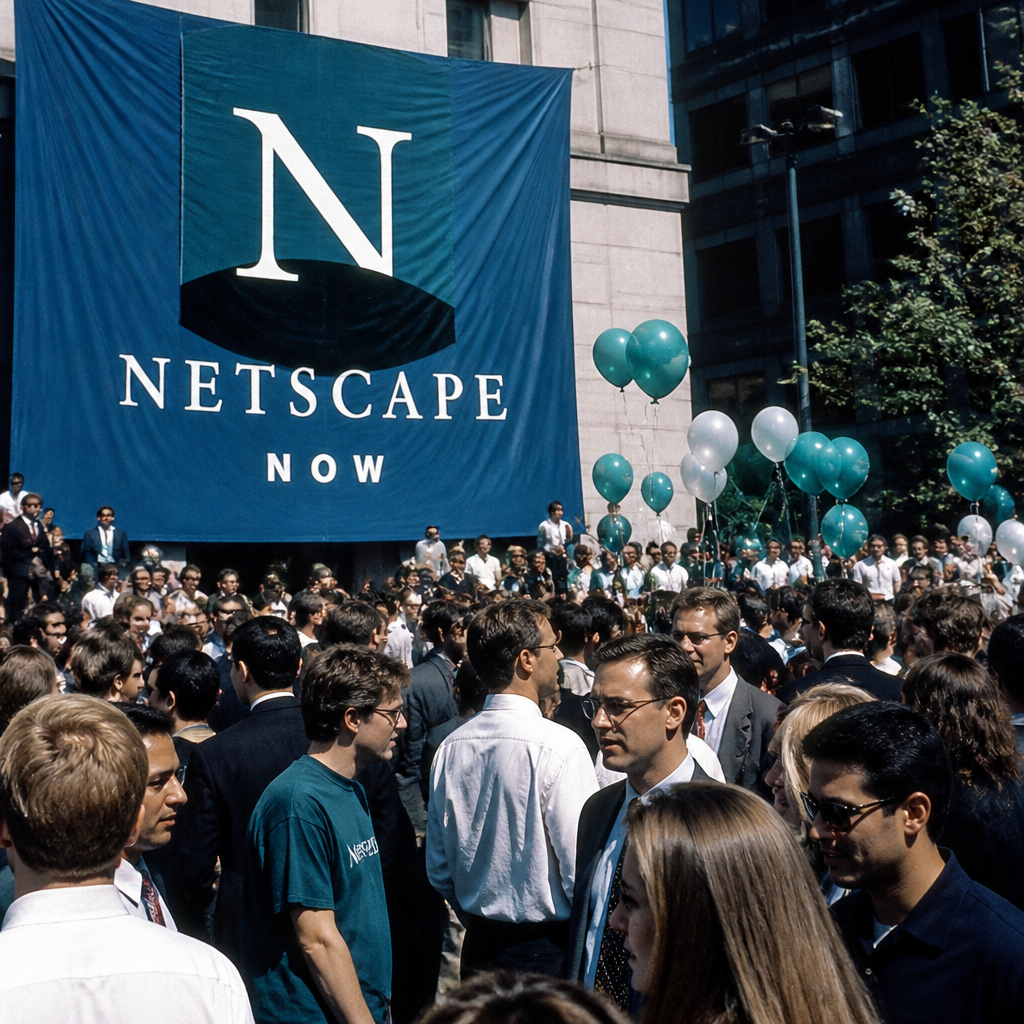
Netscape’s 1995 initial public offering did more than launch a young software company onto Wall Street; it crystallized a new belief that the internet would remake commerce, media, and everyday life. When people ask why Netscape’s IPO became a symbol of the internet boom, they are really asking how one browser maker convinced investors that a loosely connected academic network had become the foundation of a mass market. The answer sits at the intersection of technology, capital markets, and cultural timing. Netscape sold a vision of the web as a universal platform, and public investors treated that vision as immediately valuable, even before the company had built a mature business.
To understand the moment, it helps to define the key terms. An IPO, or initial public offering, is the first sale of a private company’s shares to the public. The internet boom refers to the rapid surge of investment, startup formation, and public enthusiasm around online businesses during the 1990s, culminating in the dot-com bubble. Netscape Communications, founded in 1994, built Netscape Navigator, the browser that brought the World Wide Web to mainstream users by making pages easier to access, render, and navigate. In practical terms, the browser became the front door to the internet, turning computing, storage, and networked information into a consumer experience instead of a specialist function.
This topic matters because Netscape’s IPO became a template for how markets value platform shifts. I have worked through enough technology market histories to see the same pattern repeat: investors rarely wait for accounting certainty when they believe infrastructure is changing. In the mid-1990s, personal computing had already created a large installed base of desktop machines, falling storage costs made local data handling cheaper, and dial-up internet access connected households to remote servers at scale. Netscape sat on top of those trends. Its market debut showed that finance had begun pricing the web not as a niche communications layer, but as the operating environment for the next era of software, publishing, retail, and enterprise systems.
The technology backdrop: computing, storage, and the commercial web
Netscape’s IPO cannot be separated from the technical environment that made the company possible. By 1995, personal computers had become common in offices and increasingly present in homes. Intel processors were improving, Microsoft Windows had lowered barriers for mainstream users, and hard drive capacities were rising while cost per megabyte kept falling. That mattered because browsing the early web still required enough local computing power to decode images, cache files, and run a graphical interface without exhausting the machine. Storage mattered too. Browser caches, downloaded files, bookmarked directories, and offline copies of web content all depended on cheaper disks and better memory management.
The network side was equally important. The World Wide Web, built on standards such as HTTP, HTML, and URLs, turned the internet from a command-line environment into a hyperlinked publishing system. Mosaic, developed at the National Center for Supercomputing Applications, demonstrated the appeal of graphical browsing. Netscape, founded by Marc Andreessen and Jim Clark, commercialized that experience aggressively. Navigator was fast, comparatively easy to install, and available across major operating systems. In plain terms, Netscape made the internet feel usable for ordinary people. That usability is why the browser business became strategically important: whoever controlled the browser could influence search, distribution, security protocols, and eventually application delivery.
What happened on IPO day and why it shocked Wall Street
Netscape went public on August 9, 1995. The offering was initially priced at $28 per share, then raised from an earlier expected range because demand was already running hot before trading began. Once shares hit the market, they surged rapidly, closing at $58.25 and briefly touching much higher intraday levels. For a company that was young, still unprofitable, and operating in an emerging category, that performance stunned traditional valuation thinkers. Wall Street had seen hot offerings before, but this one felt different because the company represented a new layer of economic activity rather than a conventional product cycle.
The surprise was not just the first-day pop. It was what that pop signaled. Investors were saying that internet distribution, browser adoption, and web traffic growth mattered more than near-term earnings. In earlier decades, public market investors often demanded a clearer path from revenue to profit. Netscape helped normalize a different logic: growth first, market share first, category leadership first. That mentality later shaped the financing of Yahoo, Amazon, eBay, and many smaller dot-com firms. In effect, Netscape’s stock offering gave public legitimacy to internet speculation, but it also reflected a rational belief that network effects can create winner-take-most outcomes.
Why Netscape became the symbol, not just another tech stock
Several companies contributed to the commercialization of the internet, yet Netscape became the emblem because it occupied the most visible layer of the stack. Consumers did not see backbone routers, server racks, or storage arrays first; they saw the browser window. Every webpage loaded through Navigator reinforced the idea that the internet was open, expanding, and full of commercial possibility. Symbolically, Netscape sat where infrastructure met experience. That made it easier for the public and the press to treat one software company as shorthand for the digital future.
There was also a narrative advantage. Marc Andreessen, young and outspoken, fit the media image of the internet entrepreneur. Jim Clark, already successful from Silicon Graphics, brought credibility and capital. Together they represented both insurgent innovation and seasoned execution. Investors respond strongly when a company can tell a clear story about technological discontinuity. Netscape’s story was simple: the web was growing explosively, Navigator was the leading gateway, and software could be distributed faster and more widely than in previous eras. Even if the business model was still evolving, the strategic position looked obvious.
| Factor | Why it mattered in 1995 | How it fed the boom |
|---|---|---|
| Graphical browser adoption | Made the web usable for nontechnical consumers | Expanded audience for online media, retail, and advertising |
| Falling computing and storage costs | Enabled more households and firms to run internet software | Increased the installed base for web businesses |
| Open web standards | Allowed broad compatibility across networks and systems | Reduced friction for publishers, developers, and startups |
| Public market enthusiasm | Rewarded growth over profits for internet leaders | Unlocked capital for rapid expansion and new IPOs |
| Media attention | Turned technical progress into a mainstream story | Drew more users, founders, and investors into the sector |
The business model question: browsers, servers, and monetization
A common question is how Netscape planned to make money if browsers were increasingly distributed cheaply or free. Early on, the company sold browser software and, more importantly, enterprise server products. This distinction matters. The browser attracted users, but the server side supported web publishing, application deployment, secure transactions, and corporate intranets. Netscape understood that internet adoption inside businesses would require web servers, directory services, messaging tools, and security software. In that sense, it was not merely a consumer software story; it was an enterprise infrastructure story tied directly to computing and network expansion.
Still, the model had vulnerabilities. Browser software had low distribution costs and strong strategic value, which invited aggressive competition. Microsoft recognized quickly that controlling the browser could protect Windows from being reduced to a commodity layer. The resulting browser wars showed the limits of Netscape’s market position. A powerful incumbent could bundle Internet Explorer, absorb losses, and use operating system dominance to reshape distribution. This is one reason Netscape’s IPO is historically important: it captured peak optimism just before the market learned how brutally platform competition could unfold.
The broader boom: how one offering reset expectations for internet companies
After Netscape’s debut, founders, venture capitalists, and investment banks had a public reference point for internet scale. The company’s valuation and visibility told entrepreneurs that the market would reward category leaders in online search, portals, auctions, retail, hosting, and digital communications. Venture capital flowed faster because exit possibilities looked real. Bankers could pitch future offerings by pointing to Netscape as proof that public investors understood the web narrative. Journalists, meanwhile, used the stock’s performance as a scorecard for the entire internet economy.
This reset had real economic consequences. More capital funded data centers, web hosting firms, semiconductor demand, telecom buildouts, and storage hardware purchases. Enterprises accelerated website launches and intranet projects. Universities produced more web-savvy graduates. Consumers upgraded modems and PCs. In other words, the symbolic power of the IPO fed back into the physical buildout of computing, storage, and internet infrastructure. Symbols matter in markets because they change behavior. Netscape’s offering did not create the internet alone, but it accelerated the conviction that internet capacity would be monetized across the economy.
What the Netscape moment reveals about bubbles, innovation, and historical perspective
It is tempting to treat Netscape purely as the start of irrational exuberance, but that view is too simple. Yes, the late 1990s produced overvaluation, weak business models, and spectacular collapses. Yet bubbles often form around genuine technological shifts. Railroads, radio, semiconductors, and the internet all attracted speculative excess while also laying durable infrastructure. Netscape belongs in that pattern. The stock became over-symbolic, but the underlying thesis—that networked computing would transform information access and business operations—was correct.
From a historical perspective, Netscape’s IPO is best understood as a hinge point between the pre-commercial internet and the platform internet. It linked desktop computing, cheaper storage, open standards, software distribution, venture finance, and public market psychology into one event that nonexperts could grasp. That is why it remains central within historical perspectives on computing, storage, and the internet. If you want to understand the web’s commercial rise, start with Netscape, then follow the threads outward to browsers, servers, search, e-commerce, cloud services, and the regulatory battles that followed.
Netscape’s IPO became a symbol of the internet boom because it translated technical momentum into financial and cultural certainty. The company did not merely sell stock; it sold a credible story that the browser would organize the next phase of digital life. Investors embraced that story, competitors reacted to it, and entrepreneurs used it as permission to build for the web. The result was a market turning point whose influence reached far beyond one ticker symbol.
For readers exploring historical perspectives on computing, storage, and internet development, Netscape is the essential hub case. It connects the rise of personal computers, falling storage costs, open web standards, enterprise software, venture capital, and the dot-com era’s mix of insight and excess. The lasting lesson is practical: when a technology becomes easier to use, cheaper to access, and connected to a broad platform, capital moves quickly and history moves with it.
If you are building out your understanding of internet history, use Netscape’s 1995 offering as the anchor point, then trace how browsers led to portals, e-commerce, cloud infrastructure, and modern platform strategy. That path explains not only the boom of the 1990s, but also why digital markets still reward companies that control the gateway between users and information.
Frequently Asked Questions
Why was Netscape’s 1995 IPO seen as such a historic moment?
Netscape’s 1995 initial public offering was treated as historic because it seemed to mark the exact moment when the internet stopped being a niche technology story and became a mainstream financial and cultural event. Before Netscape, many people understood the internet as a technical network used by researchers, universities, and hobbyists. Netscape changed that perception by offering a browser that made the web dramatically easier to use, more visual, and more accessible to ordinary consumers. Its IPO gave investors a way to place a direct bet on the commercial future of the internet, and that mattered enormously in a market always looking for the next transformational platform.
The excitement was amplified by the stock’s extraordinary first-day performance. Netscape was a young company with limited profits, yet demand for its shares surged so strongly that the offering came to symbolize a new kind of investing logic: the belief that scale, user adoption, and strategic positioning could matter more than traditional valuation metrics in the early stages of a technological revolution. In other words, investors were not simply buying a browser company. They were buying into a future in which the web would reshape business, communications, advertising, publishing, and retail. That broader symbolic meaning is why Netscape’s IPO is still remembered as one of the defining financial events of the internet era.
How did Netscape convince investors that the internet had real mass-market potential?
Netscape convinced investors by doing something simple but profound: it turned the internet into a product people could actually use. The company’s browser, first known as Mosaic Netscape and later Netscape Navigator, gave nontechnical users a relatively intuitive way to explore websites through clickable links, images, and a graphical interface. That usability mattered because mass markets are not built on technical elegance alone; they are built on convenience, accessibility, and habit. Netscape made the web feel less like infrastructure and more like a destination.
Investors also saw evidence that the browser could become the gateway to a much larger digital economy. If millions of people used Netscape to access the web, then Netscape occupied a strategic position between users and the online world. That suggested opportunities in software licensing, enterprise tools, web services, advertising, partnerships, and platform control. Even if the company’s immediate financials were modest, its place in the emerging internet ecosystem looked exceptionally valuable. In market terms, Netscape gave investors a narrative they could understand: this was not merely a software vendor but a front-door company for the online age.
Just as important, the timing was ideal. By 1995, personal computer adoption had grown, media curiosity about the web was rising, and venture capital was increasingly willing to back internet-related startups. Netscape’s rapid visibility helped translate that scattered momentum into a coherent investment thesis. It gave Wall Street a focal point for internet optimism, and once that happened, the web began to look less speculative and more inevitable.
What role did hype and media attention play in making Netscape’s IPO a symbol of the internet boom?
Hype and media attention were central, not incidental. Netscape’s IPO arrived at a moment when the press was eager for a story that could explain the internet to the general public in dramatic terms. A young, fast-growing technology company tied to a new communications medium was ideal material. The company’s founders, youthful leadership, and rapid ascent fit a compelling narrative about innovation moving faster than traditional business structures. Media coverage did not just report investor enthusiasm; it magnified it, turning the IPO into a public spectacle and a referendum on the internet’s future.
That attention mattered because symbols are created as much through storytelling as through fundamentals. Netscape was easy to understand at a high level. People might not have grasped packet switching, networking protocols, or server architecture, but they could understand a browser and they could imagine a world in which millions of people went online every day. The company became a vessel for larger expectations about digital transformation. Journalists, analysts, and investors increasingly spoke about Netscape as if it represented the internet itself, even though the internet was obviously far broader than any one company.
This cycle of attention and enthusiasm helped establish a pattern that would define much of the dot-com period. Strong narratives attracted capital, capital attracted more coverage, and coverage reinforced the sense that a historic shift was underway. Netscape’s IPO did not create internet excitement from nothing, but it concentrated and legitimized it. That is a key reason it became a symbol rather than just a successful public offering.
Why did Netscape’s valuation matter so much even though the company was still young?
Netscape’s valuation mattered because it signaled a major shift in how investors priced technology companies tied to emerging platforms. In more traditional industries, valuations often leaned heavily on current earnings, tangible assets, and predictable cash flows. Netscape challenged that framework. Investors were willing to assign enormous value to a company that was still early in its life because they believed it occupied a strategic chokepoint in a market that could become vast. The browser was seen as essential infrastructure for the consumer web, and control over that layer appeared potentially decisive.
This was a preview of the “growth first” mentality that became common during the internet boom. Investors were increasingly asking not just what a company earned now, but what market it might dominate later. Netscape’s valuation reflected expectations about network effects, user growth, brand recognition, and first-mover advantage. Even skeptics who questioned the numbers could see that the market was repricing the future itself. Companies connected to the web were beginning to trade on possibility as much as performance.
That shift had broad consequences. It influenced how startups were funded, how founders pitched investors, and how public markets interpreted internet business models. Netscape helped normalize the idea that a company could be worth a great deal if it appeared to own a critical piece of a coming digital ecosystem. Whether that belief was always justified is another question, but in 1995 it was powerful enough to reshape market psychology.
Did Netscape’s IPO directly cause the dot-com boom, or was it more of a turning point within a larger trend?
Netscape’s IPO did not single-handedly cause the dot-com boom, but it was one of the clearest turning points within a trend that was already building. Several forces were converging by the mid-1990s: the spread of personal computers, improved consumer software, growing internet access, venture capital interest, and rising awareness that the web could support entirely new business models. Netscape arrived at exactly the right moment to convert those underlying developments into a visible market event. It gave investors a headline, a stock ticker, and a concrete example of what internet commercialization could look like.
Its importance lies in how it changed perception. After Netscape, the internet was no longer just a promising technology sector; it became an investable narrative with social momentum. Entrepreneurs found it easier to raise money for web-based businesses. Investment banks saw stronger demand for internet-related offerings. Public market investors became more willing to reward companies for traffic, growth, and strategic positioning. In that sense, Netscape acted less like the sole cause of the boom and more like the spark that made a broad set of trends impossible to ignore.
It also set expectations that shaped what came next, for better and for worse. On the positive side, it accelerated innovation, entrepreneurship, and infrastructure investment. On the negative side, it encouraged speculative excess and inflated assumptions about how quickly internet businesses could become profitable. That dual legacy is exactly why Netscape’s IPO remains so important in hindsight. It was both a genuine milestone in the commercialization of the web and an early emblem of the exuberance that would define the internet boom.