
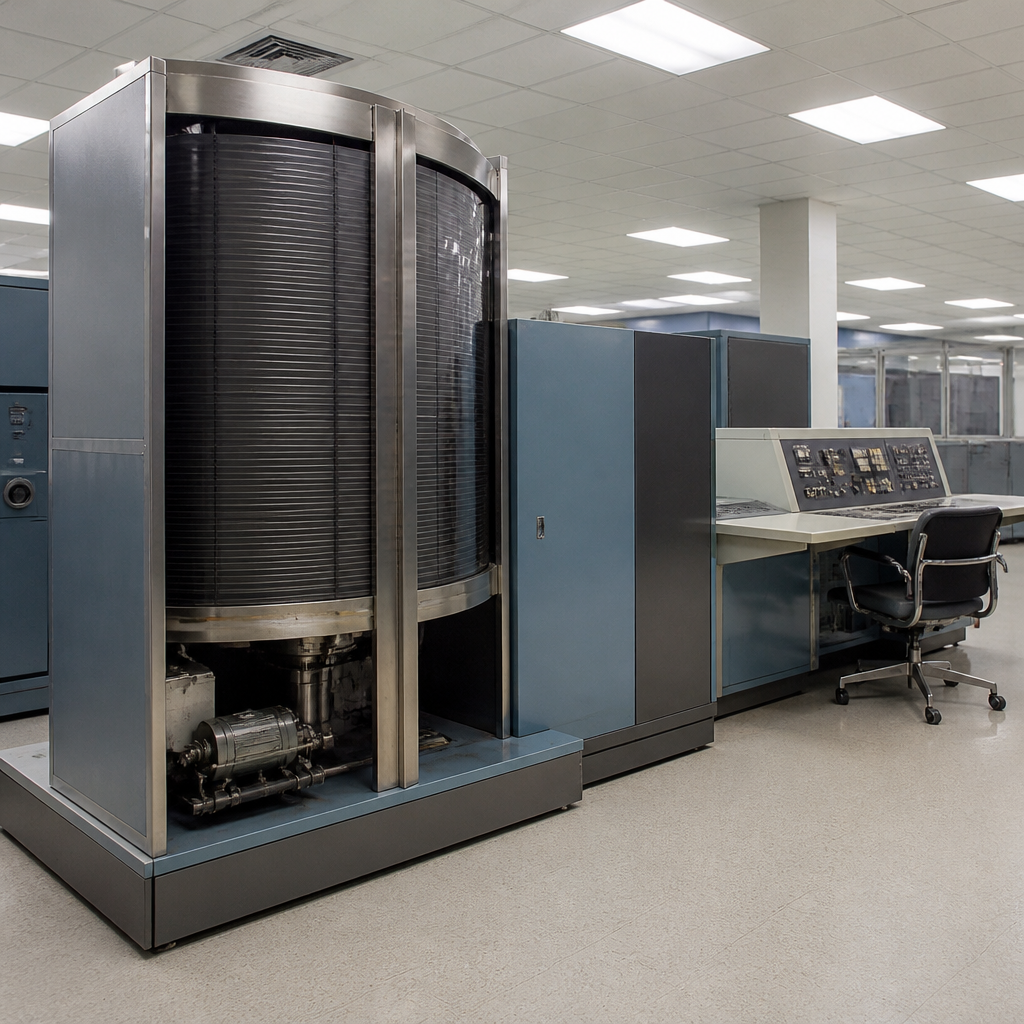
The IBM 305 RAMAC marked a turning point in computing, storage, and the long path toward today’s internet-connected world because it introduced the first commercial hard disk system. Announced by IBM in 1956, the machine’s storage unit, the IBM 350 Disk File, replaced the rigid logic of punched cards and sequential magnetic tape with something revolutionary: direct access to data. In practical terms, that meant a business could retrieve one specific record without reading everything that came before it. That single capability reshaped information handling, influenced database design, and helped establish the assumptions behind modern online systems.
To understand why the IBM 305 RAMAC matters, it helps to define the key terms. RAMAC stood for Random Access Method of Accounting and Control, a name that reflected its business purpose. Random access means the system can jump directly to a chosen location, unlike sequential storage, which must scan records in order. A hard disk system stores data magnetically on rotating platters and uses read/write heads to access those platters. Today these concepts feel ordinary. In the mid-1950s, they were transformative. I have worked with archival hardware documentation and early storage timelines, and the RAMAC consistently appears as the hinge point between mechanical record keeping and responsive electronic information retrieval.
This machine also deserves attention as a hub topic within computing, storage, and internet history because it sits at the intersection of all three. Computing history often emphasizes processors and programming languages, yet storage determines what computers can practically do. The RAMAC made larger operational datasets usable in daily business. That mattered for inventory systems, billing, reservations, and financial records, all of which later became networked services. Before cloud storage, before web servers, before search indexes, there had to be a reliable way to keep growing bodies of digital information accessible on demand. The IBM 305 RAMAC did not create the internet, but it introduced the storage model that internet-era systems still depend on.
What the IBM 305 RAMAC was and how it worked
The IBM 305 RAMAC was a business computer system designed for real-time accounting and record management. Its most famous component, the IBM 350 Disk File, used fifty 24-inch disks coated with magnetic material. Together they stored roughly 5 million characters, commonly described as about 5 megabytes by modern shorthand, although character-based capacities do not map perfectly to current byte conventions. The disks spun while a mechanical actuator moved read/write heads into position. Average access time was around 600 milliseconds, dramatically faster for random record retrieval than tape-based methods available to most businesses at the time.
Physically, the system was enormous, occupying about the footprint of two large refrigerators for the disk unit alone. It was also expensive and mechanically complex. Early RAMAC installations were leased rather than sold outright, with monthly costs that placed the machine firmly in the domain of large organizations. Yet businesses adopted it because the value proposition was clear: faster access to active records could reduce labor, improve customer service, and support decisions that previously took hours or days. In sectors with high transaction volumes, that advantage translated directly into revenue and operational control.
IBM engineered the RAMAC for practical commercial use, not laboratory demonstration. That distinction is crucial. Earlier magnetic storage ideas existed, but the 305 RAMAC put random-access disk storage into day-to-day business operations. It integrated processing, storage, and data management around real workflows such as accounts receivable, inventory lookups, and order tracking. In modern language, IBM was solving an information latency problem. Businesses no longer had to batch everything for overnight processing if they could reach current records quickly enough during the workday.
Why random access changed business computing
The biggest leap introduced by the IBM 305 RAMAC was not merely capacity. Magnetic tape could already hold substantial amounts of data. The breakthrough was access method. With tape, finding a single customer account in the middle of a file required winding through preceding records. With disk storage, the machine could go straight to the needed location. That changed system design. File structures, indexing methods, and operator procedures could be organized around immediate lookup instead of delayed batch retrieval.
Consider inventory control in a warehouse. Under a card or tape workflow, checking stock for one item often meant consulting printed reports generated at intervals, then manually verifying exceptions. With RAMAC, a clerk could retrieve the record for a specific item and update quantities closer to the time of the transaction. Airlines, banks, manufacturers, and utilities all faced versions of this same problem: too much changing information and too much cost in waiting for the next batch cycle. Direct-access storage reduced that friction and supported more timely decisions.
This shift also influenced how people thought about information itself. Records were no longer static entries sitting in sequence; they became addressable units that systems could retrieve, compare, and update as needed. That conceptual change led toward database management. Long before relational systems such as IBM System R research or Oracle databases, disk-based record access made it realistic to maintain large machine-readable files that users expected to query. The path from the RAMAC to online transaction processing is direct, even if many intermediate hardware and software advances were required.
Technical characteristics and limitations
The IBM 350 Disk File was an engineering milestone, but it had clear constraints. The heads did not fly above densely packed platters in the way later hard drives would. Mechanical movement was substantial, tolerances were demanding, and maintenance mattered. Capacity was tiny by current standards. A modern smartphone stores many millions of times more data. Even so, historical comparison must focus on function rather than raw numbers. In 1956, storing millions of characters with direct access in a commercial system was a major feat.
Performance was also bounded by the mechanics of rotation and seek motion. Access times in the hundreds of milliseconds would feel painfully slow now, yet they represented a workable compromise between speed, reliability, and cost in that era. Engineers had to balance platter size, rotational stability, head positioning, magnetic recording density, and serviceability. These tradeoffs remain familiar in storage design, although the numbers have changed. Every storage medium, from drum memory to solid-state drives, sits somewhere on the spectrum of latency, throughput, durability, and price.
| System or Medium | Typical Strength | Main Limitation | Historical Use Case |
|---|---|---|---|
| Punched cards | Human-readable workflow and simple sorting | Slow updates and physical bulk | Accounting, tabulation, payroll |
| Magnetic tape | High capacity for the period | Sequential access only | Batch processing, backups, archives |
| IBM 350 Disk File | Direct access to individual records | Large size, high cost, modest capacity | Inventory, accounting, transaction files |
| Modern SSD | Very low latency and high reliability | Higher cost per cold archive unit than tape | Databases, cloud infrastructure, endpoints |
Another limitation was environmental and operational complexity. These systems required trained staff, controlled conditions, and regular service support. They were not plug-and-play devices. IBM’s field engineering model was part of the product’s success because customers needed confidence that such a novel storage mechanism would stay operational. In that respect, the RAMAC helped establish an enduring truth of enterprise computing: infrastructure succeeds when service, software, and operations mature alongside the hardware.
From RAMAC to modern storage and the internet era
The IBM 305 RAMAC sits near the beginning of the lineage that leads to hard disk drives, networked databases, data centers, and internet services. Once random-access disk storage became commercially proven, designers could build more ambitious software around it. File systems evolved. Database indexing improved. Multi-user systems became practical. By the late 1960s and 1970s, disk storage was foundational to time-sharing, airline reservation platforms, banking systems, and enterprise resource planning. When the internet expanded decades later, servers relied on the same core premise: persistent data must be stored so it can be retrieved quickly and updated continuously.
Modern storage stacks are vastly more layered than the RAMAC. A web application today may combine DRAM for caching, NVMe solid-state drives for active datasets, object storage for scale, and tape for deep archival retention. Yet the logic behind these architectures still reflects questions first made commercially urgent in the RAMAC era: Which data must be immediately accessible? How fast must retrieval be? What is the acceptable cost per unit of storage? How should information be indexed so users can find it without delay? These are not new questions. They are the refined descendants of problems IBM tackled in the 1950s.
For readers exploring historical perspectives across computing, storage, and internet development, the RAMAC is therefore an ideal hub topic. It connects business computing to hardware engineering, information retrieval to software design, and local data processing to the later rise of networked services. If you want to understand why modern systems feel interactive, why databases matter, or why storage architecture shapes every digital platform, start with the IBM 305 RAMAC. Its legacy is simple and lasting: information became something machines could reach directly, and once that happened, the future of connected computing accelerated.
Frequently Asked Questions
What made the IBM 305 RAMAC such a breakthrough in computing history?
The IBM 305 RAMAC was groundbreaking because it introduced the first commercial hard disk storage system, the IBM 350 Disk File, and fundamentally changed how organizations could work with information. Before RAMAC, most business data processing depended on punched cards or magnetic tape. Those systems were useful, but they were slow and rigid when a company needed to locate one specific record quickly. Tape, in particular, is sequential, which means the machine often had to read through large amounts of data in order before reaching the exact item requested. The RAMAC changed that by making direct access practical in a commercial setting.
That shift mattered enormously. Instead of structuring workflows around the limitations of storage media, businesses could begin designing workflows around the needs of the user and the speed of decision-making. Inventory lookups, account updates, reservation systems, and file maintenance all became more dynamic because a record could be reached without processing everything that came before it. In that sense, the IBM 305 RAMAC was not just a new machine; it was a new model for how data could be used. It helped move computing away from batch-oriented record handling and toward interactive, responsive information systems that would eventually define modern digital life.
How did the IBM 350 Disk File work inside the IBM 305 RAMAC?
The IBM 350 Disk File, which served as the storage unit for the IBM 305 RAMAC, used a stack of magnetic disks to store information in a way that allowed direct access to individual records. Data was recorded magnetically on rotating disk surfaces, and mechanical read/write heads moved to the correct location to retrieve or update specific information. This was very different from tape-based systems, where the storage medium had to be read in order, from beginning to end or close to it, before the desired record could be found.
The core innovation was the ability to combine magnetic recording with rapid physical positioning. As the disks spun, the system could move to the proper track and access the needed data without treating the entire file as one long sequence. That design introduced a practical form of random, or more accurately direct, access storage for business computing. Although the hardware was large, mechanical, and far less efficient than later storage technologies, the concept behind it remains central to data storage history. Modern hard drives evolved dramatically in size, speed, and density, but they inherited the same basic idea: store data on spinning media and access it by moving to the specific location where that data resides.
Why was direct access to data so important for businesses in the 1950s?
Direct access was a major advancement because it solved a real business problem: the delay and inefficiency of sequential data retrieval. In the 1950s, many companies were dealing with growing volumes of records, from payroll and billing to inventory and customer accounts. If that information lived on punched cards or magnetic tape, finding and updating one record could take far too much time, especially when speed mattered. Businesses often had to organize tasks into batches and wait for scheduled processing cycles rather than responding immediately.
With the IBM 305 RAMAC, a company could request a particular record and retrieve it much more quickly. That changed what computers were useful for. Instead of being primarily machines for large scheduled calculations or overnight data runs, they could start supporting operational tasks closer to real time. For example, a business could update inventory files as transactions occurred, check account information with less delay, or improve record management in ways that were previously impractical. Direct access helped make computing more responsive, more flexible, and more aligned with everyday business operations. It was one of the key steps in the evolution from static data processing to the fast, query-driven information systems that later powered databases, networks, and internet-era services.
How did the IBM 305 RAMAC influence later hard drives and modern data storage?
The IBM 305 RAMAC set the conceptual foundation for hard disk storage by proving that direct-access magnetic disk systems could work in commercial environments. Even though the technology was primitive by modern standards, the essential storage model it introduced became one of the most important in computing history. Later hard drives became smaller, faster, cheaper, and vastly higher in capacity, but they followed the path RAMAC helped establish: persistent storage that lets systems retrieve specific data quickly without relying on sequential processing.
Its influence extends beyond hardware design. The availability of direct-access storage changed software design, database organization, and the way businesses thought about information. When storage supports fast retrieval of individual records, developers can build applications that depend on queries, indexing, updates, and more interactive forms of computing. That shift ultimately helped enable reservation systems, banking platforms, enterprise databases, personal computing, cloud infrastructure, and countless internet services. While solid-state storage now plays a major role in modern devices and data centers, the historical importance of RAMAC remains clear. It marked the point when data storage began moving toward the flexible, instantly reachable model users now take for granted.
Was the IBM 305 RAMAC really the beginning of the path toward today’s internet-connected world?
Yes, in an important historical sense, the IBM 305 RAMAC belongs on that path because modern connected systems depend on fast, practical access to stored information. The internet is often associated with networking, but networks alone are not enough. For online systems to be useful, they must be able to retrieve, update, and organize enormous amounts of data efficiently. The RAMAC represented an early and crucial step in that direction by making direct-access storage commercially viable. It helped establish the idea that information should be available on demand, not only in prearranged batches.
That principle became essential as computing expanded from isolated business machines to larger information systems and eventually to networked digital services. Search engines, e-commerce platforms, banking systems, social media, streaming libraries, and cloud applications all rely on storage systems built around the expectation of rapid access to specific records. The IBM 305 RAMAC did not create the internet, of course, but it helped shape the storage philosophy that made later interactive computing possible. In that way, it stands as one of the early milestones in the long technological arc from mid-century business machines to the always-available, data-driven world people use every day.