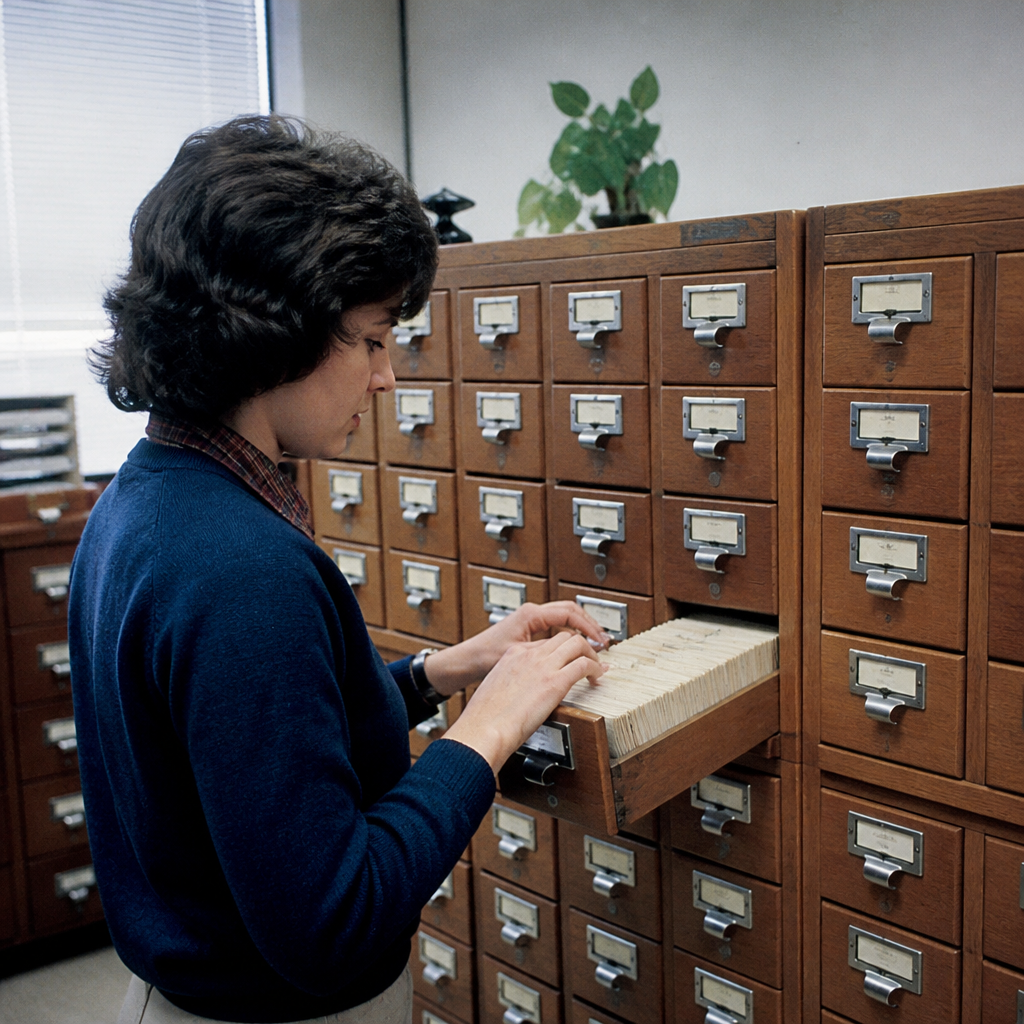
The SRI Network Information Center was the internet’s first widely used directory service, built when “finding something online” meant consulting a maintained catalog rather than typing a query into a search box. Before modern search engines indexed billions of pages automatically, network users depended on organized lists, host tables, phone-book style records, and human-edited documentation to discover computers, people, services, and files. In the historical development of computing, storage, and internet infrastructure, the NIC at Stanford Research Institute occupies a foundational place because it solved a basic problem every network faces: how users learn what is connected, who runs it, and how to reach it.
To understand why the SRI Network Information Center mattered, it helps to define the environment it served. The ARPANET, launched in 1969 with funding from the U.S. Department of Defense’s Advanced Research Projects Agency, connected research institutions through packet switching. A directory in that era was not a list of websites; the web did not exist until much later. Instead, directories described hosts, administrators, mailing lists, protocols, user resources, and documentation. The NIC became both a reference point and an operational support center, handling registration data, distributing the HOSTS.TXT file, and publishing the “white pages” of the early networked world.
I have worked with archival network documentation and legacy naming systems, and one lesson is consistent: discovery came before search. You could not use a crawler to infer the network because services were heterogeneous, file formats were inconsistent, and many resources were accessible only to approved communities. The NIC mattered because it imposed order on a rapidly changing technical landscape. It also created habits that still shape internet governance today, including centralized coordination, standard identifiers, and public technical documentation. For anyone studying computing, storage, and internet history, the SRI NIC is a hub topic because it links naming, routing, user support, protocol standardization, and the transition from curated directories to automated retrieval.
What the SRI Network Information Center Actually Did
The SRI Network Information Center, often shortened to NIC, was established at the Augmentation Research Center at SRI in Menlo Park, California. Elizabeth “Jake” Feinler led the team most closely associated with its directory work. In practical terms, the NIC served as the ARPANET’s information clearinghouse. It maintained contact records for sites and administrators, published manuals, answered user questions, assigned names, and distributed updates about network resources. If a researcher needed to know which host provided a specific service, who to contact about access, or where to obtain a protocol document, the NIC was the logical starting point.
Its role combined librarianship, systems administration, and standards support. The NIC was not merely a static archive. Staff curated information continuously, verifying site contacts and resource descriptions by hand. This mattered because the early network was small enough for human management but complex enough to become unreliable without it. A single stale address or outdated host entry could prevent mail delivery, file transfer, or remote login. The NIC reduced that friction by acting as a trusted source of current network facts.
Just as important, the NIC operated user-facing services. Researchers could connect to NIC-hosted systems and consult online directories. In an age before browser-based navigation, these systems functioned as a practical map. They helped users find organizations, official documents, and reachable machines. That made the NIC central to daily network use, not just back-office administration.
How Internet Directories Worked Before Search Engines
Before search engines, directories worked through structured curation rather than automated crawling. A resource became discoverable because someone submitted it, documented it, approved it, and placed it into a known category or file. The NIC’s methods reflected the constraints of the time: low bandwidth, limited storage, inconsistent interfaces, and a network population measured in the hundreds or low thousands, not billions. Discovery depended on metadata first and content second.
Three mechanisms were especially important. First, there were host directories, which listed machine names, network addresses, and administrative details. Second, there were person and organization listings, similar to a phone directory, allowing users to identify responsible contacts. Third, there were document and service catalogs, which explained what each host offered and how to access it. In modern terms, the directory answered: what exists, where is it, and who maintains it?
| Directory function | How it worked on early networks | Modern equivalent |
|---|---|---|
| Host identification | HOSTS.TXT listed names and network addresses distributed from the NIC | DNS records and network registries |
| People lookup | NIC white pages stored user and administrator contact details | Corporate directories and identity systems |
| Service discovery | Manual descriptions of login, file, or mail services on specific hosts | Search engines, app stores, and service catalogs |
| Document access | Catalogs of RFCs, notes, and technical references curated by staff | Indexed digital libraries and web search |
This model had clear strengths. Information quality could be high because humans verified entries. Terminology was standardized, and official records carried authority. The weakness was scale. As network growth accelerated in the 1980s, manual curation became harder to maintain. That pressure eventually drove the shift toward distributed naming systems and algorithmic search.
HOSTS.TXT, Naming, and the Limits of Centralization
One of the NIC’s most important responsibilities was maintaining HOSTS.TXT, the master file mapping host names to numeric addresses. Long before the Domain Name System, machines learned about one another by receiving periodic copies of this file. Administrators downloaded updates, and local systems used the mappings to resolve names. This process worked surprisingly well on a small network, and it demonstrates a core principle in internet history: many later “distributed” solutions began as centralized lists.
In practice, HOSTS.TXT was both elegant and fragile. It gave users readable names instead of forcing them to remember numbers, but every addition, change, or correction flowed through a central point. I have seen how quickly such files become operational bottlenecks. As the number of hosts grows, update distribution slows, duplicate names appear, and stale records propagate. By the early 1980s, these issues were no longer theoretical. The ARPANET and related networks were expanding fast enough that manual host naming could not scale indefinitely.
This limitation led directly to the development of DNS, specified in 1983 in RFC 882 and RFC 883 and later refined by RFC 1034 and RFC 1035. DNS did not erase the NIC’s legacy; it extended its core function into a distributed architecture. The need remained the same: translate human-friendly identifiers into network-locatable destinations. What changed was the method, from one authoritative file to delegated hierarchical zones.
The NIC as a Hub for Computing, Storage, and Internet History
The SRI NIC is best understood not as an isolated service but as a junction point connecting several strands of technical history. In computing, it shows how resource discovery shaped user experience before graphical interfaces. In storage, it reveals the importance of maintaining authoritative records, versioned files, and shared document repositories under severe capacity constraints. In internet development, it illustrates the evolution from centrally administered coordination to globally distributed systems.
Consider document storage alone. The NIC distributed Requests for Comments and other technical memoranda that defined protocols, conventions, and operational practice. Those documents were not passive archives; they were active infrastructure. If a site wanted to implement Telnet, FTP, or mail standards correctly, it needed access to those texts. The NIC therefore supported interoperability by storing and organizing the knowledge required to build compatible systems. That role makes it a natural hub topic for broader articles on standards bodies, RFC history, protocol suites, and archival preservation.
The NIC also highlights a social reality of early networking: trust was personal and institutional. Users often relied on named contacts, recognized labs, and official directories because the network lacked today’s abundance of discoverability signals. There were no page-rank metrics, no rich snippets, and no universal public web. Credibility came from provenance. When the NIC listed a host or contact, that listing carried weight because it represented a vetted institutional record.
From Curated Directories to Search Engines and the Web
The rise of the Domain Name System, Usenet indexing, Gopher menus, Archie, Veronica, Jughead, and eventually web crawlers marks the transition from directory-first discovery to search-first discovery. Each system solved a different part of the problem. Archie, introduced in 1990, indexed anonymous FTP file listings rather than full content. Gopher organized resources in menu hierarchies. Early web directories such as Yahoo began as human-edited catalogs, echoing the NIC’s curatorial logic. Full-text search engines later automated discovery at a far larger scale.
The shift happened because the internet changed shape. Once resources became numerous, decentralized, and publicly accessible, directory maintenance could no longer depend mainly on manual review. Automated indexing exploited falling storage costs, faster processors, and broader bandwidth. Search engines turned unstructured content into retrievable results by building inverted indexes, ranking algorithms, and link analysis methods. In other words, the web made machine-scale discovery necessary, while improvements in computing and storage made it feasible.
Yet the old directory model never disappeared entirely. Modern internet operations still depend on curated registries, certificate authorities, routing databases, WHOIS and RDAP records, software package indexes, and knowledge bases. The difference is that these systems now coexist with search rather than replacing it. The SRI NIC established the pattern: reliable networks need authoritative directories even when broader discovery tools exist.
Why the SRI NIC Still Matters Today
The historical importance of the SRI Network Information Center lies in the fact that it solved discovery, naming, and trust problems before the web existed. It showed that a network is usable only when its resources are documented, identifiable, and reachable. It also exposed the limits of central coordination, setting the stage for distributed systems like DNS. For readers exploring computing, storage, and internet history, the NIC provides a practical lens on how infrastructure matures: first through careful human curation, then through scalable automation, and finally through layered governance that combines both approaches.
The clearest takeaway is simple. Search engines did not create online discovery; they industrialized a need that directories like the SRI NIC had already defined. Understanding that earlier model makes later developments easier to interpret, from DNS and digital libraries to web indexing and internet governance. If you are building out your knowledge of historical perspectives, use the SRI NIC as a starting point and follow its connections to ARPANET operations, RFC documentation, domain naming, Gopher, Archie, and the rise of the web.
Frequently Asked Questions
What was the SRI Network Information Center, and why was it so important in the early internet?
The SRI Network Information Center, usually called the NIC, was one of the most important organizational hubs of the early ARPANET and later internet. Operated by the Stanford Research Institute, it served as a central source of trusted network information at a time when online systems were still small, specialized, and difficult to navigate. Long before anyone could type a phrase into a search engine and instantly get millions of results, users needed a dependable way to find out what computers existed on the network, who managed them, what services they offered, and how to access shared resources. The NIC filled that role.
Its importance came from the fact that early networking depended heavily on coordination. The network was not yet a vast public publishing platform with automated indexing. Instead, it was a growing but still relatively structured environment made up of research institutions, government contractors, universities, and technical organizations. The NIC maintained critical reference materials such as host directories, contact records, protocol documentation, and resource guides. In practical terms, it functioned as a combination of directory service, registrar, help desk, archive, and publishing center for network knowledge.
What made the NIC especially significant was that it imposed order on a system that could easily have become confusing and fragmented. It gave users a common point of reference and allowed administrators, researchers, and developers to work from shared records. This was essential in an era when computing resources were scarce, storage was expensive, and every network connection mattered. The SRI NIC did not “search the web” in the modern sense; instead, it made the network usable by organizing information deliberately and making that organization available to the people who needed it.
How did people find computers, services, and information online before search engines existed?
Before search engines, finding something online was much closer to consulting a library catalog, a technical handbook, or a phone directory than using Google. Users relied on curated lists, host tables, printed and digital documentation, administrators’ notes, and centrally maintained indexes. The process was often manual and depended on knowing where to look, what terms to use, and which institution or service maintained the information you needed.
One major method involved host tables, which were lists that mapped machine names to network addresses. Instead of a globally distributed naming system that updated automatically behind the scenes, users and administrators often depended on maintained files that told them what machines existed and how to reach them. If someone wanted to connect to a remote host, transfer files, or use a network service, they frequently needed to consult these records first. The SRI NIC became a central source for distributing and updating this kind of information.
People also used directory-style records for individuals and organizations. If you needed to identify the administrator of a system, locate a researcher, or find out which group was responsible for a project or resource, you would consult a maintained directory rather than run a free-text web search. In addition, users depended heavily on Request for Comments documents, technical memos, service descriptions, and resource handbooks. These were often human-edited and arranged by topic, institution, or function.
This meant discovery was more structured but also more limited. You did not search the entire online world at once. Instead, you navigated through categories, trusted registries, and known repositories. The system worked because the network community was smaller and more specialized. In that environment, careful organization often mattered more than scale, and the NIC’s role was to keep those organizing systems accurate, accessible, and useful.
In what ways was the SRI NIC more like a directory or catalog than a modern search engine?
The biggest difference is that the SRI NIC organized known information, while modern search engines attempt to discover and index information automatically at massive scale. A directory or catalog starts with deliberate inclusion: a person, institution, or managing body decides what belongs in the system, how it should be described, and where it should be placed. That was the logic behind the NIC. Its records were maintained, reviewed, categorized, and distributed as authoritative references.
Modern search engines work very differently. They use automated crawlers, ranking systems, and vast indexing infrastructure to sweep up content across billions of pages. They do not require every item to be individually approved or classified by a central human-maintained service. The early NIC model was almost the opposite. It emphasized accuracy, administrative control, and intelligibility over sheer coverage. In that sense, it resembled a card catalog, institutional archive, and operations manual combined.
Another key difference was user expectation. Today, people assume they can ask vague questions in natural language and still receive relevant results. In the NIC era, users typically approached the network with more specific goals: identify a host, retrieve a document, locate a contact, understand a protocol, or find which machine offered a given service. The system was designed to support those targeted needs. It was less about exploring an open-ended information universe and more about navigating a managed technical environment.
This directory-based approach also reflected the realities of early computing and storage. Resources were expensive, datasets were smaller, and there was stronger pressure to maintain concise, useful records rather than endlessly duplicate content. The NIC’s value came not from algorithmic ranking but from editorial structure and trust. Users depended on it because it represented a curated map of the network at a time when mapping the network was still possible by human effort.
What kinds of records and services did the Network Information Center actually maintain?
The Network Information Center maintained a wide range of records and services that were foundational to early network operation. One of its best-known responsibilities involved host-related information, including lists of networked computers and the data needed to identify and reach them. In the early ARPANET environment, this kind of information was not merely convenient; it was operationally necessary. If systems were not consistently named and documented, communication across the network became difficult and unreliable.
The NIC also maintained contact directories and organizational records. These helped users determine who was responsible for specific hosts, networks, projects, or technical issues. That might include administrators, principal investigators, institutional contacts, or support personnel. In an era before broad public internet use, online communication was still deeply tied to identifiable institutions and technical communities, so person-to-system and institution-to-resource mapping mattered enormously.
Another major role involved document distribution and archival support. The NIC became a clearinghouse for technical documentation, especially material needed to understand network protocols, standards, and procedures. This included RFC-related resources and other reference documents that were essential for developers and operators. The value of this function cannot be overstated: early networking worked because participants could rely on shared technical descriptions, and the NIC helped ensure those descriptions were available and findable.
Depending on the period, the NIC also supported registration, naming coordination, user assistance, and information referral. In that sense, it was not just a directory sitting quietly in the background. It was an active part of network governance and usability. It helped users answer practical questions, obtain official records, and navigate an ecosystem where online discovery still depended on maintained infrastructure rather than automated search. Its services reflected a time when managing information was inseparable from managing the network itself.
Why does the history of the SRI Network Information Center still matter today?
The history of the SRI NIC matters because it reveals that the internet did not begin as a chaotic sea of searchable pages. It began as a network that required curation, documentation, naming discipline, and shared administrative systems. Looking back at the NIC helps explain how digital discovery evolved from maintained catalogs to automated search, and why both models still influence the online world. Even today, some of the most important internet functions still depend on authoritative records, registries, naming systems, and trusted directories behind the scenes.
It also highlights a core truth about computing history: information is only useful when it can be organized, located, and interpreted. Advances in storage, networking, and search technology changed the scale of what could be published and indexed, but they did not eliminate the need for structure. The NIC represents an earlier stage in that evolution, when human-maintained systems carried the burden of discoverability. Understanding that period makes modern search engines easier to appreciate, because it shows just how much labor and coordination used to be required to find even basic network information.
There is also a broader lesson about trust and authority. Modern search is fast and expansive, but it can also be noisy, manipulable, and uneven in quality. The NIC belonged to a world in which information systems often prioritized verified records and institutional accountability. That does not mean the old model was better in every respect, but it does remind us that discoverability is not only a technical problem. It is also an editorial and social one.
Finally, the NIC matters because it occupies a crucial place in the story of how people learned to navigate connected computing. It was part of the transition from isolated mainframes and specialized networks to an interconnected digital environment. By studying the SRI Network Information Center, readers can see how the internet’s earliest users located machines, people, files, and services before the age of search engines—and how many of the concepts we now take for granted were built on those first carefully maintained directories.