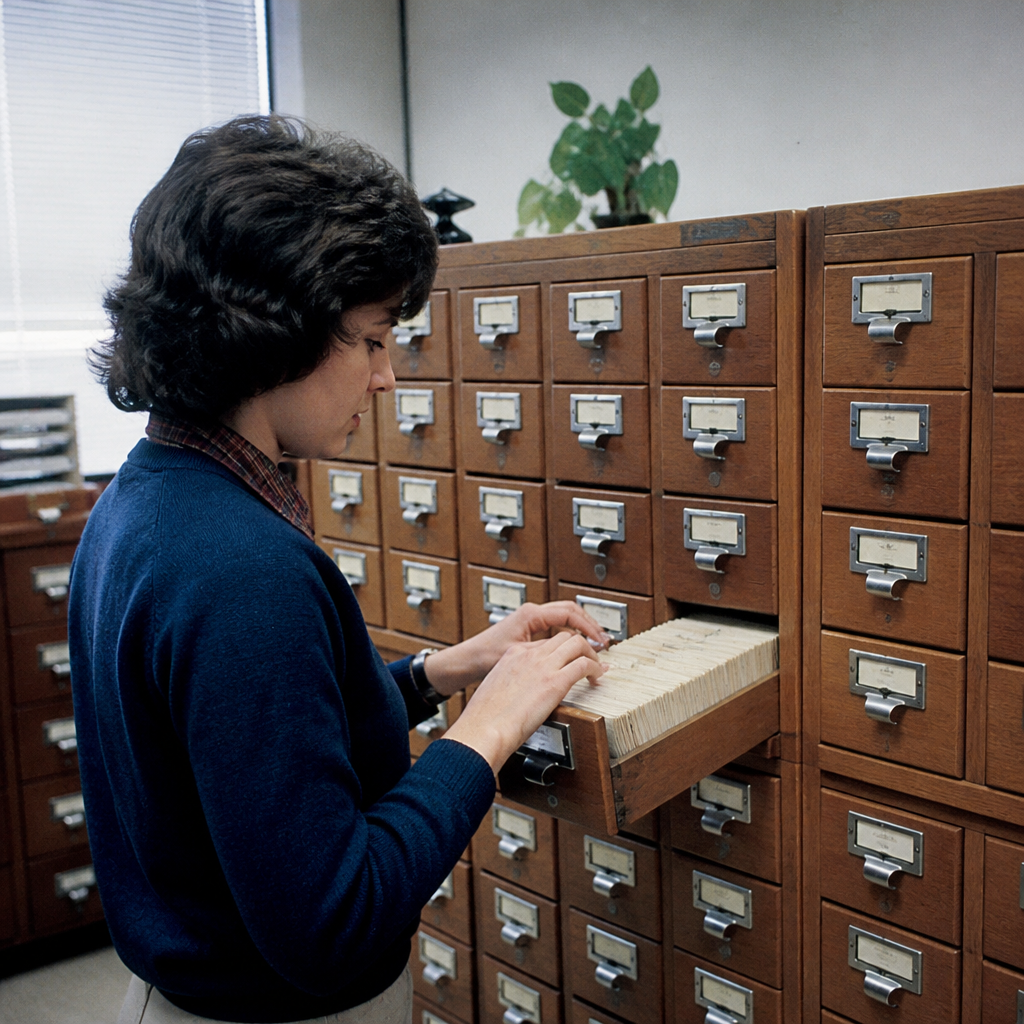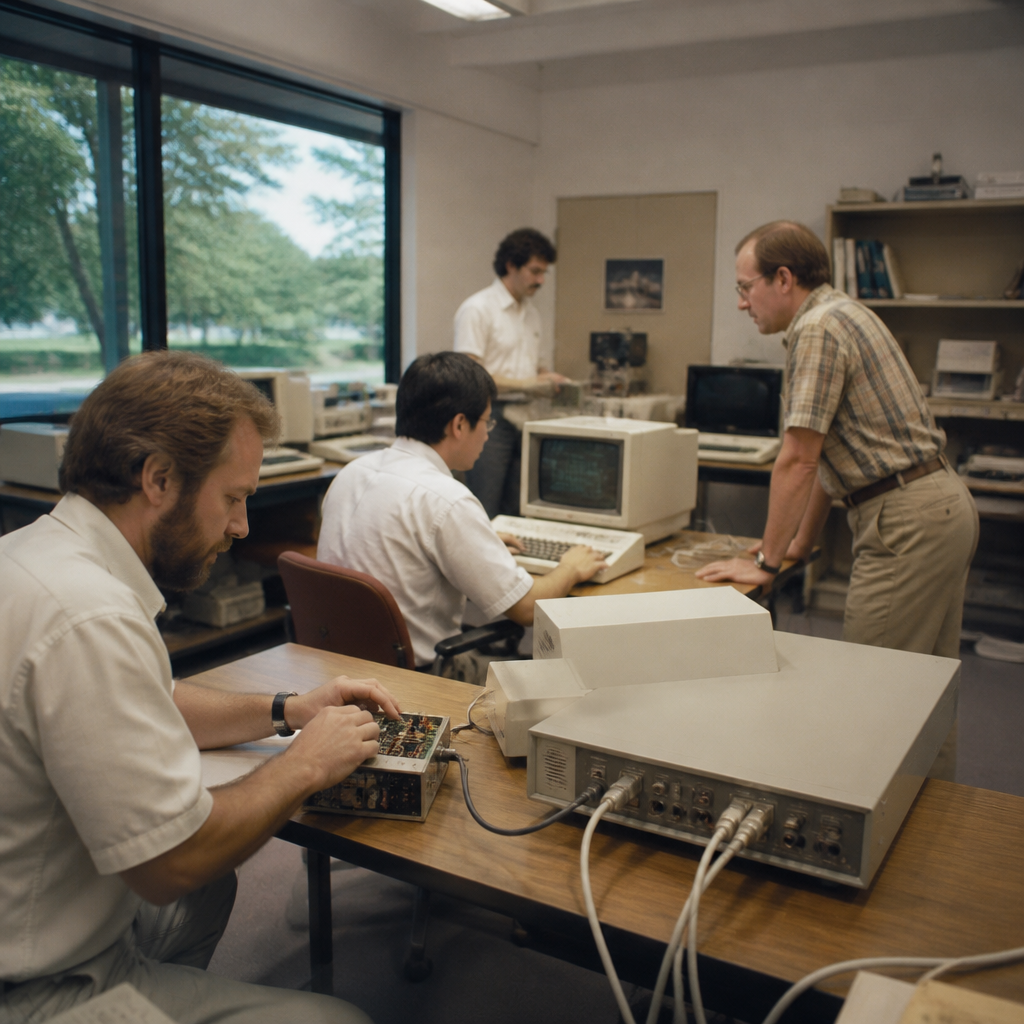
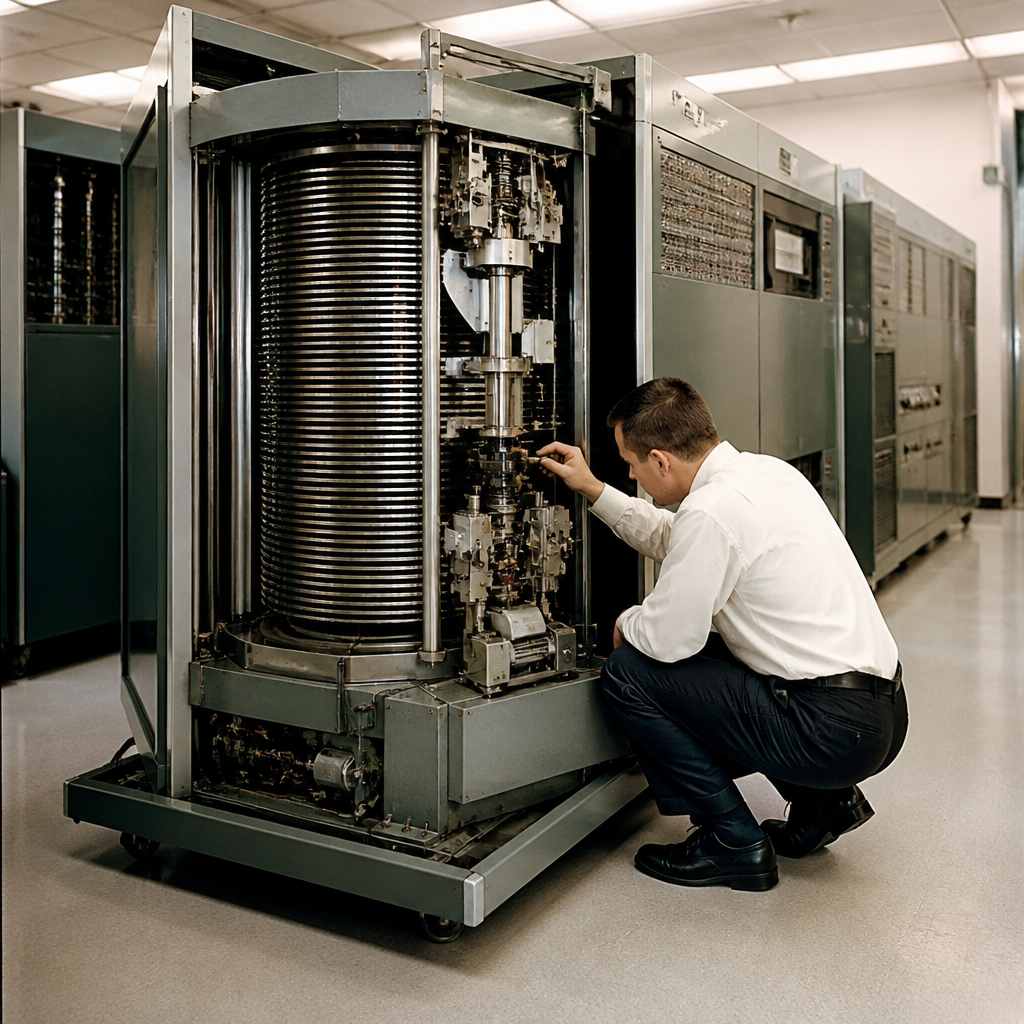
IBM San Jose and the RAMAC sit at the center of modern digital history because they mark the moment when data storage became random, reusable, and commercially practical at scale. Before the hard disk drive existed, most business machines relied on punched cards, paper tape, or magnetic tape, all of which stored information sequentially. Sequential storage meant a system had to scan through records in order, which was slow for banking, inventory, airline reservations, and any workload that required immediate lookup. The RAMAC, introduced by IBM in 1956, changed that equation by making direct access storage a real product rather than a laboratory concept.
RAMAC stands for Random Access Method of Accounting and Control, and the storage unit most associated with it was the IBM 350 Disk Storage. Developed at IBM’s San Jose laboratory under engineer Reynold B. Johnson, the IBM 350 used fifty 24-inch platters to store about 5 million characters, roughly five megabytes. That capacity sounds tiny now, but in the mid-1950s it was transformative. For the first time, a commercial customer could retrieve one record from millions without winding through a reel of tape. That single technical shift helped define interactive computing, online transaction processing, and the future geography of Silicon Valley.
This article serves as a historical hub for computing, storage, and internet development because the hard disk drive connects all three. In my work reviewing storage roadmaps and legacy infrastructure, I keep coming back to the same lesson: once organizations gained reliable random access to data, they reorganized business processes, software design, and network architecture around immediacy. The story of IBM San Jose is therefore larger than one machine. It explains how a regional engineering culture, supplier network, and ambitious customer base in Northern California helped create an industry that later powered personal computing, cloud infrastructure, and the web itself.
Why IBM San Jose mattered to the birth of the disk drive
IBM opened its San Jose research and development operation in the early 1950s, placing advanced engineering close to defense contractors, electronics talent, Stanford-linked research, and West Coast customers with large data problems. The lab became a rare place where mechanical engineering, magnetic recording, electronics, and systems thinking were combined under one commercial mission. Reynold Johnson, who had previously worked on educational devices and record processing technologies, led a team that treated storage not as an accessory but as a bottleneck that was limiting business computing.
The key insight was practical rather than abstract. Banks, retailers, and manufacturers did not merely need more storage; they needed fast retrieval of changing records. Tape was economical for backup and batch jobs, but terrible for asking simple questions like “What is the current inventory for item 247?” or “Has this customer already paid?” IBM San Jose designed around that need. Engineers had to solve head positioning, platter coating consistency, spindle reliability, air cleanliness, vibration control, and error rates long before disk drives were miniaturized. The achievement was system engineering in the fullest sense, not a single clever component.
How the RAMAC worked and what made it revolutionary
The IBM 350 Disk Storage unit used a stack of fifty aluminum disks coated with magnetic material. Read-write heads moved vertically to select a disk surface and horizontally to access tracks, allowing direct retrieval of stored records. Average access time was around 600 milliseconds, far slower than later drives but radically faster than searching sequential tape for many business tasks. Capacity was approximately 5 million six-bit characters. IBM leased the complete RAMAC 305 system rather than selling it outright, a common IBM model that lowered adoption friction for large organizations.
What made the RAMAC revolutionary was not just random access, but its integration into a business data processing workflow. Customers could update account balances, inventory records, and transaction files without rewriting entire storage volumes. That was a conceptual break from earlier methods. It encouraged software developers to think in terms of live files rather than static runs. It also made future database ideas more feasible. Long before relational systems, businesses were already learning the value of rapid lookup, modification, and indexed access patterns because disk storage made those operations economically useful.
The machine was physically enormous and mechanically delicate by modern standards, yet it delivered business value immediately. United Airlines’ reservation work, industrial inventory systems, and financial recordkeeping all pointed toward a new expectation: information should be available when needed, not hours later. Once customers experienced that shift, there was no going back to a world where the timing of access was dictated by reels and queues.
Core RAMAC facts at a glance
| Feature | IBM 350 Disk Storage | Why it mattered |
|---|---|---|
| Launch year | 1956 | Marked the first commercial hard disk drive deployment |
| System family | IBM 305 RAMAC | Connected direct access storage to accounting and control workloads |
| Capacity | About 5 MB | Enough for thousands of business records with immediate retrieval |
| Media design | 50 platters, 24 inches each | Established the platter-based architecture used for decades |
| Access method | Random access | Enabled fast record lookup instead of sequential scanning |
| Leadership | Reynold B. Johnson and IBM San Jose team | Showed the importance of multidisciplinary storage engineering |
How Silicon Valley helped make the hard disk industry possible
It is tempting to treat the RAMAC as a lone invention, but the better interpretation is regional. Silicon Valley was not yet the global brand it became later, yet the Santa Clara Valley already offered conditions that favored a breakthrough in storage technology. Stanford University had begun strengthening engineering ties with industry. Defense spending accelerated electronics manufacturing. Precision machining, instrumentation, and magnetic materials expertise were increasingly available nearby. IBM San Jose could recruit across these capabilities and iterate faster than a more isolated lab could.
This regional effect became even clearer in the decades that followed. IBM’s San Jose site helped seed a talent base that influenced storage firms across the valley. When disk drives shrank from room-sized units to removable packs, then to Winchester drives, then to personal computer form factors, engineers moved among companies, taking methods and lessons with them. The line from IBM San Jose runs through Memorex, Shugart Associates, Seagate, and many other firms that made storage one of Silicon Valley’s defining industries before software platforms dominated the public imagination.
The area also supplied demanding customers. Aerospace, semiconductors, banking, and logistics organizations all generated complex data flows. Proximity to users matters in industrial innovation. Teams can observe pain points directly, not just infer them from sales reports. That feedback loop helped storage engineering mature quickly, because reliability, serviceability, and throughput were tested against real workloads rather than idealized assumptions.
From RAMAC to databases, personal computing, and the internet
The hard disk drive mattered because it changed what computers were for. Early business computing emphasized batch processing: accumulate transactions, run them later, print reports. Disk storage enabled a move toward online systems, where current information could be queried and updated continuously. That transition fed directly into airline reservation platforms, bank account systems, manufacturing control, and later enterprise databases. IBM’s later storage products, along with systems from competitors, became the physical foundation for indexed files, transaction monitors, and eventually SQL-based platforms.
Personal computing inherited the same logic on a smaller scale. By the 1980s, hard drives made software installation, document storage, and local application performance far more practical than floppy-only systems allowed. A spreadsheet, word processor, or CAD application feels ordinary now, but these workloads depend on persistent random-access storage. The internet then extended the pattern outward. Web servers, email stores, search indexes, and content delivery platforms all relied first on magnetic disks before layering flash, object storage, and distributed file systems on top.
Even today, cloud computing still reflects the old distinction between sequential and random access. Tape remains useful for cold archives because its cost per stored bit is low. Hard disks remain critical for bulk online storage because they balance capacity and cost. Solid-state drives dominate low-latency tiers because they remove mechanical delay. When architects choose among these media, they are still working within the storage hierarchy that the RAMAC helped inaugurate.
The limitations of the RAMAC and the lessons it left behind
The RAMAC was groundbreaking, but it was not a universal solution. It was expensive, large, mechanically complex, and modest in capacity. Reliability depended on careful maintenance. Performance, while impressive for the period, would be unacceptable for later interactive systems. Those constraints matter historically because they remind us that important inventions often begin as constrained commercial compromises. The first hard disk succeeded not by being perfect, but by being useful enough to justify a new operating model for data.
Its deeper legacy lies in architecture. The IBM San Jose team proved that storage performance shapes software possibilities. They also demonstrated that media innovation is cumulative. Improvements in head flying height, areal density, servo control, error correction, clean-room manufacturing, and sealed enclosures came later, but they followed the path RAMAC opened. If you are studying computing, storage, and internet history as one connected story, this is the central takeaway: better access to data repeatedly unlocks new layers of economic and technical change. Explore the related articles in this historical perspectives hub to trace how that pattern continued from mainframes to cloud platforms.
Frequently Asked Questions
What made IBM San Jose and the RAMAC so important in the history of data storage?
IBM San Jose and the RAMAC were pivotal because they changed data storage from a slow, linear process into something far more flexible and useful for modern business computing. Before the hard disk drive, most systems stored information on punched cards, paper tape, or magnetic tape. Those media worked, but they were sequential, which meant a machine had to move through data in order until it found the record it needed. That was acceptable for batch processing, but it became a serious limitation for industries that needed fast access to constantly changing information.
The RAMAC, introduced by IBM in the 1950s, solved that problem by using magnetic disks that allowed random access to data. In practical terms, this meant a business system could retrieve a specific record without reading everything that came before it. That was a revolutionary shift. It made computing more responsive, more interactive, and much better suited to real-world operations such as banking, inventory control, and reservation systems. IBM’s San Jose operation was the center of this innovation, and its work helped establish the technical and industrial foundation for what would later become Silicon Valley’s storage and hardware ecosystem.
What does RAMAC stand for, and how did the system actually work?
RAMAC stands for Random Access Method of Accounting and Control, a name that reflects exactly why the machine mattered. It was designed to support business applications that needed immediate access to specific records rather than long sequential searches. The most famous version, the IBM 305 RAMAC, included a disk storage unit made up of multiple large magnetic platters. Data was recorded magnetically on the surfaces of those spinning disks, and a mechanical arm system moved read/write heads into position to access the required location.
What made this design so groundbreaking was not just that it stored data magnetically, but that it could jump directly to a chosen record. That capability created a new model for business computing. Instead of processing information only in large scheduled batches, organizations could update, retrieve, and manage data more dynamically. While the original RAMAC was physically huge and had modest storage capacity by modern standards, its architecture introduced the core ideas that still define hard disk drives: spinning media, movable heads, reusable storage, and direct access to stored information.
Why was random access storage such a breakthrough compared with punched cards and magnetic tape?
Random access storage was a breakthrough because it dramatically reduced the time and effort needed to find and update information. With punched cards or magnetic tape, records were arranged in sequence. If a company wanted to retrieve one customer account, one inventory item, or one transaction buried deep in a file, the system often had to scan through everything ahead of it. That was inefficient, especially as data volumes grew and businesses demanded quicker decisions.
The hard disk approach introduced by the RAMAC changed the economics and practicality of information processing. A bank could look up an account faster. A warehouse could update stock records more efficiently. An airline reservation system could check availability without waiting for long file scans. Just as important, disk storage was reusable, making it more adaptable for systems where data changed constantly. This was the beginning of storage as an active operational resource, not just an archive. In that sense, random access did more than improve speed; it reshaped what businesses expected computers to do.
How did IBM San Jose contribute to the rise of Silicon Valley?
IBM San Jose played an important role in Silicon Valley’s development by helping create one of the region’s earliest major centers of advanced computing hardware innovation. Long before Silicon Valley became globally known for semiconductors, software, and venture-backed startups, the area was already developing a culture of engineering experimentation and industrial research. IBM’s San Jose facility contributed to that environment by bringing together talent, manufacturing capability, and systems thinking around one of the most important challenges in computing: how to store and retrieve growing amounts of data efficiently.
The RAMAC project demonstrated that world-changing computer technology could be conceived, engineered, and commercialized in the Santa Clara Valley. That mattered historically because it helped anchor the region’s reputation as a place where complex technical problems could be turned into practical products. The storage industry that followed, including later hard disk companies and component suppliers, drew from the same regional strengths. In that way, IBM San Jose was not just the birthplace of an influential machine; it was part of the larger transformation that helped turn the area into a global technology hub.
What is the long-term legacy of the RAMAC in modern computing?
The RAMAC’s long-term legacy is enormous because it introduced the basic model of commercial disk storage that shaped decades of computing. Even though today’s devices are vastly smaller, faster, and denser, the RAMAC established the key idea that data could be stored on reusable magnetic disks and retrieved directly when needed. That concept supported the growth of databases, transaction processing, enterprise software, and eventually personal computing. It made digital storage far more practical for everyday operations, not just occasional or batch-oriented workloads.
Its influence also extends beyond the hard disk drive itself. By proving that direct-access storage had real business value, the RAMAC helped push computer systems toward interactivity, scalability, and continuous data management. Many of the digital experiences now taken for granted, from financial systems to cloud infrastructure, rest on the larger principle that information should be quickly accessible and constantly available. While newer technologies such as solid-state drives have changed the physical medium, the RAMAC remains a foundational milestone because it introduced the storage logic that modern information systems still depend on.