Silicon Valley has reshaped contemporary learning models by turning education into a faster, more data-driven, and more personalized system. In this context, contemporary learning models means the methods schools, universities, employers, and digital platforms use to help people acquire knowledge and skills. The learning curve, a term originally used to describe how performance improves with practice over time, now also refers to the speed, friction, and design of skill acquisition in modern education. I have worked with digital course teams and workplace training programs long enough to see the change directly: lessons are shorter, feedback loops are tighter, and learning is increasingly measured by behavior rather than seat time.
This matters because the economic life of a skill has shortened. The World Economic Forum has repeatedly argued that workers should expect major reskilling throughout their careers, and employers now hire for adaptability as much as credentials. Silicon Valley did not invent education, but it did popularize product thinking, software iteration, venture funding, platform distribution, and user analytics in ways that have altered how people learn. From adaptive learning apps to cohort-based online courses, the region’s influence extends far beyond California. Understanding that influence helps educators decide what to adopt, what to resist, and how to build a healthier learning curve for students and professionals.
At its best, the Silicon Valley approach reduces barriers to entry, broadens access to high-quality instruction, and gives learners immediate practice opportunities. At its worst, it can reward attention capture over deep understanding, push superficial completion metrics, and overstate the power of technology to solve structural inequalities. A useful hub article on the learning curve must therefore do two things at once: explain the mechanisms Silicon Valley introduced into education and evaluate the tradeoffs with precision. The central question is not whether technology affects learning. It is how the assumptions of the tech industry changed what learning is expected to look like, how progress is measured, and who benefits from the new model.
How Silicon Valley Changed the Design of the Learning Curve
One of Silicon Valley’s biggest contributions is the idea that learning experiences can be designed like products. In practice, that means mapping onboarding, activation, retention, and outcomes just as a software company would map a customer journey. Traditional education often assumed learners would tolerate friction because credentials were scarce. Technology firms assumed the opposite: if users drop off, redesign the flow. That mindset produced sign-up simplification, progress dashboards, streaks, nudges, recommendation engines, and modular lesson paths that now appear across educational resources.
The learning curve became less about passive exposure and more about time to first success. In coding education, for example, platforms such as Codecademy and freeCodeCamp reduced the intimidation of syntax by letting beginners write code in a browser and receive instant feedback. That shortened the gap between explanation and action. In language learning, Duolingo transformed repetition into short, game-like sessions with spaced review, reminders, and visible progress indicators. The pedagogical ideas behind practice and reinforcement were not new, but the delivery model was optimized for daily use at scale.
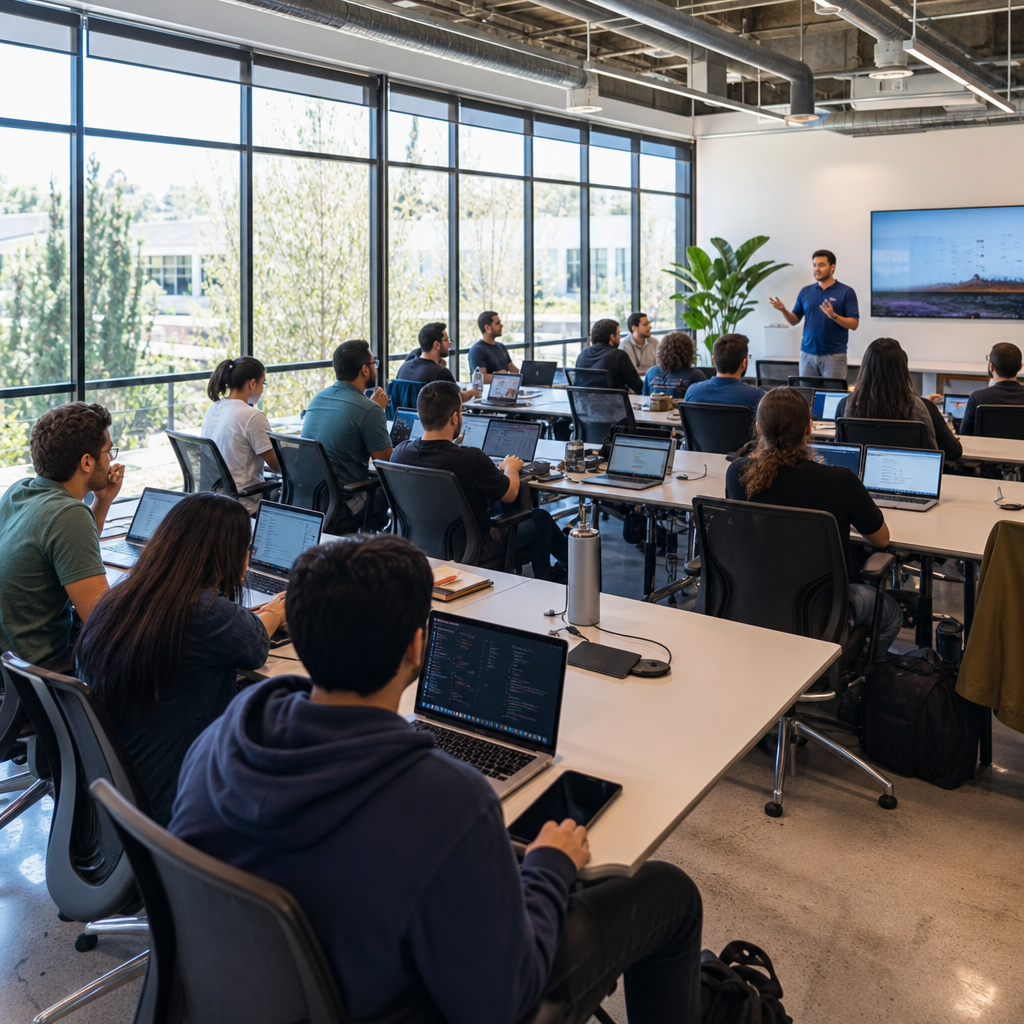
This product-driven redesign also changed expectations in formal institutions. Universities adopted learning management systems with analytics. Corporate learning teams began tracking completion, quiz performance, and application rates. Bootcamps compressed multi-year subject matter into intensive sequences focused on job readiness. The result is a steeper initial learning curve for motivated learners, especially when content is sequenced into clear milestones. However, accelerated design can hide a weakness: early wins may create confidence before conceptual depth is established. In technical subjects, that gap becomes obvious when learners face unfamiliar problems without guided prompts.
Personalization, Data, and Adaptive Instruction
Another defining Silicon Valley influence is the use of learner data to personalize instruction. Adaptive systems collect signals such as response accuracy, speed, repetition patterns, and drop-off points, then adjust the next task accordingly. The strongest versions of this model are grounded in established educational principles including formative assessment, retrieval practice, and spaced repetition. Instead of moving an entire group at one pace, adaptive learning aims to match content difficulty to the learner’s current state.
Tools like Khan Academy, DreamBox, and Coursera illustrate different forms of personalization. Khan Academy uses mastery progression and hints to support math learners. DreamBox adapts elementary math activities in near real time based on strategy use. Coursera recommends courses and specializations based on prior interests and career goals. In workplace learning, platforms such as Degreed and LinkedIn Learning curate skill paths tied to roles like project manager, data analyst, or UX designer. The shared assumption is that the learning curve improves when instruction responds quickly to evidence.
Still, personalization is not automatically effective. Data can reveal what learners clicked, how long they watched, and where they quit, but those metrics do not fully capture comprehension, transfer, or motivation. I have seen teams celebrate engagement spikes that did not translate into better performance on authentic tasks. Good adaptive instruction needs valid assessment design, not just abundant telemetry. It also requires human judgment. A learner struggling with algebra may need a different representation, encouragement, or tutoring support, none of which is guaranteed by an algorithm alone.
New Delivery Models: From MOOCs to Cohort-Based Learning
Silicon Valley helped normalize education outside conventional classrooms by funding and scaling alternative delivery models. Massive open online courses expanded access to instruction from institutions like Stanford and MIT. Later, cohort-based courses, bootcamps, and creator-led academies focused on accountability, community, and applied projects. These models serve different points on the learning curve: MOOCs are efficient for broad exposure, while cohorts are stronger for persistence, feedback, and professional identity formation.
Real-world outcomes reflect that distinction. Early MOOCs enrolled huge audiences but often recorded low completion rates, sometimes in the single digits. That did not mean they failed; many users wanted reference material, not certification. Yet low completion highlighted a core lesson about the learning curve: access alone does not produce mastery. By contrast, cohort models like altMBA, Section, and Reforge built structured deadlines, peer discussion, and project reviews into the experience. Learners paid more, but many also gained stronger completion, clearer skill application, and network effects that mattered in hiring.
| Model | Primary Strength | Main Limitation | Best Use on the Learning Curve |
|---|---|---|---|
| MOOC | Low-cost scale and broad access | Weak accountability | Exploration and foundational exposure |
| Bootcamp | Intensive job-focused practice | Compressed depth | Rapid skill transition |
| Cohort course | Community and feedback | Higher cost | Applied learning and persistence |
| Self-paced platform | Flexibility | Easy to abandon | Ongoing upskilling |
For educational resources, the practical takeaway is clear: format should match learner intent. Someone exploring data science needs a different environment from someone preparing for a technical interview or a promotion. Silicon Valley’s influence was not only creating more options; it was teaching providers to define the job the learner needs the course to do.
The Workplace, Skills Economy, and Micro-Credentials
Contemporary learning models increasingly serve labor market needs, and Silicon Valley strongly accelerated that shift. Technology employers helped popularize skills-based hiring, portfolio review, and alternative credentials because fast-changing roles often outpaced traditional degree cycles. As cloud computing, cybersecurity, product management, and machine learning expanded, industry certificates and project-based assessments gained legitimacy. Google Career Certificates, AWS Training and Certification, Salesforce Trailhead, and IBM SkillsBuild all reflect this model.
The learning curve in this environment is mapped to employability. Instead of asking whether a learner completed a course, employers ask whether the person can analyze a dataset, configure a cloud service, write maintainable code, or conduct user research. That is a healthy correction to passive credentialism. It aligns assessment with observable performance and supports midcareer learners who cannot pause for another degree. It also encourages modular learning paths where foundational knowledge, guided practice, and capstone work are assembled around a target role.
There are limits, however. Skills-first models can narrow education to immediate market value and underweight civic knowledge, ethics, writing, and historical understanding. They can also fragment learning into badges with uneven quality. Trusted credentials depend on transparent standards, rigorous assessment, and recognition by employers. Without those elements, micro-credentials become noise. The strongest programs publish competencies, require authentic tasks, and show how evidence was evaluated.
What Educators Should Adopt, Question, and Improve
Educators do not need to imitate every Silicon Valley habit to benefit from its useful ideas. They should adopt rapid feedback, learner-centered design, modular pathways, and evidence-based iteration. They should question engagement tactics that resemble compulsion loops, analytics that confuse activity with mastery, and business models that prioritize scale over support. They should improve the learning curve by combining technology with strong pedagogy: explicit instruction when concepts are new, deliberate practice when skills are forming, and reflection when transfer is the goal.
Several standards help keep that balance. Backward design remains essential: define the outcome, identify acceptable evidence, then plan instruction. Universal Design for Learning improves access by offering multiple means of engagement, representation, and expression. Learning science supports retrieval practice, spacing, worked examples, and interleaving as durable methods, regardless of platform. When schools or training teams use these principles with sensible technology choices, learners benefit from both rigor and usability.
The broad impact of Silicon Valley on contemporary learning models is therefore neither simple progress nor simple disruption. It is a powerful redesign of the learning curve around speed, access, personalization, and employability. That redesign has produced valuable educational resources and practical pathways for millions of learners, but it also demands careful scrutiny. The best next step is to audit your own learning environment: identify where friction blocks genuine progress, where data can improve support, and where human teaching must remain central. Build from there with intention.
Frequently Asked Questions
How has Silicon Valley changed contemporary learning models?
Silicon Valley has changed contemporary learning models by pushing education toward speed, personalization, scalability, and continuous feedback. Traditionally, learning was often organized around fixed schedules, standard curricula, and broad classroom averages. In contrast, the technology-driven mindset that emerged from Silicon Valley treats learning as a system that can be optimized. That means using software platforms, analytics, artificial intelligence, and user-centered design to make education more responsive to the needs of individual learners.
One of the biggest shifts is the move from one-size-fits-all instruction to adaptive learning experiences. Digital platforms can now track how a learner performs in real time, identify gaps, and recommend targeted next steps. This has influenced schools, universities, workplace training programs, and independent online learning platforms alike. It has also expanded the idea of where learning happens. Education is no longer confined to a classroom or semester calendar; it can happen on-demand, remotely, and in short, flexible formats that fit around work and life.
Just as important, Silicon Valley has reframed learning as an ongoing process rather than a stage of life. In this model, people are expected to update their skills continuously as industries evolve. That has contributed to the rise of micro-credentials, bootcamps, online certificates, and skills-based hiring. The result is a contemporary learning landscape that is faster, more modular, and more closely connected to measurable outcomes than many traditional models were in the past.
What does the learning curve mean in the context of modern education?
In modern education, the learning curve means more than the classic idea that performance improves with repeated practice over time. It now also describes how quickly someone can begin learning, how much friction they encounter, and how effectively a learning experience is designed. In other words, the learning curve has become both a measure of progress and a way of evaluating the structure of the learning system itself.
Silicon Valley’s influence is clear here because digital product design has shaped expectations around usability and efficiency. If a learning platform is confusing, slow, or poorly sequenced, it creates unnecessary barriers and steepens the learning curve in unhelpful ways. If it is intuitive, adaptive, and engaging, it can reduce friction and help learners build competence faster. This makes interface design, feedback loops, content pacing, and personalization central parts of educational strategy, not just technical details.
That broader definition matters because contemporary learning models increasingly serve people who need practical results quickly, whether they are students, employees, or career changers. A strong modern learning model does not simply deliver content; it helps learners gain momentum. It supports retention, confidence, and transfer of knowledge into real-world performance. So today, the learning curve is as much about the architecture of learning as it is about the effort of the learner.
Why is data such an important part of Silicon Valley-inspired education systems?
Data plays a central role because it allows educators, institutions, and platforms to move from intuition-based teaching toward evidence-informed learning design. In Silicon Valley-inspired systems, data is used to understand how learners engage with material, where they struggle, how long tasks take, what content leads to better outcomes, and which interventions improve performance. This creates opportunities to make learning more precise and more responsive.
For example, instead of waiting until the end of a course to discover that a student did not understand a major concept, modern platforms can detect signs of difficulty early. They can flag patterns such as repeated errors, low participation, or stalled progress and respond with hints, review modules, or human support. This helps reduce wasted time and can improve completion rates and mastery. In workplace learning, the same logic helps employers identify skill gaps and align training with changing business needs.
At the same time, the growing reliance on data raises important questions. Not everything valuable in education is easy to measure. Curiosity, creativity, ethical reasoning, and deep reflection may not fit neatly into dashboards. There are also concerns about privacy, surveillance, and bias in algorithmic decision-making. So while data can significantly improve learning models, the most effective and responsible systems use it as a tool for insight rather than as the only definition of learning success.
How has personalization influenced schools, universities, and workplace learning?
Personalization has become one of the most visible effects of Silicon Valley on contemporary learning models. In practical terms, personalization means adjusting content, pacing, feedback, and pathways to better match a learner’s background, goals, strengths, and areas for improvement. This differs from traditional models that often expected everyone to move through the same material at the same speed regardless of individual readiness or interest.
In schools and universities, personalization can take many forms, including adaptive software, customized assignments, competency-based progression, and early alerts for students who need support. In workplace learning, it often appears as role-specific training, recommended skill pathways, and on-demand modules designed around immediate job needs. Digital platforms make this possible at scale by collecting performance signals and using them to shape the next learning step for each person.
The appeal of personalization is obvious: it can make learning more efficient, more relevant, and more motivating. Learners are less likely to be bored by material they already know or overwhelmed by content they are not ready for. However, personalization works best when it is balanced with strong teaching, clear standards, and shared intellectual experiences. Education is not only about tailoring content to the individual; it is also about developing common knowledge, communication skills, and the ability to learn with and from others. The strongest contemporary learning models recognize both sides of that equation.
What are the benefits and drawbacks of Silicon Valley’s impact on education?
The benefits are substantial. Silicon Valley has helped make learning more accessible, flexible, and closely tied to practical skill development. People can now access courses from almost anywhere, learn at their own pace, receive rapid feedback, and build targeted competencies without always following traditional academic pathways. This has expanded opportunity for working adults, remote learners, and individuals seeking career transitions. It has also encouraged institutions to think more seriously about user experience, measurable outcomes, and lifelong learning.
Another major advantage is responsiveness. Contemporary learning models influenced by Silicon Valley can evolve quickly as technology, labor markets, and learner needs change. New credentials, modular programs, and digital learning ecosystems can be created faster than many legacy educational structures. That agility can be especially valuable in fast-moving industries where skills become outdated quickly and where learners need efficient ways to stay current.
Still, there are drawbacks that should not be overlooked. A strong focus on speed and optimization can encourage a narrow view of education, where only easily measurable or job-linked skills are prioritized. There is a risk of treating learning as a product rather than a human developmental process. Not all valuable learning is immediate, quantifiable, or efficient. Deep reading, critical thinking, collaboration, and intellectual exploration often require time and complexity. There are also concerns about digital inequality, overreliance on platforms, data privacy, and the commercialization of learning. The long-term challenge is not whether technology should influence education, but how to use that influence in ways that improve access and performance without weakening the broader purpose of learning itself.