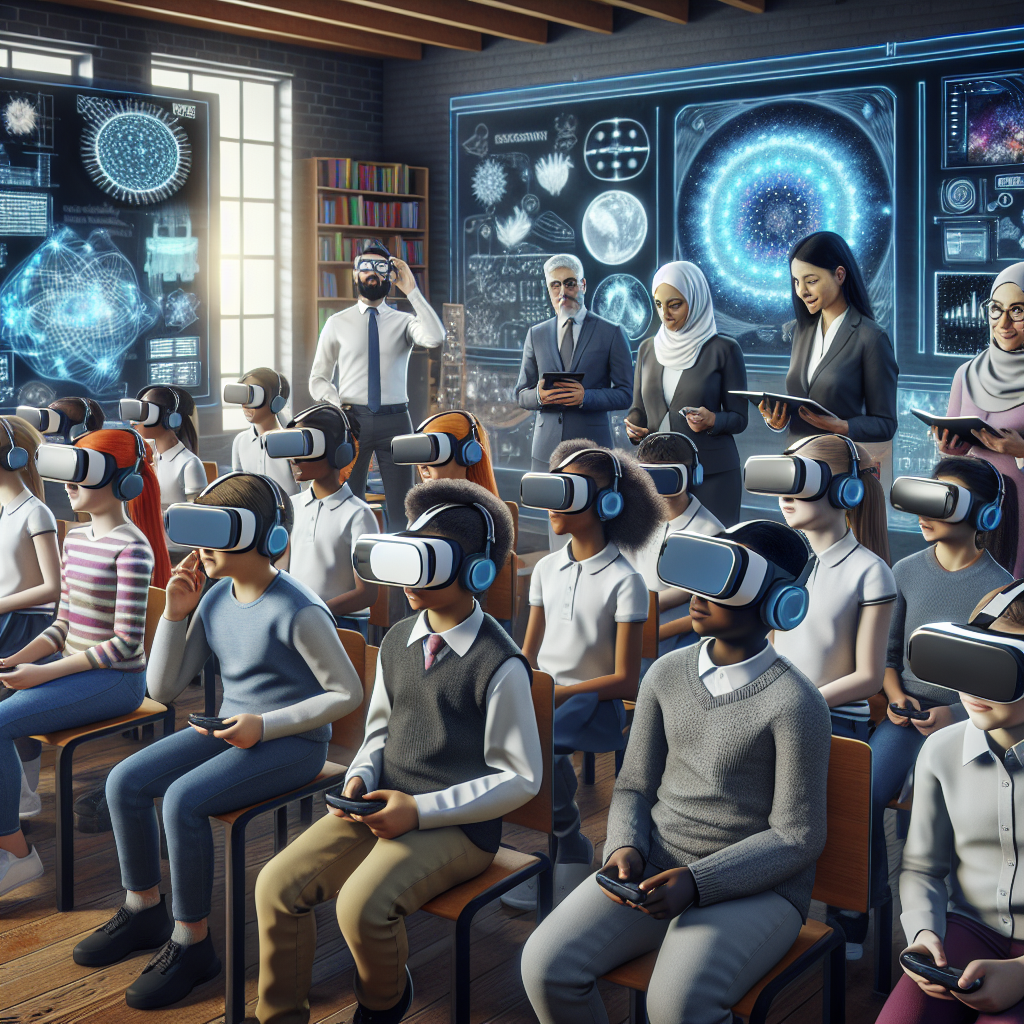
Silicon Valley, often regarded as the world’s tech nirvana, continually drives innovation and sets trends that reverberate across the globe. One of the most transformative developments emerging from this technological powerhouse is the integration of Virtual Reality (VR) into education. Imagine a classroom where students don’t just read about the Roman Empire but wander through ancient Rome, interact with historical figures, and witness historic milestones in real-time. This is the promise and potential of VR in education—a cutting-edge dimension that Silicon Valley is fervently exploring. This article delves into the latest VR educational startups, the benefits they bring to the learning experience, and the broader implications for the future of education.
Education has always been a fertile ground for technological advancement. From the introduction of the blackboard to smart classrooms, the quest to enhance learning experiences has been relentless. With the advent of VR, education is entering a new frontier, one where the lines between the virtual and the real world blur, creating immersive and interactive learning environments. Spearheading this educational revolution are startups nestled in Silicon Valley’s innovative ecosystem, where creativity meets technology, and ideas become transformative ventures.
However, the intersection of VR and education is more than just a technological novelty; it’s about reimagining how we learn and teach. VR embodies the potential to democratize education, making immersive, experiential learning accessible to all, regardless of geographical or socio-economic barriers. As we navigate through this article, we’ll explore how Silicon Valley’s VR startups are shaping the future of education, one immersive experience at a time.
Virtual Reality Startups Leading the Charge
Silicon Valley is home to a plethora of VR startups that are pioneering innovative solutions for education. Two notable names that are making waves in this space are Alchemy VR and zSpace. These companies are dedicated to creating educational content that is not only engaging but also pedagogically sound, ensuring that the immersive experience translates to tangible learning outcomes.
Alchemy VR, co-founded by content creators from the BBC, aims to produce high-quality VR educational experiences. Their mission is to transform traditional learning by immersing students in environments and scenarios that textbooks could never offer. Imagine a biology class where students shrink down to explore the inner workings of a cell, or a history lesson that transports them to witness the signing of the Magna Carta.
On the other hand, zSpace focuses on providing an even more interactive experience by creating VR and augmented reality (AR) learning environments that can be used in fields from sciences to technical education. zSpace’s approach allows students to interact with complex 3D models, whether it’s dissecting a virtual frog or exploring the intricacies of a mechanical engine. The combination of VR and AR provides a robust platform where learning becomes an engaging, hands-on experience.
These companies exemplify how VR is not just an add-on but a fundamental reinvention of educational tools, championing a new era where interactive and immersive learning becomes the norm.
Benefits of VR in Education
The incorporation of VR into education brings a wealth of benefits, redefining how knowledge is imparted and absorbed. One of the most significant advantages is the enhancement of engagement and motivation. Traditional teaching methods often struggle to capture the attention of digital-native students. VR, however, taps into their technological fluency, presenting information in an interactive and captivating manner that naturally aligns with their learning preferences.
Additionally, VR facilitates experiential learning, which is known to reinforce comprehension and retention of information. When students are placed in a lifelike environment where they can observe, interact, and participate actively, the learning experience transcends beyond mere rote memorization. For instance, in subjects like geography, students can virtually visit different parts of the world, observe geographical features, and understand climate variations firsthand, leading to a deeper and more meaningful engagement with the material.
Furthermore, VR supports differentiated learning, catering to the diverse needs of students. It can provide customized experiences that adapt to individual learning paces and styles. Students who require additional practice or those who excel and seek more challenging content can both benefit from VR’s flexible and scalable nature.
Ultimately, VR has the potential to bridge gaps in education accessibility by providing high-quality, immersive educational experiences to remote or underprivileged areas. This democratization of education ensures that every student, regardless of their circumstances, has the opportunity to engage with and benefit from innovative learning tools.
Challenges and Considerations
While the promise of VR in education is compelling, it’s not without its challenges. One of the main obstacles is the high cost of VR equipment and software. Schools and educational institutions, especially those in underfunded areas, may find it difficult to allocate budgets for such investments. Ensuring that the benefits of VR are accessible to all students requires significant financial commitment and strategic funding solutions.
Additionally, there’s a steep learning curve for both educators and students who are not familiar with VR technology. Professional development and training are crucial for teachers to effectively integrate VR into their curricula. Without the proper training, the technology can become underutilized or misapplied, leading to suboptimal educational outcomes.
Another consideration is the potential for health impacts. Prolonged use of VR headsets can cause eye strain, motion sickness, and other physical discomforts. Developers and educators must work together to establish guidelines and best practices for the safe use of VR in educational settings.
Moreover, content development for VR is still in its nascent stages. Creating high-quality, educational VR content requires considerable resources and expertise. Collaborations between tech companies, educators, and content creators are essential to produce effective and accurate educational materials that enhance learning.
Despite these challenges, the potential benefits of VR in education far outweigh the obstacles. With continued innovation and targeted efforts to address these challenges, VR can gain a foothold and become an integral part of the educational landscape.
Case Studies and Success Stories
Several pioneering schools and educational institutions have already begun integrating VR into their educational frameworks with remarkable success. One such example is the Franklin Institute in Philadelphia, which has implemented VR as part of its science education programs. Students can now take virtual tours through the human body, providing an immersive understanding of anatomy and physiology that traditional textbooks and lectures cannot match.
Similarly, Stanford University’s Virtual Human Interaction Lab has been at the forefront of researching the impact of VR on learning. Their studies have shown that VR can significantly enhance students’ understanding of complex scientific concepts, such as astrophysics and environmental science, by allowing them to visualize and interact with phenomena that are otherwise abstract or too distant to observe firsthand.
Another notable success story comes from the Cleveland Museum of Art, where VR has been used to create immersive art experiences. Visitors, including students, can now explore historical contexts, artistic techniques, and cultural backgrounds through virtual reality, making art history more engaging and accessible.
These case studies highlight the transformative power of VR in making learning more dynamic, interactive, and impactful. By showcasing tangible results and practical applications, they pave the way for broader acceptance and adoption of VR in various educational settings.
The Future of VR in Education
As we look towards the future, the role of VR in education is expected to expand and evolve. Advancements in VR technology, such as increased immersion through haptic feedback and improved graphics, will further enhance the learning experience. Additionally, as the cost of VR equipment decreases, we can anticipate wider accessibility and integration across different educational levels, from primary schools to universities.
One of the promising trends is the development of collaborative VR environments where students from different parts of the world can interact and learn together in a shared virtual space. This fosters a more inclusive and globalized approach to education, breaking down geographical barriers and promoting cultural exchange and cooperation.
Moreover, AI-powered adaptive learning within VR environments holds great potential. Imagine a VR tutor that can analyze a student’s performance in real-time, providing personalized feedback and adjusting the difficulty level to match their learning pace. This level of customization can revolutionize individual learning experiences, ensuring that each student receives tailored support to achieve their full potential.
The integration of VR in professional training and skills development is another area poised for growth. From medical students performing virtual surgeries to engineering students constructing virtual bridges, VR can provide safe, realistic training environments that prepare students for real-world challenges.
In conclusion, the future of VR in education is bright and promising. As Silicon Valley continues to lead the charge, the ongoing innovation and collaboration between technologists, educators, and content creators will shape a new era of immersive, experiential learning.
Conclusion:
The integration of Virtual Reality in education, driven by the innovative spirit of Silicon Valley, represents a monumental shift in how we approach teaching and learning. By creating immersive, interactive, and engaging learning experiences, VR has the potential to revolutionize education, making it more accessible, effective, and enjoyable for students worldwide.
While there are challenges to overcome, such as cost, training, and content development, the benefits of VR far outweigh these obstacles. With continued investment, research, and collaboration, VR can become a fundamental part of the educational landscape, helping students achieve deeper understanding and retention of knowledge.
The success stories and case studies of early adopters demonstrate VR’s transformative potential, providing a blueprint for future implementations. As technology advances and becomes more accessible, we can expect to see a proliferation of VR applications across various educational settings, catering to diverse learning needs and preferences.
Ultimately, VR in education is not just about incorporating new technology; it’s about reimagining the entire learning experience. By placing students at the center of the learning process, VR empowers them to explore, discover, and engage with knowledge in ways that were previously unimaginable. As Silicon Valley continues to innovate and push the boundaries of what’s possible, the future of VR in education holds boundless potential for creating a more dynamic, inclusive, and impactful learning environment for all.