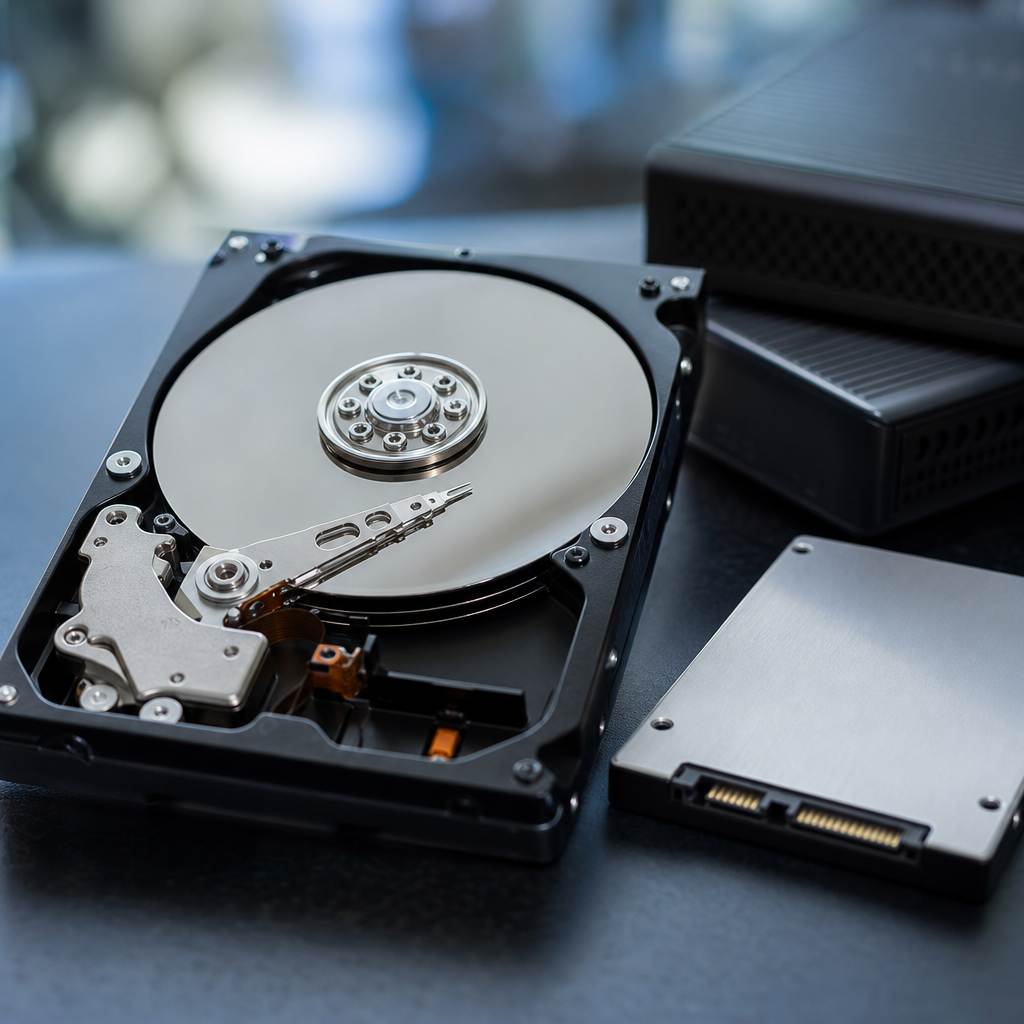
Western Digital is one of the most influential names in modern data storage, shaping how consumers, enterprises, and cloud providers capture, protect, and move information. In the Company Spotlights universe, this hub on Movers and Shakers examines why Western Digital matters, what products define its portfolio, and how its strategic decisions affect the broader storage market. Data storage refers to the hardware and software systems used to record digital information for later access, while data solutions encompass the platforms, architectures, and services that make storage practical at scale. Western Digital operates across both areas, from portable SSDs for creators to high-capacity hard drives built for hyperscale data centers.
I have followed storage vendors through product launches, supply shortages, NAND pricing swings, and infrastructure refresh cycles, and Western Digital consistently appears at the center of major market shifts. That visibility comes from reach and from technical depth. The company has built a brand around hard disk drives, flash memory, and platform-level storage technologies, while integrating acquired businesses including SanDisk and HGST into a broad portfolio. For buyers researching storage infrastructure, Western Digital is relevant because it serves distinct use cases with specialized product families instead of treating all capacity needs as the same problem.
This hub matters because storage is no longer a background purchase. Artificial intelligence workloads, edge computing, remote collaboration, surveillance retention, and compliance rules all increase the need for dependable, cost-aware data management. Western Digital sits where these pressures meet: balancing capacity, performance, endurance, energy use, and total cost of ownership. Understanding the company helps readers compare options across the Company Spotlights category and branch into related articles on semiconductor firms, infrastructure suppliers, and enterprise technology leaders. As a Movers and Shakers hub, this article connects product strategy, manufacturing realities, and market influence in plain terms.
Western Digital’s business model and market position
Western Digital designs, manufactures, and sells storage devices and related technologies for client systems, gaming, mobile devices, data centers, and industrial environments. Its core businesses have historically centered on HDD and flash. HDDs remain vital for bulk storage because they deliver the lowest cost per terabyte for large data sets. Flash products, especially NAND-based SSDs, deliver lower latency and higher input/output operations for applications that need speed. Western Digital competes with Seagate in HDDs and with firms such as Samsung, Micron, Kioxia, and Solidigm in flash and SSD segments.
The company’s market position is important because it spans consumer and enterprise channels at the same time. A shopper may know the WD Blue, WD Black, or SanDisk Extreme names, while infrastructure teams are more likely to know Ultrastar drives, OpenFlex architecture, and enterprise SSD lines. That range allows Western Digital to benefit from consumer demand cycles and from long-term enterprise contracts, though it also exposes the company to swings in PC shipments, cloud capital spending, and memory pricing. In practice, this makes Western Digital a useful barometer for broader storage industry conditions.
Corporate structure also shapes the story. Western Digital has spent years refining how it presents its HDD and flash businesses, especially as investors evaluate whether each segment would perform better with distinct strategic priorities. Those discussions matter because HDD and flash follow different technology roadmaps, margin profiles, and capital requirements. When buyers assess Western Digital, they are not just evaluating products; they are watching how leadership manages manufacturing partnerships, inventory discipline, and research investments across two storage worlds that increasingly complement each other rather than fully compete.
Key product families and where they fit
Western Digital’s portfolio is easier to understand when grouped by use case. WD Blue products usually target mainstream consumers and office users. WD Black is aimed at gaming and performance-sensitive workloads. WD Red is built for network-attached storage, where firmware tuning and vibration tolerance matter in multi-bay enclosures. Purple drives focus on surveillance workloads that write continuously and need reliable retention over long periods. In enterprise settings, Ultrastar products represent the high-capacity, high-duty-cycle tier intended for servers, cloud platforms, and large storage arrays.
Flash products follow a similarly segmented logic. SanDisk-branded cards and portable SSDs serve cameras, phones, and mobile professionals. Internal NVMe SSDs target faster boot drives and application performance for PCs and workstations. Enterprise SSDs address databases, virtualization, analytics, and mixed workloads where latency consistency and endurance are as important as raw throughput. In my experience evaluating vendor positioning, Western Digital is strongest when it clearly ties each product line to workload behavior, because buyers often choose the wrong storage class when branding is vague.
| Product family | Primary use case | Why it matters |
|---|---|---|
| WD Blue | Everyday PCs and mainstream storage upgrades | Balances price, reliability, and solid baseline performance |
| WD Black | Gaming rigs and performance desktops | Targets speed-sensitive applications and enthusiast buyers |
| WD Red | NAS systems for home offices and small businesses | Optimized for RAID environments and 24/7 operation |
| WD Purple | Video surveillance recording | Built for sustained writes and retention-heavy deployments |
| Ultrastar | Enterprise servers, cloud, and data centers | Delivers capacity, durability, and fleet-scale economics |
| SanDisk Extreme | Portable storage for creators and mobile users | Combines rugged design with fast transfer speeds |
This segmentation reflects a practical truth: storage performance is contextual. A 22TB HDD can be ideal for archive and object storage, while a PCIe NVMe SSD is better for real-time analytics or application acceleration. Western Digital’s advantage is that it can serve both ends of that spectrum. Its challenge is to communicate tradeoffs honestly. Hard drives remain unbeatable on economics for mass capacity, but SSDs win decisively on latency and responsiveness. Good storage planning often means using both, and Western Digital’s broad catalog supports that hybrid reality.
Technology roadmap: HDD innovation, NAND, and platform strategy
Many readers assume hard drives are mature and flash will simply replace them, but the market is more nuanced. Western Digital has continued pushing HDD capacity through technologies such as energy-assisted recording and improvements in areal density, mechanics, and firmware. In hyperscale environments, every additional terabyte per drive can lower rack footprint, power consumption per stored unit, and operational complexity. That is why cloud operators still buy large volumes of enterprise HDDs for warm and cold data tiers. In recent years, capacities above 20TB have become central to cloud and backup strategies.
On the flash side, Western Digital has long been associated with NAND through its relationship with SanDisk and manufacturing collaboration in Japan with Kioxia. NAND scaling depends on layer counts, controller optimization, error correction, endurance management, and packaging efficiency. These details affect real outcomes: how long a drive lasts, how consistently it performs under sustained load, and how efficiently it handles writes. Western Digital’s SSD success depends not only on memory supply but also on firmware quality and controller architecture, which are the hidden factors buyers only notice when something goes wrong.
Platform strategy matters as much as components. Storage vendors increasingly sell solutions rather than isolated drives, especially in enterprise deployments. Western Digital has promoted concepts such as disaggregated storage and composable infrastructure, where capacity can be pooled and assigned more flexibly. Standards from organizations like SNIA and interfaces such as NVMe and NVMe over Fabrics influence these designs. For decision-makers, the takeaway is clear: Western Digital is not only shipping devices. It is participating in the architectural shift toward scalable, software-aware storage environments built for cloud-native and AI-adjacent workloads.
Leadership, strategy shifts, and industry impact
As a Movers and Shakers company, Western Digital deserves attention not just for what it sells but for how leadership decisions ripple across supply chains and customer planning. Storage is a capital-intensive industry with long qualification cycles and volatile demand patterns. When Western Digital adjusts output, reorganizes business units, or signals a strategic separation between HDD and flash operations, channel partners, OEMs, and investors pay attention. Those moves can influence pricing, inventory availability, and roadmap confidence across the market, especially during downturns or periods of rapid AI-driven infrastructure spending.
The company’s acquisition history also explains its influence. Buying HGST strengthened enterprise HDD capabilities and gave Western Digital stronger standing with data center customers. Acquiring SanDisk expanded flash expertise, consumer reach, and manufacturing leverage. These were not cosmetic deals; they redefined the company’s identity. I have seen few storage vendors blend legacy magnetic media and modern flash branding as visibly as Western Digital has. The integration work has not always been simple, but it created a portfolio broad enough to compete in consumer retail aisles and in hyperscale procurement discussions.
Western Digital’s impact extends to channel education and buyer expectations. When it launches a new NAS drive class, refreshes portable SSD branding, or updates enterprise capacity points, competitors often respond with positioning of their own. That is a hallmark of a market mover. The company also affects how buyers think about workload-specific storage. Instead of asking only, “How much capacity do I need?” organizations increasingly ask, “What data tier is this, what latency does it require, and what endurance profile fits?” Western Digital has helped normalize that more mature conversation.
What buyers, investors, and readers should watch next
Looking ahead, the biggest questions around Western Digital involve execution. Can it maintain HDD leadership as cloud customers demand ever higher capacities? Can its flash business compete effectively in a market where pricing cycles are brutal and differentiation is technically difficult? Can it translate product breadth into cleaner messaging and stronger margins? Buyers should watch enterprise qualification wins, portable SSD reliability perception, and how the company communicates roadmap timing. Investors should monitor demand recovery, gross margin trends, capital spending discipline, and any structural changes that alter how the market values HDD versus flash.
For readers exploring Company Spotlights, Western Digital is a strong hub entry because it connects many recurring themes across Movers and Shakers: consolidation, technology transitions, supply chain strategy, and the tension between commodity hardware and specialized solutions. The company’s story shows that storage is not a simple capacity race. It is a balancing act among economics, engineering, manufacturing scale, and customer trust. If you are building a shortlist of influential infrastructure companies, use Western Digital as a reference point, then continue to the related spotlight articles to compare how other leaders are shaping the future of data storage.
Frequently Asked Questions
1. Why is Western Digital considered such an important company in the data storage industry?
Western Digital is considered a major force in data storage because it plays a central role in how digital information is created, stored, accessed, and protected across consumer, business, and cloud environments. Over the years, the company has built a strong position by delivering storage technologies that serve very different needs, from everyday personal backup and gaming storage to enterprise infrastructure and hyperscale data center deployments. That breadth matters because modern data growth is not limited to one market segment. Individuals are storing more photos, videos, and game files, while businesses are managing expanding volumes of operational data, and cloud providers are handling massive workloads at global scale.
What makes Western Digital especially influential is its ability to participate across multiple layers of the storage ecosystem. The company has long been associated with hard disk drives, but its relevance extends beyond traditional HDDs into solid-state storage, external drives, embedded flash, and platform-level solutions for enterprise and cloud customers. That broad portfolio gives it visibility into changing storage demands and allows it to help shape industry direction. When Western Digital introduces new capacity points, performance improvements, or strategic product shifts, those moves can affect purchasing decisions, supply expectations, and competitive behavior throughout the market.
Its importance is also tied to the fact that data storage is foundational infrastructure. Nearly every digital service depends on reliable storage hardware somewhere in the chain. Whether the use case is a home user backing up family media, a creative professional editing large files, a corporation archiving records, or a cloud provider supporting AI and analytics workloads, storage remains essential. Western Digital matters because it is one of the companies that helps make that infrastructure available at scale, and because its product and strategy decisions often reflect larger trends in how the world handles data.
2. What are the main types of products and solutions Western Digital is known for?
Western Digital is best known for offering a wide range of storage products designed for different performance, capacity, durability, and workload requirements. One of its most recognizable categories is hard disk drives, which continue to be important for cost-effective, high-capacity storage. HDDs are widely used in desktops, external backup devices, network attached storage systems, surveillance applications, and large-scale data centers where storing massive amounts of data economically is a top priority. Despite the rise of flash storage, hard drives remain highly relevant, especially for bulk storage and archival workloads.
The company is also closely associated with solid-state storage products. SSDs are valued for their faster read and write speeds, lower latency, improved shock resistance, and compact form factors. These advantages make them useful in laptops, gaming systems, high-performance desktops, enterprise servers, and other applications where responsiveness and speed are critical. Western Digital’s SSD lineup generally addresses both consumer and professional use cases, helping users choose between value-oriented performance and more demanding workload support.
Another major area is external and portable storage. Western Digital has long been a familiar brand for external hard drives and portable drives used for backup, file transfer, travel, content creation, and personal data management. These products are particularly important for people who need extra space beyond what is built into a computer or who want a straightforward backup option. The company also participates in enterprise and cloud storage solutions, where reliability, scalability, and workload optimization become much more important than simple consumer convenience.
In the broader storage conversation, Western Digital’s portfolio is significant because it reflects the full spectrum of modern data needs. Some users prioritize raw capacity, others focus on speed, others need rugged portability, and large organizations require infrastructure-grade reliability and long-term total cost efficiency. Western Digital’s product mix helps explain why it remains such a visible player in the storage market: it is not defined by one device category alone, but by a broad set of technologies that support how data is stored and moved in the real world.
3. How does Western Digital serve consumers, businesses, and cloud providers differently?
Western Digital serves these groups differently because each one has distinct expectations around performance, scale, durability, price, and manageability. For consumers, storage products are often built around simplicity and practical use. A home user may want an external drive for backups, extra storage for media libraries, or a faster SSD for a laptop or gaming PC. In these scenarios, the priorities are usually ease of use, affordability, compatibility, and dependable everyday performance. Western Digital’s consumer offerings are designed to meet those expectations without requiring specialized technical knowledge.
For businesses, the equation changes. Organizational storage must support ongoing operations, employee productivity, security requirements, and business continuity. That means reliability and consistency become more critical, along with solutions that can support heavier workloads and longer duty cycles. Businesses may need storage for application data, shared files, backup and recovery, video retention, analytics, and increasingly complex hybrid environments. Western Digital addresses those needs with products intended for sustained operation, specific business workloads, and more structured storage strategies.
Cloud providers and hyperscale operators operate at another level entirely. Their storage environments are built for extreme scale, efficiency, and density, often supporting millions of users or massive enterprise customers. At this level, storage hardware is not just a device purchase; it is part of a broader infrastructure architecture where power consumption, rack density, serviceability, workload specialization, and cost per terabyte all matter. Western Digital’s role here is important because cloud providers need trusted partners capable of delivering high-capacity and high-reliability solutions in volume. The ability to serve this part of the market helps reinforce Western Digital’s influence, since cloud demand now plays a major role in shaping the economics and direction of the global storage industry.
In simple terms, Western Digital adapts its product and solution strategy based on who is using the storage and why. A consumer wants convenient backup, a business wants dependable operational support, and a cloud provider wants scalable infrastructure efficiency. The company’s reach across all three segments is one reason it remains so prominent in discussions about where data storage is headed.
4. Why do Western Digital’s strategic decisions have an impact on the broader storage market?
Western Digital’s strategic decisions matter because it operates at a scale where product introductions, technology investments, partnerships, and portfolio changes can influence the behavior of customers, competitors, and suppliers. In the storage industry, major vendors do more than sell devices; they help define what types of capacity, performance, and deployment models become viable or mainstream. When a company like Western Digital emphasizes a particular technology path, expands production in a category, or repositions parts of its portfolio, the ripple effects can be felt across pricing, demand planning, channel activity, and infrastructure roadmaps.
This is especially true in a market where storage demand is shaped by long-term digital trends such as cloud expansion, AI workloads, video growth, edge computing, cybersecurity needs, and the continued explosion of enterprise data. Western Digital is one of the companies that must respond to those trends at scale, and its choices often signal where the market sees future opportunity. For example, a stronger push into high-capacity enterprise storage can reflect rising hyperscale demand, while emphasis on certain consumer or prosumer categories may indicate shifts in user behavior around content creation, gaming, or personal backup.
Strategic decisions also matter because the storage market is highly competitive and capital intensive. Manufacturing, research, supply chain coordination, and technology transitions require significant investment. When a major player adjusts priorities, restructures business units, pursues new innovation tracks, or responds to changing demand patterns, those decisions can alter industry momentum. Buyers pay attention because they want confidence in roadmap stability and support. Competitors pay attention because positioning and timing can determine who wins in key segments. Investors and analysts pay attention because storage remains a foundational but cyclical market with broad implications for digital infrastructure.
In that sense, Western Digital is not just reacting to the storage industry; it is part of the process that shapes it. Its decisions help reveal how the company interprets future demand, and because of its size and reach, those interpretations often become part of the wider market story.
5. What should readers understand about Western Digital’s role in the future of data storage and solutions?
Readers should understand that Western Digital’s future role is tied to one of the biggest realities in technology: the world continues to generate more data than ever before, and that data must be stored somewhere in ways that balance cost, performance, security, and accessibility. As digital transformation accelerates across industries, storage is becoming even more central to how organizations operate. Artificial intelligence, machine learning, streaming media, connected devices, cloud services, cybersecurity systems, and regulatory retention requirements all contribute to rising storage demand. Western Digital sits in the middle of that expansion because it supplies technologies that help turn raw digital growth into usable infrastructure.
The future of storage will not be defined by a single format or one universal customer need. Some environments will continue to require large-capacity hard drives because economics matter and data volumes are enormous. Other environments will prioritize flash performance because speed and responsiveness are mission critical. Many organizations will use a mix of storage types depending on workload, frequency of access, and budget. Western Digital’s significance lies in its ability to participate in these blended environments and support multiple storage strategies rather than relying on a single trend.
It is also important to recognize that data storage is no longer a background category that only IT specialists think about. It now directly affects productivity, content creation, digital experiences, enterprise resilience,