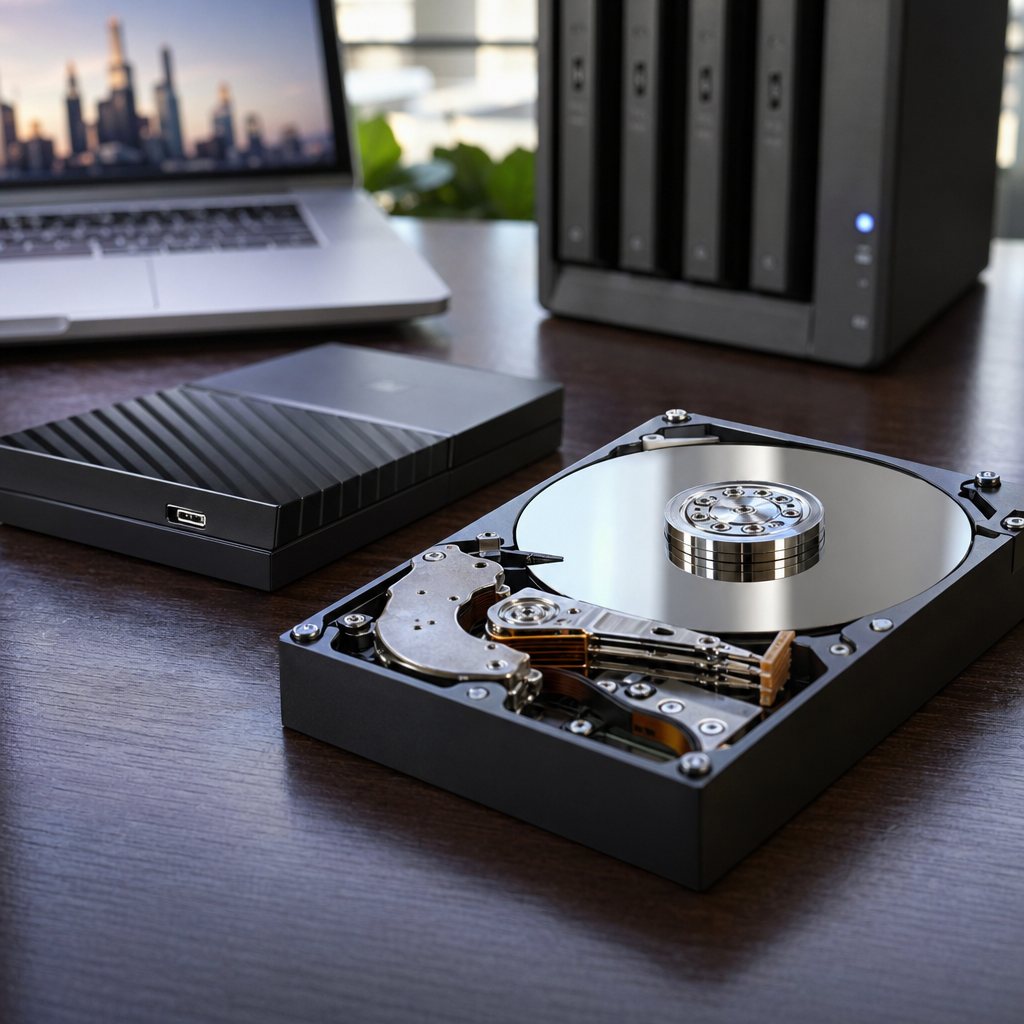
Western Digital’s role in shaping digital storage is inseparable from the modern history of computing, because the company has influenced how consumers, enterprises, and cloud providers store, protect, and move data at scale. In practical terms, digital storage refers to the hardware and software systems that preserve information so it can be accessed later, whether that information is a family photo on an external drive, surveillance video in a datacenter, or machine learning training data spread across petabytes. A company spotlight on Western Digital matters because few firms have operated across so many layers of this stack: hard disk drives, solid-state storage, flash memory partnerships, branded consumer products, and enterprise infrastructure. When I evaluate storage vendors, I look for more than capacity claims. I examine reliability history, interface standards, firmware maturity, workload fit, and ecosystem support. Western Digital consistently appears in those assessments because its portfolio reaches from portable devices sold at retail to helium-filled enterprise drives engineered for hyperscale racks. For readers exploring corporate giants, this hub article provides the context needed to understand not only one company’s trajectory, but also the broader forces that transformed storage from a back-office component into a strategic asset. Western Digital’s story illuminates consolidation, innovation, manufacturing scale, and the constant tension between cost per terabyte, performance, and endurance.
From Drive Maker to Storage Platform Leader
Western Digital began in 1970 and initially produced semiconductor products before becoming best known for hard drive technology. That shift was significant. During the personal computer boom, hard disk drives became the default medium for mass storage, and success depended on precision engineering, supply chain discipline, and the ability to improve areal density year after year. Western Digital’s growth accelerated through product execution and acquisitions, most notably the purchase of Hitachi Global Storage Technologies in 2012. That deal expanded its enterprise reach and strengthened its manufacturing position at a time when the HDD market was consolidating around a small number of global players. In the storage industry, consolidation is not a side note; it shapes pricing power, R&D budgets, and the pace at which new recording technologies can be commercialized.
The company’s later acquisition of SanDisk in 2016 was equally transformative. It gave Western Digital direct access to NAND flash expertise, controller design, and a stronger consumer and enterprise solid-state lineup. That mattered because the storage market was no longer defined by hard drives alone. Mobile computing, content creation, virtualization, and cloud-native applications pushed demand toward flash for speed-sensitive workloads. With SanDisk, Western Digital could serve both high-capacity HDD use cases and low-latency SSD deployments. In my experience, this dual capability is one reason Western Digital remains central in buyer evaluations: many organizations need tiered storage, not a one-format answer. Backup repositories, media archives, and object storage clusters still favor hard drives for economics, while transactional databases and edge devices often favor flash.
How Western Digital Influenced Core Storage Technologies
Western Digital helped shape digital storage by advancing the technologies that increase capacity without making systems unaffordable. In HDDs, one of the major levers has been areal density, the amount of data that can be stored on a given platter surface. The company invested in techniques such as perpendicular magnetic recording and later energy-assisted approaches, while also expanding the use of helium-sealed drives. Helium reduces turbulence inside the drive, allowing more platters, lower power draw, and improved thermal characteristics. In hyperscale environments, those gains compound across thousands of servers. A one-watt difference per drive may look minor in isolation, but multiplied across a large fleet it affects cooling requirements and operating cost.
On the flash side, Western Digital’s role extends through NAND development, SSD firmware, and controller optimization. The market often reduces SSDs to read-and-write speed numbers, but seasoned practitioners know endurance, garbage collection behavior, overprovisioning, and power-loss protection matter just as much. Western Digital’s enterprise and client products have competed by balancing those variables across workload classes. Named standards such as NVMe, SATA, SAS, and PCIe define interfaces, yet implementation quality determines real-world results. That is why product segmentation matters. A portable SSD for creators, a client NVMe drive for laptops, and a datacenter SSD for mixed workloads cannot be judged by the same criteria, even when they share a brand umbrella.
Western Digital also shaped storage by making category distinctions clearer for buyers. Brands like WD Blue, WD Black, WD Red, WD Purple, and WD Gold are more than marketing labels. They signal intended workloads: mainstream computing, performance systems, NAS devices, surveillance retention, and enterprise environments. That labeling helped normalize the idea that storage should be matched to use case. I have seen costly mistakes when teams deploy desktop-class drives into multi-bay NAS systems or overlook vibration tolerance and duty cycle ratings. Western Digital’s portfolio made those tradeoffs easier to explain in plain language to non-specialist buyers.
Why Western Digital Matters Across Consumer, Business, and Cloud Markets
One reason Western Digital deserves a hub-level company spotlight is its unusual range. In consumer markets, the company became a familiar name through external hard drives, USB flash storage, memory cards, and portable SSDs. These products supported the rise of digital photography, 4K video capture, console gaming, and personal backup habits. For professionals, especially photographers and editors, SanDisk memory cards and SSDs became workflow staples because they paired broad device compatibility with dependable performance. In business environments, Western Digital’s role is more structural. NAS drives support small office file sharing and backup, while enterprise HDDs and SSDs underpin virtual machines, analytics clusters, and cloud storage nodes.
At hyperscale and cloud levels, the company participates in one of the most important realities of the data economy: most cold and warm data still lives on spinning disks. Flash is critical, but HDD economics continue to dominate for vast repositories, backups, archives, and object storage pools. Cloud providers optimize around cost per terabyte, predictable failure domains, and efficient replacement cycles, which is why high-capacity enterprise drives remain strategically important. Western Digital’s relevance here is not theoretical. Its products are designed for 24/7 operation, vibration-heavy multi-drive enclosures, and firmware tuned for datacenter behaviors. This industrial role is easy to miss if someone only knows the brand from a retail shelf.
| Market | Typical Western Digital Product Class | Primary Need | Practical Example |
|---|---|---|---|
| Consumer | Portable HDDs and SSDs | Personal backup and mobility | Photographer offloads RAW files after a shoot |
| SMB | NAS-focused drives | Shared storage and redundancy | Design firm runs a four-bay office NAS |
| Enterprise | Datacenter HDDs and SSDs | Performance, endurance, uptime | Virtualized workloads in a private cloud |
| Hyperscale | High-capacity HDD platforms | Lowest practical cost per terabyte | Object storage for backups and archives |
Corporate Strategy, Competition, and Industry Tradeoffs
To understand Western Digital fully, readers should also understand the competitive pressures around it. The company operates in markets defined by capital intensity, cyclic demand, and rapid technology shifts. In HDDs, it competes primarily with Seagate and Toshiba. In flash and SSDs, competition includes Samsung, Micron, Kioxia, Solidigm, and others. That landscape forces difficult strategic choices. A vendor must invest heavily in next-generation recording methods, controller development, firmware validation, and manufacturing partnerships long before revenue is guaranteed. The reward for getting timing right is substantial; the penalty for missing transitions can be severe.
Western Digital’s partnership structures and corporate moves have reflected these realities. NAND manufacturing, for example, demands enormous capital expenditure, and no serious player treats fab economics casually. At the same time, the company has had to navigate changing demand patterns caused by PC cycles, smartphone saturation, cloud buildouts, and inventory corrections. Storage is foundational, but it is not immune to macroeconomic swings. I have seen procurement teams delay drive refreshes during tight budget periods, then rush purchases when capacity constraints begin hurting operations. That stop-and-start behavior affects every major storage supplier.
There are also real tradeoffs in the company’s product mix. HDDs remain unmatched on cost per terabyte, but SSDs deliver dramatically lower latency and better random I/O. Surveillance systems prioritize sustained writes and long retention windows, while NAS systems emphasize vibration tolerance, RAID compatibility, and error recovery behavior. Enterprise buyers increasingly evaluate telemetry, security features, and software management tools, not just hardware specs. Western Digital’s challenge and opportunity have been to translate these divergent needs into coherent product families without confusing the market.
What Western Digital Teaches About Corporate Giants in Technology
As a hub for deeper company spotlights, this article should frame Western Digital as more than a single brand story. It is a case study in how technology giants evolve through specialization, acquisition, and adaptation to standards. It shows why hardware companies still matter in a software-centric era: without reliable, scalable storage, cloud services, AI pipelines, media platforms, and enterprise applications stall. It also illustrates a broader lesson about corporate giants. Longevity in technology rarely comes from one breakthrough alone. It comes from repeated execution across engineering, manufacturing, channel strategy, and product positioning.
Western Digital also reminds readers to evaluate companies in context. Market leadership is not static. A strong quarter does not erase long-term risks, and a product setback does not negate decades of engineering contribution. The best way to study a corporate giant is to look at how it responds to changing interfaces, workload demands, and buyer expectations. That method applies across this entire Company Spotlights subtopic. When you examine firms like Western Digital, you are really studying the infrastructure decisions behind digital life itself. Explore the related company profiles in this hub to compare strategies, technologies, and competitive models shaping the next era of storage and computing.
Frequently Asked Questions
1. Why is Western Digital considered so important in the history of digital storage?
Western Digital is widely seen as a major force in digital storage because its products and technology have helped define how data is stored across personal computing, enterprise infrastructure, and cloud environments. As digital information expanded from simple documents to massive libraries of photos, video, software, analytics, and artificial intelligence datasets, the need for reliable and scalable storage grew with it. Western Digital played an important role in meeting that need by developing and delivering storage solutions that could serve very different markets, from consumer hard drives and portable devices to enterprise-grade systems built for nonstop workloads.
Its importance also comes from its ability to evolve alongside the broader computing industry. Storage has never been a static category. It has moved from local desktop use to networked environments, then to hyperscale datacenters and edge computing. Western Digital has remained relevant through these shifts by participating in the development of hard disk drives, solid-state storage, flash technologies, and the software and platform strategies that support modern data infrastructure. That adaptability helped make digital storage more accessible, more affordable, and more capable over time.
Just as important, Western Digital’s influence is not limited to raw hardware capacity. The company has contributed to the larger conversation around performance, durability, security, workload optimization, and long-term data preservation. In other words, its role in shaping digital storage is about more than making devices that hold files. It is about helping establish the standards, expectations, and innovations that allow individuals and organizations to trust that their data can be stored, protected, and retrieved when needed.
2. How has Western Digital supported both consumers and large-scale enterprise or cloud storage needs?
One of Western Digital’s defining strengths has been its ability to serve very different types of users without losing sight of the core purpose of storage: preserving data in a dependable and useful way. For consumers, that has often meant internal drives for PCs, external storage for backups, network-attached storage options for homes and small offices, and portable solutions for creators who need to move large files quickly. In these contexts, people generally care about simplicity, affordability, ease of use, and confidence that personal files such as photos, videos, and documents will remain safe and accessible.
In enterprise and cloud settings, however, the requirements become much more complex. Datacenters need storage systems that can operate continuously, support heavy read-and-write workloads, and scale across enormous volumes of data. They also need predictable performance, strong endurance, efficient power use, and designs that fit specialized architectures such as virtualization clusters, high-performance databases, content delivery systems, and AI pipelines. Western Digital has been relevant in this space because it has developed products tailored to these demanding environments rather than treating all storage use cases the same.
This broad market reach matters because it reflects a larger truth about modern digital storage: the same global data ecosystem depends on many layers of infrastructure working together. A smartphone backup, a surveillance archive, a corporate compliance record, and a machine learning training dataset all require storage, but not necessarily the same kind. Western Digital’s ability to participate across these layers has made it a meaningful player in how storage technology serves everyday users while also underpinning the systems that run businesses, platforms, and online services at scale.
3. What role has Western Digital played in the transition from hard disk drives to flash and solid-state storage?
Western Digital’s role in the shift from traditional hard disk drives to flash and solid-state storage is significant because the transition has not been a simple replacement of one technology with another. Instead, modern storage has become a layered ecosystem in which different media types serve different performance, cost, and capacity needs. Hard disk drives remain valuable for high-capacity and cost-efficient storage, especially in archival, backup, surveillance, and hyperscale environments. Solid-state storage, by contrast, offers faster access times, lower latency, and better performance for workloads that demand rapid data retrieval and processing. Western Digital has helped shape this balance by maintaining a presence in both areas.
This matters because the future of storage is not defined by a single winning format. Enterprises and cloud providers often use tiered architectures, where frequently accessed data may live on SSDs while colder or less time-sensitive data is stored on HDDs. Consumers also experience this split, often using fast internal solid-state storage for operating systems and applications while relying on external or network-based hard drives for larger media libraries and backups. Western Digital’s portfolio has helped support these hybrid realities, allowing users to choose storage based on what they value most: speed, capacity, endurance, or price efficiency.
By participating in both hard drive innovation and flash-based storage development, Western Digital has influenced how the market understands storage strategy itself. Rather than pushing a one-size-fits-all model, the company has helped reinforce the idea that effective digital storage depends on matching technology to workload. That perspective has become central to modern IT planning, where performance-sensitive applications, massive archives, and data-intensive analytics all demand different approaches to storage design.
4. How does Western Digital influence data reliability, protection, and long-term accessibility?
Storage is only valuable if the data remains intact and recoverable, which is why reliability and protection are central to Western Digital’s influence in the digital storage industry. A drive’s capacity or speed may attract attention, but organizations and consumers ultimately depend on storage systems that can withstand real-world conditions, including constant operation, high workloads, power fluctuations, environmental stress, and the simple passage of time. Western Digital has long operated in a market where trust is essential, and that has made reliability engineering a key part of its role.
Data protection also extends beyond the physical device. Modern storage needs support for backup strategies, redundancy, workload-appropriate design, firmware optimization, and integration into broader systems that manage risk. For example, a home user may need a dependable external drive for personal archives, while an enterprise may require arrays designed for high availability, disaster recovery planning, and retention policies driven by regulation or business continuity requirements. Western Digital’s participation in these different use cases has helped shape the expectation that storage should be selected not just for space, but for resilience and purpose.
Long-term accessibility is another critical issue. As the amount of digital information grows, organizations must think about how data can remain usable over years or even decades. This includes media durability, migration planning, interface compatibility, and balancing performance with preservation. Western Digital’s role in this area is important because storage vendors are not simply selling hardware; they are supporting the lifecycle of information. In practical terms, that means helping users preserve everything from family memories to institutional records to research datasets in ways that remain manageable and retrievable over time.
5. What does Western Digital’s role in storage tell us about the future of computing and data growth?
Western Digital’s position in the storage industry highlights a broader reality about the future of computing: nearly every major technology trend depends on the ability to store and move more data efficiently. Cloud services, streaming platforms, remote work systems, cybersecurity tools, edge devices, smart cities, connected vehicles, and AI workloads all generate enormous volumes of information. Storage is therefore not a background detail; it is foundational infrastructure. Western Digital’s continued relevance suggests that as computing grows more distributed and data-intensive, storage technologies will become even more strategically important.
This also points to the increasing complexity of storage decision-making. Future environments will need to balance capacity, speed, energy efficiency, physical footprint, cost, and security. A single organization may need ultra-fast storage for real-time analytics, durable flash for transactional systems, and high-capacity disk for long-term retention. Western Digital’s involvement across multiple storage categories reflects where the market is going: toward integrated strategies rather than isolated products. The future is less about choosing one storage technology forever and more about building smart storage ecosystems that align with different workloads.
Ultimately, Western Digital’s role tells us that digital storage is central to how modern society remembers, operates, and innovates. Every new application that creates value from data also creates pressure on storage infrastructure. That means the companies helping shape this field influence not just hardware trends, but the practical limits of what businesses, researchers, creators, and consumers can do with information. In that sense, Western Digital’s story is also part of the larger story of how computing continues to scale in a world defined by data.