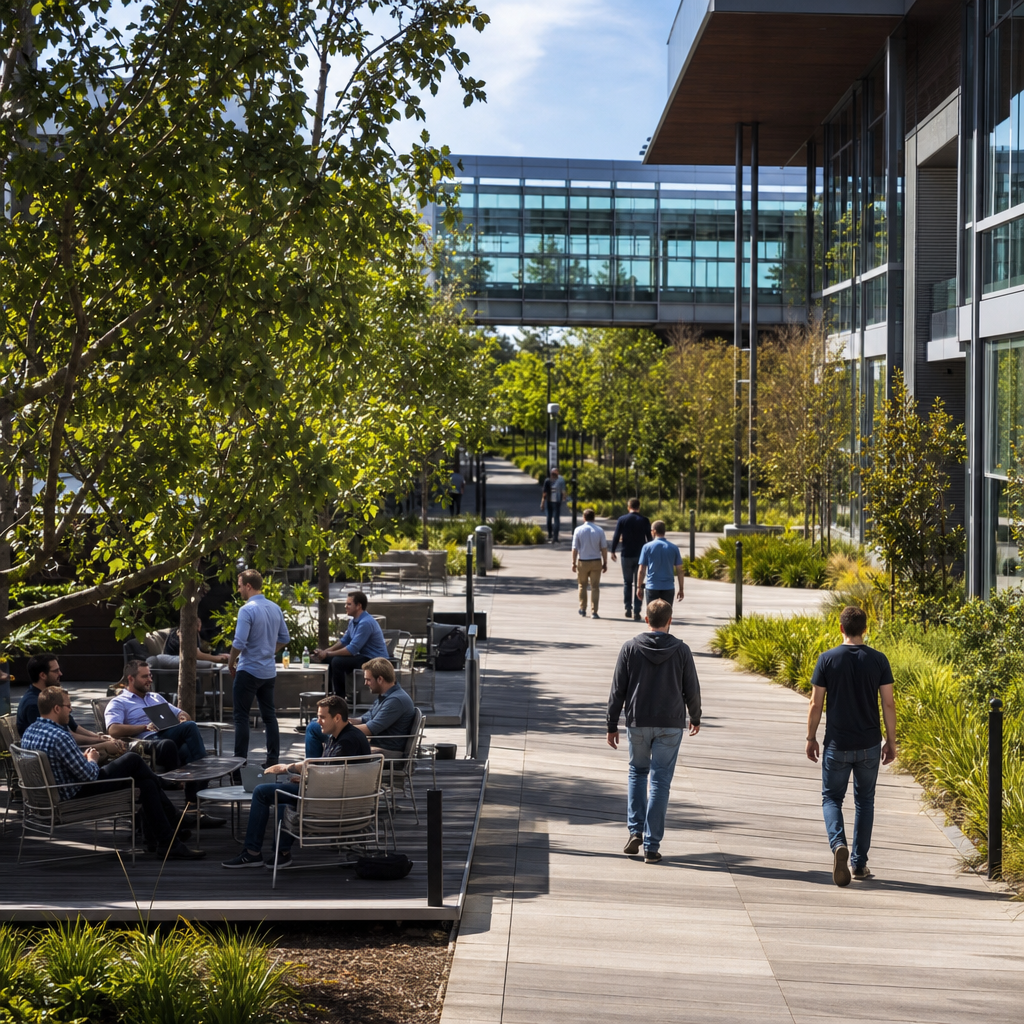
Silicon Valley became the world’s best-known launchpad for startups because it combines technical talent, risk capital, research institutions, and a culture that rewards experimentation in one unusually dense region. For tech entrepreneurs, that concentration matters more than sunshine or prestige. It means faster hiring, easier fundraising, quicker product feedback, and repeated exposure to people who have built, scaled, sold, and revived companies before. When founders ask why so many ambitious software, semiconductor, biotech, and artificial intelligence ventures still gravitate toward Northern California despite high costs, the answer is not a single advantage. It is a stacked system.
At its core, Silicon Valley refers to the southern San Francisco Bay Area, especially Santa Clara County and nearby cities such as Palo Alto, Mountain View, Menlo Park, San Jose, and Cupertino. The term originally came from the region’s semiconductor industry, where silicon chips powered early electronics growth. Today, the label also represents a broader entrepreneurial model built around innovation and investment. Innovation means turning research, engineering, and market insight into products people will pay for. Investment means supplying the capital, networks, and governance needed to move an idea from prototype to scale. Together, they create a repeatable engine for company formation.
This matters because startups rarely succeed on product quality alone. In my work with founders, the winners usually combine timing, talent, customer discovery, disciplined execution, and access to investors who understand venture-scale risk. Silicon Valley improves the odds by putting those ingredients within reach. A founder can meet an angel investor in Palo Alto, recruit an ex-Google engineer in Mountain View, pilot software with a SaaS buyer in San Francisco, and get legal advice from a firm that has closed hundreds of venture rounds. Few regions offer that level of entrepreneurial infrastructure in such a compact geography.
The historical foundation: from semiconductors to software and AI
Silicon Valley did not become a startup capital by accident. Its roots trace back to Stanford University, defense research, and the semiconductor breakthroughs of the 1950s and 1960s. Companies like Fairchild Semiconductor helped establish the region’s technical base and a powerful spinout pattern: employees left, launched new firms, and spread expertise across the ecosystem. Intel, founded in 1968, reinforced that cycle. Later waves included personal computing with Apple, enterprise software with Oracle, internet platforms with Yahoo and Google, social media with Facebook, and cloud infrastructure through companies such as Salesforce. Each wave created founders, operators, and investors who recycled knowledge and wealth into the next generation.
This history matters because startup hubs are cumulative. Once a region develops specialist lawyers, recruiters, executive coaches, product leaders, and venture investors, new companies can form faster. The Valley also normalized stock options as a wealth-building tool for employees, giving early hires a reason to join risky ventures. That compensation model helped startups compete against larger employers and created a broad base of future angel investors. The same dynamic now supports AI startups, climate tech ventures, and enterprise infrastructure companies, many of which are founded by alumni of OpenAI, Google, Meta, Nvidia, and Stripe.
Why venture capital concentrates here
Silicon Valley remains a venture capital magnet because investors want proximity to deal flow, talent, and technical change. Sand Hill Road in Menlo Park became symbolic of this model, housing firms such as Sequoia Capital, Andreessen Horowitz, Benchmark, and Kleiner Perkins. Venture capital works differently from bank lending. Investors expect most startups to fail, a few to return modest gains, and a tiny number to generate outsized outcomes that repay the entire fund. That logic favors dense networks where investors can source deals early, assess founding teams quickly, and support portfolio companies through hiring, partnerships, and later rounds.
For entrepreneurs, the practical effect is significant. A founder building developer tools or healthcare software can often meet multiple seed funds in a week, refine a pitch through immediate feedback, and access warm introductions through shared contacts. Investors also compare notes on market categories, customer demand, and technical defensibility, which helps strong startups sharpen their positioning. The Valley’s funding environment supports every stage, from angel checks and accelerators to growth equity and public market preparation. Y Combinator, though now globally influential, is a prime example of how a local institution can standardize early-stage formation and dramatically increase startup velocity.
The talent engine: universities, immigrants, and operator density
Talent density is Silicon Valley’s most durable advantage. Stanford and the University of California, Berkeley supply world-class engineers, computer scientists, and researchers, while nearby institutions contribute specialized expertise in design, business, and law. Just as important, the region attracts immigrants at an exceptional rate. Many successful Valley founders were born outside the United States or are children of immigrants, reflecting a culture that values technical merit and ambitious mobility. High-skilled immigration has consistently expanded the founder pool, especially in software, semiconductors, robotics, and biotech.
Operator density makes the difference between a promising startup and a scalable company. In Silicon Valley, founders can recruit people who have already managed product launches, cloud migrations, growth experiments, enterprise sales motions, and IPO readiness. That experience shortens learning curves. When I have advised early-stage teams, the biggest accelerant was often not cash but one senior hire who had seen the movie before. A former VP of engineering from a hypergrowth company can establish architecture discipline. A sales leader with SaaS experience can build pipeline stages, forecast accuracy, and pricing structure far earlier than a first-time founder usually can.
The culture of experimentation and informed risk
Silicon Valley’s culture rewards intelligent risk-taking more consistently than most business environments. Failure is not celebrated for its own sake, but it is treated as data rather than permanent stigma. That attitude encourages entrepreneurs to test hypotheses, release minimum viable products, talk to users early, and iterate. Lean startup principles, customer discovery interviews, agile development, and rapid prototyping all found especially fertile ground in the Valley because local investors and operators understood that iteration reduces uncertainty.
There is a practical side to this culture. Founders can gather product feedback quickly from design partners, beta users, and experienced advisors. Engineers are often willing to join a startup before every process is fully defined. Investors are generally comfortable backing teams before revenue is mature if the market is large and the technical edge is real. This combination helps entrepreneurs move faster than peers in ecosystems where every decision requires consensus, collateral, or long operating history.
| Factor | How Silicon Valley helps entrepreneurs | Real-world example |
|---|---|---|
| Capital access | Dense network of angels, seed funds, and growth investors shortens fundraising cycles | A B2B software founder can meet several qualified funds in Menlo Park within days |
| Talent | Experienced engineers and operators are easier to recruit for high-growth roles | Former Google or Nvidia employees often join AI startups at early stages |
| Knowledge spillover | Advice from founders, lawyers, and product leaders spreads quickly through networks | Startup counsel familiar with SAFEs, priced rounds, and option pools reduces execution mistakes |
| Customer access | Nearby enterprises and tech buyers enable faster pilots and feedback loops | Cloud infrastructure startups can test with sophisticated early adopters |
How innovation and investment reinforce each other
The strongest reason Silicon Valley remains a hub is that innovation and investment are mutually reinforcing. Breakthrough ideas attract capital, and capital gives ideas the runway to become products, companies, and platforms. This is visible in sectors where technical development is expensive and uncertain. Nvidia’s rise in accelerated computing supported an explosion of AI startups, which in turn attracted more venture funding, specialized talent, and cloud infrastructure partnerships. The same loop appears in biotech around South San Francisco and in climate technologies tied to advanced batteries, grid software, and industrial decarbonization.
For entrepreneurs, this means money is rarely just money. The best investors help refine hiring plans, connect founders to design partners, structure governance, and prepare for follow-on financing. Good boards create accountability without suffocating speed. Strong seed investors understand that category creation often precedes conventional proof points. At the same time, founders must recognize the tradeoffs. Venture capital is appropriate when a business has the potential for large, nonlinear growth. It is often a poor fit for steady, profitable companies serving narrow markets. Silicon Valley works best for entrepreneurs pursuing scalable technology businesses with meaningful defensibility.
The limits of the model and what founders should learn from it
Silicon Valley is not magic, and it is not universally necessary. Costs are high, competition for talent is intense, and the ecosystem can amplify hype cycles. Founders may feel pressure to raise too much capital, chase unsound growth, or build for investors instead of customers. Remote work has also redistributed some startup activity to cities like Austin, New York, Seattle, London, Bangalore, and Tel Aviv. Great companies can now be built elsewhere, especially when founders have digital access to customers, cloud infrastructure, and distributed teams.
Still, the Valley offers enduring lessons. First, entrepreneurial ecosystems thrive when universities, capital, and experienced operators interact frequently. Second, innovation compounds when employees can leave established firms and start new ones without heavy stigma. Third, funding is most productive when paired with mentorship and market access, not just term sheets. If you are building under the broader theme of entrepreneurship and venture capital, the actionable takeaway is clear: study Silicon Valley not as a myth, but as a system. Build networks intentionally, validate demand early, recruit for experience where it matters, and align your financing strategy with the kind of company you actually want to create. That is how entrepreneurs embrace innovation and investment in a way that lasts.
Frequently Asked Questions
Why did Silicon Valley become such an important place for tech entrepreneurs?
Silicon Valley became a global center for tech entrepreneurship because it developed an unusually powerful mix of assets in one place: world-class engineering talent, top research universities, experienced founders and operators, major venture capital firms, and a business culture that accepts risk as part of building something new. That concentration creates momentum. Entrepreneurs are not just launching companies near investors or near engineers; they are building inside an ecosystem where each part reinforces the others.
For founders, this matters in practical ways. It is easier to recruit specialized employees, meet early adopters, find mentors, and raise capital when so many relevant people are nearby and already accustomed to startup speed. Silicon Valley also benefits from a long history of company creation, which means entrepreneurs can learn from people who have started, scaled, failed, pivoted, exited, and started again. Over time, that depth of experience becomes a real competitive advantage. The region’s reputation is important, but the real reason it became so influential is that it consistently makes the startup process faster, denser, and more informed than many other places.
How do venture capital and funding networks help startups grow faster in Silicon Valley?
Access to capital is one of the biggest reasons Silicon Valley has remained attractive to tech entrepreneurs. The region has a dense network of angel investors, seed funds, venture capital firms, corporate investors, and repeat founders who actively back new companies. That does more than provide money. It gives startups access to relationships, introductions, strategic advice, recruiting help, and pattern recognition from investors who have seen similar businesses grow before.
In Silicon Valley, fundraising can move faster because investors are already looking for ambitious technology companies and are comfortable with high-growth, high-risk models. Founders benefit from being close to the people writing checks, but also from being close to the broader network around those investors, including lawyers, advisors, executive recruiters, and early customers. This shortens the time between idea, validation, and scale. While raising money is never easy, entrepreneurs in Silicon Valley often have more chances to get feedback, refine their pitch, and connect with the right backers than they would in regions where startup capital is less concentrated.
What role do universities and technical talent play in Silicon Valley’s startup ecosystem?
Universities and technical talent are foundational to Silicon Valley’s success. Institutions such as Stanford University and nearby research centers have long supplied not only highly trained engineers and scientists, but also ideas, research breakthroughs, and an entrepreneurial mindset. These schools help create a steady pipeline of people who are capable of building advanced products in software, hardware, artificial intelligence, biotech, and other emerging fields.
Just as important, the talent pool in Silicon Valley is deep and experienced. Entrepreneurs are often able to hire people who have already worked at startups or major technology companies and who understand product development, scaling infrastructure, go-to-market execution, and rapid iteration. That experience reduces friction. Founders can move from concept to prototype more quickly when they can assemble teams with relevant expertise. It also improves decision-making, because employees, advisors, and peers often bring lessons from previous launches and growth stages. In short, Silicon Valley is not just a place with smart people; it is a place with a high concentration of startup-ready talent that can turn ideas into real companies faster.
Why is Silicon Valley’s culture often described as uniquely supportive of innovation and risk-taking?
Silicon Valley is known for a culture that treats experimentation as normal and failure as part of the entrepreneurial process rather than as a permanent mark against a founder. That mindset encourages people to test ideas, launch early, gather feedback, and pivot when necessary. In many traditional business environments, failed projects can damage credibility. In Silicon Valley, they often produce valuable experience and stronger future decisions.
This culture also supports openness and speed. Founders regularly exchange insights with peers, seek advice from experienced operators, and learn through communities built around startups, product development, and investment. Because so many people in the region have direct exposure to company building, there is often a shared understanding of uncertainty, iteration, and long-term vision. That creates an environment where ambitious ideas are taken seriously, even when they seem unproven at first. For entrepreneurs, this can be incredibly valuable. It lowers some of the social barriers to starting a company and increases the odds of finding people willing to help refine a concept rather than dismiss it too early.
Is Silicon Valley still the best place for tech entrepreneurs today?
Silicon Valley is still one of the most powerful startup ecosystems in the world, but whether it is the best place depends on the entrepreneur, the industry, and the company’s stage. Its biggest advantage remains concentration. Few places can match the density of investors, technical talent, experienced mentors, startup service providers, and potential partners available in one region. For founders building venture-backed technology companies that need rapid scaling, frequent fundraising, and access to highly specialized expertise, Silicon Valley continues to offer major advantages.
That said, the startup world is more distributed than it once was. Strong tech communities now exist in many cities, and remote work has made it easier to build teams outside the Bay Area. Some entrepreneurs may find lower costs, less competition for talent, or stronger local industry ties elsewhere. Even so, Silicon Valley remains highly influential because of its network effects. People there are deeply connected to one another through past companies, investment relationships, research communities, and shared operating experience. For many founders, that density still translates into quicker learning, faster introductions, and more opportunities to build momentum. So while it is no longer the only path for tech entrepreneurs, it remains a uniquely powerful one.