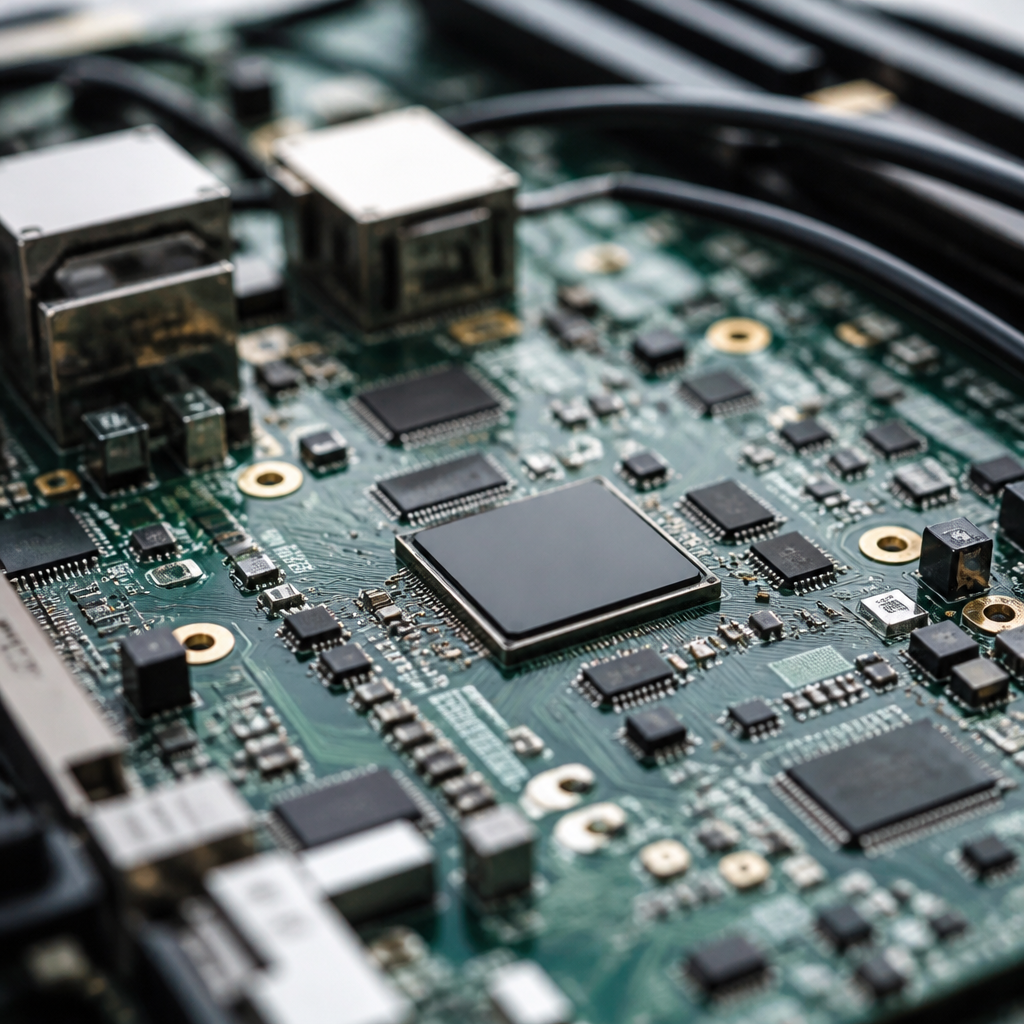
Edge AI chips are transforming machine learning by moving inference from distant data centers onto devices that sit in factories, cars, hospitals, retail stores, and homes. In simple terms, an edge AI chip is a semiconductor designed to run artificial intelligence workloads locally, near the source of data, instead of sending every image, sound clip, sensor reading, or command to the cloud. That shift matters because it cuts latency, reduces bandwidth costs, improves privacy, and keeps systems working when connectivity is weak or unavailable. Within the broader world of semiconductors and compute, edge AI chips now sit at the center of product strategy for startups and incumbents alike.
I have watched this category evolve from low-power digital signal processors and mobile neural engines into a distinct architecture race involving CPUs, GPUs, NPUs, FPGAs, and custom ASICs. The core technical challenge is straightforward: modern machine learning models require massive parallel math, but edge devices have strict limits on power, thermal headroom, memory, cost, and physical size. A cloud server can consume hundreds of watts and access large pools of DRAM; a battery-powered camera or wearable cannot. Edge AI chip design is therefore an exercise in optimization across compute throughput, memory bandwidth, model compression, software tooling, and reliability under real operating conditions.
This hub article covers semiconductors and compute through the lens of edge AI. It defines the main chip categories, explains how these processors accelerate neural networks, outlines where they are deployed, and clarifies the engineering tradeoffs that shape adoption. It also matters for founders, operators, and technical buyers because chip choices influence bill of materials, battery life, product safety, data governance, and the ability to ship updates over years. If you want to understand why machine learning is increasingly running off the cloud, start with the silicon.
What edge AI chips are and how they work
An edge AI chip is any processor optimized to execute machine learning tasks on-device, most often inference rather than training. Inference means using a trained model to classify an image, transcribe speech, detect anomalies, estimate depth, or make a recommendation. These chips accelerate the linear algebra behind neural networks, especially matrix multiplication and convolution, by using parallel compute units and dataflow designs that reduce unnecessary memory movement. In practice, moving data often consumes more energy than computing on it, so efficient architecture matters as much as raw tera operations per second.
Different chip types serve different edge workloads. CPUs remain important for orchestration, control logic, and mixed software stacks, but they are rarely the most efficient engines for dense neural math. GPUs excel at parallel workloads and appear in robots, industrial PCs, and advanced vehicles. NPUs, sometimes called neural processing units or AI accelerators, are increasingly common in smartphones, laptops, and cameras because they deliver high performance per watt for common model operators. FPGAs give teams reconfigurability for specialized pipelines, while ASICs provide the best efficiency when volumes justify custom silicon. Most production systems combine several of these components in a system-on-chip or module.
Quantization is one of the biggest enablers of edge deployment. Many models that train in FP32 can run inference in INT8, FP16, or even lower precision with little accuracy loss if calibrated correctly. Pruning, sparsity, operator fusion, and model distillation also help fit useful intelligence into constrained devices. I have seen teams cut power draw dramatically not by changing the model objective, but by reducing memory accesses and using compilers such as TensorRT, TVM, OpenVINO, or vendor SDKs to map workloads efficiently onto the target hardware.
Why off-cloud machine learning is gaining momentum
The clearest reason to run machine learning at the edge is latency. A robot arm avoiding a collision, an automotive driver-assistance system identifying a pedestrian, or a factory camera rejecting a defective part cannot wait for a round trip to a remote server. Local inference delivers responses in milliseconds and avoids the jitter that comes with congested networks. Reliability is the second driver. Oil fields, warehouses, farms, and remote infrastructure often operate with intermittent connectivity, yet they still need vision, anomaly detection, and predictive maintenance to function continuously.
Privacy and compliance are equally important. Sending raw video, audio, or biometric data to the cloud can trigger legal, contractual, and reputational risks. Processing data on-device lets organizations keep sensitive information local and transmit only metadata or alerts. In healthcare, for example, an imaging device may flag suspicious patterns without uploading full patient data streams. In retail, a smart camera can count foot traffic or detect empty shelves without storing identifiable faces. This architecture does not eliminate risk, but it narrows the exposure surface and simplifies data minimization efforts.
Economics also favor edge deployment when data volumes are large. High-resolution cameras, lidar, industrial sensors, and always-on microphones generate continuous streams that are expensive to move and store. A smart manufacturing line might produce terabytes of visual inspection data per day. Filtering that data at the source lowers cloud compute bills and network costs. For startups, this can change unit economics materially. A product that requires constant cloud inference often struggles with gross margin; a product that performs most inference locally can scale more sustainably.
Chip architectures, workloads, and real deployment choices
Choosing the right edge AI chip depends on workload shape, software maturity, and deployment constraints, not just benchmark scores. Computer vision is the most mature edge use case because convolutional and transformer-based models map well to accelerators and deliver immediate operational value. Audio inference, keyword spotting, predictive maintenance, and sensor fusion are also common. TinyML pushes this further by placing compact models on microcontrollers from vendors such as STMicroelectronics, NXP, and Ambiq, enabling wake-word detection, vibration analysis, and low-power classification in milliwatt regimes.
At the higher end, automotive and robotics platforms often rely on heterogeneous compute. NVIDIA Jetson modules, Qualcomm platforms, Intel processors with integrated accelerators, AMD adaptive computing devices, and custom automotive SoCs combine CPU cores, GPUs, DSPs, NPUs, and image signal processors. The system must balance perception, planning, connectivity, and safety workloads at once. Thermal design becomes decisive. A chip that performs well in a lab may throttle in an enclosed chassis mounted in summer heat. That is why experienced teams validate sustained performance, not peak numbers.
| Chip approach | Typical strengths | Common edge uses | Main tradeoff |
|---|---|---|---|
| CPU | Flexibility, broad software support | Control logic, mixed workloads | Lower AI efficiency |
| GPU | High parallel throughput | Robotics, vehicles, industrial vision | Higher power draw |
| NPU/ASIC | Best performance per watt | Phones, cameras, appliances | Less flexible operator support |
| FPGA | Reconfigurable pipelines, deterministic latency | Networking, industrial, specialized vision | Harder programming model |
| MCU with AI extensions | Ultra-low power, low cost | Wearables, sensors, wake-word devices | Limited model size |
Memory architecture often determines real-world performance more than nominal compute. Edge models are bottlenecked by on-chip SRAM size, cache behavior, DRAM bandwidth, and interconnect efficiency. If weights and activations spill repeatedly to external memory, latency and power both rise sharply. This is why packaging, memory compression, and operator scheduling matter. It is also why startups building edge AI silicon frequently emphasize dataflow architecture and software compilers rather than only quoting TOPS. TOPS can be useful, but without precision context, sparsity assumptions, and power measurements, it is an incomplete metric.
Where edge AI chips create value across industries
In manufacturing, edge AI chips power visual inspection, worker safety systems, and predictive maintenance. A camera mounted over a production line can detect scratches, alignment issues, or missing components in real time and reject faulty items before they move downstream. In logistics, smart cameras and embedded vision systems track parcel flow, count inventory, and help autonomous mobile robots navigate warehouses. These deployments usually succeed when models are tightly scoped, retrained on site-specific data, and integrated with existing operational technology instead of replacing it wholesale.
Automotive is another major frontier. Advanced driver-assistance systems need fast perception under strict power and safety limits, so local compute is nonnegotiable. Vehicles increasingly process camera, radar, ultrasonic, and sometimes lidar data on dedicated hardware. In the consumer market, smartphones and laptops use on-device AI for image enhancement, voice assistants, transcription, translation, and personalization. Apple, Google, Qualcomm, and MediaTek all market integrated AI engines because users expect features to work instantly, privately, and even in airplane mode.
Healthcare, agriculture, energy, and smart cities are following similar patterns. Portable ultrasound systems can assist image interpretation on-device. Agricultural drones and tractors use edge inference to identify weeds, crop stress, or equipment anomalies in the field. Utilities deploy embedded AI for substation monitoring and fault detection where backhaul links may be limited. In each case, the winning solution is rarely the biggest model. It is the model-hardware-software combination that achieves reliable accuracy within the environment’s power, thermal, and lifecycle constraints.
The business case, limits, and what comes next
For startups and enterprise buyers, edge AI chip strategy should start with total system economics. The right design lowers cloud spend, improves responsiveness, and creates differentiated product features, but the wrong one can lock a team into immature toolchains or expensive redesigns. Software support is often the deciding factor. Model conversion, debugging, profiling, over-the-air updates, and security patching must be practical over a product life that may last five to ten years. Supply chain resilience matters too; recent semiconductor shortages showed how fragile single-source plans can be.
There are real limits. Large generative models still strain edge devices because they need substantial memory and sustained compute, even with quantization. Thermal management, battery life, and model drift remain persistent issues. Some applications still belong in the cloud, especially those requiring heavy training, fleet-wide analytics, or elastic scaling. The future is therefore hybrid, not absolute. More inference will move onto devices, while orchestration, retraining, and long-horizon analysis stay centralized. New packaging, chiplets, RISC-V designs, and better compilers will expand what is feasible at the edge.
Edge AI chips are bringing machine learning off the cloud by putting intelligence where data is created and decisions are made. The practical benefits are clear: lower latency, stronger privacy, reduced bandwidth use, and more dependable operation in the real world. Across semiconductors and compute, this is now a defining shift, influencing everything from microcontrollers to automotive platforms. If you are evaluating the next wave of tech innovation and startups, pay close attention to edge AI silicon, software ecosystems, and deployment economics, then map those choices to the exact workload you need to run.
Frequently Asked Questions
What is an edge AI chip, and how is it different from a regular processor or a cloud-based AI system?
An edge AI chip is a specialized semiconductor built to run artificial intelligence tasks directly on a local device rather than sending data to a remote cloud server for processing. In practical terms, that means the chip can analyze images, audio, video, sensor streams, or control signals right where the data is created, such as inside a car, a factory machine, a medical device, a security camera, or a smart appliance. While a traditional CPU is designed to handle a broad range of general-purpose computing jobs, an edge AI chip is optimized for the math behind machine learning inference, especially matrix operations and parallel workloads used by neural networks. Many edge AI systems also combine CPUs, GPUs, NPUs, DSPs, and memory architectures tuned for fast, efficient on-device decision-making.
The biggest difference between edge AI and cloud AI is location. In a cloud-based model, raw data is collected by a device and transmitted over a network to a centralized data center, where an AI model processes it and sends back a result. That approach can work well for some workloads, but it introduces delay, depends heavily on connectivity, and may raise privacy concerns. An edge AI chip avoids those limitations by keeping inference local. The result is faster response times, more predictable performance, lower bandwidth usage, and often better data security. In short, edge AI chips are what make real-time, intelligent behavior possible on devices that cannot afford to wait for the cloud.
Why are edge AI chips becoming so important across industries like automotive, healthcare, manufacturing, and retail?
Edge AI chips are becoming essential because many real-world environments demand immediate decisions, reliability, and local control. In automotive systems, for example, driver-assistance features and autonomous functions need to interpret camera feeds, radar, lidar, and other sensor inputs in milliseconds. A delay caused by network transmission is not just inconvenient; it can be dangerous. In healthcare, diagnostic devices, patient monitoring systems, and wearable tools often need to process sensitive data on site for both speed and privacy. In manufacturing, edge AI enables predictive maintenance, quality inspection, robotics coordination, and anomaly detection without relying on constant cloud access. Retail environments use edge AI for cashierless checkout, shelf monitoring, customer flow analysis, and loss prevention, all of which benefit from low-latency local inference.
Another major reason for growth is economics. Transmitting massive amounts of raw video, audio, or industrial sensor data to the cloud can become expensive and inefficient. Edge AI chips reduce those bandwidth costs by processing most information locally and sending only useful insights, alerts, or summaries upstream. They also improve resilience. If a network connection becomes slow, unstable, or unavailable, the device can continue operating instead of failing outright. As more businesses deploy connected systems in remote, mobile, or mission-critical settings, edge AI chips offer a practical way to scale machine learning beyond the data center. Their value is no longer theoretical; they are now a core enabler of modern intelligent infrastructure.
What are the main benefits of running machine learning inference on edge AI chips instead of in the cloud?
The most widely cited benefit is low latency. Because the data does not need to travel to a distant server and back, the system can respond almost instantly. That matters in applications such as collision avoidance, industrial automation, voice interfaces, surveillance, and medical monitoring, where delays can reduce usefulness or create risk. Local inference also lowers dependence on internet connectivity, which is especially important in rural areas, moving vehicles, secure facilities, or industrial sites with limited network reliability. If the cloud becomes unreachable, an edge-enabled device can often continue to perform critical tasks on its own.
Privacy and security are equally important advantages. When sensitive images, conversations, health information, or operational data remain on the device, organizations can reduce exposure to interception, unauthorized transfer, or unnecessary storage in external systems. This can help with regulatory compliance and user trust. Edge AI chips also cut bandwidth consumption by filtering and analyzing data locally rather than streaming everything to centralized infrastructure. That translates into lower operating costs and more scalable deployments, especially for video-heavy use cases. Finally, edge AI can improve energy efficiency at the system level by reducing network traffic and allowing optimized hardware to perform inference more efficiently than general-purpose compute alone. Taken together, these advantages explain why edge AI is not just a technical alternative to cloud AI, but a strategic one.
What challenges do companies face when deploying edge AI chips in real products and systems?
Despite their advantages, edge AI deployments come with meaningful technical and operational challenges. One of the biggest is balancing performance, power, and thermal limits. Edge devices often operate in constrained environments, such as battery-powered sensors, compact medical equipment, smart cameras, or embedded automotive modules. Engineers must choose hardware that can deliver acceptable inference speed and accuracy without generating too much heat or draining too much power. Model optimization is also critical. Large neural networks trained in the cloud may need to be compressed, quantized, pruned, or otherwise adapted to run efficiently on edge hardware with limited memory and compute resources.
Software fragmentation is another challenge. Different chip vendors support different toolchains, frameworks, compilers, and acceleration libraries, which can complicate development and portability. A model that runs well on one edge AI platform may require additional engineering to work on another. Security and lifecycle management add further complexity. Devices deployed in the field need secure boot, encrypted storage, safe model updates, and defenses against tampering or adversarial attacks. Organizations also need a clear strategy for monitoring, updating, and maintaining edge AI systems over time, especially when those devices are distributed across many locations. In other words, successful edge AI is not just about buying a chip; it requires thoughtful hardware selection, software integration, model engineering, and long-term operational planning.
How do edge AI chips fit into the future of machine learning and the broader shift away from cloud-only architectures?
Edge AI chips are a major part of the next phase of machine learning because they support a more distributed, hybrid computing model. The future is not likely to be edge versus cloud, but edge and cloud working together. In this model, the cloud still plays a central role in large-scale training, fleet-wide coordination, analytics, and long-term data storage. Edge AI chips, meanwhile, handle real-time inference, local autonomy, and immediate decision-making on devices in the field. This division of labor is efficient because it uses each environment for what it does best: the cloud for centralized scale and the edge for speed, resilience, and proximity to data.
As AI applications continue expanding into everyday products and critical infrastructure, the need for local intelligence will only grow. Devices are becoming smarter, sensors are generating more data, and users increasingly expect instant, private, always-available experiences. Edge AI chips make that possible by embedding machine learning directly into endpoints rather than treating intelligence as something that exists only in distant servers. Over time, improvements in semiconductor design, memory architecture, software tooling, and model efficiency will make edge AI even more capable and accessible. That means more intelligent cameras, robots, vehicles, healthcare tools, consumer devices, and industrial systems operating with greater autonomy. In many sectors, edge AI chips are not simply an optimization of machine learning delivery; they are redefining where intelligence lives and how digital systems interact with the physical world.