
Defense tech startups in Silicon Valley are attracting serious venture capital because national security has become a software, data, and manufacturing problem as much as a government procurement problem. In practical terms, “defense tech” now includes autonomous systems, satellite platforms, cyber tools, AI-enabled sensing, secure communications, advanced materials, and dual-use software that can serve both commercial and military customers. “Space tech” overlaps heavily with this category because launch, Earth observation, positioning, and satellite communications underpin modern logistics, disaster response, and warfighting. I have watched investor conversations on this shift move from cautious curiosity to active competition as founders prove they can build faster than traditional primes and sell into a broader market. For readers tracking Tech Innovations & Startups, this matters because capital flows signal where the next decade of engineering talent, industrial capacity, and strategic influence will concentrate.
The change did not happen overnight. For years, many Silicon Valley investors avoided defense because they saw long sales cycles, complex compliance requirements, and reputational risk. That posture has weakened as geopolitical tension, supply-chain fragility, and breakthroughs in AI, robotics, and launch economics have made the sector impossible to ignore. Russia’s invasion of Ukraine demonstrated the battlefield importance of cheap drones, satellite internet, and rapid software iteration. U.S.-China competition has sharpened interest in resilient semiconductors, maritime autonomy, and orbital infrastructure. At the same time, the Department of Defense has expanded pathways such as SBIR, Other Transaction Authority, and innovation offices like DIU to make startup engagement more practical. The result is a market where venture firms now see defense tech startups in Silicon Valley not as outliers, but as a major category inside the broader startup ecosystem.
Why venture capital is moving into defense and space now
Venture capital follows large, durable demand, and defense plus space increasingly meet that test. Global military spending exceeded $2.4 trillion in 2023 according to SIPRI, while the commercial space economy continues to expand through launch services, remote sensing, navigation, and in-orbit infrastructure. Investors are responding to three specific dynamics. First, software and autonomy reduce the cost of building meaningful capability. A startup can now combine open-source models, custom sensors, and edge compute into systems that once required a major prime contractor. Second, governments want nontraditional suppliers because legacy acquisition cycles are too slow for AI-driven competition. Third, dual-use revenue creates a more venture-compatible path. The same geospatial analytics platform may support insurers, agriculture companies, and defense planners; the same drone stack may inspect infrastructure before serving contested logistics.
In Silicon Valley, talent density amplifies these forces. Engineers who built cloud platforms, developer tools, computer vision systems, and robotics products can redirect their skills into mission-critical applications. That migration is visible in companies such as Anduril, which packaged autonomy, sensing, and software into deployable defense systems, and Shield AI, which focused on autonomous flight in GPS-denied environments. Venture firms are also more comfortable with hard tech than they were a decade ago. The rise of SpaceX reset assumptions about launch economics and vertical integration, while success stories across climate tech and advanced manufacturing trained investors to underwrite longer technical timelines. In meetings, what I hear now is less “Why defense?” and more “Which layer of the stack will matter most?” That is a meaningful cultural shift, and it explains why funding is moving from experimental bets toward sustained conviction.
What defense tech startups in Silicon Valley are actually building
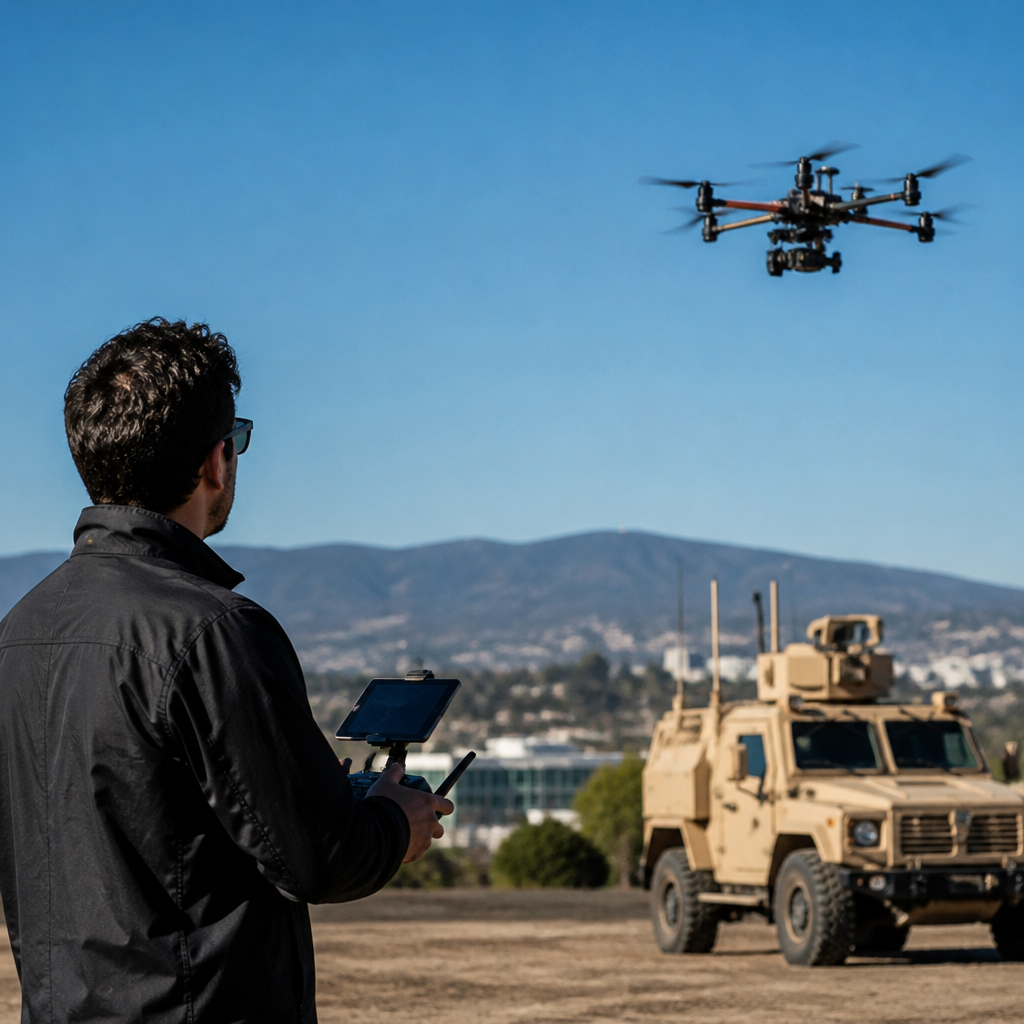
The category is broader than drones. Startups are building autonomous aerial, maritime, and ground systems; synthetic aperture radar satellites; secure mesh networking; electronic warfare tools; space domain awareness software; resilient positioning alternatives to GPS; mission planning platforms; and factory automation for critical components. Palantir helped define the value of software for defense decision-making, but newer companies are pushing farther into the operational edge, where sensors, models, and operators must work together in real time. Space startups are also moving beyond launch headlines. They are designing small satellite buses, propulsion modules, optical inter-satellite links, and analytics engines that turn raw imagery into actionable intelligence for wildfire monitoring, border surveillance, and maritime tracking.
What makes these businesses investable is not only the mission but the architecture. The strongest startups design around modular hardware, software-defined functionality, and fast upgrade cycles. Instead of shipping fixed platforms that age slowly, they build systems that can accept new payloads, deploy over-the-air updates, and integrate through APIs with military and commercial networks. That approach mirrors the best practices of enterprise software while respecting the realities of regulated hardware. It also creates defensibility. A company that owns autonomy software, sensor fusion, test data, and field feedback can compound performance much faster than a contractor relying on static requirements documents. For a hub covering Space & Defense Tech, the central theme is convergence: software, manufacturing, orbital infrastructure, and autonomy are no longer separate stories. They are one investment thesis expressed across multiple products and customers.
The business model: how startups navigate procurement, dual use, and scale
The hardest question founders face is simple: how do you sell to government fast enough for venture timelines? The best answer is to avoid a single-channel strategy. Most successful defense tech startups combine several paths: prototype funding through SBIR programs, pilot projects through DIU or service innovation units, direct contracts with program offices, and commercial revenue where the technology solves adjacent problems. This mixed model reduces dependency on one contract and gives investors evidence that the product solves a real operational need. It also helps founders refine unit economics early. Hardware margins, deployment costs, maintenance obligations, export controls, and security requirements can destroy an otherwise compelling pitch if they are not modeled from the start.
I have seen companies win support quickly when they frame their value in operational terms rather than abstract technical brilliance. A founder who says, “Our autonomy stack increases mission endurance by 30 percent while reducing operator workload,” is speaking the customer’s language. The same discipline applies in space. Satellite startups that promise images are less persuasive than those that promise revisit rates, latency targets, and analytics accuracy for a named use case. Investors increasingly expect this rigor.
| Startup focus | Primary customer path | Why investors like it |
|---|---|---|
| Autonomous drones and maritime systems | Defense pilots, border security, industrial inspection | Dual-use demand, recurring software upgrades, strong data moat |
| Earth observation and geospatial analytics | Government intelligence, agriculture, insurance, logistics | Multiple revenue streams, scalable software layer, expanding imagery demand |
| Secure communications and cyber defense | Military networks, critical infrastructure, enterprise security | High urgency, subscription economics, clear compliance value |
| Space infrastructure and in-orbit services | Civil agencies, commercial satellite operators, defense space units | Strategic importance, high technical barriers, long-term platform potential |
Scale depends on manufacturing discipline as much as software quality. Founders who can shorten test cycles, qualify suppliers, and design for production have an advantage. Tools such as digital twins, model-based systems engineering, and secure cloud development environments are becoming standard. The winners are usually the teams that treat procurement, certification, and production as core product functions rather than back-office obstacles.
Risks, ethics, and what separates durable companies from hype
Not every defense startup deserves capital, and investors know it. The sector carries real risks: classified work can limit transparency, export controls can constrain growth, program dependencies can create revenue cliffs, and hardware failures can be catastrophic. There are ethical questions too. Autonomous weapons, surveillance applications, and data governance require more than clever engineering; they require clear policy boundaries, testing standards, and accountable human oversight. Serious companies address these issues early. They build compliance into operations, document model performance limits, run rigorous red-team testing, and align product use with legal frameworks such as ITAR, FedRAMP, and established acquisition rules where applicable.
Durable companies also understand that patriotism is not a substitute for product-market fit. The startups that persist usually share five traits: a sharp mission need, a customer already trying to solve that need, a product that works in rough field conditions, a team with both technical and domain credibility, and a financing plan that matches the realities of government adoption. Hype-driven companies often fail on integration. Their demo looks impressive, but the system cannot survive denied communications, poor weather, electronic interference, or the paperwork required for deployment. That is why experienced investors conduct diligence on field performance, supply chains, security posture, and contracting strategy, not just slide decks and valuation momentum.
What this means for the future of Space & Defense Tech
Venture capital is moving into defense tech startups in Silicon Valley because the sector now fits the modern startup model better than many outsiders assume. The addressable markets are large, the technology cycles are accelerating, and the strategic need is unmistakable. Space and defense are also becoming inseparable from adjacent industries including semiconductors, AI infrastructure, advanced manufacturing, energy resilience, and telecommunications. For founders, that creates room to build companies that matter commercially and nationally. For investors, it offers exposure to categories with long-term demand and high barriers to entry. For readers using this page as a hub within Tech Innovations & Startups, the key takeaway is straightforward: the most important stories in Space & Defense Tech are no longer niche. They sit at the center of how innovation, policy, and industrial power now interact.
The opportunity is real, but disciplined execution will decide who wins. Look for startups that combine mission clarity, deployable products, credible compliance, and a realistic path from pilot to scaled production. Watch the connective tissue across the sector: launch, satellites, autonomy, cyber resilience, supply chains, and government software are reinforcing one another. If you want to understand where venture capital is placing its next strategic bets, start here, then follow the companies turning technical depth into operational advantage.
Frequently Asked Questions
Why are venture capital firms investing so heavily in defense tech startups in Silicon Valley now?
Venture capital is moving into defense tech because the sector now sits at the intersection of national security, software innovation, and advanced manufacturing. For years, many investors viewed defense as a slow, procurement-driven market dominated by large prime contractors and long sales cycles. That perception has changed. Today, critical defense capabilities increasingly depend on technologies that startups are well positioned to build faster than legacy players, including artificial intelligence, autonomy, cyber defense, satellite infrastructure, secure communications, data fusion platforms, and next-generation sensing systems.
Another major reason is that geopolitical competition has made defense resilience a top strategic priority. Governments are looking for technologies that can be deployed quickly, updated continuously, and integrated across domains such as land, sea, air, space, and cyber. That favors startup-style development models built around rapid iteration, software-defined products, and modular hardware. Investors see a market where demand is not only real, but growing, especially as defense agencies seek more commercially derived innovation rather than relying exclusively on traditional contractors.
Silicon Valley also brings a unique advantage: it concentrates engineering talent, ambitious founders, defense-aware operators, and capital in one ecosystem. As a result, startups can recruit top technical teams, build dual-use products, test commercial adoption, and still pursue government contracts. For venture firms, that combination of mission urgency and large market potential makes defense tech increasingly attractive as a long-term category rather than a niche investment theme.
What types of companies are considered defense tech startups today?
Defense tech is much broader than many people assume. It no longer refers only to companies building weapons systems or traditional military equipment. In today’s market, defense tech includes startups developing autonomous drones, robotic systems, cyber tools, secure networking platforms, AI-enabled intelligence software, satellite components, launch-related systems, advanced sensors, electronic warfare tools, resilient supply chain technologies, and materials engineered for extreme environments. It also includes companies building software that supports logistics, battlefield awareness, mission planning, and infrastructure security.
A defining feature of modern defense tech is the rise of dual-use companies. These are businesses whose products serve both commercial and government customers. For example, a startup might build machine vision software useful for industrial inspection and also adaptable for reconnaissance. A satellite company might support climate monitoring, telecom, and national security missions at the same time. A cybersecurity platform may protect enterprises while also addressing defense and intelligence needs. This dual-use model is especially important because it can create diversified revenue streams and reduce dependence on a single government buyer.
Space tech also overlaps heavily with defense tech because space-based capabilities now play a central role in communications, positioning, intelligence gathering, and resilience. Startups building satellite buses, payloads, in-orbit services, launch infrastructure, or geospatial analytics often fall into the same investment conversation. In short, if a company is solving strategic problems related to security, infrastructure resilience, mobility, data dominance, or mission-critical operations, it may reasonably be considered part of the defense tech landscape.
Why is Silicon Valley such a strong hub for defense tech innovation?
Silicon Valley remains a powerful center for defense tech because the technologies shaping modern security are closely tied to the region’s core strengths. The Valley excels at software development, semiconductors, AI research, robotics, data infrastructure, cloud systems, and venture-backed company building. Those capabilities matter enormously in a world where military and national security advantage increasingly depends on speed of innovation, computational power, autonomous systems, and secure digital networks rather than just conventional hardware procurement.
The region also benefits from a well-established startup playbook. Founders know how to move quickly from concept to prototype, raise venture financing, recruit highly specialized engineers, and scale products through iterative development. That speed is appealing in defense, where governments are under pressure to modernize capabilities faster than traditional acquisition timelines often allow. Silicon Valley startups can often build and improve products in months rather than years, especially when software is at the center of the solution.
There is also a cultural shift underway. More founders, engineers, and investors now see national security as a legitimate and important area for innovation. That was not always the case. In the past, some tech circles were hesitant to engage with defense-related work. Today, concerns about cyber threats, infrastructure vulnerability, global conflict, and strategic competition have made the mission more concrete. As a result, Silicon Valley is not just supplying capital and talent to defense tech; it is increasingly helping define what the category looks like in practice.
What makes defense tech startups attractive to investors despite long government sales cycles?
Government sales cycles are still a real challenge, but investors are becoming more comfortable with them because the structure of many defense tech businesses has improved. One important change is the prevalence of dual-use business models. When a startup can sell into commercial markets while also pursuing defense contracts, it reduces some of the timing risk associated with procurement. Commercial traction can validate the technology, generate early revenue, and support product development while government opportunities mature.
Investors are also paying attention to how procurement itself is evolving. Defense agencies have created more pathways to work with nontraditional vendors through pilot programs, innovation units, rapid acquisition mechanisms, and software-focused contracting models. These changes do not eliminate friction, but they do create more opportunities for startups to prove value, secure smaller contracts earlier, and gradually scale into larger programs. Venture firms recognize that the old assumption—startups cannot navigate defense procurement at all—is no longer universally true.
Beyond sales mechanics, the underlying market is compelling. National security spending is large, persistent, and less sensitive to some of the cyclical demand swings seen in consumer sectors. If a startup builds a capability that is genuinely mission critical, the long-term value can be significant. Investors also like that many defense technologies benefit from durable demand drivers: geopolitical competition, cybersecurity threats, supply chain hardening, contested space infrastructure, and the need for autonomous and AI-enabled systems. In other words, while the path to revenue may be more complex, the strategic importance of the end market can make the investment case very strong.
How are defense tech and space tech connected, and why does that matter for venture capital?
Defense tech and space tech are deeply connected because space has become essential to both civilian infrastructure and military operations. Satellites support communications, navigation, weather forecasting, earth observation, timing signals, and intelligence collection. That means startups building space-related systems are often creating capabilities with direct relevance to national security, even if their initial customer base is commercial. A company focused on satellite imagery, launch logistics, orbital services, or resilient communications may be highly relevant to defense planners because those assets are now foundational to modern operations.
This overlap matters to venture capital because it expands the addressable market. Space startups are not limited to one buyer type or one use case. The same platform might support agriculture, shipping, disaster response, telecom, and defense. That makes the company more investable by giving it multiple paths to scale. It also aligns well with the dual-use thesis that many investors prefer. Rather than betting on a product that only works inside a classified or highly specialized defense environment, VCs can back companies whose technologies have broader economic utility and strategic importance.
The convergence of space and defense also reflects a larger trend: national security is increasingly tied to infrastructure layers that are software-defined, networked, and commercially influenced. Venture capital sees opportunity where commercial innovation can become strategic capability. In practical terms, that is why startups in launch systems, satellite manufacturing, geospatial analytics, space-based sensing, secure communications, and orbital resilience are drawing so much attention. They are not just space companies or defense companies; they are often both, and that combined relevance is a major reason capital continues to flow into the sector.