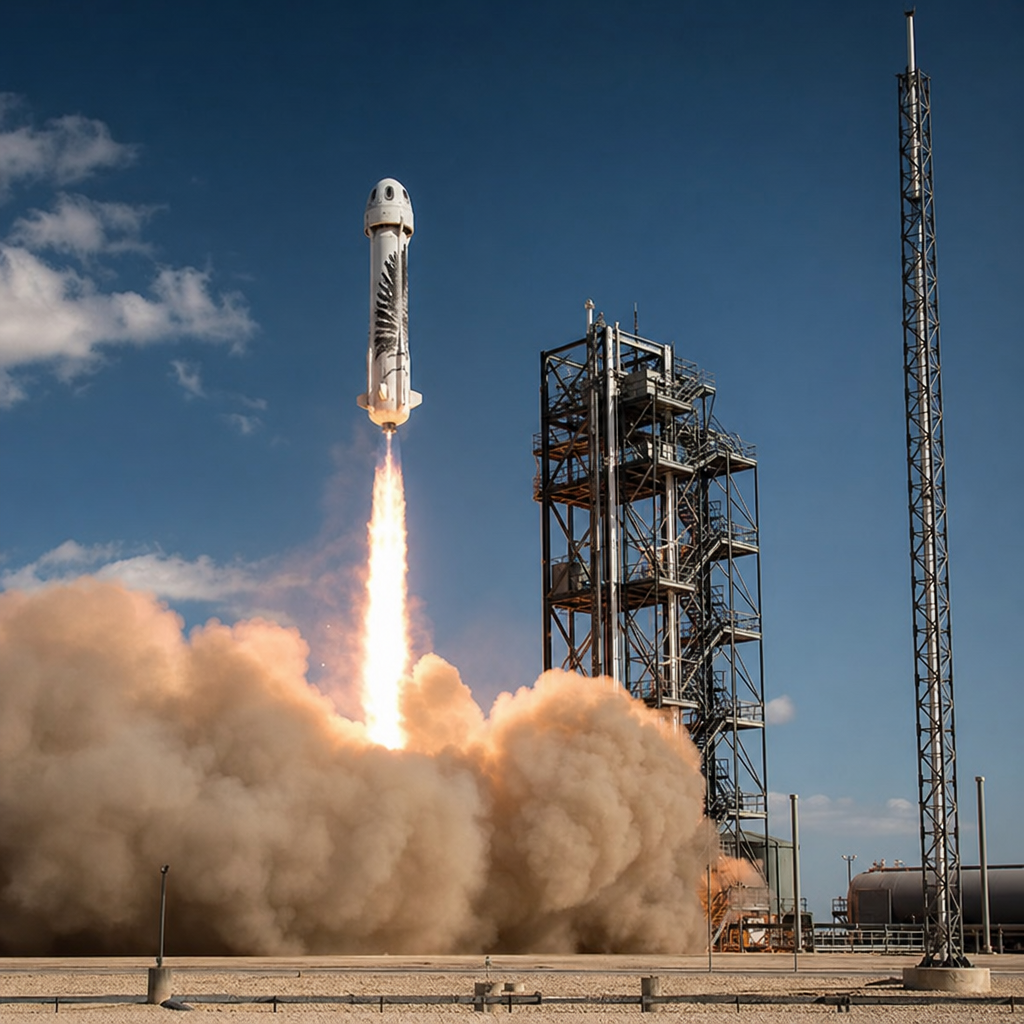
Blue Origin has become one of the most closely watched private space companies because it combines long-horizon engineering, reusable launch systems, and a founder-backed strategy aimed at lowering the cost of access to space. In the context of tech innovators and market leaders, Blue Origin matters not only as a rocket builder but as a company shaping how commercial launch, human spaceflight, lunar logistics, and future orbital infrastructure may develop. I have followed private launch programs for years, and Blue Origin stands out for a methodical approach that differs sharply from faster-moving rivals. That difference makes it important to understand what Blue Origin is, how its programs work, and where it fits in the larger aerospace market.
Founded by Jeff Bezos in 2000, Blue Origin describes its core vision as enabling millions of people to live and work in space. That mission is broader than tourism. It includes reusable rocket engines, suborbital crewed flights, heavy-lift orbital launch vehicles, lunar landing systems, and in-space transportation concepts. Key terms help frame the company clearly. Reusability means recovering and flying major hardware more than once, reducing per-mission costs over time. Suborbital flight reaches space without entering full orbit, while orbital launch accelerates payloads fast enough to circle Earth. Cislunar refers to the region between Earth and the Moon, an increasingly strategic area for government and commercial missions.
Why does Blue Origin matter now? First, government agencies and commercial satellite operators want more launch capacity, not less. Second, national space programs increasingly rely on private contractors for transport, landing systems, and infrastructure. Third, competition among launch providers is driving innovation in engines, manufacturing, and mission economics. As a hub article for company spotlights on tech innovators and market leaders, Blue Origin provides an especially useful case study because it sits at the intersection of aerospace engineering, capital-intensive manufacturing, national policy, and long-term market creation. Understanding its business model, flagship systems, and competitive position helps readers evaluate both the company itself and the wider commercial space industry.
Blue Origin’s Founding Vision and Business Model
Blue Origin was created as a privately funded aerospace company with the unusual advantage of patient capital. Bezos has long funded the company through stock sales, allowing management to work on long development cycles that many venture-backed firms could not tolerate. In practice, that has produced a slower but more infrastructure-oriented roadmap. Rather than chase only near-term satellite launch revenue, Blue Origin has invested across a stack of capabilities: engines, launch vehicles, crew systems, lunar hardware, and space station partnerships.
The company’s business model rests on several revenue and strategic pillars. One is human spaceflight through New Shepard, its suborbital vehicle used for tourism and research payloads. Another is launch services through New Glenn, the heavy-lift orbital rocket designed for commercial, civil, and national security missions. A third pillar is engine supply, most notably the BE-4 engine, which also powers United Launch Alliance’s Vulcan rocket. Blue Origin has also pursued government-funded development work through NASA’s Artemis program and related lunar initiatives. This blend matters because no single segment is large enough on its own to justify the company’s scale and ambition.
What has impressed many industry observers, including teams I have worked alongside on launch market analysis, is Blue Origin’s willingness to build industrial depth instead of relying solely on a single flagship product. The tradeoff is obvious: broader capability takes longer to mature. But in aerospace, owning propulsion, manufacturing, test infrastructure, and mission integration can create durable advantage once systems reach operational cadence.
New Shepard and the Economics of Suborbital Spaceflight
New Shepard is Blue Origin’s best-known operational system because it has already flown passengers above the Kármán line, commonly used as the boundary of space at 100 kilometers above Earth. The vehicle consists of a reusable booster and a crew capsule designed for vertical launch and parachute-assisted landing. It is named after Alan Shepard, the first American in space. From a technical perspective, New Shepard has validated Blue Origin’s capability in powered landing, rapid refurbishment, autonomous flight control, and crew escape system design.
Suborbital tourism often attracts skepticism, but dismissing it misses the platform’s broader role. The system provides high-visibility brand value, creates operational flight experience, and supports microgravity research. Universities, government labs, and commercial experiment providers can use suborbital flights to test payloads in minutes of weightlessness at a lower cost and with faster turnaround than many orbital missions. That makes New Shepard more than a luxury product; it is also a research service and a proving ground for reusable flight operations.
There are limits. Suborbital flights do not generate the same long-term revenue potential as satellite launch or large government contracts. Flight cadence has also been constrained by safety reviews and vehicle availability. Even so, New Shepard established a critical fact: Blue Origin can operate reusable human-rated hardware and turn engineering demonstrations into repeatable missions.
New Glenn, BE-4, and Blue Origin’s Orbital Ambitions
The company’s larger strategic test is New Glenn, a heavy-lift orbital rocket designed to compete for commercial satellite deployments, NASA science missions, and U.S. national security launches. Named after John Glenn, the first American to orbit Earth, New Glenn features a reusable first stage intended to land on a maritime platform and a large payload fairing suitable for high-volume satellite missions. In launch economics, payload envelope and recovery architecture both matter because customers buy schedule certainty and mission flexibility, not just raw lift performance.
Central to Blue Origin’s orbital strategy is the BE-4 engine, a liquefied natural gas and liquid oxygen engine in the high-thrust class. Methane-fueled engines are attractive because they can support cleaner combustion than kerosene systems and are well suited to reusable operations. The BE-4 is significant beyond Blue Origin itself because United Launch Alliance selected it for Vulcan. That gives Blue Origin a rare dual role in the market: launch provider and critical propulsion supplier.
| Program | Primary Role | Why It Matters |
|---|---|---|
| New Shepard | Suborbital crew and research flights | Validates reusable human spaceflight operations |
| BE-4 | Methane-fueled rocket engine | Powers Blue Origin and external launch systems |
| New Glenn | Heavy-lift orbital launch vehicle | Targets commercial, civil, and defense missions |
| Blue Moon | Lunar landing architecture | Positions the company in Artemis-era lunar logistics |
The challenge is execution. Orbital launch is far less forgiving than suborbital flight, and schedule slips can damage customer confidence. In aerospace procurement, reliability history often outweighs promised capability. Blue Origin therefore needs New Glenn to do more than reach orbit once. It must demonstrate repeatability, recovery success, manufacturing throughput, and responsive integration with customer payloads.
Lunar Strategy, NASA Partnerships, and Long-Term Infrastructure
Blue Origin’s long-term relevance may depend as much on lunar and in-space infrastructure as on launch. Through its Blue Moon lander work and participation in NASA’s Artemis-related programs, the company is positioning itself for a future in which the Moon becomes a sustained destination for science, technology demonstration, and eventually industrial activity. That is not speculative branding alone. NASA has increasingly structured exploration programs around commercial partnerships, milestone payments, and service-based procurement models.
Blue Origin has also participated in broader orbital infrastructure efforts, including commercial space station concepts through partnerships and industry alliances. The logic is straightforward. If more activity moves to low Earth orbit and cislunar space, value will shift from isolated launch events to transportation networks, habitats, cargo systems, power, robotics, and surface access. Companies that can serve multiple layers of that stack will have stronger strategic positions than firms tied to one product line.
From a market leader perspective, this is where Blue Origin becomes especially important within the company spotlights category. It represents a type of innovator that is not defined by software-style speed but by systems integration and industrial persistence. Aerospace leadership often looks slow until hardware reaches scale. Then barriers to entry become very high.
Competitive Position in the Private Space Industry
Blue Origin operates in a market shaped by SpaceX, United Launch Alliance, Rocket Lab, Arianespace, and a growing set of national launch providers. Compared with SpaceX, Blue Origin has generally moved slower and launched less frequently. That is a real competitive weakness because cadence improves reliability, lowers cost through learning effects, and builds customer trust. Compared with traditional incumbents, however, Blue Origin has been more aggressive in reusability, vertical integration, and long-term commercial space infrastructure.
Its strongest advantages are capital access, propulsion capability, government relationships, and a strategic willingness to invest beyond immediate return. Its biggest risks are schedule pressure, execution complexity, and the possibility that competitors lock in launch market share before New Glenn reaches mature operations. In my experience reviewing aerospace programs, the companies that win are rarely those with the best slide decks. They are the ones that hit manufacturing milestones, qualify engines, close supplier gaps, and fly repeatedly without surprises.
For readers exploring tech innovators and market leaders, Blue Origin is therefore best understood as a high-potential, high-discipline aerospace builder. It has already influenced reusable spaceflight, engine development, and lunar contracting. Its next phase will determine whether it becomes a full-spectrum market leader or remains a company known more for ambition than delivered capacity.
Blue Origin is pushing the boundaries of space exploration by pursuing a layered strategy: reusable suborbital flight, heavy-lift orbital launch, advanced methane engines, and lunar transportation systems designed for the Artemis era and beyond. The company matters because it is helping expand launch capacity, diversify space infrastructure, and normalize the idea that private firms can build systems once reserved for national agencies. Its progress has not been linear, and that is worth stating plainly. Development delays and tough competition have tested the company’s reputation. Yet the underlying assets are substantial: proven reusable flight operations, a strategically important engine program, major government partnerships, and a long-term vision grounded in industrial capability.
For anyone following company spotlights, Blue Origin offers a clear lens on how real market leadership develops in frontier sectors. It is not only about headlines or founder visibility. It is about engineering depth, patient investment, supply chain control, and the ability to convert vision into reliable hardware. If New Glenn scales successfully and Blue Moon secures a durable role in lunar missions, Blue Origin could shape the next generation of commercial space as decisively as earlier aerospace primes shaped the last. Explore the related articles in this hub to compare Blue Origin with other tech innovators and market leaders transforming transportation, energy, communications, and advanced manufacturing today.
Frequently Asked Questions
What makes Blue Origin different from other private space companies?
Blue Origin stands out because it has consistently pursued a long-term, infrastructure-first vision rather than focusing only on short-term launch contracts or headline-grabbing milestones. Founded by Jeff Bezos, the company has built its identity around the idea that millions of people should eventually be able to live and work in space, and that goal shapes how it invests in rockets, engines, lunar systems, and future orbital capabilities. Instead of treating each vehicle as a one-off project, Blue Origin has emphasized reusable launch systems and the industrial capacity needed to support frequent, lower-cost access to space over time.
Another major differentiator is the company’s methodical engineering culture. Blue Origin is often described as more deliberate than some of its competitors, with a strong preference for testing, iteration, and vertically integrated development. That approach can make progress appear slower from the outside, but it reflects a strategy built around reliability, scalability, and durable operational capability. In practical terms, Blue Origin matters not just because it launches rockets, but because it is helping define how private companies might contribute to commercial launch services, human spaceflight, lunar logistics, and future space infrastructure in the decades ahead.
How important is reusability to Blue Origin’s space strategy?
Reusability is central to Blue Origin’s entire business model and long-term vision. The company’s core belief is that access to space will only become meaningfully more affordable and routine if launch systems can be flown again and again, much like aircraft. This is why reusable vehicle development has been such a major focus, particularly through the New Shepard program, which demonstrated vertical takeoff and vertical landing capabilities in repeated missions. Those flights were important not only as technical achievements, but also as proof points that private companies can recover, refurbish, and reuse major flight hardware in a repeatable way.
That philosophy extends beyond suborbital tourism. Reusability has broader economic implications for the entire space sector because it can reduce the cost per mission, support higher launch cadence, and make more ambitious commercial activity possible. If launch becomes cheaper and more reliable, then satellite deployment, scientific missions, human spaceflight, lunar operations, and orbital manufacturing all become more viable. Blue Origin’s investment in reusable systems is therefore not just about operational efficiency; it is part of a larger effort to reshape the economics of space transportation and build a sustainable commercial ecosystem above Earth.
What role does Blue Origin play in human spaceflight?
Blue Origin has become an important player in human spaceflight by demonstrating that private companies can safely fly civilians on suborbital missions and expand public access to space beyond traditional government astronaut programs. Through New Shepard, Blue Origin has carried passengers above the Kármán line, offering a brief but meaningful spaceflight experience that includes weightlessness and a direct view of Earth from space. While these missions are shorter and less complex than orbital flights, they represent a major shift in how human spaceflight is perceived, funded, and commercialized.
The company’s significance in this area goes beyond tourism. Human spaceflight systems require robust safety processes, carefully validated escape mechanisms, reliable vehicle operations, and extensive crew preparation. By building those capabilities, Blue Origin is contributing to the larger commercial human spaceflight framework that will likely support future missions in low Earth orbit, lunar exploration, and private orbital destinations. In that sense, Blue Origin is helping normalize the idea that human access to space can become a recurring commercial service rather than something limited exclusively to national space agencies.
Why is Blue Origin considered important for lunar exploration and future space infrastructure?
Blue Origin is important to lunar exploration because it has positioned itself as more than a launch provider. The company has pursued technologies and partnerships connected to lunar landers, cargo delivery, and the broader logistics systems that would be needed for sustained activity on and around the Moon. That matters because the future of lunar exploration is increasingly expected to involve a mix of government and private-sector contributions, with companies building transportation, landing systems, power support, cargo movement, and eventually habitat-related infrastructure.
More broadly, Blue Origin’s strategic relevance comes from its ambition to help build the foundational layers of a space-based economy. Future orbital infrastructure will likely depend on reliable heavy-lift launch capability, in-space transportation, propulsion systems, and commercial platforms that support research, manufacturing, and long-duration human presence. Blue Origin’s investments in engines, large rockets, lunar systems, and long-range industrial capacity suggest that it wants to be part of that full stack. For observers tracking tech innovators and market leaders, this makes Blue Origin notable not simply as a company building rockets, but as one shaping how the next era of commercial space development could be organized and financed.
What should investors, industry watchers, and space enthusiasts pay attention to when evaluating Blue Origin’s future?
Anyone evaluating Blue Origin should pay attention to execution across several key areas: launch cadence, reliability, engine production, heavy-lift capability, government partnerships, and progress toward operational commercial services. In the space sector, vision matters, but execution matters more. The most revealing signals are whether a company can move from development into repeatable operations, win and fulfill high-value contracts, and prove that its systems work consistently under real-world conditions. For Blue Origin, that means watching how it scales beyond demonstration and into sustained market presence.
It is also worth following how Blue Origin fits into the wider competitive landscape. The company operates in a market shaped by national security launches, commercial satellite demand, crewed spaceflight, lunar programs, and evolving orbital business models. Its founder-backed resources give it unusual staying power, but long-term success will still depend on technical delivery, manufacturing maturity, and the ability to serve customers at a compelling price point. For industry watchers, Blue Origin is one of the most important companies to monitor because its progress could influence launch economics, public-private space partnerships, and the pace at which space shifts from a specialized frontier into a functioning commercial domain.