
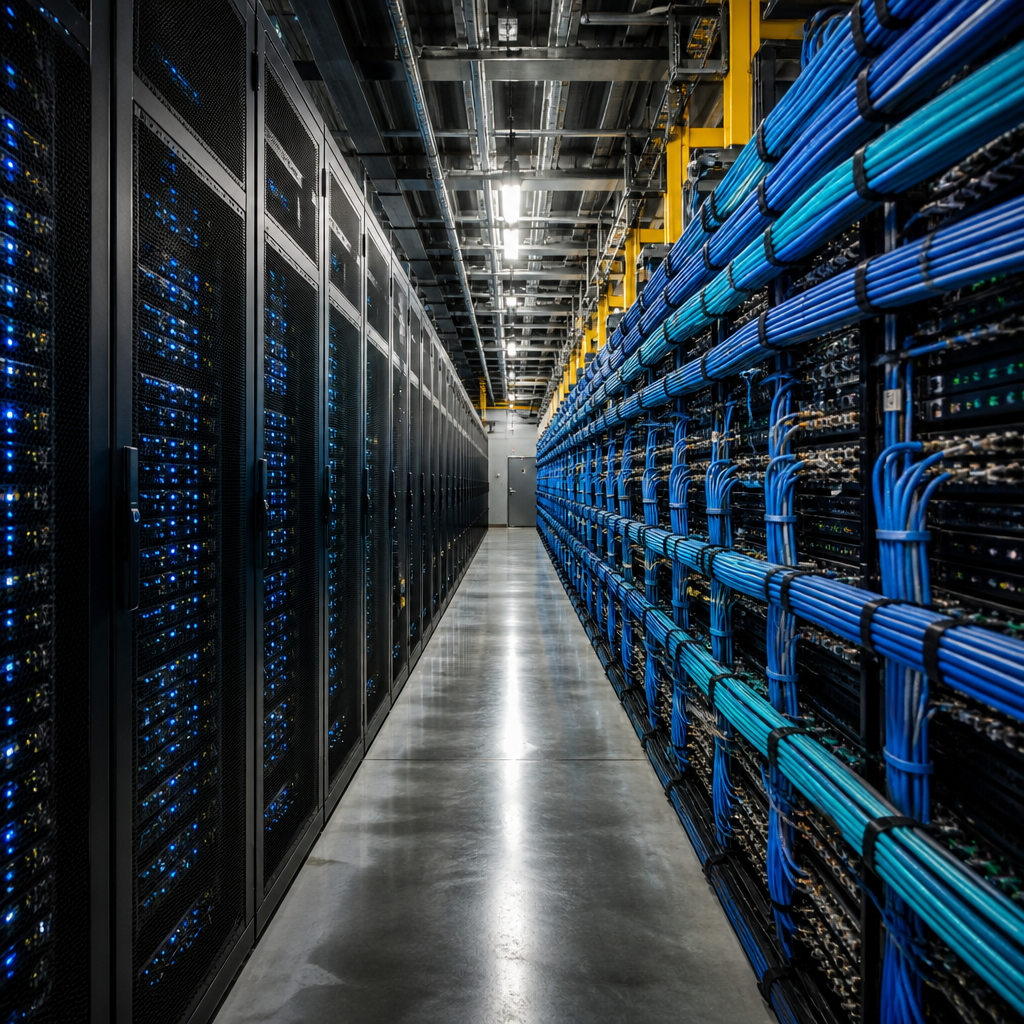
Data center networking for AI has moved from a back-office infrastructure topic to a primary determinant of model training speed, inference quality, and total platform cost. In practical terms, bandwidth is the rate at which data moves across a network, latency is the delay before that movement begins, and topology is the way servers, switches, and accelerators are interconnected. For years, organizations treated compute as the scarce resource: more CPUs, then more GPUs, solved most scaling problems. That assumption no longer holds. Modern AI clusters can pack tens of thousands of accelerators into a single fabric, and those chips spend expensive cycles idle when the network cannot feed gradients, parameters, embeddings, or training data quickly enough.
I have seen this shift directly in platform planning discussions. Teams that once benchmarked only GPU count now ask about oversubscription ratios, east-west traffic patterns, RDMA support, and optical interconnect roadmaps. The reason is simple: large language models, recommendation systems, multimodal pipelines, and retrieval workloads all generate enormous volumes of server-to-server communication. During distributed training, every step may require collective operations such as all-reduce or all-gather, which means each accelerator depends on timely data from many others. If the fabric stalls, utilization drops, job completion times stretch, and infrastructure economics deteriorate fast.
This matters beyond hyperscalers. Startups building foundation models, enterprises deploying private AI environments, and colocation providers expanding GPU capacity all face the same constraint. AI infrastructure and data centers are now defined as much by network architecture as by compute density or power availability. The hub topics connected to this issue include GPU clustering, InfiniBand versus Ethernet, network interface cards and DPUs, storage throughput, liquid cooling, power distribution, and observability. Understanding data center networking for AI is essential because it explains why adding more accelerators often fails to deliver linear gains, why certain fabrics dominate advanced training clusters, and how infrastructure choices ripple into cost, reliability, and deployment speed.
Why AI Workloads Turn Networks into the Bottleneck
AI workloads stress networks differently than traditional enterprise applications. A web application may tolerate small delays and bursty traffic because requests are mostly independent. Distributed AI training is tightly synchronized. In data parallel training, each worker processes a shard of data, computes gradients, and then exchanges those gradients with peers before the next step begins. One slow link can delay the entire group. Model parallel and expert parallel approaches create even heavier communication because activations, parameters, and token routing move between devices continuously.
The result is a network bottleneck that shows up before raw compute capacity is exhausted. GPU utilization can fall sharply when collective communications saturate links or encounter congestion. NVIDIA has repeatedly emphasized that scaling cluster performance depends on both accelerator speed and network throughput, especially as models expand into hundreds of billions of parameters. Ethernet vendors and InfiniBand providers make the same point from different angles: AI clusters are communication machines. The more distributed the job, the more the fabric determines delivered performance.
Inference is also network-intensive, especially for real-time serving architectures. A single user query may trigger retrieval from a vector database, prompt assembly, calls to a model server, guardrail checks, and logging pipelines. In multi-tenant environments, east-west traffic can exceed north-south traffic. That makes switching capacity, packet scheduling, and congestion control operational priorities, not design afterthoughts.
Key Network Building Blocks in AI Data Centers
AI data center networks are built from several tightly coupled layers. At the server edge, high-speed network interface cards connect GPUs or CPUs to the fabric, often at 100, 200, 400, or 800 gigabits per second. Many AI clusters rely on RDMA, which allows one server to place data directly into another server’s memory with minimal CPU overhead. On Ethernet fabrics, this is often implemented through RoCE. In loss-sensitive environments, operators tune priority flow control, explicit congestion notification, and buffer management carefully because poor settings can trigger head-of-line blocking or congestion spreading.
Above the server layer sit top-of-rack, leaf, and spine switches. The most common designs use leaf-spine topologies to provide predictable east-west bandwidth and low hop counts. At larger scales, operators may use Clos architectures, rail-optimized designs, or multi-tier fabrics to keep collective traffic balanced. Optical transceivers and fiber plant quality matter more than many newcomers expect; a weak physical layer can create errors that surface as retransmissions, tail latency, or reduced effective throughput.
Storage and data pipelines also affect the network story. AI training does not only move gradients. It streams datasets, checkpoints, embeddings, and logs between storage clusters and compute nodes. Parallel file systems, object storage gateways, and local NVMe caches all change traffic patterns. In production, I have seen teams solve one bottleneck by buying faster GPUs, only to uncover another at the NIC, switch uplink, or storage network boundary.
InfiniBand, Ethernet, and the Fabric Decision
One of the central decisions in AI infrastructure and data centers is whether to build around InfiniBand, Ethernet, or a hybrid architecture. InfiniBand has historically led in large-scale training because it offers mature support for low-latency, high-throughput communication and strong collective performance. Its software stack and transport behavior have made it attractive for tightly coupled HPC and AI workloads. Many frontier-model training environments still choose it for these reasons.
Ethernet, however, continues to gain ground. Cloud operators and enterprises value its broad ecosystem, staffing familiarity, and integration with existing data center operations. Modern high-performance Ethernet with RoCE can support serious AI workloads when engineered well. The tradeoff is that success depends heavily on disciplined congestion management, lossless fabric tuning, and precise validation under load. Ethernet is not a shortcut; it is a flexible path that rewards operational maturity.
| Fabric option | Primary strengths | Main tradeoffs | Common fit |
|---|---|---|---|
| InfiniBand | Low latency, strong collectives, mature for tightly coupled training | Specialized skills, ecosystem concentration, higher integration specificity | Frontier model training, HPC-style GPU clusters |
| Ethernet with RDMA | Broad vendor ecosystem, operational familiarity, easier alignment with existing networks | Tuning complexity, congestion sensitivity, performance depends on design quality | Enterprise AI, cloud platforms, mixed workloads |
| Hybrid designs | Can separate storage, training, and service traffic efficiently | More operational complexity, multiple toolchains | Large platforms with diverse AI pipelines |
The right answer depends on workload shape, team expertise, supply chain access, and growth plans. There is no universal winner. The mistake is choosing solely on port speeds or marketing claims rather than communication patterns and operational realities.
Topology, Oversubscription, and Cluster Scale
Bandwidth constraints become sharper as clusters grow. A small pod of GPUs may perform acceptably on a design that collapses under multi-rack training. Oversubscription is the key concept here: it describes how much potential demand exceeds available upstream capacity. In conventional enterprise designs, moderate oversubscription may be acceptable because not every server transmits at line rate simultaneously. In AI training clusters, many nodes often do exactly that during synchronized collectives.
That is why serious AI environments aim for very low oversubscription, and in many training fabrics, effectively non-blocking designs. Leaf-spine architectures help by providing multiple equal-cost paths, while modern routing and load-balancing methods distribute elephant flows more evenly. Placement strategy matters too. Schedulers such as Kubernetes with device plugins, Slurm, or vendor-specific cluster managers can reduce cross-fabric contention by keeping related jobs within locality domains.
Scale creates failure-domain issues as well. When thousands of accelerators participate in one job, small packet loss rates can become large application-level slowdowns. Operators therefore monitor not just link status but queue depths, retransmissions, per-port utilization, and collective completion times. Good topology is not only about peak throughput; it is about predictable behavior under synchronized stress.
Designing for Training, Inference, and Storage Together
Not all AI traffic is equal, and the best infrastructure separates patterns that interfere with each other. Training networks need sustained east-west throughput and low jitter. Inference platforms need fast response times, tenant isolation, and smooth scaling under unpredictable bursts. Storage fabrics must support data ingest, feature pipelines, checkpoint recovery, and replication. Treating these as one undifferentiated pool often creates noisy-neighbor problems and difficult troubleshooting.
Many advanced operators segment traffic physically or logically. Separate rails for storage and training, dedicated management networks, and quality-of-service policies for latency-sensitive inference are common. DPUs and smart NICs can offload security, telemetry, and virtualization functions that would otherwise steal host CPU cycles. Meanwhile, observability tools such as Prometheus, Grafana, vendor fabric managers, and packet telemetry systems help correlate application slowdowns with switch congestion or path imbalance.
Energy and cooling are linked to networking decisions too. Higher radix switches, optics, and denser cabling increase power draw and thermal load. As rack power climbs with GPU density, network gear becomes part of the cooling equation. Planning AI infrastructure and data centers now requires cross-functional design between network architects, facility engineers, storage teams, and ML platform owners.
What Startups and Enterprises Should Do Next
The main lesson is clear: in AI infrastructure, compute no longer guarantees performance unless the network is designed to keep accelerators busy. Bandwidth, latency, congestion control, and topology now shape training speed, inference consistency, and unit economics as directly as GPU selection. Teams evaluating AI data centers should analyze communication patterns first, then map those demands to fabric design, storage throughput, and cluster scheduling strategy. That approach prevents costly underutilization and avoids buying premium compute that sits idle behind network bottlenecks.
For startups, the smartest move is usually staged design. Start with a realistic growth model, validate workload behavior under distributed load, and choose a fabric your team can actually operate well. For enterprises, prioritize integration: align AI networking with data governance, observability, security, and capacity planning rather than treating GPUs as an isolated purchase. For providers building at larger scale, invest in topology discipline, low-oversubscription fabrics, and deep telemetry from day one.
This hub page is the foundation for deeper topics across AI infrastructure and data centers, from GPU clustering and RDMA tuning to storage architecture and cooling design. If you are planning an AI platform, audit your network assumptions before your next compute purchase, because bandwidth is now the constraint that decides whether AI investment turns into usable performance.
Frequently Asked Questions
1. Why is bandwidth becoming the new compute constraint in AI data centers?
Bandwidth is becoming the new compute constraint because modern AI workloads depend on constant, high-volume data movement between GPUs, CPUs, storage systems, and network switches. In earlier infrastructure models, organizations could often improve performance simply by adding more processors or more powerful accelerators. That approach works only up to the point where the network can keep those devices fully supplied with data. Once the interconnect cannot move training data, model parameters, gradients, and inference requests fast enough, expensive compute resources sit idle waiting for communication to complete.
This problem is especially visible in distributed AI training. Large models are rarely trained on a single accelerator; they are spread across many nodes that must frequently exchange updates. Techniques such as data parallelism, tensor parallelism, and pipeline parallelism all increase east-west traffic inside the data center. In that environment, the rate of communication often determines job completion time as much as raw GPU performance does. A cluster with world-class accelerators but insufficient network throughput can underperform a smaller, better-balanced system.
Bandwidth also matters for inference at scale. Serving large language models, recommendation engines, and multimodal applications often requires fast access to shared memory pools, distributed caches, and multiple accelerator nodes. If network capacity is limited, inference latency rises, throughput falls, and quality of service becomes harder to maintain during traffic spikes. In practical terms, organizations are discovering that they cannot fully monetize AI investments unless the network is designed as a performance-critical part of the platform rather than a supporting utility.
2. How do bandwidth, latency, and network topology affect AI training performance?
Bandwidth, latency, and topology influence AI training in different but closely related ways. Bandwidth is the volume of data that can move across the network in a given period of time. For AI training, high bandwidth is essential because large clusters exchange enormous amounts of information, including training batches, synchronization data, and parameter updates. If bandwidth is too low, communication phases take longer, and GPUs spend more time waiting instead of computing.
Latency is the delay before data transfer begins and the time required for messages to traverse the network. While bandwidth dominates many large-transfer workloads, latency becomes critical when training jobs involve frequent synchronization across many devices. Small but repeated delays can compound quickly in tightly coupled distributed jobs. Even a powerful high-bandwidth fabric can become a bottleneck if latency is inconsistent or if congestion introduces jitter during collective operations such as all-reduce.
Topology refers to how servers, accelerators, and switches are interconnected. This matters because physical and logical design determines hop count, oversubscription, path diversity, and fault tolerance. A poorly chosen topology can create chokepoints where traffic converges, while a well-designed fabric can deliver more predictable performance across the cluster. Architectures such as leaf-spine are common because they provide scalable, high-bandwidth connectivity with relatively consistent paths between nodes. In larger AI environments, topology decisions directly affect how efficiently clusters can scale from dozens to hundreds or thousands of accelerators.
Together, these three factors shape real-world training efficiency. High bandwidth without low-latency communication or an optimized topology may still leave performance on the table. The best AI networking strategies account for all three at once, ensuring that compute, storage, and interconnect are balanced to support the communication patterns of distributed machine learning.
3. Why can adding more GPUs fail to improve AI performance if the network is not upgraded too?
Adding more GPUs does not automatically deliver better AI performance because distributed computing introduces communication overhead. As organizations scale from a single server to many GPU-equipped nodes, the workload becomes increasingly dependent on coordination across the network. Each accelerator may be capable of tremendous local compute, but in multi-node training, those devices must continually exchange gradients, synchronize model states, and access shared datasets. If the network cannot keep pace, the additional GPUs contribute less useful work than expected.
This is a classic scaling efficiency problem. In theory, doubling the number of GPUs should nearly halve training time. In practice, the gains are often much smaller because communication time rises with cluster size. At some point, the marginal benefit of each new accelerator declines sharply. Instead of improving throughput, more GPUs can amplify congestion, increase synchronization delays, and expose oversubscription in the fabric. That means organizations may spend heavily on compute expansion while seeing disappointing returns in actual model training speed.
There is also a cost dimension. Idle or underutilized GPUs are among the most expensive inefficiencies in an AI environment. If the network architecture was designed for traditional enterprise traffic rather than AI-scale east-west communication, the infrastructure may not support the data exchange patterns required by modern model training. In that case, the solution is not simply more compute, but a coordinated upgrade that includes higher-speed links, lower-latency switching, better traffic engineering, and a topology built for distributed AI workloads. The takeaway is straightforward: compute scaling and network scaling must happen together, or performance and economics both suffer.
4. What network design choices matter most for AI data centers?
The most important network design choices for AI data centers include link speeds, switching architecture, topology, congestion management, and support for efficient collective communication. High-speed interconnects are foundational because AI clusters generate far more internal traffic than many legacy enterprise applications. Choosing appropriate speeds at the server, rack, and spine layers helps ensure that bandwidth does not collapse under scale. Just as important is making sure the switching fabric can sustain non-blocking or minimally oversubscribed performance where AI workloads demand it.
Topology is another major decision. AI clusters benefit from designs that provide predictable latency and multiple efficient paths between nodes. Leaf-spine architectures are widely used because they scale cleanly and reduce bottlenecks, but design details still matter, including uplink ratios, rack placement, and alignment between physical network layout and workload placement. In larger deployments, operators may also segment clusters or create specialized fabrics for training and inference to isolate traffic patterns and improve consistency.
Congestion control and traffic management are equally critical. AI jobs often produce bursty, synchronized communication patterns that can overwhelm buffers and degrade performance if the network is not tuned correctly. Features and protocols that reduce packet loss, control queue buildup, and optimize transport behavior can materially improve job completion times. Organizations should also pay attention to observability. Without detailed telemetry on flow behavior, latency hotspots, and link utilization, it is difficult to identify whether bottlenecks stem from the model, the scheduler, or the network itself.
Finally, network design should be aligned with business goals, not just technical specifications. The right architecture balances performance, resilience, and cost. Some environments require maximum training speed for frontier-model development, while others prioritize efficient multi-tenant inference or predictable service-level performance. The best AI data center networks are not simply the fastest possible; they are intentionally designed around workload communication patterns, utilization goals, and long-term scaling plans.
5. How does better networking improve AI cost efficiency, scalability, and inference quality?
Better networking improves AI cost efficiency by increasing utilization of expensive infrastructure. GPUs, AI accelerators, and high-performance storage systems represent major capital and operating expenses. When the network allows those resources to exchange data quickly and reliably, organizations get more useful work from the same hardware footprint. Training jobs finish sooner, clusters spend less time stalled, and capacity planning becomes more predictable. In contrast, a weak network can force companies to overprovision compute just to compensate for communication inefficiencies, driving up total platform cost.
From a scalability perspective, strong networking enables clusters to grow without suffering steep drops in efficiency. This matters because many advanced AI workloads only become practical when spread across large numbers of accelerators. A scalable network fabric supports that expansion by maintaining throughput, minimizing latency penalties, and preventing traffic bottlenecks as node counts rise. It also improves operational flexibility by making it easier to schedule distributed jobs, share infrastructure across teams, and onboard new workloads without constant architectural rework.
Inference quality is influenced more by networking than many organizations initially assume. Real-time AI systems depend on low-latency communication between front-end services, model-serving layers, retrieval systems, vector databases, and accelerators. If those interactions are delayed, the user experience degrades through slower responses, timeout risk, and inconsistent output delivery. In retrieval-augmented generation and multimodal applications, network performance can also affect how quickly supporting context is fetched and incorporated into a response. That means networking contributes not just to speed, but to the consistency and reliability of the overall inference pipeline.
Ultimately, better networking turns AI infrastructure into a more balanced system. It helps organizations extract full value from compute investments, support larger and more sophisticated models, and deliver more dependable application performance. As AI deployments mature, networking is no longer just an infrastructure line item. It is a direct lever for training efficiency, inference responsiveness, and long-term economic sustainability.